
H1B Lottery 2026: What Happens If You Don't Get Selected and Your Options After

Sarah Mitchell
April 6, 2026

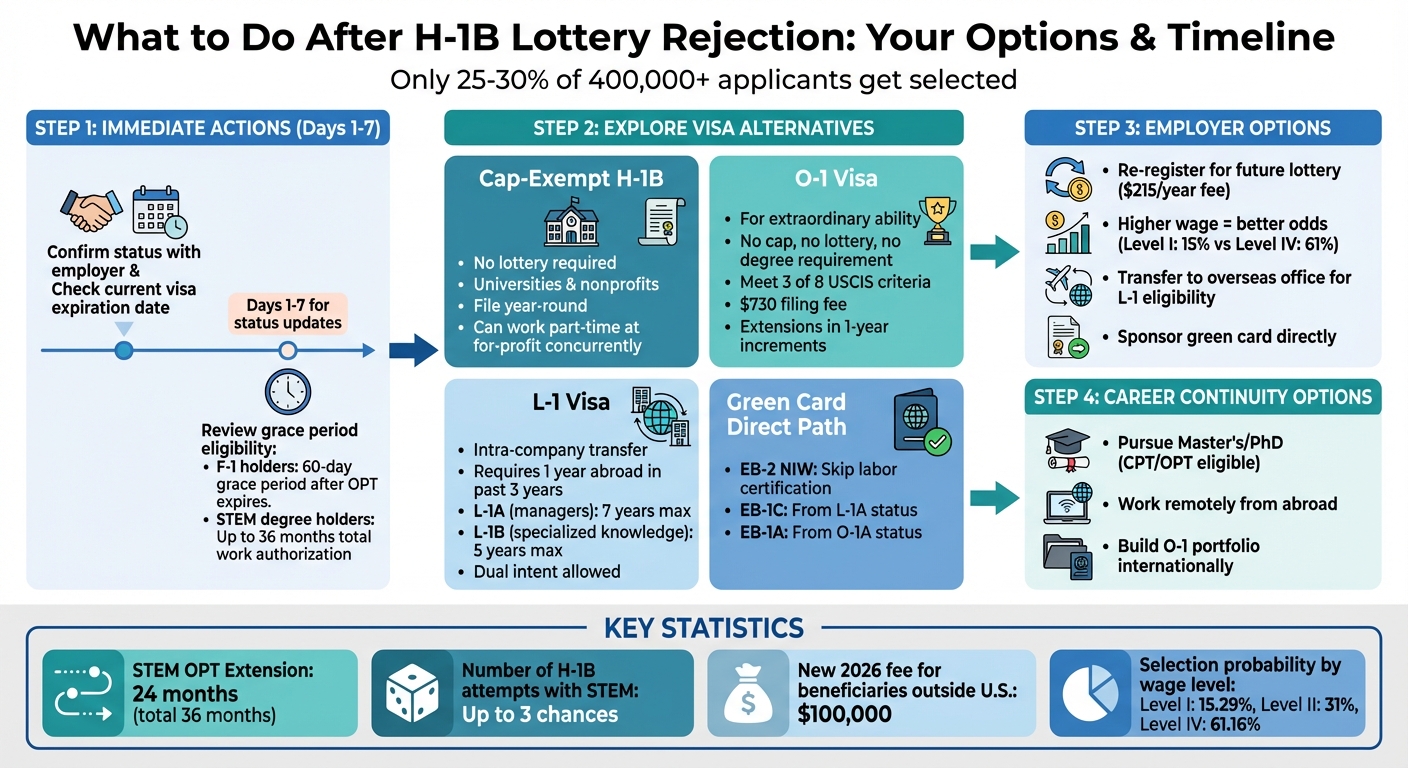
With only 25-30% of over 400,000 applicants selected, not getting picked is common. The good news? You have alternatives to continue working or staying in the U.S. legally. Whether it’s exploring cap-exempt H-1B roles, extending your F-1 status, or considering other visa categories like O-1 or L-1, there are actionable steps to take. Here’s a breakdown:
- First Steps: Confirm your status with your employer and check your current visa expiration. F-1 visa holders may have options like STEM OPT extensions.
- Visa Alternatives: Look into cap-exempt H-1B roles, O-1 for extraordinary ability, or L-1 for intra-company transfers.
- Grace Periods: F-1 holders have a 60-day grace period after OPT expiration to plan their next move.
- Employer Support: Employers can reapply for H-1B, explore cap-exempt roles, or consider green card sponsorship.
- Career Adjustments: Options like pursuing further education (CPT/OPT) or working remotely for U.S. companies abroad may help.
Platforms like Scale.jobs specialize in visa-friendly job applications, offering tailored resumes and expert guidance to help you find roles aligned with your immigration needs. Let’s dive deeper into these options and strategies.
H-1B Lottery Rejection: Your Step-by-Step Action Plan and Visa Alternatives
Not Selected in the H-1B Lottery? Here Are Your BEST Options! #h1bvisa #greencard #usa
What Happens After You're Not Selected
Not being selected in the H-1B lottery doesn’t immediately affect your current visa status. You will continue under your existing visa category - whether it’s F-1, L-1, or O-1 - until its expiration. While USCIS communicates updates to employers and attorneys through the MyUSCIS portal, it’s important to confirm your status with your visa sponsor to avoid any misunderstandings. This step is crucial as you evaluate your options and follow an H1B cap checklist to consider alternative visa routes. Below, we’ll explore the grace periods available and how your employer’s actions could shape your next steps.
Grace Periods and Legal Status Timeline
For individuals on F-1 OPT, the 60-day grace period begins only after your work authorization expires, not immediately after the lottery results are announced. This grace period allows you to explore options such as enrolling in another academic program, applying for a different visa, or preparing to leave the U.S. However, the "Cap-Gap" extension - which bridges the gap between OPT expiration and the October 1 H-1B start date - only applies if your petition was selected and filed. If you weren’t selected, you’ll need to rely on any remaining OPT or STEM OPT time.
If you hold a STEM degree, you can extend your initial 12-month OPT by an additional 24 months, giving you a total of 36 months of work authorization. This provides up to three chances to participate in the H-1B lottery. It’s essential to act within 7–14 days of your authorization nearing expiration to maintain your legal status. This grace period not only preserves your current status but also gives you time to strategize for future H-1B lottery attempts or alternative visa options. If you change employers or work locations, make sure to update your SEVIS records promptly.
What Your Employer Can Do Next
After ensuring your visa status is secure, your employer can explore several pathways to help you continue working in the United States. While they’re not legally required to retain you beyond your work authorization, they can re-register you for the H-1B lottery in future years - there’s no limit on how many times they can try. Keep in mind, a $215 registration fee applies each year. Under the new wage-weighted visa system set for 2026, your chances of selection can improve if your employer offers a higher prevailing wage. For example, moving from Level I (~15% selection rate) to Level II (~31%) significantly increases your odds.
Employers can also consider cap-exempt H-1B roles at universities or nonprofit research organizations, which bypass the lottery and can be filed at any time during the year. For multinational companies, another option is arranging a transfer to an overseas office for one year, after which you may return to the U.S. under L-1 status. Additionally, some employers might opt to sponsor you directly for a green card through the EB-2 National Interest Waiver process, allowing you to skip the H-1B system entirely.
If you’re pursuing multiple visa options and need to present yourself competitively, professional resume services can help you craft ATS-optimized documents. These services can highlight your achievements in a way that aligns with O-1 visa criteria or cap-exempt roles. By leveraging these employer-driven strategies, you can keep your career on track, whether through future lottery attempts or alternative pathways.
Other Visa Options If You Weren't Selected
If the H‑1B lottery didn’t work out, don’t lose hope - there are alternative visa options like the O‑1, L‑1, and cap‑exempt H‑1B visas that can help you continue your career in the U.S. Unlike Lazyapply’s automated approach, scale.jobs offers human-assisted, ATS-optimized resume services to strengthen your visa-related job applications. Below, we break down these visa options, each offering a unique opportunity to work in the U.S.
O‑1 Visa: For Individuals With Exceptional Achievements
The O‑1 visa is designed for those who have achieved significant recognition in their field, whether in science, arts, education, business, or athletics. This visa bypasses the annual cap, lottery, and degree requirements, making it an excellent option for highly accomplished professionals. To qualify, you’ll need to meet at least three of the eight USCIS criteria, which include accomplishments like receiving major awards, being featured in prominent publications, or making significant contributions to your industry.
"The O-1 is a nonimmigrant visa for individuals with extraordinary ability... Unlike the H-1B, there's no annual cap, no lottery, and no degree requirement." - Tukki
Your employer or agent must file Form I‑129 on your behalf, with a filing fee of $730. You’ll also need to provide a strong evidence package showcasing your achievements, such as recommendation letters, proof of high earnings, or documentation of published work or patents. Unlike the H‑1B, the O‑1 visa has no maximum duration, and extensions are granted in one-year increments after the initial three-year period. If you need help presenting your qualifications effectively, professional resume services can assist in crafting a compelling application that meets USCIS standards.
L‑1 Visa: Intra-Company Transfers
The L‑1 visa allows multinational companies to transfer employees from their foreign offices to U.S. locations without going through a lottery. To qualify, you must have worked for the company abroad for at least one year within the past three years. The L‑1 visa is divided into two categories:
- L‑1A: For managers and executives, with a maximum stay of seven years.
- L‑1B: For employees with specialized knowledge, with a maximum stay of five years.
"The L-1 lets multinational companies transfer employees from a foreign office to a U.S. office, and it has no annual cap or lottery." - Tukki
A major advantage of the L‑1 visa is its dual-intent nature, allowing you to pursue a green card while maintaining temporary status. L‑1A holders, in particular, have a faster route to permanent residency through the EB‑1C category, which skips the labor certification process. If you didn’t make it through the H‑1B lottery, your employer could assign you to an overseas office for a year to meet L‑1 eligibility before transferring you back to the U.S. Additionally, spouses of L‑1 visa holders are granted work authorization under the L‑2 visa.
Cap‑Exempt H‑1B: Opportunities in Academia and Nonprofits
Certain jobs at universities, nonprofit organizations affiliated with universities, and research institutions are exempt from the H‑1B cap. These roles allow you to bypass the lottery entirely, as petitions can be filed year-round using Form I‑129. If you secure a cap‑exempt position, you can even take on a concurrent part-time role at a for-profit company without needing lottery selection, provided you maintain your cap‑exempt employment.
Cap‑exempt roles are common in academic research labs, medical centers, and government-funded institutions. It’s essential to confirm that the nonprofit is officially affiliated with a higher education institution to qualify. If you later wish to transition to a for-profit company, you’ll need to enter and win the H‑1B lottery to maintain your status.
Who Should Choose scale.jobs vs. Lazyapply
- Who should use Lazyapply: Ideal for those seeking basic automation with minimal human interaction.
- Who should choose scale.jobs: Perfect for applicants requiring tailored guidance, ATS-optimized documents, personalized support via WhatsApp, and detailed proof-of-work for visa-related applications.
Comparison: scale.jobs vs. Lazyapply
| Feature | scale.jobs | Lazyapply |
|---|---|---|
| Human Involvement | Human experts review and tailor applications | Automated bulk submissions |
| Resume Customization Depth | ATS-optimized resumes for visa sponsorships | Template-based automation |
| ATS Handling | Dedicated optimization for each application | Basic compatibility |
| Application Execution | Strategic, human-guided submissions | High-volume automation |
| Transparency & Proof of Work | Real-time tracking with detailed updates | Limited visibility |
| Pricing Model | One-time payment with clear deliverables | Subscription-based pricing |
Career Options That Don't Require a New Visa
Navigating your career while maintaining ties with U.S. employers can feel challenging, especially when visa renewals are off the table. However, there are strategies to keep your professional journey on track without needing new visa approvals. Below, we’ll explore some practical paths that not only sustain your career momentum but also prepare you for future opportunities. Unlike Simplify’s automated tools, scale.jobs offers a personalized approach, combining human expertise with ATS-optimized applications to help you transition effectively.
Going Back to School for a Master's or PhD
Enrolling in a U.S. graduate program can extend your F-1 status and significantly improve your chances in future H1B lotteries. Advanced degree holders benefit from a separate pool of 20,000 visas under the H1B cap. According to the weighted selection system introduced in February 2026, candidates with higher degrees often qualify for higher wage levels. For instance, Wage Level I applicants face a 15.29% selection probability, while Level IV candidates - typically advanced degree holders - see their chances rise to 61.16%.
Through Curricular Practical Training (CPT), you can continue working for your current employer while pursuing your studies. Additionally, STEM degree holders enjoy up to 36 months of work authorization under OPT and the STEM OPT extension. This extended timeline provides up to three attempts in the H1B lottery while allowing you to build specialized skills that align with higher-paying roles. Staying in the U.S. as a student also opens the door to filing a "Change of Status" petition, helping you avoid the $100,000 fee imposed on H1B beneficiaries residing outside the U.S. If you need help aligning your academic and professional credentials for visa-related applications, scale.jobs offers resume services tailored to these requirements.
Working Remotely for U.S. Companies From Abroad
Remote work is another effective way to stay connected with U.S. employers while living abroad. If your current employer has international offices, you might work at a foreign branch for at least one year to qualify for an L-1A (managerial) or L-1B (specialized knowledge) transfer to the U.S. - no lottery required. This option works well with multinational companies that have a global presence.
Alternatively, working remotely can give you time to build a portfolio for an O-1A visa, which doesn’t require a lottery or adhere to annual caps. By accumulating evidence such as awards, publications, or proof of a high salary, you can meet at least three of the USCIS criteria for extraordinary ability. Depending on your nationality, alternative visas like the E-3 (for Australians) or TN (for Canadians and Mexicans) may also be viable options, bypassing the H1B process altogether.
These approaches not only keep you connected to your U.S. professional network but also position you for future visa opportunities. Below is a comparison of two job application tools - scale.jobs and Simplify - to help you decide which platform best suits your needs during this transition.
Who Should Use Simplify vs. Who Should Choose scale.jobs
Who should use Simplify:
- Job seekers looking for quick, automated job matching.
- Candidates comfortable with template-based applications.
- Individuals prioritizing speed over tailored strategies.
Who should choose scale.jobs:
- Professionals navigating visa transitions who need personalized, human-guided assistance.
- Job seekers requiring ATS-optimized resumes tailored to immigration needs.
- Those who value transparent, real-time updates on application progress.
- Individuals preferring one-time payment options over subscription models.
| Feature | scale.jobs | Simplify |
|---|---|---|
| Human Involvement | Career strategists guide visa-related transitions | Automated job matching algorithms |
| Resume Customization Depth | Immigration-focused ATS optimization | Template-based autofill |
| Application Execution | Strategic, human-submitted applications | One-click automated submissions |
| Transparency & Proof of Work | Time-stamped screenshots and live updates | Basic application tracking |
| Pricing Model | One-time flat fees with unused-credit refunds | Subscription-based access |
Switch to scale.jobs if…
- You need personalized guidance to navigate visa transitions effectively.
- Automated job matching isn’t meeting your needs, especially for visa-sponsorship roles.
- You value transparency, with real-time proof of application submissions.
- You require immigration-focused resume optimization for roles like O-1, L-1, or cap-exempt positions.
- You prefer a one-time payment model over recurring subscription fees.
Decision Summary
Choose Simplify for a high-volume job search with standard applications when speed is your priority. Choose scale.jobs if you’re managing complex visa transitions, need expert guidance to position your profile for immigration-friendly roles, and want transparent, step-by-step support to maintain career continuity.
How to Plan Your Next Steps
Deciding on Your Long-Term Immigration Plan
Choosing your next move in the immigration process depends on your ultimate goals. If obtaining a green card is your priority, consider pathways like the EB-2 NIW, which allows advanced degree holders working in areas that benefit U.S. national interests to bypass the labor certification process. Alternatively, the L-1A visa for managers and executives can lead directly to the EB-1C green card category, while the O-1A visa offers a route to EB-1A status, both avoiding the labor certification (PERM) bottleneck.
For those seeking a different approach, gaining international experience with a multinational company for at least one year can qualify you for an L-1 transfer, skipping the need for another H-1B lottery cycle. If staying in the U.S. immediately is a priority, consider cap-exempt H-1B roles at universities, nonprofit research institutions, or government facilities, which allow for year-round filing. The O-1 visa, though not subject to a lottery or annual cap, requires meeting at least three of eight USCIS criteria, such as receiving industry awards, publishing research, or earning a salary that significantly exceeds industry norms.
For F-1 students, utilizing the full 36 months of STEM OPT work authorization can provide multiple chances at the H-1B lottery while also building credentials for alternative visa options. Keep in mind that both H-1B and L-1 visas allow you to pursue permanent residency while maintaining temporary status. However, visas like the F-1 or J-1 can complicate green card applications due to their restrictions.
To simplify these decisions and streamline your application process, consider tools like Scale.jobs, which provide tailored, human-assisted guidance for tracking sponsors and boosting your lottery odds. If navigating these complexities feels overwhelming, the next section highlights when professional advice becomes essential.
When to Hire an Immigration Lawyer or Career Advisor
Understanding when to seek professional help is critical, especially with the evolving immigration landscape. For example, the new weighted selection system, effective February 27, 2026, adds complexity to H-1B registration. Under this system, candidates at Wage Level IV have a 61.16% selection probability, while those at Wage Level I face a much lower chance at 15.29%. Employers also now face a $100,000 fee for H-1B beneficiaries residing outside the U.S., making it essential to carefully decide between change of status and consular processing.
If you're considering visas like the O-1A or EB-2 NIW, consulting an immigration attorney is highly recommended. These categories require substantial documentation, such as evidence of awards, publications, or significant contributions recognized by USCIS. F-1 students should reach out to their Designated School Official (DSO) as soon as possible to explore options like OPT, STEM OPT, or CPT programs, ensuring they maintain legal status in the U.S. For those actively looking for new roles, following a structured job search system can help secure a sponsoring employer more efficiently.
Additionally, USCIS has intensified fraud investigations, requiring employers and applicants to provide strict attestations under penalty of perjury regarding job offers and wage levels. Given this heightened scrutiny, seeking professional legal advice can help ensure your application remains valid and free from issues like duplicate entries or other compliance risks.
Conclusion: Your Options After the H-1B Lottery
Navigating your next steps after the H-1B lottery can feel overwhelming, but there are actionable paths forward. Unlike platforms such as Lazyapply or Simplify, which focus on automated job matching, scale.jobs provides tailored, human-driven support designed to align with visa sponsorship requirements. Missing out on the lottery - where only a small percentage of over 400,000 applicants are selected - doesn’t define your skills or potential. What matters now is how you use the right tools to shape your career journey.
Why scale.jobs Stands Out for Post-Lottery Job Searches
- Personalized Application Support: Career strategists ensure every application is tailored to visa-friendly employers and cap-exempt roles.
- ATS-Optimized Resumes and Cover Letters: Documentation is customized to meet the standards of both employers and USCIS for visas like O-1, L-1, and cap-exempt H-1B positions.
- Transparent Pricing: One-time payment options with refunds for unused credits eliminate the hassle of recurring fees.
- Real-Time Assistance: Dedicated WhatsApp support offers immediate guidance on alternative visa pathways and application strategies.
- Proof of Progress: Time-stamped updates and live screenshots provide full visibility into your application process.
Exploring cap-exempt H-1B roles at universities, nonprofit research organizations, or government facilities can help you bypass the lottery and apply year-round. If you qualify for an O-1A visa, meeting three of USCIS’s eight criteria - such as receiving industry awards, publishing research, or earning a high salary - you gain access to a lottery-free, cap-free option. Additionally, multinational employees can consider the L-1 visa after a year abroad, while F-1 students with STEM degrees may benefit from up to 36 months of work authorization, allowing multiple H-1B attempts. For a more permanent solution, the EB-2 NIW visa offers a direct path to residency without requiring labor certification.
Lazyapply vs. scale.jobs: Which Is Right for You?
Lazyapply may suit you if:
- You prefer high-volume, automated job applications with minimal involvement.
- You’re comfortable using generic, template-based applications for broader job searches.
scale.jobs is ideal if:
- You’re navigating visa transitions and need immigration-focused, personalized support.
- You require ATS-optimized resumes tailored to cap-exempt, O-1, or L-1 visa roles.
- You value real-time updates and proof of application submissions.
- You prefer one-time payment options over recurring subscriptions.
Consider Switching to scale.jobs If…
- Automated platforms haven’t helped you secure visa-sponsorship opportunities or cap-exempt roles.
- You need specialized resume optimization to meet USCIS and employer requirements.
- You’re looking for expert guidance in positioning your profile for O-1A or L-1 visa eligibility.
- Transparency and real-time updates on your job applications are priorities.
- You want a straightforward, one-time payment structure with clearly defined deliverables.
Final Thoughts
If speed and volume are your primary focus, Lazyapply might be the right tool for you. But if your goal is to navigate visa complexities, secure immigration-friendly roles, and maintain career momentum, scale.jobs offers the expertise and transparency you need.
The H-1B lottery isn’t your only shot. Strengthen your visa eligibility, document your achievements, and consult with an immigration attorney to explore the most effective pathways. Whether you’re preparing for alternative visa options or refining your materials for cap-exempt roles, professional resume services can help ensure your documentation meets both employer expectations and USCIS standards. Keep moving forward - your career in the U.S. is still within reach.
FAQs
How do I keep work authorization if my OPT ends before October 1?
If your OPT is set to expire before October 1, you may still maintain your work authorization through the OPT Cap-Gap extension. This provision extends your F-1 status and work authorization until the start date of your H-1B visa, provided your employer files an H-1B petition during the registration period.
If the Cap-Gap extension doesn’t apply or isn’t an option, you can explore alternative visa pathways. These include cap-exempt H-1B, O-1, L-1, or J-1 visas, depending on your qualifications and circumstances. Additionally, if you meet the requirements, applying for a new OPT extension might be another route to consider.
Which visa is fastest if I missed the H-1B lottery?
The quickest option for bypassing the H-1B lottery is the cap-exempt H-1B visa, which can be submitted at any time throughout the year. Processing usually takes around 3 to 5 months. This route works best for individuals connected to cap-exempt employers, like universities or nonprofit organizations.
What documents should I gather for an O-1 or EB-2 NIW visa?
To apply for an O-1 visa, gather documents that showcase your exceptional skills and accomplishments. This might include recommendation letters from well-known professionals in your field, evidence of your authorship in respected publications, awards you’ve received, and any media coverage highlighting your work. Citations of your research or significant contributions to leading organizations can also strengthen your case.
For an EB-2 NIW (National Interest Waiver), the focus shifts to demonstrating how your work aligns with U.S. national interests. Key documents include proof of advanced degrees, patents you’ve secured, media features about your achievements, and letters of support from experts attesting to the importance of your contributions.