
How to negotiate salary without losing offer?

Sarah Mitchell
May 16, 2026

Negotiating your salary can feel intimidating, but it’s a critical step to ensure you’re paid fairly for your skills and experience. The good news? Statistics show that 91% of HR professionals have never rescinded an offer due to negotiation, and candidates who negotiate often secure starting salaries that are 18.8% higher on average. The key is knowing when and how to negotiate professionally.
Here’s a quick breakdown:
- Timing: Negotiate only after receiving a written offer. This is when you hold the most leverage.
- Preparation: Use verified market data from tools like Glassdoor, Payscale, and Levels.fyi to back your request.
- Tone: Keep the conversation collaborative. Avoid ultimatums and focus on phrases like, “Is there flexibility to move closer to X?”
- Flexibility: If the base salary is non-negotiable, pivot to benefits like signing bonuses, extra PTO, or remote work options.
- Key Numbers: Define your target, anchor (10–20% higher), and walk-away salary before starting the conversation.
Negotiating is not just about asking for more money - it’s about demonstrating your value. Highlight measurable achievements and industry-specific skills to justify your ask. Always confirm agreements in writing to avoid misunderstandings.
For personalized support, platforms like Scale.jobs provide tailored tools, from AI resume builders to negotiation scripts, ensuring you’re fully prepared to secure the compensation you deserve.
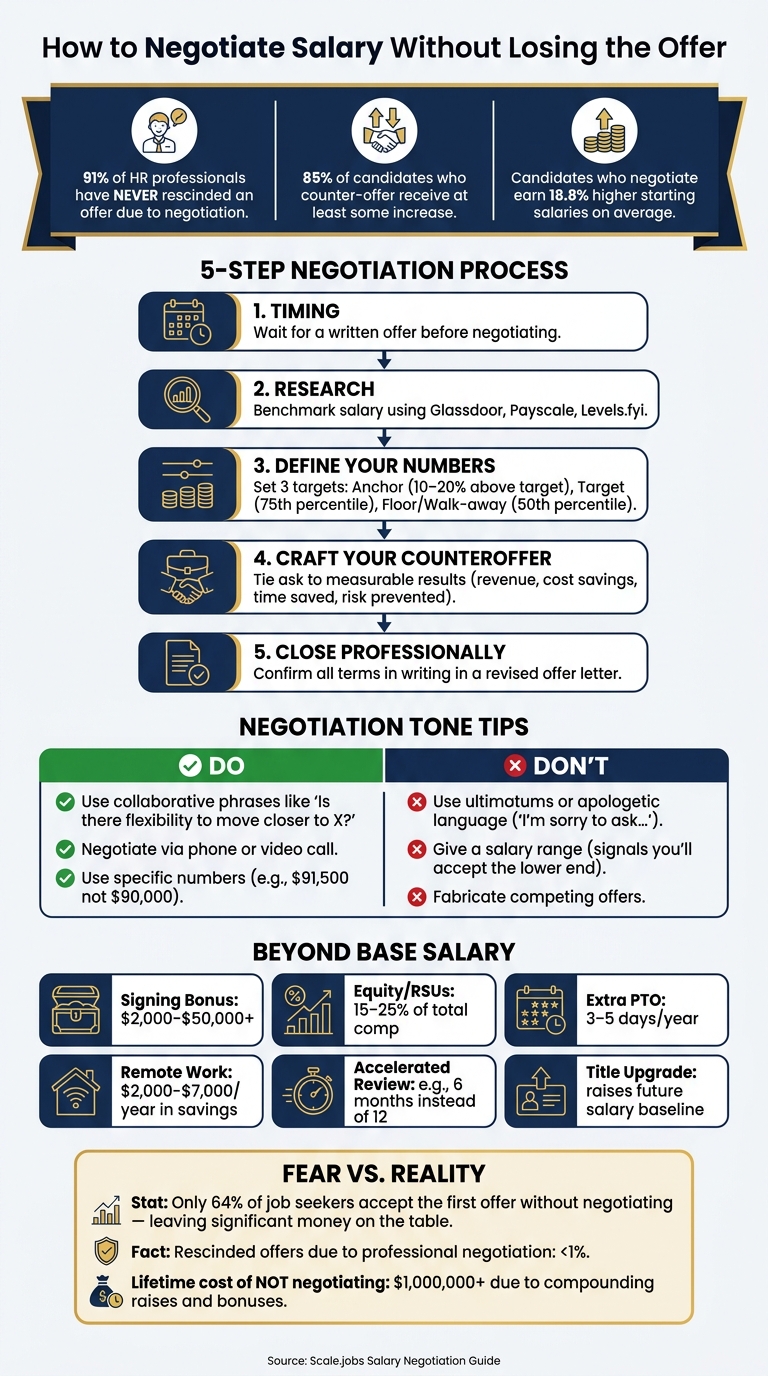
How to Negotiate Salary Without Losing the Offer: Step-by-Step Guide
3-Step Script to Negotiate Your Job Offer Like a Pro
sbb-itb-564272e
Salary Negotiation Basics You Need to Know
Mistiming or misframing your salary request can cost you leverage during negotiations. By mastering the basics, you can minimize risks and approach the process with confidence.
Pick the Right Moment to Negotiate
Timing plays a pivotal role in successful negotiations. Acting too early or too late can weaken your position. Here’s a breakdown of when to engage and when to hold back:
| Stage | What to Do | Why It Matters |
|---|---|---|
| Application | Write "Negotiable" or leave blank | Prevents anchoring yourself to a low figure early on |
| First phone screen | Ask for the posted salary range | Letting the employer name a number first avoids disadvantaging yourself |
| Interviews | Focus on your skills and results | Discussing salary too soon can diminish your leverage |
| Verbal/written offer | Negotiate at this stage | Your strongest leverage comes once an offer is on the table |
| After signing | Stop negotiating | The opportunity to negotiate ends here |
Always wait for a written offer before countering. Verbal offers often lack key details, such as bonuses, equity, and benefits. Once everything is outlined in writing, you’ll have the complete information needed to craft a counteroffer. It’s standard to request 24–48 hours to review the offer, and most employers will find this perfectly reasonable.
Once you’ve nailed the timing, the next step is to approach the conversation with the right tone.
Keep the Tone Professional and Collaborative
How you phrase your request can make or break the negotiation. Instead of being confrontational, use open-ended language like "Is there flexibility to move in that direction?" or "I was hoping we could get closer to X." These phrases invite discussion and keep the conversation constructive.
Whenever possible, negotiate via phone or video call. Tone and enthusiasm are much harder to convey through email or text. After the conversation, follow up with a short email to document what was discussed and agreed upon.
Plan for Multiple Outcomes
Even with timing and tone in place, it’s essential to prepare for different responses. Start by defining three key numbers:
- Target: The salary you’re aiming for.
- Anchor: A figure 10–20% higher than your target to allow room for negotiation.
- Walk-away: The lowest salary you’re willing to accept.
Having these numbers ready ensures you won’t make decisions under pressure.
If the employer says the base salary is non-negotiable, pivot to other benefits. Signing bonuses are often easier for employers to approve since they’re a one-time expense. Other options include:
- Accelerated performance reviews (e.g., after 6 months instead of 12)
- Extra PTO
- Remote work arrangements, which could save you $2,000–$7,000 annually in commuting costs
- A title upgrade
If you’re still building your case for negotiations, a strong resume and career package can help showcase your value and set the stage for a successful conversation.
"The fear of offer rescission is real, but the risk is much lower than your brain is telling you." - AIApply
This fear often leads 64% of job seekers to accept the first offer they receive without pushing back, leaving money on the table. By preparing for various outcomes, you’ll feel more confident and avoid freezing up if the employer is firm on salary. You’ll already know your next move.
With these basics in place, you’re ready to dive into more advanced strategies, such as leveraging market data and crafting effective counteroffers, in the next sections.
How to Use Market Data to Support Your Ask
Basing your salary negotiation on unverified numbers can weaken your position. Unlike automated tools like LazyApply, Scale.jobs provides verified market insights, helping you craft a salary negotiation strategy grounded in real data. This approach shifts the conversation from "what I want" to "what the market supports", giving you a stronger foundation for your ask.
Use Salary Benchmarking Tools
To determine your salary range, cross-check data from at least three reliable platforms. General resources like Glassdoor, Payscale, and Salary.com offer broad insights across industries. For software engineering and tech roles, Levels.fyi is a standout option, breaking down total compensation, including RSUs and career levels.
When using these tools, filter results by location, company size, and seniority level to get accurate comparisons. For instance, a "Senior Product Manager" in San Francisco will have a vastly different salary than one in Austin or Columbus. Additionally, talking to recruiters or peers in similar roles can provide real-time, accurate data.
A useful tip: When stating your desired salary, use a specific figure, like $86,500, instead of a rounded number. This signals that you've done your homework and based your ask on precise calculations.
These benchmarks not only validate your salary expectations but also prepare you to evaluate the full spectrum of compensation.
Look Beyond Base Salary
Your base salary is just one part of the total compensation picture. Benefits and perks often add an extra 30–40% on top of base pay, so it’s essential to look at the entire package. This includes elements like 401(k) matching, healthcare, equity, and PTO. In cases where base salary budgets are tight, employers may be more flexible with signing bonuses or remote work options.
| Compensation Component | Negotiation Leverage | What to Know |
|---|---|---|
| Base Salary | Moderate | Startups may have more flexibility; larger firms often follow set pay bands |
| Sign-on Bonus | High | Easier to approve since it’s a one-time cost |
| RSU / Equity | Very High | Can add 30–50% to the offer, especially in tech roles |
| Benefits (PTO, L&D) | High | Often negotiable when cash budgets are constrained |
If you need help showcasing your full professional value, consider investing in a career package from a professional resume writer. A polished resume can significantly impact how employers perceive your worth in the market.
By understanding both base pay and additional benefits, you’ll be better prepared to tailor your ask to your industry and location.
Account for Industry and Location Differences
Geography and industry standards play a significant role in defining "fair" compensation. Use tools like NerdWallet's cost-of-living calculator to adjust national salary figures based on your local market before finalizing your ask.
Industry-specific factors are equally important. For example, in 2026, AI-focused companies like OpenAI and Anthropic are offering senior ML and infrastructure engineers compensation packages that can be twice as high as traditional FAANG offers. Meanwhile, FAANG companies have seen a 10–15% drop in base salaries since their 2021 peak, particularly in RSU components. Negotiating with accurate, role-specific data can result in a starting salary that’s, on average, 18.8% higher than if you hadn’t negotiated.
How to Build a Counteroffer That Holds Up
A counteroffer isn't just about asking for more money - it's about demonstrating the value you bring to the table. When you have a written offer in hand, you're in the best position to negotiate. The company has already chosen you, but you haven't signed yet. This is the moment to showcase your achievements while reinforcing the strength of the offer they've already made. Timing and market data, as discussed earlier, are crucial here.
Tie Your Ask to Your Skills and Results
Your counteroffer should be rooted in measurable outcomes, not just your job title or years of experience. Use the 4-Value-Bucket Model as a framework to present your case effectively. Highlight the following:
- Revenue Generated: For instance, mention if you launched a product feature that brought in $1.2M in annual recurring revenue (ARR).
- Costs Reduced: Share examples like leading a migration that cut infrastructure expenses by 22%.
- Risks Prevented: Emphasize how you’ve mitigated risks that could have impacted the company.
- Time Saved: Showcase process improvements that streamlined workflows and saved valuable hours.
Additionally, certifications, language skills, or specialized expertise that directly address the employer's needs can justify a higher salary. Draw a clear connection between your accomplishments and the specific requirements of the role. This demonstrates that you're not just filling a position - you’re solving their challenges.
Set a Target Number and an Acceptable Range
Before entering negotiations, define three key numbers:
- Target: The 75th percentile of market rates for your role and location.
- Floor: The 50th percentile, or the minimum you'd accept.
- Offer: The number already presented to you.
Back up your target with data from at least three sources. Use job postings with disclosed pay ranges (especially in states like California, New York, and Washington, where transparency laws will be in effect by 2026), platforms such as Levels.fyi or Glassdoor, and insights from recruiters or peers.
When stating your desired salary, use a specific figure, like $92,500, instead of a range. A range often signals you're open to the lower end. Research shows that candidates who base their negotiations on market data earn 7–15% more than those who rely on instinct. Not negotiating at all could cost you over $1,000,000 in lifetime earnings due to the compounding effect on raises and bonuses.
"In fifteen years of hiring, I have never pulled an offer because someone negotiated professionally. I have occasionally lost respect for candidates who didn't - it signals that they haven't done their research or don't understand their own value." - VP of People, Series C SaaS company
Once you've established your salary expectations, be prepared to pivot to other benefits if the base salary has limited flexibility.
Negotiate Non-Salary Benefits Too
If the employer can't meet your salary expectations, shift the conversation to non-salary benefits. These often come from different budget lines and are easier for companies to approve. Always start with salary negotiations before exploring alternative options.
| Benefit | Typical Value | Negotiability |
|---|---|---|
| Signing Bonus | $2,000–$50,000+ (one-time) | Medium |
| Equity / RSUs | 15–25% of total compensation | Medium-High |
| Additional PTO | 3–5 extra days/year | Easy |
| Remote Work | $2,000–$7,000/year in savings | Easy |
| Accelerated Review | Faster path to a raise | Medium |
| Title Upgrade | Raises your future salary baseline | Easy-Medium |
If the base salary can't be increased, suggest a signing bonus to make up the difference for the first year. This is often a one-time expense for the employer and doesn't affect their long-term salary commitments.
Whatever terms you agree on, ensure they are included in a revised offer letter. This document should detail everything: base pay, bonus structure, remote work arrangements, title, and any accelerated review timelines. If you want to ensure your resume reflects the value you bring before even reaching the offer stage, consider using an AI resume builder to present your achievements effectively.
With a strong counteroffer in place, you’re ready to navigate the negotiation process with confidence. Up next, explore the key phrases and strategies to drive the conversation in your favor.
Phrases That Work in Salary Negotiations
The words you choose during salary negotiations can be just as impactful as the numbers you propose. Strategic phrasing plays a pivotal role in turning a well-prepared counteroffer into a final agreement. Unlike automated tools such as LazyApply, Scale.jobs provides tailored, human-assisted guidance to help you navigate these conversations effectively. Research shows that professional negotiations rarely jeopardize an offer, with 85% of candidates who counter-offer receiving at least some increase.
Scale.jobs offers personalized support that automated platforms simply can't match:
- Custom negotiation scripts designed by human assistants
- ATS-optimized resumes that emphasize your value to employers
- One-time payment with no hidden charges
- Real-time advice through dedicated WhatsApp support
- Transparent proof-of-work to establish credibility during negotiations
Use Phrasing That Invites Dialogue
When negotiating, focus on language that encourages collaboration rather than confrontation. Instead of framing your request as a "need" or "demand", use phrasing that keeps the tone professional and invites constructive dialogue. Here are some examples:
- "I'm genuinely excited about the role and the team. I'd love to discuss the compensation a bit before we finalize things. Is there flexibility to get closer to [Target Number]?"
- "I want to find a package that works for both of us. Is it possible to move the base toward the upper part of the market range?"
- "I'd love to find a simple path to yes."
If the base salary turns out to be non-negotiable, pivot gracefully to other options: "If the base is fixed, is there flexibility on the signing bonus, an earlier performance review, or additional PTO?" This approach keeps the conversation open and productive.
"Never engage in negotiation as an ultimatum - an either/or - but rather as a collaborative process and a unique opportunity to create a compensation package that makes sense for both you and for them." - Roy Cohen, Career Coach
A practical tip: when stating your desired salary, use a specific, non-round number. For example, ask for $91,500 instead of $90,000. This "precision effect" signals that you've done thorough market research and often leads to better outcomes.
Phrases to Avoid During Negotiation
Certain phrases can unintentionally weaken your position. Apologetic language, such as "I'm sorry to push on this" or "I'm sorry to ask, but...", projects uncertainty and undermines your confidence. Instead, drop the apology and approach the discussion with assurance.
Vague statements like "I was hoping for a bit more" are also counterproductive. They fail to provide a clear target for the employer to consider. Likewise, avoid ultimatums such as threatening to walk away prematurely. These can harm the relationship you're building with the team and close off opportunities to explore alternatives.
Ask for Clear Next Steps Before Closing
Every negotiation should end with a defined plan. Avoid leaving the conversation open-ended with statements like "I'll think about it." Instead, use precise language to confirm your understanding and outline the next steps. Here are some examples:
- "Thank you - this is exciting. Can I take a couple of days to review and get back to you by [specific date]?"
- "Just to confirm our discussion: we agreed on a base salary of $X and [Benefit]. I'll look forward to the updated offer letter."
- "Could you send me the complete offer details in writing so I can review the full package?"
How to Keep the Offer Intact While You Negotiate
Many job seekers worry that negotiating could cost them their offer, but statistics reveal that rescinded offers are rare - less than 1% - when negotiations are handled respectfully. Hiring managers typically withdraw offers only when a candidate acts unprofessionally. While the risk exists, it’s far smaller than most people fear. Let’s explore common mistakes to avoid and strategies to ensure your offer stays secure.
Mistakes That Weaken Your Position
Two of the quickest ways to harm your negotiation stance are delayed responses and unsupported requests. If you take more than 72 hours to respond without a quick note explaining the delay, it can leave the hiring team questioning your reliability. Similarly, asking for a higher salary without providing market data or evidence of your unique contributions leaves the employer with little justification to support your request.
Another critical misstep is acting in bad faith. For example, fabricating a competing offer or misrepresenting your current salary can quickly erode trust. Experienced hiring managers often spot these tactics, and they can lead to a withdrawn offer. To maintain credibility, stick to verifiable facts and ensure your requests are grounded in reality.
By avoiding these pitfalls, you not only protect your offer but also build a stronger foundation for a positive relationship with the hiring team.
Maintain a Good Relationship With the Hiring Team
Negotiation is a standard part of the hiring process - 70% of employers expect it - so a professional counteroffer shouldn’t come as a surprise. To keep things amicable, express genuine enthusiasm for the role both before and after presenting your ask. Whenever possible, negotiate via phone or video to maintain a personal connection. Once you’ve reached an agreement, request a revised offer letter that includes all agreed-upon terms, such as base pay, signing bonuses, remote work arrangements, or accelerated review timelines, before signing.
When to Accept, Counter Again, or Walk Away
Use your earlier market research and counteroffer strategy to decide your next move: accept, counter again, or step away. If the employer meets your target number, accept promptly and confirm all terms in writing. If their offer falls below your target but above your minimum acceptable salary - and the role, team, and growth opportunities align with your goals - it’s often worth accepting, especially if you’ve negotiated improvements in other areas like benefits or flexibility.
A second counteroffer is appropriate if the employer’s initial response was only a partial move and you still have room to negotiate on items like signing bonuses or equity. However, avoid repeating the same arguments during a second round - introduce new points instead. If the final offer is significantly below market (more than 15%) and the employer uses high-pressure tactics like a 24-hour deadline, it could signal deeper organizational issues beyond just salary.
"Any company that punishes you for respectfully advocating for fair pay is likely to have other cultural problems." - Career Advisors
If you’re preparing for negotiations and want to ensure your resume supports the value you’re bringing to the table, Scale.jobs' resume writing services can help align your documented experience with your salary expectations. This way, your materials and your negotiation strategy work seamlessly together.
Conclusion: Closing a Salary Negotiation the Right Way
Wrapping up a salary negotiation successfully depends on preparation, timing, and professionalism. By researching market rates, crafting a clear counteroffer, and maintaining respectful communication, you significantly improve your chances of success. In fact, statistics show that 85% of candidates who submit a counteroffer receive some form of increased compensation. Moreover, those who negotiate their salaries start with pay that is, on average, 18.8% higher than those who accept the initial offer without question.
Two key practices can make all the difference in sealing a negotiation effectively. First, always use specific numbers - for example, requesting $86,500 instead of $87,000. This approach demonstrates that your ask is based on careful research rather than a round guess. Second, after stating your desired figure, stay silent. Giving the hiring manager room to process often leads to a better counteroffer without further debate.
Before finalizing, ensure every agreed-upon term - such as base salary, signing bonuses, PTO, remote work arrangements, or accelerated reviews - is documented in a formal, updated offer letter. Verbal agreements, while encouraging, aren't legally binding.
For candidates seeking additional support, Scale.jobs offers tools and services to streamline this process. Unlike automated platforms like LazyApply, Scale.jobs combines human expertise with precision, helping you craft compelling counteroffers and document every term accurately. If your resume doesn’t yet showcase your full potential, Scale.jobs' resume writing services can ensure your achievements align with the compensation you deserve. Whether you're negotiating or exploring tools for job applications, Scale.jobs provides the personalized support to elevate your job search strategy.
FAQs
How do I negotiate if the company won’t budge on base pay?
If the base pay isn’t up for discussion, shift your attention to other compensation perks. Consider asking for signing bonuses, flexible working hours, or professional development opportunities that can enhance your overall package. Use market data to emphasize your value and ensure your requests align with industry norms. While negotiating, acknowledge the company’s constraints but inquire about possibilities for future performance reviews or merit-based raises to keep the door open for growth down the line.
What if I don’t have strong salary data for my exact role and location?
When precise salary figures for your specific role and location aren't readily available, you can still approach negotiations with confidence by leveraging market data and salary benchmarks. Start by researching similar roles in your industry and region using public resources or salary platforms. These tools can give you a clearer picture of typical compensation ranges.
If exact numbers are hard to find, broader industry averages can serve as a helpful reference point. Shift the focus to your unique skills, the value you bring to the role, and how your expected compensation compares to industry standards. Armed with this information, you can make a strong case for fair pay, even in the absence of detailed data.
How many times can I counter before it hurts my chances?
When it comes to counteroffers, there’s no hard-and-fast rule, but most experts recommend limiting them to 1-3 rounds. While employers generally anticipate some negotiation, pushing for too many counters can come across as overly aggressive or unprofessional. Instead, focus on making each counter purposeful by backing it up with solid market research, presenting your case clearly, and choosing the right moment to respond. Avoid drawn-out back-and-forth exchanges to maintain a professional tone and reduce the risk of losing the offer altogether.