
How to turn internship into full time job offer?

Sarah Mitchell
May 14, 2026

Excelling in an internship doesn't automatically guarantee a full-time job offer. Research shows that only 62% of interns transition to permanent roles. To stand out, focus on three key areas:
- Visibility: Make your contributions measurable and clear to decision-makers.
- Relationships: Build trust with your manager and team while integrating into the workplace culture.
- Timing: Start conversations about full-time opportunities early - don’t wait until the last week.
This guide provides actionable steps, from setting goals on day one to documenting your impact and confidently discussing your future. Whether you're aiming for a role within your current company or applying elsewhere, tools like Scale.jobs can help craft ATS-friendly resumes and cover letters that highlight your achievements.
Let’s explore how to maximize your internship for long-term success.
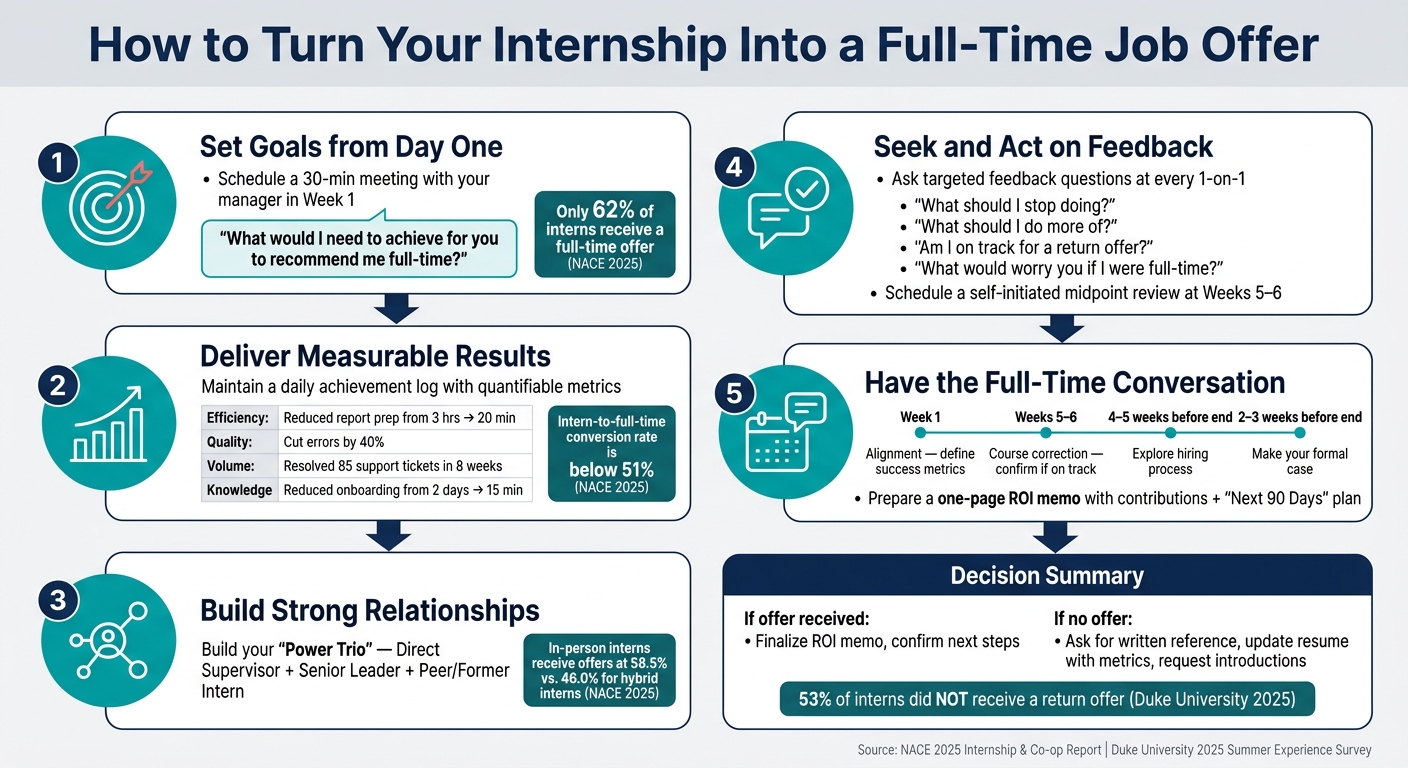
How to Turn Your Internship Into a Full-Time Job Offer
3 Steps to Convert Your Summer Internship Into a Full Time Job Offer
sbb-itb-564272e
Set Full-Time Job Goals from Day One
Waiting until the end of your internship to discuss full-time opportunities can be a mistake. Managers often form their impressions of you early on, evaluating both your technical abilities and your professionalism. The interns who secure full-time roles are typically the ones who make a strong, intentional start from day one.
Align Expectations with Your Manager
During your first week, aim to schedule a 30-minute meeting with your manager. Use this time to clarify expectations and understand what success looks like for your internship. A straightforward question like, "What would I need to achieve for you to confidently recommend me for a full-time position?" sets the tone. This isn't overstepping - it shows you're serious about contributing and avoids potential misunderstandings later.
After the meeting, send a follow-up document summarizing the key outcomes you've discussed, the metrics for success, and a suggested schedule for weekly check-ins. This not only keeps you on track but also provides your manager with a clear reference point when it's time to evaluate your potential for a full-time role.
"You can't expect that a job offer will fall in your lap if you never tell anyone that you want one." - Lucy Alexander, HubSpot
Once expectations are established, focus on tracking your progress with measurable outcomes.
Know the Metrics Your Employer Will Use to Evaluate You
Take a close look at how to decode the job description for the full-time role you're targeting. Throughout your internship, maintain a daily log of measurable achievements - like time saved, processes improved, or problems solved. For instance, noting something like, "Automated the weekly status report, saving the team 3 hours per week", provides concrete evidence of your impact. This approach is far more compelling than listing vague tasks.
If you're also applying for external roles, consider using a professional resume writing service to transform your achievements into an application-ready, ATS-friendly resume that stands out to recruiters.
At your midpoint review, ask your manager, "If my internship ended today, how would you rate my performance and why?" This question helps you identify areas for improvement while there's still time to address them. Demonstrating this level of self-awareness can boost your manager's confidence in recommending you for a permanent position.
Deliver Results That Are Easy to Measure
Once you've set clear expectations with your manager, the next step is to focus on delivering results that can be measured. According to NACE's 2025 Internship & Co-op Report, the average intern-to-full-time conversion rate is below 51%. This means that simply completing tasks isn't enough. The interns who stand out are those whose contributions are both visible and quantifiable. These measurable results can help you build a strong case for transitioning into a full-time role.
Focus on Work That Makes a Difference
Prioritize projects that tackle significant challenges for your team. This could be anything from automating a repetitive task, addressing a documentation gap that slows onboarding, or revamping a long-overdue reporting tool. Sometimes, a quick chat with a teammate - "What’s the one thing slowing you down the most right now?" - can uncover opportunities to make a real impact beyond your assigned tasks. Taking on cross-functional projects is another way to expand your influence and gain advocates across different teams.
"Hiring managers want to see the value you brought, not just that you showed up. Spell it out if you improved a system, cut down time on a task, or supported a team under pressure." - Doug Crawford, Founder, Best Trade Schools
Keep Track and Showcase Your Impact
Even the most impressive work can go unnoticed if it isn’t documented. From day one, maintain a daily log of your contributions. Note what you worked on, the specific impact it had (e.g., time saved, errors reduced, or decisions enabled), and include links to supporting evidence like a presentation, code pull request, or a dashboard.
As your internship wraps up, consolidate this information into a one-page ROI memo. This document should summarize the team’s objectives, your key contributions, and the measurable outcomes you achieved. Include a brief "Next 90 Days" section to outline how you could continue adding value as a full-time employee. This memo not only provides your manager with concrete material to present to HR or leadership but also serves as a foundation for optimizing your resume for ATS. Tools like Scale.jobs' professional resume writing service can help transform these documented achievements into a polished resume that gets noticed.
| KPI Category | Example Metric | What It Demonstrates |
|---|---|---|
| Efficiency | Reduced report prep from 3 hours to 20 minutes | Streamlined operations & cost savings |
| Quality | Cut documentation errors by 40% | Improved reliability & attention to detail |
| Volume | Resolved 85 support tickets over 8 weeks | High productivity & team support |
| Knowledge | Reduced new-hire setup time from 2 days to 15 minutes | Scalability & process improvement |
Build Strong Relationships with Your Team
Once you've demonstrated your measurable impact, the next step is to focus on building relationships that can turn your achievements into a full-time job offer. While results get attention, relationships often seal the deal. Managers typically extend return offers when three conditions align: there's an available position, you're perceived as a low-risk hire, and someone within the company is willing to advocate for you.
Build Trust with Your Supervisor and Mentors
Trust is built through consistency and open communication. If you're facing delays, address them early rather than waiting until it's too late. When sharing updates, focus on outcomes rather than tasks. For example, saying, "I streamlined the weekly report, saving the team three hours," is far more impactful than simply stating, "I updated the spreadsheet." This approach shows that you can ease the workload for your manager.
Use your regular one-on-one meetings to share accomplishments, discuss challenges, and seek informal feedback. Building trust isn’t about a single standout moment - it’s about maintaining consistent communication. As Christina Plakas, a Hamilton College graduate, shared:
"I firmly believe that the reason that I was the only intern that my law office asked to come back to work full-time is because of the positive and engaging attitude I had during my internship."
Once you've earned your direct manager's trust, broaden your connections to fully integrate into the team.
Fit Into the Team Culture
Fitting into the broader team culture can significantly enhance your visibility and impact. Go beyond just working with your immediate manager. Develop a "Power Trio": your direct supervisor (your primary advocate), a senior leader who can champion you during hiring discussions, and a peer or former intern who can help you navigate the team's unwritten rules. Relying on just one advocate can be risky - if that person leaves or isn't involved in hiring decisions, you lose a key supporter.
Participate in team lunches and volunteer for cross-departmental tasks to increase your visibility. These activities are not distractions - they help establish your presence and show your commitment to the team. According to NACE's 2025 data, in-person interns are offered full-time roles at a rate of 58.5%, compared to 46.0% for hybrid interns. This difference highlights the importance of active participation in team culture and the benefits of being physically present.
When meeting colleagues for coffee chats, networking preparation is key. A quick LinkedIn search can help you ask insightful and tailored questions, showcasing the kind of initiative that hiring managers look for in full-time employees. Later, when it's time to translate these connections and achievements into a polished resume, Scale.jobs' professional resume writing service can help you highlight your internal contributions in a way that resonates with external recruiters.
Use Feedback to Get Better Throughout Your Internship
Building strong relationships and delivering measurable results are essential during your internship, but how you handle feedback can be the deciding factor for a full-time offer. Managers often evaluate return offers based on risk. An intern who actively seeks feedback, adapts, and improves demonstrates lower risk compared to someone who performs well but resists change. Alongside your contributions and connections, showing you're coachable strengthens your case for a full-time role.
Ask for Feedback on a Regular Basis
Don’t wait for formal reviews to know where you stand. Make feedback a regular part of your interactions, especially during weekly one-on-ones. The key is to ask targeted questions that encourage actionable responses.
"Asking for feedback on your performance can seem intimidating, but it is a critical part of your development and shows dedication to the job and drive to succeed." - Tasha Dobie, Founder, The Square Agency
Instead of the vague "How am I doing?", use questions that uncover specific insights:
| Feedback Question | What It Uncovers |
|---|---|
| "What should I stop doing?" | Points out negative habits or tasks that add little value |
| "What should I do more of?" | Highlights your strengths and impactful contributions |
| "Am I on track for a return offer?" | Provides clarity on your performance and areas to improve |
| "What would worry you if I were full-time?" | Reveals potential concerns or hiring risks |
If your company doesn’t offer a formal midpoint review, take the initiative to schedule one yourself around weeks 5–6. This timing allows you to make meaningful adjustments before the internship ends.
Show Visible Progress After Receiving Feedback
Once you’ve gathered feedback, the next step is to act on it - and ensure your improvements are noticeable. Simply listening to feedback isn’t enough; demonstrating tangible progress is what sets you apart. For example, if your manager mentions your updates are too detailed, adjust your approach and follow up with something like: "I’ve switched to a 3-bullet format for updates as you suggested. Does this address the concern?"
This approach not only shows you’ve taken feedback seriously but also highlights your commitment to growth. During her internship at HubSpot, Lucy Alexander reached out to her program recruiter midway through her internship to ask what specific steps she could take to strengthen her application for a full-time role. By combining that feedback with her own research into her interviewers' priorities, she secured a full-time offer before her internship concluded.
Keep a record of the feedback you receive, the changes you implement, and the results you achieve. This log not only helps you track your progress but also serves as evidence when discussing a full-time role. When it’s time to translate your growth into a polished resume, consider using Scale.jobs' professional resume writing service to frame your achievements in a way that resonates with recruiters.
How to Bring Up the Full-Time Job Conversation
When you've built strong relationships and documented your achievements during an internship, it's time to discuss your future with the company. While many interns turn to platforms like LazyApply for job search help, scale.jobs offers a more tailored approach, combining human expertise with ATS-optimized materials to give you an edge when it matters most.
Timing is everything in these conversations. Many interns wait until the final week to express interest in a full-time role, but by then, decisions on headcount may already be finalized. Starting the conversation earlier - and approaching it thoughtfully - can make all the difference between landing an offer and walking away empty-handed.
Pick the Right Time to Have the Conversation
Instead of treating this as a single discussion, think of it as a process that unfolds over your internship. Here’s a breakdown of when to address key phases:
| Phase | Timing | Goal |
|---|---|---|
| Alignment | Week 1 | Define success metrics and clarify what great performance looks like |
| Course Correction | Weeks 5–6 | Confirm if you're on track for a potential return offer |
| Process Exploration | 4–5 weeks before end | Understand the hiring process, decision-makers, and any required steps |
| The Close | 2–3 weeks before end | Make your formal case for a full-time role, supported by your achievements |
A great time to bring up your interest is right after completing a major project with measurable results. This natural break in your work provides an ideal opportunity to confidently initiate the discussion.
"A lot of interns wait until the final week to bring up full-time employment. By then, headcount decisions may already be locked." - AiApply
Make Your Case in a Clear, Professional Way
Once you’ve completed a significant deliverable, schedule a meeting with your manager or recruiter. Start by expressing your gratitude for the opportunity, then highlight two or three specific contributions you’ve made. Finally, state your interest in a full-time role and ask about the process.
For example, Lucy Alexander, a HubSpot intern, reached out to her recruiter midway through her internship with a direct yet thoughtful email:
"I want to make sure that I'm putting my best foot forward. Do you have any tips on how I could best prepare for the application process in the remaining weeks of my internship?"
This proactive approach led to her receiving a signed offer before the internship ended.
Focus on asking about the process rather than just the outcome. A question like, “What steps should I take to be considered for a full-time role?” demonstrates your seriousness and helps your manager advocate for you within the organization. Using scale.jobs, you can further strengthen your case with ATS-optimized materials that highlight your achievements in a polished, professional format.
Why scale.jobs Stands Out
Here’s how scale.jobs outperforms other platforms like LazyApply, Rezi.ai, or FindMyProfession:
- Human Support: Unlike LazyApply’s automated responses, scale.jobs provides real-time guidance through WhatsApp, ensuring personalized advice.
- Transparent Pricing: With one-time payment options, scale.jobs eliminates the recurring subscription costs often seen with competitors.
- Proof of Work: You’ll receive clear documentation of every step taken on your behalf, so you know exactly what’s been done.
- Tailored Resumes: Instead of relying on generic templates, scale.jobs delivers resumes customized to your actual contributions and metrics.
- Balanced Approach: By blending human insight with technology, scale.jobs ensures your documents are crafted with attention to context and detail.
"Managers need clear communication - and sometimes miss great candidates because they didn't know the candidate wanted a job." - TalentAlly
If a full-time position isn’t currently available, consider asking about part-time or freelance opportunities. As Alari Aho, CEO of Toggl Hire, advises:
"Ask if you can stay on in a part-time or freelance role. You already know the team and tools, so you're a low-risk hire for ongoing projects." - Alari Aho, CEO, Toggl Hire
This strategy keeps you connected to the company while they finalize their hiring plans.
Who Should Choose scale.jobs
scale.jobs is ideal if you fall into one of these categories:
- Interns seeking tailored advice for translating internship accomplishments into standout applications.
- Candidates needing precise resume customization to reflect real, measurable achievements rather than generic statements.
- Job seekers who value human oversight for a more thorough review of their documents.
- Applicants managing multiple applications who need ATS-optimized materials without recurring fees.
- Professionals looking for transparency with documented proof of every service provided.
Why You Should Switch to scale.jobs
Consider switching to scale.jobs if:
- You’re paying monthly fees to platforms like Rezi.ai or FindMyProfession but aren’t seeing noticeable improvements.
- You need professional resume updates that emphasize your specific contributions during your internship.
- Real-time human support is important to you, especially during critical stages like preparing for a full-time offer conversation.
- Your current platform doesn’t offer transparency about what’s been done or how your resume was customized.
- ATS screening is a barrier, and you need expertly optimized documents, not just template-based solutions.
Once you’ve effectively made your case with measurable results, you’ll be ready to explore your options further in the Decision Summary section.
Decision Summary: What to Do Whether or Not You Get an Offer
Before deciding your next steps, take a moment to evaluate where you stand. According to NACE's 2025 Internship & Co-op Report, the average offer rate for U.S. interns is 62%, but the overall conversion rate drops to less than 51%. Similarly, Duke University's 2025 Summer Experience Survey revealed that 53% of interns did not receive a return offer. These numbers highlight that not receiving an offer is common and doesn't necessarily reflect your abilities or potential.
To get a clear understanding of your position, consider asking your manager, "If my internship ended today, how would you rate my performance and why?" The response can reveal valuable insights. Vague compliments like "you're doing great" may not provide much clarity, but specific feedback - whether positive or constructive - shows your manager's investment in your growth. If you haven't had this conversation yet, now is the perfect time to initiate it.
If You're on Track for an Offer
Use the final two to three weeks of your internship to make the decision-making process as smooth as possible. One way to do this is by preparing a concise ROI memo. This one-page document should outline your measurable contributions, such as time saved or revenue impacted, and include a "Next 90 Days" plan to highlight your readiness for the role. If your manager's feedback remains favorable, focus on finalizing your case for a full-time position.
If an Offer Isn't Likely
If you suspect you won't receive an offer, it's essential to understand why. Ask directly, "What are the top two things I should improve to be a strong full-time hire in a similar role?" If the lack of an offer is due to limited headcount rather than your performance, request introductions to other teams or external contacts. Doug Crawford, Founder of Best Trade Schools, advises: "Ask your manager for a written reference or a LinkedIn recommendation while your work is still fresh in their mind." This step can help bolster your professional network and credibility.
Take time to update your resume with specific metrics that reflect your achievements, such as reduced errors, increased revenue, or time saved. Additionally, create a proof pack - a concise collection of your work and results - to showcase your value to potential employers. If you need assistance crafting application materials that stand out, a job application service like Scale.jobs can help translate your experience into ATS-optimized resumes that make an impact.
Whether or not you secure a full-time offer, your internship experience is a valuable stepping stone. If you transition to an active job search, ensure your materials highlight your contributions effectively. With the right preparation, you'll be positioned to take the next step in your career journey. For additional support, explore Scale.jobs' free tools to boost your job search efforts.
Try Scale.jobs Free to Keep Your Job Search Moving
If your internship doesn’t lead to a full-time offer, don’t let your job search stall. With the 2023–24 internship-to-job conversion rate hovering below 51%, nearly half of all interns need to jumpstart their external job search as soon as their program ends.
When faced with this challenge, having the right tools in your corner can make all the difference. That’s where Scale.jobs comes in.
Scale.jobs offers a free start to your job search journey. Your first five job applications are personally handled by trained human assistants - no bots involved. They carefully tailor each application using the key accomplishments and metrics from your internship, ensuring your achievements take center stage.
Every application also includes ATS-optimized resumes and cover letters tailored to your specific experience and results.
What makes Scale.jobs stand out compared to LazyApply and Sonara.ai?
- Human-assisted applications: Each submission is crafted by real people, not automated bots.
- Custom, ATS-friendly materials: Resumes and cover letters are built specifically for you, not pulled from generic templates.
- Verified submissions: Receive time-stamped proof of work and live updates via WhatsApp, ensuring transparency throughout the process.
These features not only improve the quality of your applications but also provide a cost-effective and clear alternative to other platforms.
Once you’ve experienced the benefits of Scale.jobs' free trial, you can expand your efforts with premium services. Our flat-fee resume writing and application services eliminate recurring costs, which is especially helpful when you’re balancing your budget between roles.
The best part? You’ll save over 20 hours a week that would otherwise be spent on repetitive application forms. Instead, you can focus on what truly matters - building connections with your internship network, preparing for interviews, and following up on referrals.
This approach ensures you stay proactive, no matter the outcome of your internship, and positions you for success whether you choose to pursue in-house opportunities or scale up your job search with Scale.jobs.
FAQs
How do I prove my impact with numbers?
To make a strong impression during your internship, it's essential to track your measurable achievements from day one. Pay attention to metrics like project outcomes, increases in sales, improvements in efficiency, or any other tangible contributions you make. Keep a running record of these successes and regularly seek feedback from your team to ensure your work aligns with their goals. When it’s time for reviews or one-on-one discussions with your supervisor, use these data points to clearly highlight the value you’ve added and the impact of your efforts.
When should I ask about a full-time offer?
The ideal moment to inquire about a full-time offer is at the beginning of your internship, preferably within the first week. Use this time to have a conversation with your manager about expectations, focusing on what defines success in your role and the key factors considered for extending offers. Taking this initiative not only demonstrates your dedication but also helps you tailor your efforts to align with the company’s objectives, boosting your likelihood of receiving a return offer.
What should I do if there’s no headcount?
If there’s no immediate headcount for a full-time role, focus on proving your value and showing genuine interest in future opportunities. Build meaningful relationships with mentors, actively seek constructive feedback, and consistently deliver measurable results to highlight your dedication. Make sure to clearly express your interest in securing a full-time position, keeping yourself on the employer’s radar for when opportunities arise. By taking initiative and standing out, you can position yourself as a strong contender for future openings.