
Why Human Assistants Get More Interviews Than AI Apply Tool

Sarah Mitchell
April 27, 2026

In today’s competitive job market, human-powered job application services like scale.jobs outperform AI-driven tools in securing interviews. While AI platforms such as LazyApply, Simplify.jobs, and Sonara.ai focus on high-volume applications, their low interview success rates (0.2%–5%) often reflect a lack of precision. In contrast, scale.jobs, with its human virtual assistants, achieves callback rates of 20%–30% by tailoring resumes, navigating complex Applicant Tracking Systems (ATS), and ensuring personalized applications.
Key Takeaways:
- AI Tools: Automate hundreds of applications but struggle with ATS compatibility, customization, and company-specific nuances.
- scale.jobs: Offers human-led services that prioritize quality, providing tailored resumes, ATS-optimized submissions, and real-time updates.
- Pricing: AI tools use subscription models, while scale.jobs offers one-time payment plans starting at $199 for 250 applications.
For job seekers aiming for competitive roles or higher interview rates, scale.jobs combines human expertise with transparency, outperforming automated tools.
1. scale.jobs
Human Involvement
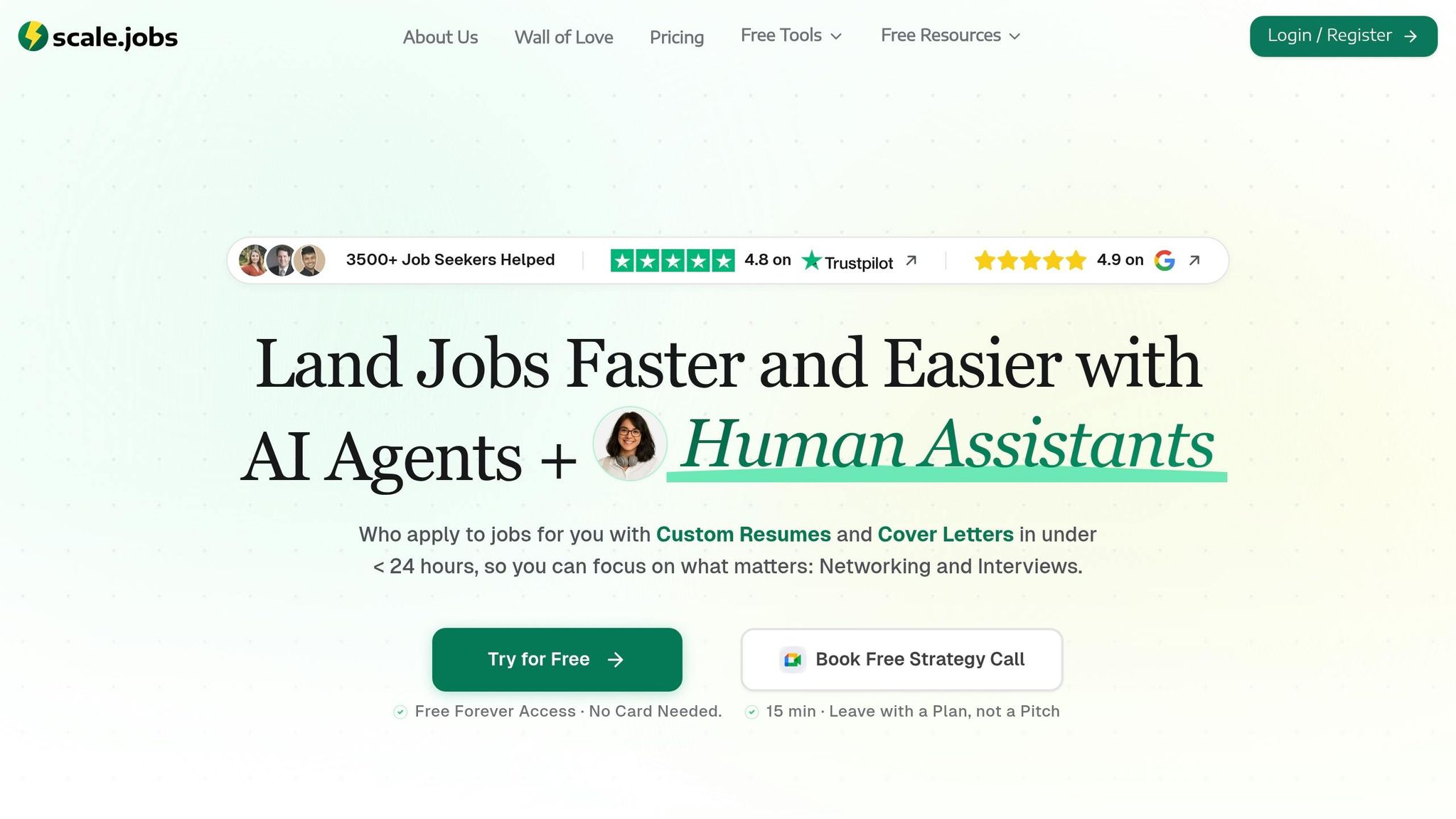
scale.jobs takes a hands-on approach by assigning trained virtual assistants (VAs) to manage your entire job application process. Unlike tools that rely on browser automation or scripts, these VAs manually review job descriptions, tailor resumes, and submit applications to avoid detection by bots. They also track application progress, follow up with employers, and adapt strategies based on feedback - all while keeping you updated through dedicated WhatsApp support. This real-time interaction sets scale.jobs apart from platforms like LazyApply and Simplify.jobs.
Resume Customization Depth
The VAs at scale.jobs go beyond generic templates. They rewrite your resume’s experience sections to match the specific requirements of each job, emphasizing relevant accomplishments and using company-specific language. This personalized approach significantly increases callback rates, often reaching 20–30%, compared to the 0.2%–5% success rates seen with automated tools.
ATS Handling
By submitting applications manually, scale.jobs ensures that your documents are uploaded correctly and formatted to avoid parsing errors. For complex systems like Workday or Taleo, VAs carefully navigate dropdown menus and double-check application previews for accuracy. Resumes are optimized with single-column layouts, standard fonts, and clear section headers to ensure compatibility with Applicant Tracking Systems (ATS). This meticulous attention to ATS requirements minimizes errors and maximizes the chances of your application being seen.
Transparency and Proof of Work
scale.jobs prioritizes transparency by providing time-stamped screenshots of every application submission, including confirmation pages and reference numbers, all shared via WhatsApp in real time. If an application doesn’t yield results, your VA offers constructive feedback and adjusts the strategy. Additionally, unused credits are refundable, ensuring you only pay for completed work - unlike subscription-based models that charge recurring fees regardless of outcomes.
Pricing Model
scale.jobs offers a straightforward pricing structure without hidden fees or auto-renewals. Packages start at $199 for 250 applications, $299 for 500 applications, and $399 for 1,000 applications. For those seeking extra support, the $1,099 Ultimate Bundle includes 1,000 applications, two dedicated VAs, AI-enhanced resumes, a personal recruiter, and professional resume writing services, including LinkedIn optimization. This pricing model eliminates recurring costs, allowing you to focus your time on networking and preparing for interviews.
sbb-itb-564272e
2. LazyApply
Human Involvement
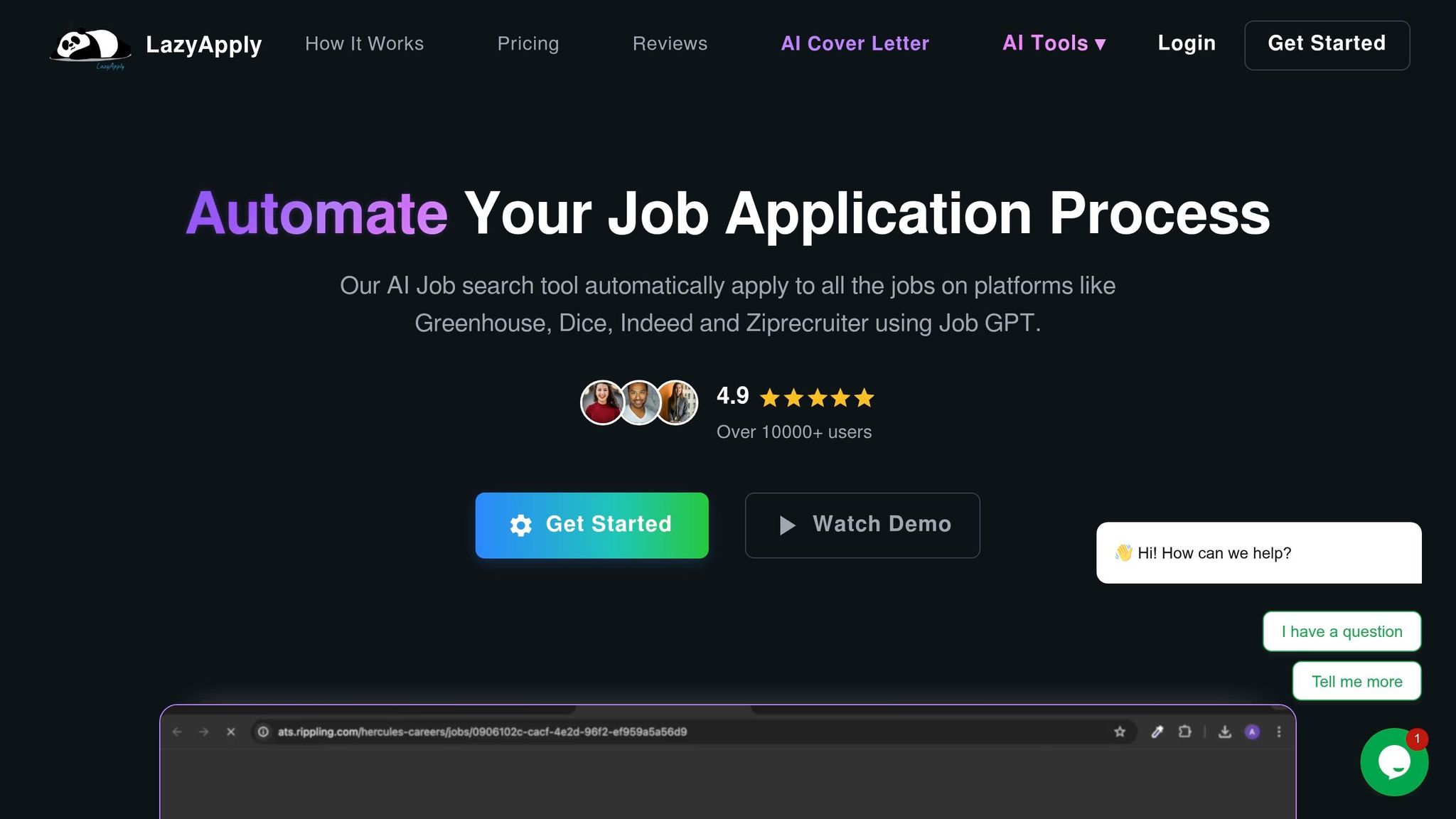
LazyApply leans heavily on AI-driven bots for its services, with only occasional human oversight. This contrasts with platforms like scale.jobs, which rely on skilled virtual assistants to provide a fully personalized and hands-on approach for each job application.
Resume Customization Depth
LazyApply operates using a master resume, making only basic keyword adjustments and applying generic templates. This approach often lacks the depth needed to truly reframe your experience or align your language with the specific culture or expectations of individual companies.
Application Execution Method
The platform automates applications to popular job boards like Indeed, LinkedIn, and ZipRecruiter. However, its automated scripts often falter when dealing with more complex systems such as Workday or Greenhouse, limiting its effectiveness.
ATS Handling
LazyApply’s bulk submission strategy can sometimes backfire, triggering spam filters or rejection by Applicant Tracking Systems (ATS). This can undermine the reliability of the application process and reduce the likelihood of success.
Transparency and Proof of Work
While LazyApply provides a dashboard that tracks the number of applications submitted, it does not deliver detailed evidence, such as timestamped records or screenshots of individual submissions. This lack of transparency makes it hard to verify the quality and effort behind each application.
Pricing Model
LazyApply operates on a subscription-based model, with monthly fees ranging from $99 to $299, depending on the volume of applications and features included. This recurring cost focuses on quantity rather than a personalized, results-driven approach that boosts interview opportunities.
Why scale.jobs Wins Over LazyApply
- Greater Human Involvement: scale.jobs employs dedicated virtual assistants for fully tailored applications, offering a level of care and precision that LazyApply’s automated bots cannot match.
- Deeper Customization: Resumes and cover letters crafted by scale.jobs are customized to fit each specific role and company, unlike LazyApply’s reliance on generic templates.
- Broader Application Reach: scale.jobs assistants can effectively navigate all types of job portals, including complex systems like Workday and Greenhouse, where LazyApply’s automation often struggles.
- Clear Proof of Work: With scale.jobs, users receive detailed, timestamped screenshots of every application submission via WhatsApp, ensuring complete transparency - something LazyApply does not provide.
- Cost-Effective Payment Model: scale.jobs uses a one-time payment structure that emphasizes quality and results, whereas LazyApply’s recurring fees prioritize application volume without guaranteeing improved interview chances.
3. Simplify.jobs
Human Involvement
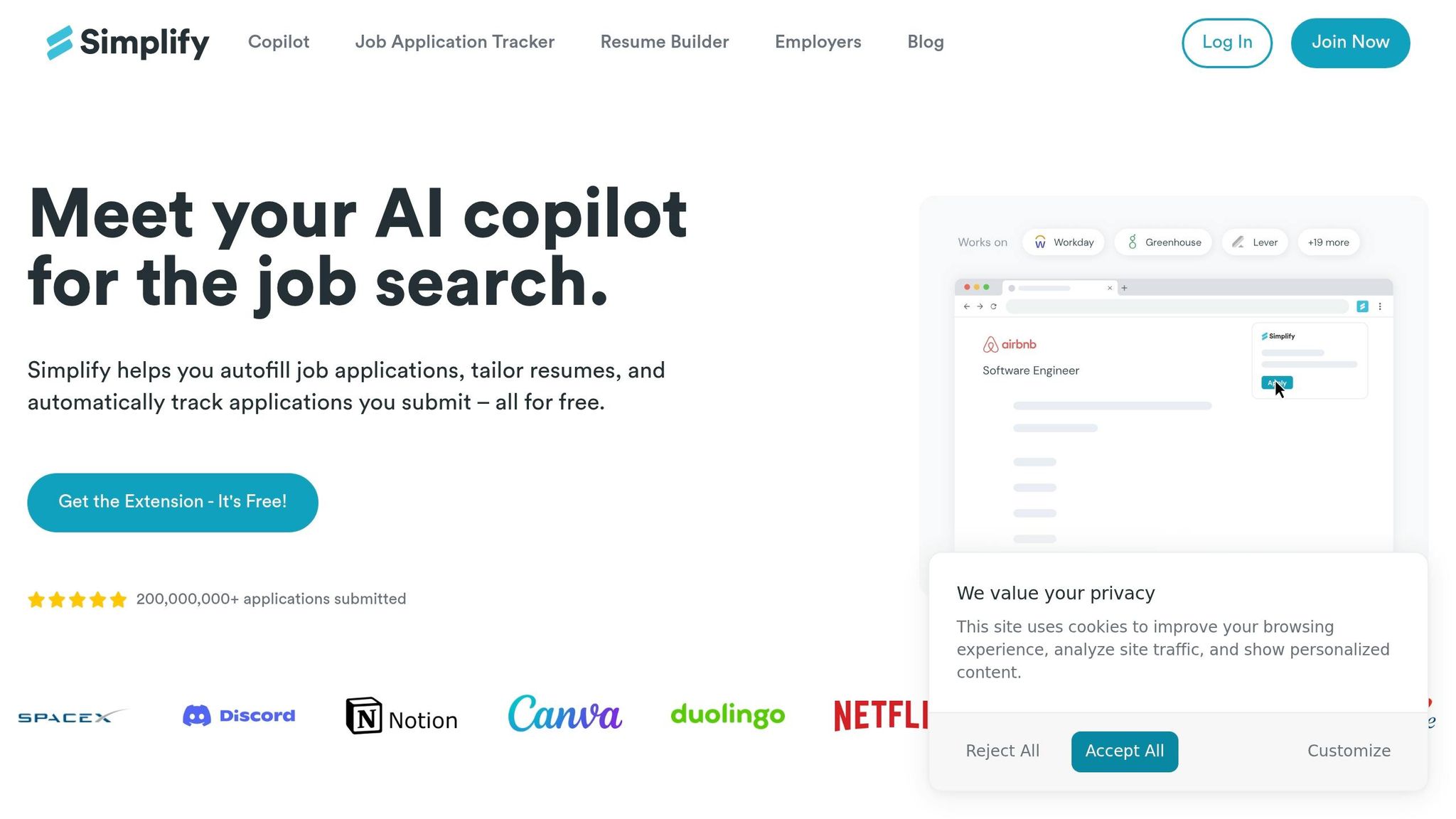
Simplify.jobs operates entirely through AI, without any human involvement. It functions as a Chrome extension - called Simplify Copilot - that you manually activate for each job posting. While the AI assists with filling out application forms, the responsibility of finding job opportunities and initiating the process still falls on you. In contrast, scale.jobs offers a fully managed service with human oversight, handling every aspect of the job application process.
Resume Customization Depth
Simplify.jobs uses your saved profile to autofill applications, adding basic keywords that match job descriptions. However, it struggles with more advanced tasks like crafting compelling narratives or quantifying achievements - skills that resonate strongly with hiring managers. Its templates often fail to address long-form or behavioral questions effectively, which can be a disadvantage for competitive roles. To understand how human-assisted vs. automated job applications compare in resume customization, refer to the scale.jobs section.
Application Execution Method
With Simplify.jobs, you must manually search for jobs on platforms like LinkedIn or Indeed, then activate the extension to autofill applications. While this speeds up form completion, the burden of job discovery remains on you. On the other hand, scale.jobs takes a completely different approach: virtual assistants handle job discovery, customization, and submission for you, saving significant time and effort.
ATS Handling
When it comes to navigating Applicant Tracking Systems (ATS), Simplify.jobs relies on scripts that often trigger bot-detection mechanisms on platforms like Workday and Greenhouse, leading to potential rejections. While user testimonials claim an ATS pass rate of 80–90%, independent tests suggest inconsistent results, especially with more complex systems. In contrast, scale.jobs avoids these issues entirely by having human assistants submit applications as real users, bypassing the red flags that automated tools can raise.
Transparency and Proof of Work
Simplify.jobs provides a dashboard that tracks submission counts and response rates, but it lacks detailed proof of submission, such as email confirmations or screenshots. This makes it harder to verify whether applications were successfully submitted or troubleshoot any issues. scale.jobs, however, emphasizes transparency by providing timestamped screenshots via WhatsApp for every application, ensuring you have clear evidence of work completed.
Pricing Model
Simplify.jobs uses a subscription-based pricing model, charging $39/month for 100 applications or $69/month for unlimited submissions. An annual plan costs $299, offering a discount compared to monthly billing. While the pricing appears affordable, user-reported interview conversion rates of 1.3–2.7% suggest that the focus is more on application volume than quality. By contrast, scale.jobs employs a one-time payment structure centered on delivering results, eliminating the need for ongoing subscription fees and the pressure to justify recurring costs.
Why scale.jobs Wins Over Simplify.jobs
- End-to-End Management: scale.jobs handles job discovery, customization, and submission entirely, while Simplify.jobs requires manual effort to find and activate applications.
- Enhanced Personalization: Human assistants at scale.jobs craft tailored resumes and responses, unlike Simplify.jobs' reliance on generic AI templates.
- ATS-Friendly Submissions: scale.jobs avoids bot-detection issues by using human navigators, whereas Simplify.jobs' scripts are often flagged by systems like Workday and Greenhouse.
- Verified Proof of Work: scale.jobs provides timestamped screenshots for every application, ensuring transparency, while Simplify.jobs offers only a basic dashboard.
- Cost-Effective Results: scale.jobs charges a one-time fee with a focus on interview callbacks, compared to Simplify.jobs' subscription model that prioritizes volume.
Who Should Use Simplify.jobs
Simplify.jobs is a good fit for job seekers who prefer to stay in control of their application process while reducing the time spent on repetitive data entry. It's especially useful for those applying to straightforward roles on major job boards like LinkedIn and Indeed, where ATS systems are less complex. If you’re comfortable managing job searches yourself and need a quick, low-cost tool to streamline form-filling, Simplify.jobs can be a practical choice. It’s also a suitable option for high-volume applications where deep customization isn’t a priority.
Who Should Choose scale.jobs
scale.jobs caters to professionals who want a fully managed service designed to maximize interview opportunities rather than application numbers. It’s ideal for individuals targeting competitive roles in industries like tech, finance, or marketing, where tailored resumes and ATS optimization can make a significant difference. Career changers, senior-level professionals, and those with limited time to dedicate to job applications will benefit from the personalized support and higher callback rates offered by scale.jobs. If you prioritize measurable outcomes, dedicated assistance, and a transparent process, scale.jobs provides a more effective and efficient solution with its one-time payment model.
4. Sonara.ai
Human Involvement
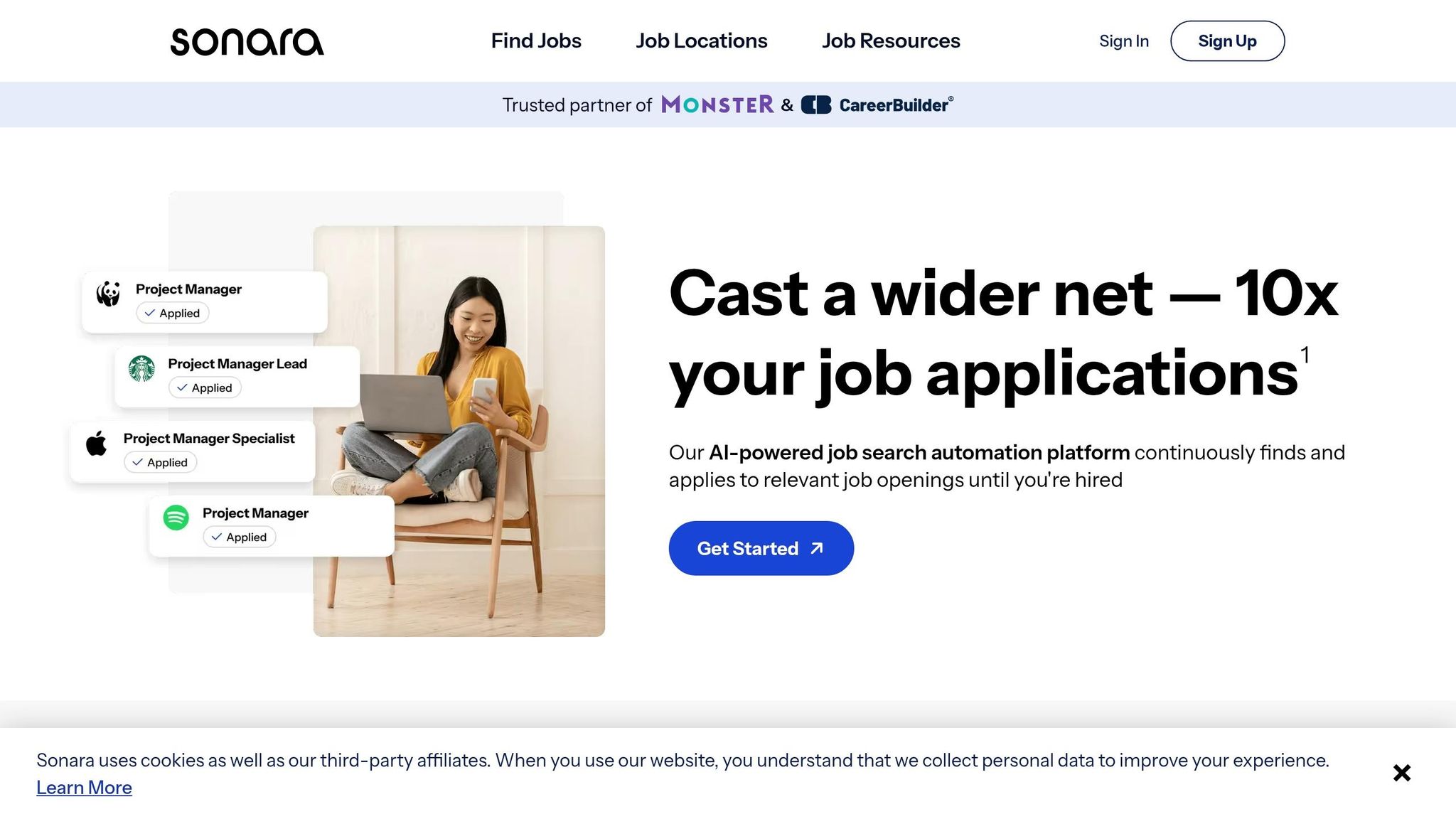
Sonara.ai relies entirely on AI without any human supervision. It scans over 1 million job postings daily from platforms like LinkedIn, Indeed, and company career sites. The system then applies automatically based on keyword matching. However, there’s no human intervention to review your resume, refine your strategy, or provide insights into why certain applications may not be yielding results.
Resume Customization Depth
The platform uses AI to align your uploaded resume with job descriptions by adding relevant keywords for better compatibility. While this approach helps with basic keyword matching, it lacks the ability to tailor resumes in a way that highlights specific achievements or tells a compelling story. For example, it won’t take a generic bullet point like "managed projects" and turn it into something impactful, such as "led a cross-functional team of 8 to deliver a $2.3M product launch three weeks ahead of schedule."
Application Execution Method
Sonara.ai automates the application process entirely, submitting between 50 and 100 applications daily based on an AI scoring system. Once you upload your resume and set your preferences, the platform handles everything. While this high-volume strategy creates activity, its success rates are lower compared to scale.jobs, which emphasizes targeted applications. With scale.jobs, human assistants focus on quality over quantity, achieving interview conversion rates of 15–25% through personalized submissions.
ATS Handling
Sonara.ai claims to optimize resumes for Applicant Tracking Systems (ATS) by using keyword parsing and formatting to pass initial scans. However, it cannot handle company-specific ATS quirks or non-standard application requirements. In contrast, scale.jobs employs human assistants who navigate ATS platforms manually, avoiding bot-detection issues and ensuring applications meet unique requirements. This hands-on approach often results in higher success rates compared to fully automated tools.
Transparency and Proof of Work
Sonara.ai provides a dashboard with submission screenshots but lacks detailed insights into its job selection process. This makes it challenging for users to refine their job search strategy over time. On the other hand, scale.jobs offers greater transparency by providing timestamped screenshots via WhatsApp for every application, along with notes explaining any challenges or strategic decisions made during the process.
Pricing Model
Sonara.ai uses a subscription-based pricing model, starting at $19.99 per week for 50 applications, $49.99 per month for unlimited submissions, or $399 per year for unlimited applications with priority support. While the monthly cost may seem reasonable for high-volume applications, the lack of a refund policy and the recurring fees can add up, especially if interview conversion rates remain low. scale.jobs operates on a one-time payment model, focusing on delivering results through interview callbacks rather than maximizing application volume. This eliminates recurring costs and reduces the pressure to justify ongoing expenses.
Why scale.jobs Wins Over Sonara.ai
- Targeted Applications: Human assistants at scale.jobs focus on quality applications, achieving 15–25% interview conversion rates compared to Sonara.ai's automated mass submissions.
- Personalized Resumes: With scale.jobs, resumes are customized to highlight specific achievements and tell a story, unlike Sonara.ai's basic keyword adjustments.
- Manual ATS Navigation: Human oversight ensures compatibility with unique ATS requirements, avoiding the limitations of automated tools.
- Detailed Proof of Work: scale.jobs provides clear communication and proof of work via WhatsApp, while Sonara.ai offers only a basic dashboard.
- One-Time Payment: The pricing model at scale.jobs eliminates recurring fees, focusing solely on results.
- Human Expertise: By combining human assistants, tailored documents, and real-time support, scale.jobs consistently outperforms automated platforms.
Who Should Use Sonara.ai
Sonara.ai is best for job seekers who prefer a hands-off approach and are comfortable with high-volume, lower-quality applications. It’s suitable for early-career professionals applying for entry-level or high-turnover roles where customization is less critical. If you’re okay with lower interview conversion rates and prefer paying a subscription fee for automated activity, Sonara.ai can meet these needs.
Who Should Choose scale.jobs
scale.jobs is ideal for those who value quality over quantity and want a strategic, human-driven approach to job applications. It’s particularly effective for mid-to-senior level professionals, career changers, or anyone targeting competitive roles in industries like tech, finance, or marketing. If you’re frustrated by low response rates from automated tools and need verifiable proof of work with personalized support, scale.jobs offers a more results-driven solution with its one-time payment model and human-led strategy.
Employers push back as job seekers rely heavily on AI-generated applications
Strengths and Weaknesses
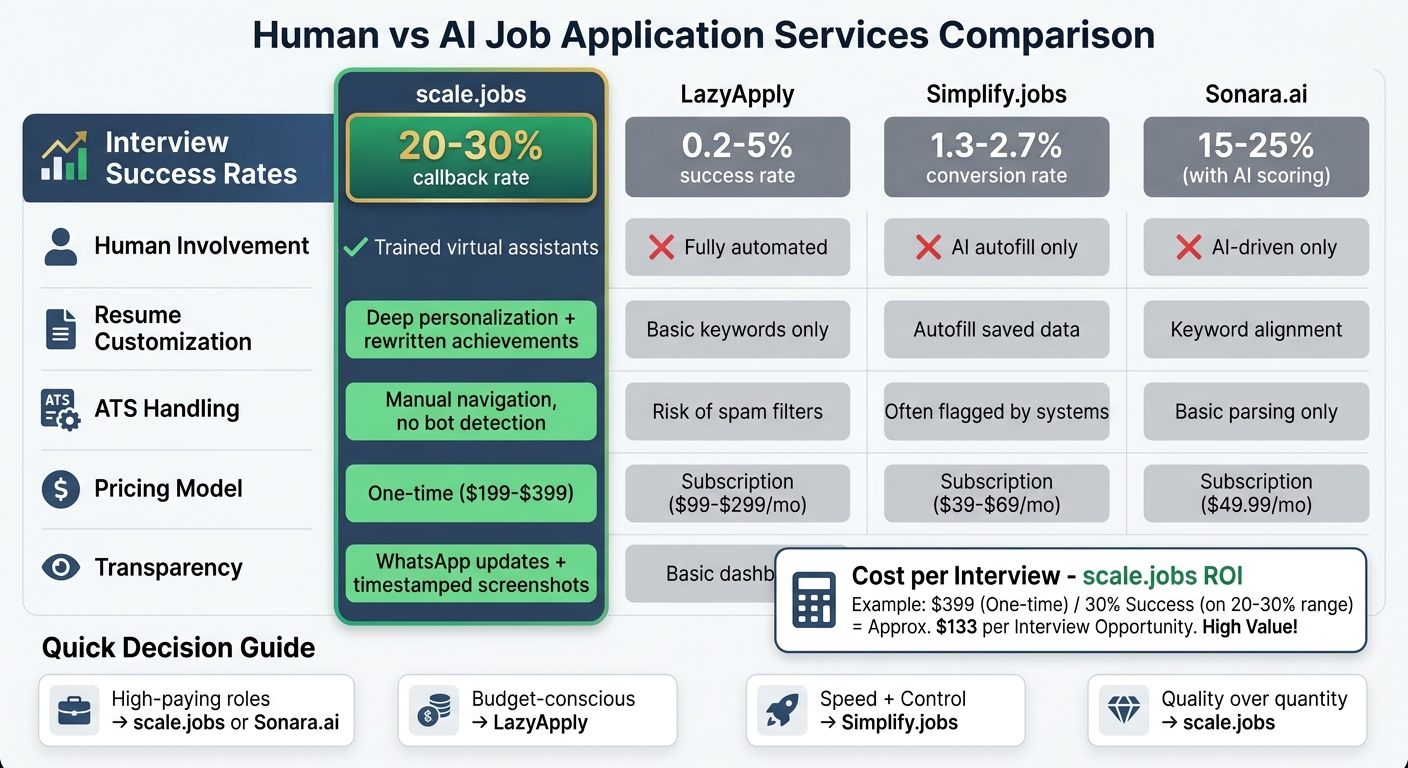
Human vs AI Job Application Services: Success Rates and Features Comparison
When it comes to job application services, the debate between human involvement and AI automation often boils down to quality versus quantity. Each platform strikes its own balance, trading off customization for volume. Understanding these differences is key to choosing the approach that aligns with your priorities. Here's a detailed comparison of how scale.jobs stacks up against LazyApply, Simplify.jobs, and Sonara.ai.
| Criterion | scale.jobs | LazyApply | Simplify.jobs | Sonara.ai |
|---|---|---|---|---|
| Human Involvement | Trained virtual assistants manage each application with strategic oversight. | Fully automated, no human review. | Uses a browser extension with AI autofill, no human oversight. | Entirely AI-driven with no human supervision. |
| Resume Customization Depth | Offers deep personalization, including rewriting achievements and tailoring career narratives for each role. | Limited to basic keyword insertion and template matching. | Autofills saved data with minimal customization. | Aligns keywords using AI but lacks tailored reframing. |
| ATS Handling | Experts manually navigate ATS quirks, ensuring smooth submissions and avoiding bot detection. | Automated scripts risk triggering anti-bot measures, increasing rejection chances. | Browser automation sometimes flagged as bot activity. | Basic keyword parsing struggles with non-standard formats. |
| Application Execution Method | Focuses on 30 targeted, high-quality applications per day. | Enables bulk submissions but with lower conversion quality. | Speeds up manual applications using autofill while keeping user control. | Relies on AI scoring for bulk submissions with minimal targeting. |
| Transparency and Proof of Work | Provides real-time WhatsApp updates with timestamped screenshots and strategic notes for every application. | Offers a dashboard showing submission counts but limited strategy insights. | Displays application progress live, though details can vary. | Basic dashboard with screenshots but lacks strategic depth. |
| Pricing Model | One-time flat fee (e.g., $199 for 250 applications, $299 for 500, $399 for 1,000). | Subscription-based pricing. | Freemium model with premium plan upgrades. | Subscription-based pricing with different payment cycles. |
Why scale.jobs Stands Out
When comparing scale.jobs to platforms like LazyApply, Simplify.jobs, and Sonara.ai, the difference in approach becomes clear. Automated tools prioritize high-volume submissions, but they often lack the nuance and strategic focus needed to stand out in competitive job markets. By contrast, scale.jobs places a premium on quality, offering human-led, ATS-optimized applications that significantly boost interview conversion rates.
Additionally, cost analysis reveals that human-assisted services like scale.jobs often reduce the cost per interview compared to automated tools. This makes them an excellent choice for job seekers looking to maximize their return on investment. If you've been frustrated by automated tools that generate activity without results, combining professional resume writing services (explore more at scale.jobs/resume-writing-services) with human-led strategies can deliver far better outcomes.
When to Consider scale.jobs
Switching to scale.jobs could be the right move if:
- You need resumes that are carefully tailored to showcase your achievements and align with specific company values.
- You want applications to navigate complex ATS systems like Workday and Greenhouse without errors.
- You prefer a one-time payment structure instead of recurring subscription fees.
- Real-time support via WhatsApp and dedicated human assistance is important to you.
- You value transparency, including timestamped screenshots and detailed proof of work for every application.
For job seekers focused on quality and strategic execution, scale.jobs consistently delivers better results compared to automated platforms. It’s a smart choice for those who value precision and personal attention in their job search.
Which Service Fits Your Job Search
When deciding on the right service for your job search, it’s essential to align your choice with your specific needs and career goals. Here's a breakdown of the options to help you choose:
scale.jobs
Go with scale.jobs if you’re looking for a highly tailored approach to your job applications. This service is particularly helpful for individuals navigating visa complexities (such as H1B, O1, or TN visas) or those making significant career shifts where every application requires meticulous attention. With trained human assistants, scale.jobs ensures your applications are optimized for Applicant Tracking Systems (ATS).
The pricing is straightforward: $199 for 250 applications, $299 for 500, and $399 for 1,000. This structure works best if you’re applying to 30–50 carefully chosen positions per week. Plus, the inclusion of real-time WhatsApp updates with timestamped proof of work provides transparency. For better results, pair this service with professional resume rewriting.
LazyApply
Choose LazyApply if you’re working with a limited budget and want to focus on high-volume applications. With pricing under $50 per month, LazyApply is ideal for recent graduates or those targeting entry-level roles. It’s designed for users who aim to submit 500+ applications quickly across platforms like Indeed, LinkedIn, and Glassdoor.
This service is all about quantity over quality, making it a great option for those testing the waters in multiple markets. On average, you can expect about three interviews for every 1,000 applications. LazyApply also offers a free tier, allowing you to experiment without committing financially - a smart choice if you’re in a city where networking complements your broad application efforts.
Simplify.jobs
If you’re seeking a balance of efficiency and control, Simplify.jobs might be the right fit. This service is tailored for mid-career professionals who are managing around 50 targeted applications each week. Its Chrome extension simplifies repetitive form-filling tasks, while still giving you the freedom to make personal adjustments to each application.
The Pro plan, priced at $9.99 per month, is a practical option for competitive job markets like New York. However, Simplify.jobs lacks human oversight and provides limited proof of work, offering only basic dashboards for tracking your progress.
Sonara.ai
For passive job seekers or those targeting niche, high-level roles, Sonara.ai is a strong contender. It’s particularly effective for professionals like senior data scientists or executives who need precise job matches. At $49 per month, the service uses AI to scan for relevant positions and tailor your resume accordingly.
Sonara.ai claims an impressive 35% interview rate for matched jobs, making it a solid choice for those pursuing high-paying opportunities. However, if you’re looking for a more personalized approach with higher interview conversion rates, scale.jobs might still be the better option.
Decision Summary
Here’s a quick guide to help you decide:
- Investing in high-paying roles? Consider Sonara.ai or scale.jobs for a better return on investment.
- Need full automation? LazyApply is the best choice.
- Want to review AI suggestions before submission? Opt for Sonara.ai.
- Looking for a mix of speed and control? Simplify.jobs offers a balanced approach.
FAQs
How can I confirm my applications were submitted?
Reputable platforms like Scale.jobs prioritize transparency by offering real-time proof of submission. They provide features such as time-stamped screenshots and regular updates through WhatsApp, ensuring you're informed throughout the process. This approach helps build trust and reassures you that your job applications have been successfully submitted.
Do human-applied submissions reduce ATS or bot-detection issues?
Yes, applications submitted with human involvement can greatly minimize issues with ATS (Applicant Tracking Systems) or bot detection compared to automated tools. Unlike AI-driven platforms that often generate generic resumes, services like Scale.jobs focus on crafting personalized, ATS-optimized applications. By refining formatting, strategically incorporating keywords, and ensuring the content aligns with the job description, these tailored applications are more likely to pass ATS filters and avoid being flagged during automated screenings. This approach can significantly boost the chances of receiving callbacks.
How many tailored applications should I send per week to get interviews?
Sending around 30 personalized job applications each week is a smart strategy to improve your chances of securing interviews. With Scale.jobs, this process is taken to the next level - 30 applications are submitted on your behalf every single day. These applications are carefully crafted to prioritize quality and ensure they are optimized for Applicant Tracking Systems (ATS), giving you the best shot at success.