
7 Ways of Networking For Job Search in Slack Communities (Scripts included)

Sarah Mitchell
May 6, 2026

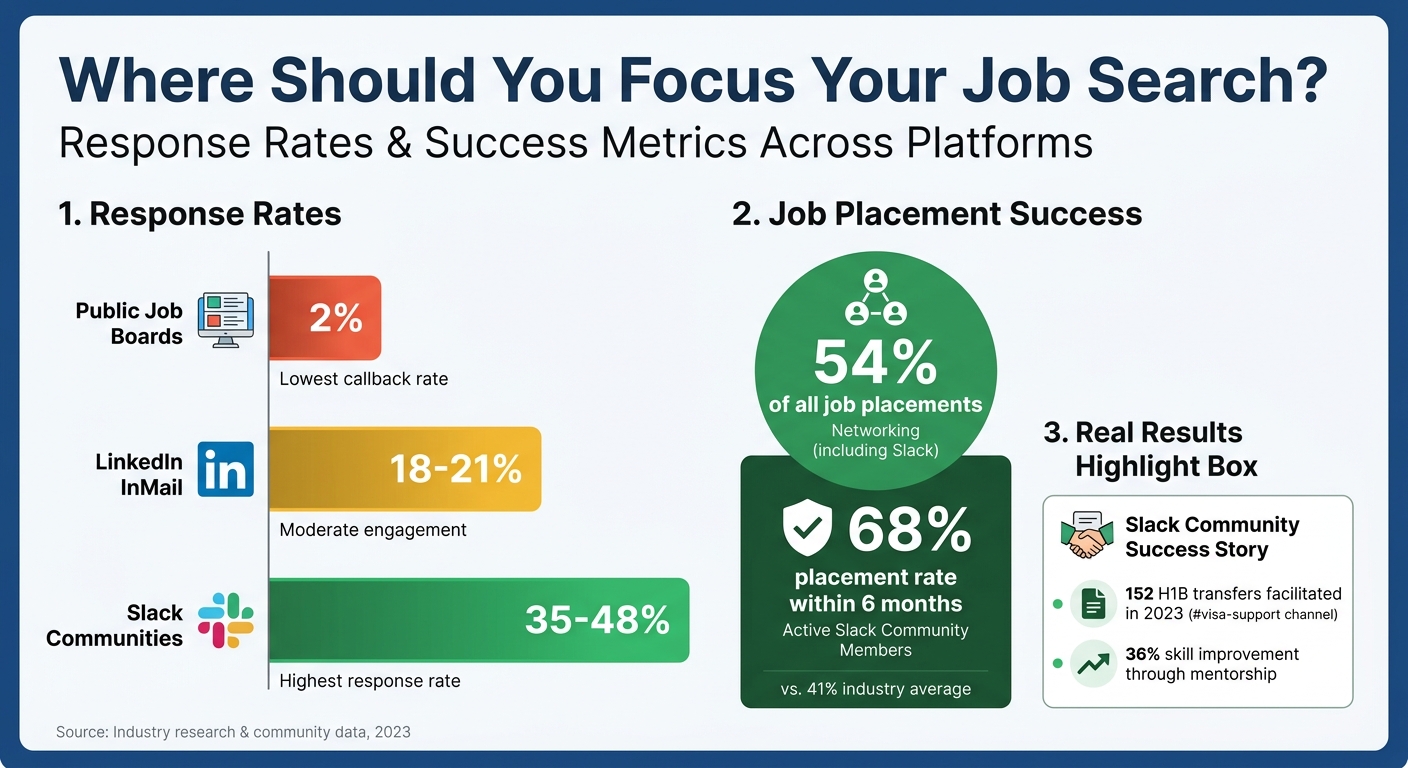
Networking in Slack communities can dramatically improve your job search success. While public job boards have a low 2% callback rate and LinkedIn InMail averages 18–21%, Slack communities boast a much higher 35–48% response rate. These communities connect you directly with hiring managers and professionals in your field, offering a unique way to showcase your expertise and build relationships.
This guide breaks down seven actionable strategies to help you leverage Slack for your job search. From finding the right communities to posting impactful introductions, engaging in topic-specific channels, and sending personalized direct messages, these steps can help you stand out. Whether you're looking for remote work, navigating visa challenges, or tired of automated rejection emails, these tips and scripts can give you an edge.
Here’s what you’ll learn:
- How to find Slack communities tailored to your industry.
- Crafting effective introductions in #intros channels.
- Best practices for engaging in #jobs and skill-based discussions.
- Tapping into private channels for hidden opportunities. This is a key part of accessing the hidden job market.
- Sending direct messages to build meaningful connections.
Slack networking isn’t just about finding jobs - it’s about creating a "living résumé" through your contributions. Combine these strategies with tools like scale.jobs to streamline your applications and maximize your efforts. Let’s dive in.
Job Search Response Rates: Slack vs LinkedIn vs Job Boards
How To Find A Job On Slack - Talent Insights [Ep 35]
sbb-itb-564272e
1. Find Slack Communities That Match Your Industry and Role
Joining the right Slack communities can be a game-changer for your job search. For instance, the #visa-support channel in one such community helped facilitate 152 H1B transfers in 2023, showing how impactful these specialized groups can be.
To find the right fit, start with curated directories like Slofile, which lists Slack groups tailored to various industries. If you're in engineering management, check out Rands Leadership Slack, while DevRel Collective is ideal for developer relations professionals. Marketing experts might gravitate toward Online Geniuses (with over 35,000 members) or RevGenius, which offers more than 30 channels focused on sales and revenue strategies. For HR professionals, HR Powerhouse (10,000+ members) and Hacking HR are excellent choices, particularly for discussions on people analytics and the future of work.
You can also use targeted Google searches like "[your role] Slack community invite" or look at LinkedIn profiles of industry leaders - they often mention the Slack groups they manage. For remote workers, Nomadlist stands out with 33,000+ members, while Game Industry Job Hunt provides valuable leads for those in gaming. To avoid being overwhelmed by notifications, limit yourself to 3–5 groups where you can actively participate and engage with other members.
When selecting communities, remember that smaller, focused groups (around 500 members) often provide better opportunities for meaningful interactions and access to the hidden job market compared to larger, more general groups. Recruiters are increasingly turning to these niche Slack spaces to find talent, as response rates in these communities range from 35–48%, significantly higher than LinkedIn InMail’s 18–21%. To make the most of these opportunities, ensure your resume is polished and aligned with industry standards. If needed, consider professional resume writing services to help you stand out.
Before you dive in, set up a professional Slack profile. Include a clear headshot, a concise bio, and links to your LinkedIn or portfolio. Once you join a group, check out the #jobs or #hiring channels to assess how active and relevant the postings are. This will help you determine whether the community is worth your time or just a passive member list.
Being strategic about your Slack presence can open doors to new opportunities. Up next, discover how to make a lasting impression in the #intros channel.
2. Post Your Introduction in #intros Channels
Your introduction post is your first chance to make an impression in a Slack community. Hiring managers often review message histories to find potential candidates, so including specific keywords related to your expertise - like UX design, Python, or Product Marketing - can help your post appear in relevant searches. To make the most of this opportunity, take the time to familiarize yourself with the community's norms and tailor your introduction accordingly.
Take a week or two to observe before posting. Browse previous introductions in the #intros channel to get a feel for the tone and format. Some communities even pin templates or share specific posting guidelines - following these ensures your post doesn’t get flagged as spam. Also, make sure your Slack profile is polished and aligns with the message you're about to share.
When crafting your introduction, be straightforward. Mention your current role or the type of position you’re pursuing, highlight your key skills and tools (e.g., React, Kubernetes, Figma), and note your location and work preferences (remote, hybrid, or onsite). Clarity is key here - avoid vague statements like "exploring opportunities." Instead, try something like, "I'm a senior product manager seeking remote SaaS roles with a salary range of $120k–$140k." If your resume could use some fine-tuning before you dive into networking, consider using the best resume writing service to ensure your materials match the professionalism of your introduction.
End your post with a clear call to action. Invite members to connect for informational chats or specific discussions. Engagement is vital - 68% of active Slack community members find roles within six months, compared to the broader industry’s 41%. This is a key way to unlock the hidden job market for tech roles. To stand out as more than just a job seeker, participate in discussions or help answer questions in other channels right after posting your intro.
"By searching a user's message history in the community, a hiring manager can get a sense for how a prospective hire thinks without a resume and cover letter." - Rob Litterst, The Hustle
3. Respond to Posts in #jobs Channels
Once your introduction is polished, it's time to make the most of #jobs channels in Slack communities. These channels provide a direct line to hiring managers and key decision-makers, skipping over traditional recruiters entirely. However, most communities have specific rules for posting and interacting - ignoring these can harm your reputation or even get you banned.
Before you respond to any job post, take a moment to review your Slack profile. This is often the first thing hiring managers will check, even before reading your message. Make sure your headshot, bio, and links (like your LinkedIn or portfolio content) are up-to-date and professional. Think of your profile as a mini-resume - every detail counts. Start by engaging publicly in the job post thread. Ask a thoughtful question about the role or share an insight related to the post. This not only highlights your expertise but also makes you visible to others in the community, including the original poster.
When you're ready to send a direct message, make it personal. Reference specific details from the job post, such as the tools or technologies mentioned, or connect it to a relevant project you've worked on. Avoid generic messages - they’re usually ignored. For instance, you could say: "I noticed your post about the senior DevOps role that requires Kubernetes experience. At [Company], I’ve been managing Kubernetes clusters for the past two years and recently led a migration to a multi-cloud infrastructure. Would you mind if I shared more details about my background?" This approach shows you're prepared and genuinely interested.
If you’re new to the community, follow the "2-week rule." Spend some time actively engaging in discussions across other channels before responding to job posts. Hiring managers often review your activity history to get a sense of your communication skills and expertise. Your contributions in the community can serve as proof that you're an engaged member, not just someone looking for a quick job lead.
Be upfront about your expectations. Communities tend to respond better when you clearly outline your preferences - mention your desired salary range (e.g., "$130,000–$150,000"), location preferences such as remote or hybrid setups, and specific skills like React, AWS, or TypeScript. Avoid vague phrases like "open to opportunities" or "competitive salary expected", as they often fail to make an impression in these settings.
4. Request Career Advice in Topic-Specific Channels
Once you've built a solid reputation through introductions and job-related contributions, it's time to take the next step: seeking focused career advice in specialized channels. Channels like #mentorship, #salary-negotiation, or #newbie-help can be goldmines for career insights - if you approach them thoughtfully. The key is to leverage the credibility you've already established by contributing to the community. Jumping in with requests before giving back is a surefire way to be overlooked. Instead, take time to engage, whether by answering questions, sharing resources, or offering feedback.
Before posting your question, do a quick search to see if someone has already asked something similar. This shows you're respectful of members' time and have done your due diligence. When you're ready to ask, be specific. A vague question like "How do I get into product management?" likely won’t get much traction. Instead, try something like, "I'm transitioning from engineering to product management and struggling to highlight my technical skills on my resume. Has anyone made a similar shift and can share tips that worked for them?" This kind of detail makes it easier for others to provide meaningful advice.
Spend at least two weeks actively engaging in the community before asking for help. Participate in discussions in channels like #debug-help or #strategy-shares, share articles, or thoughtfully comment on others' posts. This not only builds your reputation but also increases the likelihood that members will be willing to assist you later. For example, in 2023, the #visa-support channel within the Women in Tech Slack network facilitated 152 H1B transfers. Those who received help had typically been active contributors for weeks, showing the power of consistent engagement.
When requesting feedback, especially for something like a portfolio, tailor your ask to the person and their expertise. For instance: "Hi Sarah! I saw you work with Kubernetes at Stripe. I've been using it in my portfolio project and would love your feedback on whether my implementation aligns with what engineers at your level expect. Here's the repo: [link]. Any advice would be greatly appreciated!" This approach, with its clear context and specific question, is far more likely to get a response than a generic, open-ended request.
If you find yourself needing more structured support, consider using a professional resume service to create an ATS-optimized document tailored to your career goals. For Slack-based advice, keep your requests manageable, like asking for a quick 15-minute Zoom call. The lower the effort required, the more likely someone will agree to help. And don’t forget to express gratitude - follow up with a public acknowledgment or a quick DM to thank them. Keeping track of those who assist you can lead to meaningful, long-term professional connections.
5. Share Your Knowledge in Skill-Based Discussions
After establishing your presence in career-focused channels, take it a step further by actively participating in skill-based discussions. Engaging in these conversations not only highlights your expertise but also makes you more visible to hiring managers. When you contribute to technical channels like #debug-help, #seo, or #case-thursdays, you create a lasting, searchable record of your problem-solving abilities and thought process.
"By searching a user's message history in the community, a hiring manager can get a sense for how a prospective hire thinks without a resume and cover letter." – Rob Litterst, The Hustle
This kind of social proof holds more weight than a standard resume bullet point. It’s a real-time demonstration of your skills and how you approach challenges, which can directly connect your online presence to job opportunities.
Focus on channels that align with your expertise. For example, Online Geniuses, a community of 35,000 digital marketers, has an active #seo channel where members discuss technical SEO issues and algorithm updates. Similarly, in the Business Strategy Group, the #case-thursdays channel allows its 8,000 members to tackle real-world business problems. By answering questions in these spaces, you’re positioning yourself in front of potential employers or collaborators. For instance, a six-person development agency successfully filled three senior engineering roles within eight weeks by staying active in groups like Rands Leadership Slack, DevRel Collective, Elixir Forum Slack, and Coding Coach. They achieved a 42% response rate simply by engaging in meaningful discussions instead of relying on cold outreach.
When contributing, go beyond surface-level statements. Be specific and reference tools or methods to showcase your expertise. For example, instead of saying, "I know React", try something like: "I noticed some questions about state management earlier. I recently tackled a similar issue using Zustand to reduce re-renders. Here’s a link to the approach I used - it might help anyone facing this challenge." These kinds of detailed responses demonstrate your skills far better than a generic LinkedIn endorsement.
To complement your activity in these discussions, consider using ATS-optimized resume tips to ensure your application materials align with your online presence. Also, optimize your Slack profile with a professional headshot, a concise bio, and links to your LinkedIn or portfolio. This makes it easy for recruiters or hiring managers to verify your credentials. Interestingly, members of tech-focused Slack groups report a 36% improvement in their skills through mentorship and discussions, with engaged users landing roles at a 68% success rate within six months - significantly higher than the 41% industry average.
Once you’ve showcased your skills in public discussions, the next step is to learn how to leverage private channels and direct messages to build deeper connections.
6. Join or Start Private Channels Focused on Hiring
Public Slack channels can give you broad exposure, but private, invite-only channels often hold the most promising job opportunities. These exclusive spaces, sometimes called "whisper networks", have gained popularity as a response to recruiter overload on platforms like LinkedIn, where senior professionals might receive 3–7 recruiter messages each week. Within these private groups, members share roles that aren't publicly advertised, along with direct referrals that can fast-track your job search.
Once you've established yourself in public channels, these private groups can help you build deeper connections and access hidden opportunities. To get started, check LinkedIn profiles of community leaders for links or guidelines to join. Public directories like Slofile can also point you toward larger Slack communities; from there, ask moderators about smaller, hiring-focused sub-channels. Keep an eye on virtual events like conferences or webinars, as they often lead to private post-event channels where job leads are shared. If you can't find a suitable group, consider creating your own Slack workspace tailored to your industry or role - whether that's UX design, product marketing, or another niche. Slack's free version allows unlimited channels, making it easy to build a space for peers to share opportunities.
Once you're in, focus on earning trust by engaging thoughtfully. A good rule of thumb is the "2-Week Rule": spend at least two weeks actively contributing in public channels before asking for access to private ones. Share helpful resources, answer questions, and establish yourself as a valuable member of the community. When posting job leads, be transparent - include salary ranges, work setup (remote, hybrid, or onsite), and key tools or technologies. This level of detail encourages meaningful conversations and sets you apart from generic corporate job postings.
Pay attention to your response rates. Recruiting through Slack communities can yield 35–48% response rates, far higher than LinkedIn InMail's 18–21%. Networking is a powerhouse for job seekers, accounting for 54% of all job placements, compared to the slim 2% callback rate from public job board applications. To illustrate, a cybersecurity marketing professional managed to schedule around 20 interviews in just one week after joining a private Slack community for their field and engaging with its leaders. These numbers underscore why private channels are a game-changer for job seekers who want to stand out.
Once you've joined these groups, the next step is refining your direct messaging skills to turn casual conversations into informational interviews.
7. Send Direct Messages to Active Members for Informational Interviews
Once you've established yourself within a community, direct messages can turn casual interactions into meaningful informational interviews. The secret lies in being selective - don’t send mass, impersonal messages. Instead, focus on members who’ve contributed thoughtfully to discussions, shared expertise, or asked insightful questions that highlight their industry knowledge. Use these interactions as a starting point to craft personalized messages. Take it a step further by checking their LinkedIn profiles to confirm their current role and level of experience. This intentional approach ensures your outreach feels genuine and impactful.
Before reaching out, remember the 2-Week Rule: actively participate in public channels to build credibility and trust. This helps you avoid coming across as someone who joined the community solely to ask for favors. When you're ready to send a direct message, make it personal and specific. Reference a particular thread or discussion where the person shared valuable insights. For example:
"Hi Sarah, I came across your post in #product-strategy about feature prioritization for B2B SaaS. Your framework on customer segmentation really resonated with me. I’m transitioning from marketing to product management and would love to hear about your experience making a similar move. Would you be open to a quick 15-minute chat next week?"
Messages like this show you’ve taken the time to understand their expertise and aren’t just sending a generic request.
The numbers back up this approach: Slack communities see 35–48% response rates for direct messages, compared to LinkedIn InMail’s 18–21%. Additionally, active members in these communities have a 68% job placement rate within six months, far exceeding the 41% industry average. If you’re unsure how to position yourself effectively in these conversations, consider professional support like resume writing assistance to sharpen your narrative and value proposition.
Focus on members who’ve been active within the last 30 days to improve your chances of receiving a response. Prioritize those who’ve demonstrated expertise in their public posts over those who share surface-level content. When you do reach out, keep your message concise - three to four sentences at most - and propose a specific time for a brief call. Respecting their time increases the likelihood they’ll agree to connect.
Comparison Table: Slack Networking vs. scale.jobs
Here's a closer look at how Slack networking and scale.jobs cater to different aspects of the job search process.
Slack networking thrives on building organic connections within professional communities, helping you bypass traditional recruiting filters. On the other hand, scale.jobs is all about streamlining high-volume applications, with human assistants managing the time-consuming tasks of submitting resumes and optimizing for applicant tracking systems (ATS).
The key difference lies in time commitment. Slack networking demands 10–15 hours weekly, where active participation - answering questions, sharing knowledge, and building credibility - eventually leads to valuable referrals. However, juggling this while applying to dozens of jobs weekly can be overwhelming.
This is where the two methods complement each other. Slack helps you secure direct referrals that bypass ATS hurdles, while scale.jobs ensures efficient application management by submitting custom resumes and cover letters to hundreds of openings. Together, they allow you to focus on meaningful networking while handling the volume game seamlessly. If you're starting out and need to refine your personal pitch for these networking efforts, consider using a professional resume writing service to sharpen your narrative.
Here's a side-by-side comparison to break it down further:
| Feature | Slack Networking | scale.jobs |
|---|---|---|
| Primary Method | Organic peer-to-peer connections | Human assistants submit applications at scale |
| Human Involvement | High; direct DMs and public threads | High; trained VAs submit each application manually |
| ATS Strategy | Bypasses ATS via direct referrals | ATS-optimized resumes with manual submission, avoiding bot flags |
| Proof-of-Work | Searchable message history shows expertise | Time-stamped screenshots + application dashboard |
| Placement Rate | Strong results for engaged members | Focused on application efficiency + interview volume |
| Response Rate | Strong DM response in niche communities | Depends on application quality + ATS compatibility |
| Time Investment | 10–15 hours/week (active participation) | 20+ hours/week reclaimed (VAs handle submissions) |
| Cost | $0 (free communities) | $199–$1,099 one-time (250–1,000 applications) |
| Transparency | Public channel contributions | WhatsApp updates + proof-of-work screenshots |
Switch to scale.jobs if…
- You need to increase application volume beyond what personal networking allows.
- You value human-assisted vs. AI job application services over DIY efforts.
- You want clear, time-stamped proof of work for every application.
- You're looking to save 20+ hours a week while maintaining application quality.
- You aim to balance networking with high-volume job board submissions.
Decision Summary
Opt for Slack networking when your focus is on building genuine industry relationships, accessing hidden job opportunities, and showcasing your expertise through active participation in professional communities.
Choose scale.jobs when you want to handle large-scale applications with precision, leveraging ATS optimization and human quality control, all while freeing up time for other priorities.
The most effective job seekers combine both strategies. Spend your mornings networking on Slack to build connections and secure referrals, while scale.jobs manages your high-volume, ATS-friendly applications in the background. This dual approach ensures you're maximizing opportunities on both fronts.
Conclusion
This guide has outlined seven practical networking strategies, emphasizing how combining active Slack participation with tools like scale.jobs can elevate your job search. These approaches - ranging from engaging in industry-specific Slack communities to sending personalized direct messages - are effective because they cut through the low callback rates of public job boards, connecting you directly with decision-makers. For instance, spending time contributing to a #react-developers channel or sharing insights in a #compensation-transparency group allows hiring managers to see your expertise and collaborative mindset before they even glance at your resume.
That said, maintaining an active presence in multiple Slack groups while managing numerous job applications can quickly become overwhelming. Balancing these efforts is where integrating Slack networking with efficient application management tools comes into play. By pairing your community engagement with services like professional resume services or scale.jobs, you can maximize your reach. While you build trust and credibility in communities like RevGenius or Women in Tech - known for their impressive 68% placement rates within six months - scale.jobs takes care of submitting ATS-optimized applications to hundreds of job openings.
This combination works seamlessly: Slack helps you secure high-quality referrals that bypass traditional hiring filters, while scale.jobs ensures you don’t miss out on opportunities by managing the volume of applications. This approach can save you over 20 hours each week, freeing up time for meaningful networking conversations that lead to real results. Unlike comparing application volume tools like findmyprofession or lazyapply, scale.jobs offers a balanced strategy with ATS optimization, human oversight, and updates via WhatsApp, complete with proof-of-work screenshots.
FAQs
What should I put in my Slack #intros post to get replies?
When introducing yourself in a Slack #intros channel, clarity and brevity are key. Here's how to make your introduction stand out and spark engagement:
- Be Clear and Concise: Share your name, profession, and a bit about your background. For example, “Hi, I’m Alex, a graphic designer with a passion for branding and visual storytelling.”
- State Your Goals: Mention what you’re hoping to achieve or learn from the group. For instance, “I’m currently exploring opportunities in the tech industry and looking to connect with like-minded creatives.”
- Show Genuine Interest: Let your enthusiasm for the community shine through. This helps others feel your introduction is sincere and worth engaging with.
- End with a Call to Action: Pose a question or request advice to encourage replies. Something like, “I’d love to hear how others here got started in freelance design - any tips?”
Finally, don’t just wait for responses - engage with others’ introductions too. A quick comment or question on their post can go a long way in building connections!
How do I DM hiring managers in Slack without sounding pushy?
Reaching out to hiring managers on Slack can be tricky, but it’s all about creating a genuine connection without overwhelming them. Start with a polite, personalized introduction. Mention something you both share - like a common interest, mutual connection, or the Slack community itself. This helps your message feel more thoughtful and less transactional.
Instead of diving straight into self-promotion, focus on asking insightful, industry-related questions. This approach shows your interest in their expertise rather than just your own goals. Another great way to ease into a conversation is by participating in group discussions or threads within the Slack community. This not only helps establish rapport but also makes your eventual direct message feel more natural.
When crafting your message, keep it short and respectful. Tailor your words to the recipient and avoid generic or overly formal language. The goal is to engage meaningfully without sounding like you’re sending out mass messages or being overly pushy. A little effort in personalizing your approach can go a long way in making a positive impression.
How can I find private Slack channels with hidden job leads?
To begin, check out public Slack directories such as Slofile to discover communities dedicated to job searching or professional networking. Once you find relevant groups, join them and participate actively in discussions. Building genuine connections with members can often lead to invitations to private channels. Additionally, reach out to your existing network or industry contacts - they might know of exclusive groups that align with your interests. Once you’re invited to private channels, make use of Slack's channel management tools to easily navigate and access these spaces within the communities.