
7 Signs Recruiters Know Your Resume Was AI-Written

Sarah Mitchell
April 8, 2026
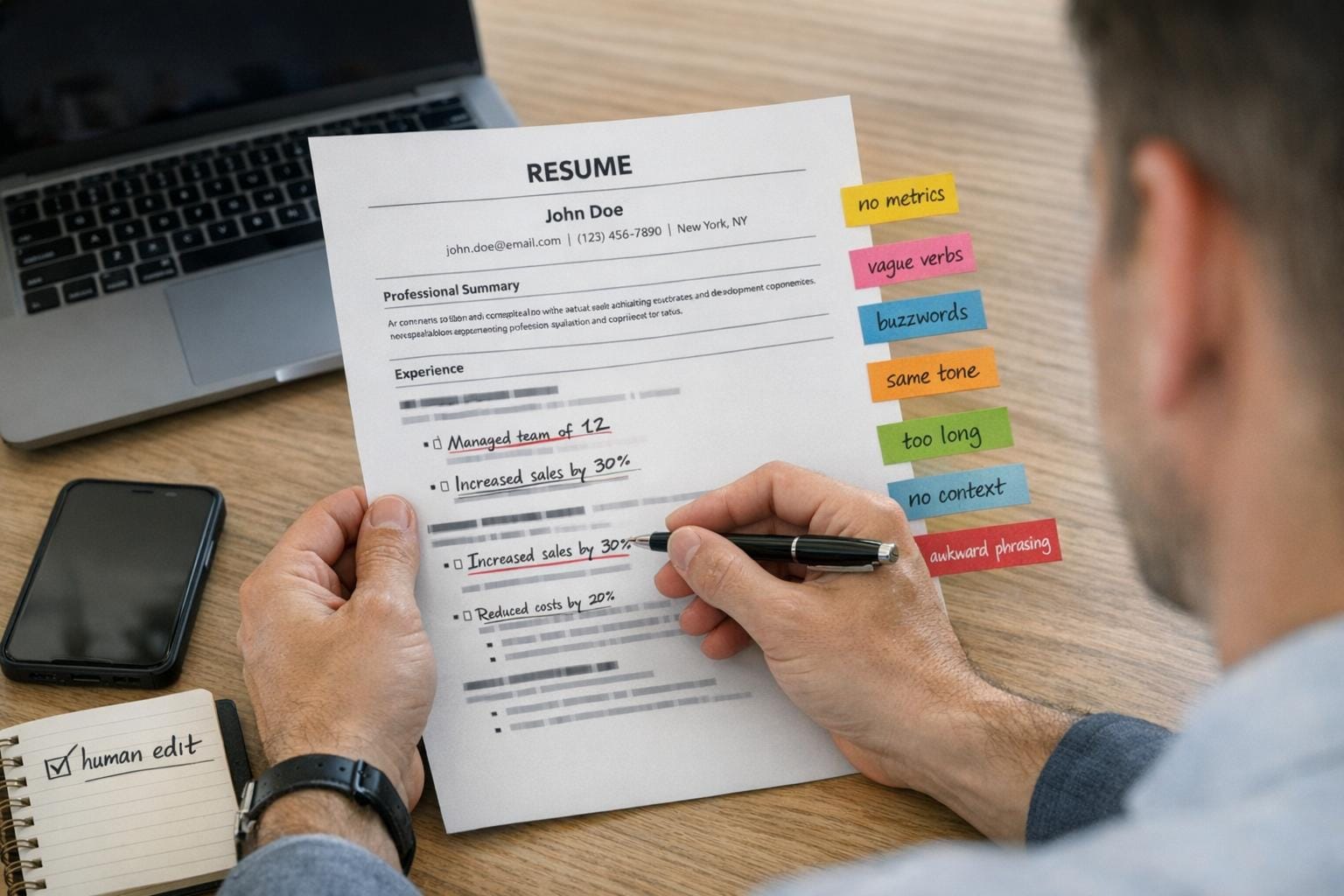
Recruiters are getting better at identifying resumes generated by AI tools like Rezi.ai or LazyApply. These resumes often lack resume customization, use generic phrases, or fail to include specific achievements. Here are the top signs that give away AI-generated resumes:
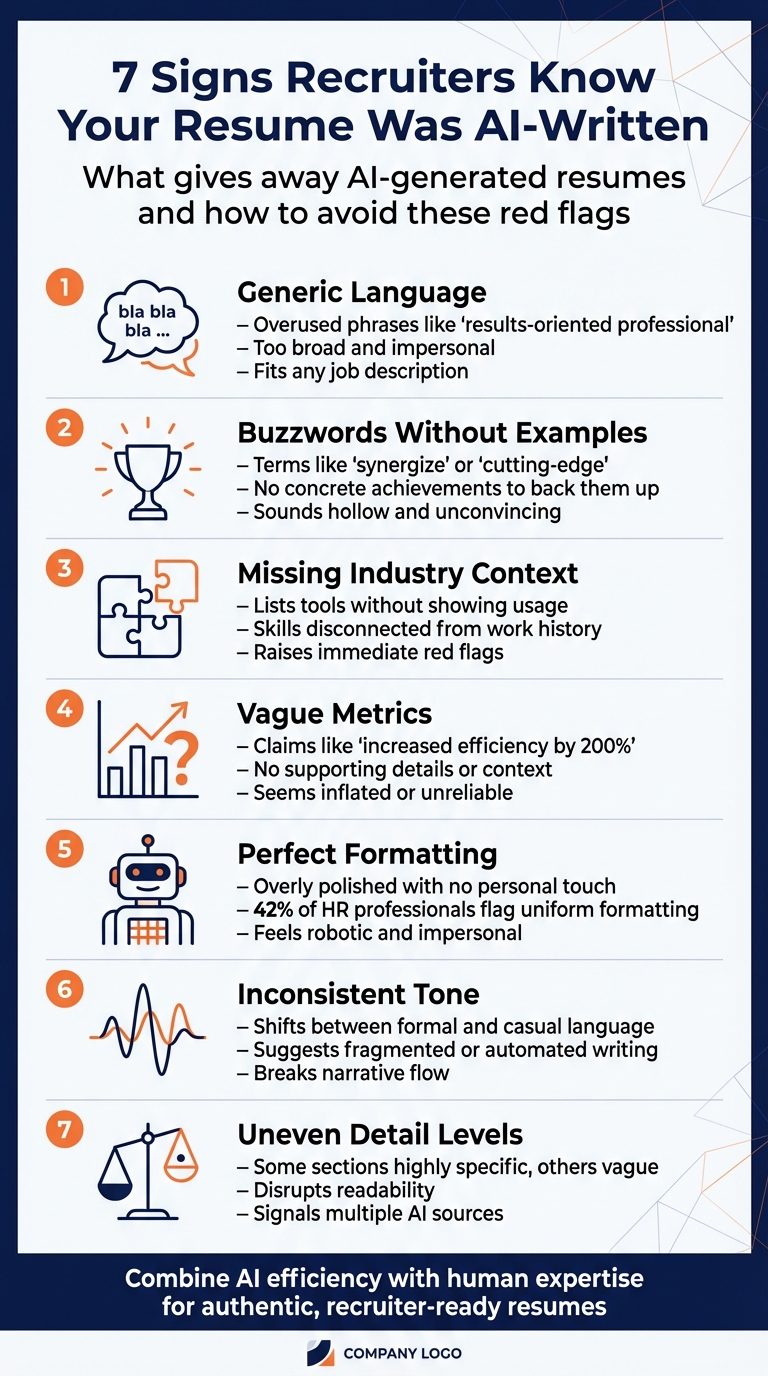
- Generic language: Overused phrases like "results-oriented professional" or "adept at leveraging skills" are too broad and impersonal.
- Buzzwords without examples: Terms like "synergize" or "cutting-edge" sound hollow without concrete achievements to back them up.
- Missing industry context: Listing tools or skills without showing how they were used in a role raises red flags.
- Vague metrics: Claims like "increased efficiency by 200%" without details can seem inflated or unreliable.
- Perfect formatting: Overly polished resumes with no personal touch feel robotic.
- Inconsistent tone: Shifts between formal and casual language suggest fragmented or automated writing.
- Uneven detail levels: Some sections may include specifics, while others remain vague, breaking the narrative flow.
To stand out, focus on crafting resumes that combine measurable results, personal insights, and role-specific details. Tools like Scale.jobs offer a hybrid approach, blending AI efficiency with human expertise to ensure your application feels authentic and tailored. Unlike fully automated platforms, they provide real-time updates and personalized support, making your resume recruiter-ready.
For more tips on improving your job applications, explore resources like job search virtual assistant or ai resume builder.
7 Signs Your Resume Was AI-Written That Recruiters Spot Instantly
1. Generic Language That Fits Any Job
Degree of Personalization
One of the biggest pitfalls of AI-generated resumes is their tendency to sound overly generic. Phrases like "results-oriented professional" or "transformative leader" might seem polished but fail to tell your unique career story. Elspeth Coates-Gibson, Chief Commercial Officer at Appointedd, points out:
"Often this nuance is lost through AI, and there's so much value that can be understood by seeing how a person pitches themselves in their own words."
Recruiters, who often scan resumes in a matter of seconds, are looking for signs that you’ve taken the time to customize your resume for every job. Unfortunately, tools like Rezi.ai and LazyApply frequently produce broad, one-size-fits-all statements that could apply to almost any job, signaling a lack of customization. Beyond this, the absence of quantifiable results further diminishes the impact of these resumes.
Use of Measurable Achievements
Another common drawback of AI-generated resumes is the lack of measurable achievements. Instead of showcasing specific outcomes, these resumes often stick to vague role descriptions. For instance, rather than saying, "Developed a loyalty program that led to a 13% increase in sign-ups", they might use generic language like "Responsible for improving customer relationships." Lisa Shaver, International Senior Product Marketing Manager at Toast, explains:
"Where AI falls flat is the often business-jargony, over-embellished language (but also very generic) that brings no real texture to a job seeker's previous responsibilities or accomplishments."
Without specifics like numbers, team sizes, or project details, your resume can feel hollow and unconvincing. Recruiters may interpret this lack of detail as reliance on AI-generated content rather than genuine expertise. On the other hand, resumes that include clear, quantifiable achievements stand out from the crowd. For job seekers aiming to transform their experience into compelling, results-driven narratives, working with the best resume writing services can ensure every claim is backed by meaningful details and authenticity.
Why Recruiters Instantly Spot Bad AI Resumes
2. Buzzwords Without Concrete Examples
When it comes to resumes, buzzwords without real-world examples can be a dead giveaway of AI involvement. These terms may sound polished but often lack the depth that recruiters are looking for.
Use of Measurable Achievements
AI-generated resumes frequently rely on corporate jargon like "synergize", "transformative", or "pivotal." While these words might seem impressive, they fail to convey any actual accomplishments. For instance, phrases such as "results-oriented leader" or "proactive team player" can raise red flags if they aren't backed by specific examples. Henry Garrison, Senior Content Writer at Resume.co, highlights this issue:
"AI-generated resumes aren't inherently bad, but they can be if they show a lack of effort and attention to detail."
Consider the difference between saying "responsible for improving customer relationships" and providing a concrete example like "implemented a new CRM outreach strategy that generated $1.2M in Q3 revenue." The latter demonstrates clear impact and effort, which is what hiring managers want to see.
Beyond measurable achievements, the overuse of industry buzzwords without any supporting context can further erode trust in your application.
Inclusion of Industry-Specific Details
While numbers and results add credibility, the way you present technical skills also matters. AI-generated resumes often fall into the trap of "context-less keyword stuffing." For example, listing tools like "Kubernetes" or "Salesforce" in a skills section without mentioning them in your job descriptions can signal a lack of genuine experience. Many recruiters use AI tools to cross-check skills with work history, and discrepancies can quickly raise doubts.
This lack of depth and authenticity can make your resume feel impersonal. Lisa Shaver, International Senior Product Marketing Manager at Toast, explains:
"Where AI falls flat is the often business-jargony, over-embellished language (but also very generic) that brings no real texture to a job seeker's previous responsibilities or accomplishments."
Instead of vague statements like "marketing manager with a proven track record of delivering dynamic solutions", aim for specifics. For example: "Marketing manager with 5+ years of experience leading a team of 15, increasing social media engagement by 35%." If you're unsure how to translate your experience into compelling, results-driven language, consider using professional resume writing services to refine your narrative.
Unlike generic AI tools, scale.jobs focuses on crafting resumes that combine measurable achievements with industry-specific details, ensuring your application stands out for all the right reasons.
3. Missing Industry-Specific Terms and Context
When it comes to crafting a compelling resume, one major pitfall is the lack of genuine industry context. This issue often arises when AI-generated resumes fail to integrate technical terms into real-world job experiences.
Inclusion of Industry-Specific Details
Recruiters are quick to notice resumes that list technical terms like "Kubernetes" or "Salesforce" without showing how these tools were utilized in actual roles. It's not enough to simply name-drop; recruiters want to see these skills in action. Many companies now use AI screening tools to verify claims, and if there’s a disconnect between listed skills and your work history, your application could be flagged.
The problem goes beyond missing keywords. AI-generated resumes often lack the depth and precision needed to convey real expertise. As Elspeth Coates-Gibson, Chief Commercial Officer at Appointedd, points out:
"Often this nuance is lost through AI, and there's so much value that can be understood by seeing how a person pitches themselves in their own words."
Rather than showcasing authentic knowledge, these resumes can come across as a random collection of industry jargon. For instance, a phrase like "proven track record of delivering dynamic solutions" is vague and doesn’t communicate any actual capabilities or sector knowledge.
Degree of Personalization
Another telltale sign of an AI-crafted resume is the inaccurate attribution of skill levels. For example, labeling an entry-level candidate as having "expert proficiency" in crisis management is a red flag for recruiters who understand how skills develop over time in specific industries.
This lack of personalization becomes even more evident when job titles with sector-specific nuances are misinterpreted. A "Business Analyst" role at a startup differs significantly from the same title at a Fortune 500 company, yet AI often fails to make these distinctions. If you’re struggling to highlight these nuances, professional resume writing services can help bridge the gap, ensuring your resume accurately reflects your expertise and aligns with industry expectations.
For candidates looking to showcase real-world experience, services like scale.jobs combine human insight with technical expertise to add the necessary context to your resume. This human touch can make all the difference, particularly when compared to fully automated solutions that often miss the mark on industry-specific details. Tailoring your resume with this level of care can significantly improve your chances of standing out in a competitive job market.
4. Vague Descriptions Instead of Numbers
Use of Measurable Achievements
Using vague or generic phrases in your resume can hurt your chances of standing out. Recruiters often spend less than 10 seconds scanning a resume, and phrases like "proven track record of delivering dynamic solutions" can come across as hollow and unconvincing. These statements lack the depth and specificity needed to make an impression.
For example, a claim such as "Increased revenue by 200%" might catch attention initially, but if you can't explain the details - like the size of the project, the team involved, or the exact strategy behind the increase - it can damage your credibility during an interview. Numbers without context can feel inflated or disconnected from reality, leaving recruiters skeptical.
Consistency in Tone and Style
Another common issue is inconsistency in tone and style. AI-generated resumes often assign advanced accomplishments or skills to entry-level candidates, creating a mismatch that experienced recruiters can quickly identify. These inconsistencies can raise red flags about the authenticity of your experience.
Rather than avoiding metrics altogether, focus on providing meaningful context for your achievements. For instance, instead of saying "optimized organizational efficiency", describe the specific challenge you faced, the actions you took, and the measurable results you achieved. If you're unsure how to frame your accomplishments effectively, comparing resume writing services vs AI builders can help you craft a resume that accurately reflects your skills and aligns with industry expectations.
5. Perfect Formatting With No Personal Touch
Degree of Personalization
AI-generated resumes often feature impeccable formatting - everything from bullet points to spacing is perfectly aligned. While this might seem appealing at first glance, it can come across as overly polished and robotic. Real resumes, crafted by individuals, often include subtle variations that reflect personal choices. For instance, a candidate might bold a standout accomplishment, tweak spacing to emphasize a key promotion, or use custom headers like "Key Wins" instead of the generic "Achievements." These small, human touches can make a big difference.
A 2024 ResumeBuilder survey found that 42% of HR professionals use formatting uniformity as a key indicator of AI-generated resumes. This lack of personalization can make your resume feel detached, masking the unique experiences and achievements that set you apart.
Consistency in Tone and Style
The problem extends beyond appearance. AI tools often apply the same formatting and tone across all sections of a resume, regardless of the role or its significance. This one-size-fits-all approach can make it seem like every job you've held carries the same weight, which isn't realistic or effective.
Recruiters can spot these patterns quickly. For example, if every bullet point has the same structure or level of detail, even for vastly different positions, it signals an algorithm at work. If you're unsure how to strike the right balance between professionalism and personalization, seeking help from professional resume writers can help you create a resume that feels authentic and tailored.
Inclusion of Industry-Specific Details
Your resume should also reflect your career journey. Overly rigid formatting that doesn’t evolve with your career progression is another red flag for recruiters. For example, someone who has moved from entry-level roles to senior positions should naturally highlight those transitions through formatting and emphasis. AI-generated resumes often fail to adapt in this way, making them feel static and impersonal.
A 2023 Jobscan study found that while 68% of AI-generated resumes passed automated formatting checks, many were flagged by human reviewers for lacking the personal touch and industry-specific details that demonstrate genuine effort and expertise. Tailoring your resume to reflect your unique path not only improves its authenticity but also increases its appeal to recruiters.
6. Sudden Changes in Writing Style
Consistency in Tone and Style
One telltale sign of an AI-generated resume is a lack of consistency in the writing style. Recruiters can quickly spot when a resume shifts from formal, polished language like "Optimized operational workflows to enhance efficiency" to a more casual tone such as "delivered measurable results." These abrupt changes suggest that different sections were created separately, resulting in what professionals often call a fragmented resume.
Human-written resumes tend to maintain a consistent voice throughout. This means sticking to either active or passive voice, ensuring uniform sentence lengths, and keeping the same level of formality across the entire document. AI tools, on the other hand, often combine data from various sources, which can lead to sudden shifts between technical jargon and overly simple phrasing.
Degree of Personalization
Another red flag is inconsistent personalization. AI-generated resumes frequently mix generic statements with specific details, creating an uneven flow. For instance, a resume might start with broad responsibilities like "Managed team projects" and then suddenly dive into specifics such as "Led my Agile team at XYZ Corp to achieve 20% faster sprints." These shifts can make the resume feel disjointed and less professional compared to a human-written one, where the tone and structure remain uniform from start to finish.
To address these issues, take the time to review your resume carefully for inconsistencies. Writing the entire document in one sitting can help maintain a cohesive tone. Alternatively, consider enlisting the help of professional resume writers, who specialize in crafting resumes that reflect your authentic voice. Simple strategies, like ensuring all bullet points follow similar sentence lengths (around 10-15 words) and consistently using active voice, can make a significant difference in presenting a polished and professional image.
7. Awkward Phrasing or Uneven Detail Levels
Recruiters don’t just skim resumes for keywords - they also evaluate how consistently your narrative flows. Uneven phrasing or mismatched levels of detail can make your resume stand out for the wrong reasons.
Consistency in Tone and Style
AI-generated resumes often lean on flashy, corporate jargon that sounds impressive at first glance but lacks depth. For example, you might see a resume boasting "spearheaded transformative initiatives" in one section, only to find a vague phrase like "helped with team projects" in the next. This inconsistency in tone and detail is a dead giveaway that AI tools were involved.
Human-written resumes, on the other hand, tend to maintain a steady level of detail and clarity. They provide context for achievements, tying technical skills to real-world applications. When this balance is missing, it disrupts readability and raises doubts about the candidate’s authenticity.
Inclusion of Industry-Specific Details
Another common issue is listing skills without showing how they’ve been applied. For instance, if you mention proficiency in tools like Kubernetes or Salesforce but fail to include examples of how you used them, recruiters will notice the gap. Since they spend less than 10 seconds on an initial scan, they’re quick to flag resumes that lack this connection.
This becomes even more problematic when entry-level candidates claim expertise in areas like strategic leadership or crisis management - skills that typically require years of experience to develop. As Elspeth Coates-Gibson, Chief Commercial Officer at Appointedd, explains:
"Often this nuance is lost through AI, and there's so much value that can be understood by seeing how a person pitches themselves in their own words."
To sidestep these issues, ensure that every skill you list is backed by specific examples in your work experience. For instance, if you mention project management, highlight a time you successfully led a team or delivered a project on time and within budget. Tools like scale.jobs can help you craft a resume that pairs skills with measurable results, ensuring your experience comes across as polished and authentic.
Ultimately, your resume should tell a cohesive story, with consistent detail and tone throughout. This human touch not only enhances readability but also leaves a stronger impression on recruiters.
How AI Tools Compare to Human-Powered Services
When deciding between LazyApply, Rezi.ai, and scale.jobs, it's essential to consider how each platform handles key aspects like personalization, ATS compatibility, and transparency. These factors directly impact the effectiveness of your applications, as recruiters can quickly spot generic, AI-generated resumes.
LazyApply operates as an automated bot, submitting resumes across various job boards without human oversight. While it allows for high-volume applications, it often sacrifices quality. The lack of industry-specific context and occasional awkward phrasing can make your application stand out for the wrong reasons. LazyApply follows a subscription model but offers no proof of how your resume is customized for each position. This tool may work for job seekers focused on quantity over quality, but its automated nature can raise red flags with recruiters.
Rezi.ai uses AI to help optimize resumes for ATS systems. Its features, like the Keyword Scanner and Bullet Point Writer, aim to improve your resume's match with job descriptions. Users can monitor their progress with the "Rezi Score", which highlights missing keywords. However, while Rezi.ai identifies gaps, users must manually refine the content to ensure it feels authentic and relevant. The free plan is limited to one resume and three PDF downloads, while the Pro plan costs $29 per month or $149 for lifetime access. While helpful for keyword optimization, the AI-generated content often lacks the depth and personalization recruiters expect.
On the other hand, scale.jobs takes a more tailored approach by combining AI tools with human expertise. Each resume and cover letter is reviewed and customized by trained virtual assistants, ensuring they align with specific job postings. Features like real-time WhatsApp updates and time-stamped proof-of-work screenshots provide transparency throughout the process. Unlike LazyApply's automated submissions or Rezi.ai's DIY model, scale.jobs assigns a dedicated assistant to handle the entire application process, even for platforms that don't support auto-apply. Pricing starts at $199 for 250 applications, with no recurring subscription fees, and unused credits are refundable. This human-centric approach reduces the risks associated with generic phrasing and improves the chances of passing ATS filters.
Why scale.jobs Stands Out
- Human oversight reduces AI detection risks: A trained virtual assistant reviews and customizes each resume and cover letter, avoiding the pitfalls of fully automated tools like LazyApply and Rezi.ai.
- Tailored ATS optimization: By blending AI keyword checks with human editing, scale.jobs ensures your resume includes meaningful details, unlike Rezi.ai's automated suggestions that require manual adjustments.
- Full transparency: Real-time updates and time-stamped screenshots offer clear visibility into every application, a feature absent in LazyApply's process.
- One-time payment model: With a flat-fee structure and refundable credits, scale.jobs eliminates the uncertainty of subscription-based services.
The table below compares these three services:
| Feature | LazyApply | Rezi.ai | scale.jobs |
|---|---|---|---|
| Human involvement | None (fully automated) | None (AI-generated content) | Trained VAs review and customize every application |
| Resume customization depth | Generic template applied broadly | AI keyword matching; manual editing required | Human-tailored resume and cover letter per job |
| ATS handling | Basic keyword insertion | Keyword Scanner and Rezi Score | ATS-optimized documents reviewed by humans |
| Application execution | Automated bot submissions | User submits manually | Human VAs submit on any portal |
| Transparency and proof of work | No visibility into submissions | Self-service dashboard | WhatsApp updates and time-stamped screenshots |
| Pricing model | Subscription-based | $29/month or $149 lifetime | $199–$399 one-time (250–1,000 applications) |
Who Should Choose Each Service?
- LazyApply: Ideal for those who prioritize speed and volume over quality, despite the risks of generic, automated submissions.
- Rezi.ai: Best for DIY candidates who are comfortable editing AI-generated content and manually submitting applications while benefiting from ATS keyword optimization.
- scale.jobs: Perfect for professionals seeking personalized, human-reviewed applications, especially if targeting niche job boards, senior roles, or navigating complex application processes.
When to Switch to scale.jobs
- You're not getting interview callbacks despite using AI resume tools.
- You need applications submitted on specialized job boards or company-specific portals.
- Transparency is a priority, and you want real-time updates for every submission.
- You prefer a one-time payment model with refundable credits over recurring fees.
- You need resumes and cover letters that avoid AI-detection risks and meet recruiter expectations.
Decision Summary
LazyApply suits those who favor volume over customization, while Rezi.ai offers a budget-friendly option for job seekers willing to refine AI-generated resumes manually. However, for those who value personalized, human-reviewed applications, scale.jobs stands out as the most reliable choice. Its combination of human expertise, transparency, and flexible pricing ensures a higher chance of success in your job search.
For more support, consider exploring a job search virtual assistant or a virtual assistant for job seekers to streamline your application process further.
Conclusion
Recruiters are often able to identify AI-generated resumes by recognizing seven common warning signs:
- Generic language that feels impersonal and could fit any role.
- Buzzwords without concrete examples, making accomplishments hard to evaluate.
- Lack of industry-specific details, which diminishes relevance.
- Vague descriptions without metrics, failing to showcase measurable impact.
- Overly polished formatting, which can lack the subtle nuances of a personal touch.
- Inconsistent writing style, creating an unnatural flow.
- Awkward phrasing and uneven detail, which can signal automated writing.
These issues underscore the importance of a human touch in resume writing. Resumes reviewed or crafted by professionals consistently stand out because they combine compelling storytelling, quantifiable achievements, and tailored language that resonates with hiring managers. For instance, a professional can transform a vague statement like "managed projects" into something impactful, such as "led a cross-functional team of 5 to deliver a $500K project 20% under budget."
Given these challenges, many job seekers opt for human-reviewed resumes over fully automated ones. While tools like LazyApply and Rezi.ai offer quick solutions, Scale.jobs provides the human oversight that makes a difference. If your applications aren’t leading to interviews, partnering with experts who understand what recruiters value might be the game-changer. A professionally written resume from Scale.jobs combines the precision of AI keyword optimization with the expertise of trained professionals. Their virtual assistants ensure your resume and cover letter reflect your unique experience while building ATS-friendly resumes and cover letters.
Key Takeaway: If you want a resume that blends personalization, ATS optimization, and human expertise - with added perks like WhatsApp support and transparent pricing - Scale.jobs is the ideal choice. For a quick, high-volume approach, competitors like LazyApply or Rezi.ai may suit your needs. However, for a tailored, recruiter-ready resume that avoids the pitfalls of AI, Scale.jobs is the trusted option.
FAQs
How can I use AI without my resume sounding AI-written?
When crafting your resume, make it stand out by including specific, measurable achievements and adding a personal touch. Highlight milestones like exceeding sales goals, leading successful projects, or mastering niche skills. If you've undergone a career shift or possess unique abilities, weave those into your narrative to show depth and individuality. Stay away from overused phrases, repetitive wording, or cramming in keywords unnaturally - they can make your resume feel impersonal or robotic.
For the best results, pair AI tools with human review. AI can streamline formatting and suggest strong phrasing, but a human eye ensures the tone feels genuine and aligns with your story. This combination helps you craft a resume that reflects your distinct background while avoiding the pitfalls of AI-generated content.
What metrics should I include if my job didn’t have clear numbers?
When your job didn’t involve easily measurable results, focus on qualitative achievements and provide context to showcase your contributions. For instance, include specifics like the size of the team you managed, the scope of a project, or how you improved processes. Examples could be: "Led a team of 10 to streamline internal workflows" or "Introduced a new process that boosted team efficiency."
Additionally, highlight outcomes that demonstrate your value. Statements like "Developed a training program that enhanced team skills" or "Consistently received positive feedback from clients" can effectively illustrate the impact you made, even without hard numbers.
How can I connect skills and tools to achievements without keyword stuffing?
When showcasing your skills on a resume, focus on turning them into measurable accomplishments. For instance, instead of a vague statement like "Proficient in Excel," opt for a result-driven example such as, "Used Excel to analyze sales data, leading to a 15% increase in quarterly revenue."
This approach not only highlights your expertise but also demonstrates how your skills directly contribute to success. Always tailor these examples to the specific role you're applying for, using action-oriented language and quantifiable results. By doing so, your resume becomes more engaging and avoids generic keyword stuffing, making it feel personalized and impactful.