
What Happens If Your Cap-Exempt Job Ends Mid-H1B?

Sarah Mitchell
July 9, 2026

If your cap-exempt H-1B job ends, your work permission for that employer stops that day, and your 60-day grace period usually starts right away. That means you need to act fast: find another cap-exempt sponsor, line up a cap-subject path if you already qualify, file a status change, or leave the U.S. before the window closes.
Here’s the short version:
- You cannot keep working after the termination date unless a new filing supports work authorization.
- Your I-797 end date does not let you keep working after the job ends.
- Another cap-exempt employer is often the most direct next move.
- A cap-subject employer usually cannot solve this fast unless you were already cap-counted or already selected.
- If no U.S. filing is ready by day 60, leaving the U.S. may be the cleanest backup plan.
I’d treat this as a filing deadline, not just a job search. That means focusing on employers that can move now, tightening your document set, and using the right support, whether that’s a job search platform, a job application service, or a job search coach.
What Happens If You Lose Your Job on a Cap-Exempt H1B After I-140 Approval?
My take
The article’s core message is simple: legal fit and timing both matter. Many people spend too long applying broadly when the better move is to target the small set of employers that can file inside 60 days. If I were in this spot, I would stop thinking in months and start thinking in days.
What I’d do first
- Confirm the last payroll/termination date
- Count the 60-day grace period
- Check whether I can move to another cap-exempt employer
- If not, review whether a status change is possible
- Build a short list of sponsors and start to Apply for jobs with urgency
- Prepare a departure plan in case no filing is ready
The main decision path
1) Move to another cap-exempt employer
This is often the cleanest path if you can get an offer in time. Universities, affiliated nonprofits, and research groups are the first places I’d target.
A broad search can waste time. I’d focus on roles that are plainly tied to sponsor-ready employers, including some full time jobs and selected research or campus-linked roles.
2) Use a cap-subject employer only if the filing path already exists
This option is often misunderstood. If you were never counted under the H-1B cap, a cap-subject employer usually cannot just file right away unless you already have the needed cap history or selection.
That is why timing breaks many cases. The issue is not just “Can I get hired?” It is also “Can this employer file in time?”
3) Change status or leave the U.S.
If no employer can file inside the grace period, I’d review a status change with counsel and prepare a backup exit plan. Waiting until the last week can turn a hard situation into a bad one.
A simple 7-day playbook
Day 1–2
- Confirm end date
- Gather immigration records
- Update resume
- Build a target list of cap-exempt employers
Day 3–4
- Start targeted outreach
- Use a Virtual Assistant for Job Applications or virtual assistant for job seekers if application volume is slipping
- Ask each employer one direct question: Can you file within my grace period?
Day 5–7
- Prioritize interviews with sponsor-ready teams
- Drop low-fit roles
- Build a backup plan for travel or consular steps if needed
Why tool choice matters in a 60-day window
The article makes one point that I agree with: visa-sensitive applications can fail on one bad sponsorship answer. That is why I would be careful with pure automation, even if I was using the best job boards or an ai resume builder to speed up prep work.
For many people, the issue is not finding postings. It is getting the last-mile submission right.
Is scale.jobs worth it?
If your case is time-sensitive and visa-sensitive, I can see why a human-assisted workflow may fit better than one-click tools. The article points to:
- 5 free job applications
- 250 applications for $199
- human review of sponsorship questions
- proof-of-work screenshots
- WhatsApp updates
If I needed volume and careful form handling, I’d test the free option first. If I only needed resume tuning or cover letters, I might pair lighter tools with an ai cover letter builder instead.
sbb-itb-564272e
LazyApply vs Scale.jobs
If I were comparing them for an H-1B grace-period search, I’d keep it simple:
- LazyApply: better for people who want automation
- Scale.jobs: better for people who need a person to check visa-related fields
That difference matters when one work authorization answer can knock out an application.
FAQ
Does my H-1B stay valid until the I-797 expiration date?
No. If your employment ends, your permission to work for that employer ends on the termination date, even if the petition end date is later.
How long is the grace period after H-1B termination?
It is generally up to 60 days.
Can I work during the 60-day grace period?
In general, no. You need a filing or status basis that allows work.
Is another cap-exempt employer the best next step?
In many cases, yes, because it may avoid the cap issue that blocks many cap-subject moves.
Should I apply broadly or narrow my search?
I’d narrow it. Under a 60-day deadline, sponsor fit matters more than raw volume.
Bottom line
I’d treat a cap-exempt H-1B job loss as a 60-day legal and hiring sprint. The best next step is often another cap-exempt employer. If that is not moving, I’d check status-change paths and prepare to leave the U.S. before the deadline.
The article’s main point is right: speed, sponsor fit, and correct filing strategy matter more than a broad search.
How cap-exempt H-1B status works and what changes when the job ends
Here’s the rule set that controls what you can still do inside the 60-day window.
What counts as cap-exempt employment
Cap-exempt status is tied to the employer and the specific worksite, not permanently to you as a worker. Under federal immigration rules, the employer types that usually qualify are:
- Institutions of higher education
- Nonprofit entities related to or affiliated with those institutions
- Nonprofit research organizations
- Governmental research organizations
Some private employers may qualify too, but only when you are assigned mainly to a cap-exempt site. If that placement ends, the exemption usually ends with it. That’s the part many people miss. The label is not something you carry from job to job on your own.
What ends on the termination date
When your cap-exempt job ends, your pay stops and your work permission for that employer ends. The I-797 end date only shows petition validity. It does not extend work permission after termination.
USCIS generally provides a 60-day grace period after termination. You can use that time to transfer, change status, or depart the United States. You should not work during that period.
There’s one more point that matters. If your employer terminates you before your authorized period ends, they are generally required to pay the cost of return transportation to your last country of residence.
Why concurrent or future cap-subject H-1B plans get complicated
If you held a concurrent cap-subject H-1B job alongside your cap-exempt role, that setup often depends on the cap-exempt position staying active as the primary employment. Once the cap-exempt job ends, that arrangement can be affected.
Cap-exempt employment does not count you toward the annual H-1B cap. So if you have never been cap-counted, a cap-subject employer still needs a lottery-selected filing before it can sponsor you. In plain English: can a cap-subject employer file for you right now? Usually only if you already cleared the lottery, or if you are ready to wait for the next registration cycle.
That’s why timing matters so much in this window. If you’re trying to line up your next move, this is the moment to focus on the fastest option that can actually work before the grace period runs out.
Your options after a cap-exempt H-1B job ends
Once termination starts the clock, your first move is simple: confirm your exact end date. After that, focus on the fastest path that can actually be filed. At this stage, speed matters more than perfect long-range planning.
If you're trying to Apply for jobs, this is not the time for a broad, slow search. You need openings tied to sponsors that can move fast, make decisions fast, and file fast.
Option 1: Move to another cap-exempt employer
This is often the quickest route. If you can get a filing-ready offer from another cap-exempt employer, move on it right away and file without delay.
This is where a tight search process helps. Instead of sending applications everywhere, target employers that already understand the visa process and can act within the grace period. A focused job search platform or job application service can help cut wasted time.
Option 2: Plan for cap-subject employers or a status change
Use this route only if the new employer can file in time or if your status change fits inside the grace period. The main danger here is missing the 60-day window.
A lot of people lose time debating edge cases when the bigger issue is execution. Can the employer file in time? Do you have the documents ready? Is counsel lined up? Those are the questions that matter now. If you need help keeping the process moving, a job search coach or Virtual Assistant for Job Applications may help keep things organized.
Option 3: Leave the U.S. and process abroad
If no filing or status change will be ready before day 60, plan to leave. Consular processing adds travel planning and appointment timing risk, so start early.
That means getting your documents in order before the grace period gets close to the end. Waiting until the last week can turn a stressful situation into a mess. If your search is stalled, using a virtual assistant for job seekers can help you keep momentum while you prepare a backup plan.
| Path | What it requires | Best if… |
|---|---|---|
| Cap-exempt employer transfer | A filing-ready cap-exempt employer | You can secure and file a qualifying offer fast enough |
| Cap-subject employer / status change | A new employer or visa path that fits the grace period | Your cap-exempt search is not moving fast enough |
| Leave the U.S. and process abroad | Departing and completing the next step abroad | No domestic option is ready before day 60 |
The next issue is not just eligibility. It is whether the filing can happen before day 60. That’s why application speed, sponsor targeting, and execution matter more than usual.
Why application speed, targeting, and tool choice matter more under a grace period
The numbers: 60-day grace period, 30% sponsor fit, and 300-800 applications
Once the 60-day grace period starts, the margin for error gets small. For many H-1B job seekers, only about 30% of open roles are a fit for sponsorship. On top of that, a lot of companies stop reviewing once the first 100 applicants are in. Put those two things together, and the numbers get tough fast.
That’s why many candidates end up sending 300–800 applications, which works out to about 5–13 targeted applications a day. At that pace, volume matters. But volume alone won’t save you if you’re applying to the wrong roles or using the wrong system to do it.
If you're trying to Apply for jobs under pressure, the goal isn't just to move fast. It’s to move fast without burning submissions on poor-fit roles.
Why automated apply tools can miss visa-sensitive details
This is where many automated apply tools fall apart.
Bot-driven systems can break on dynamic forms. They can also submit the wrong answer to sponsorship questions, which is a much bigger problem than a small formatting mistake. Work authorization fields and ATS knock-out filters often need human judgment. A bot usually can’t tell when a question is asking about current status, future sponsorship, or both.
That matters a lot for H-1B candidates. One wrong click can push your application out before a recruiter even sees it.
Generic tools also tend to miss details around employer type, sponsor fit, and filing readiness. So you may spend time applying to roles that were never a match in the first place. In a 60-day window, that’s not a small issue. It’s lost time, lost slots, and added stress.
If you're comparing options across different best job boards or using a broad job search platform, the weak point is often the last mile: the actual form submission.
In a 60-day window, one wrong sponsorship answer can waste one of your limited submissions.
scale.jobs now includes 5 free job applications
scale.jobs uses a different model. Instead of relying on bots, trained human assistants complete each application form by hand. That gives them room to check sponsor-fit details instead of guessing.
The process also includes time-stamped proof-of-work screenshots, so you can confirm each submission without having to chase updates. You also get real-time WhatsApp updates, which makes the workflow easier to track day to day. If your resume needs ATS cleanup first, that can be handled before the application goes out.
For job seekers who want a hands-on job application service, that setup is a better match for visa-sensitive applications than a one-click bot.
The simplest way to try it is the free offer: the first 5 job applications are free. That gives you a low-risk way to test the human-assisted process and the WhatsApp coordination before you decide to keep going. If you need more volume after that, the Basic plan covers 250 applications for $199.
For people who want more support than a tool but don’t need a full job search coach, this sits in a useful middle ground. It works a lot like a virtual assistant for job seekers, but with the application workflow built in.
That baseline sets up the next question: which tools can actually handle this workflow better than a human-assisted apply process?
scale.jobs vs competitors for a cap-exempt H-1B transition
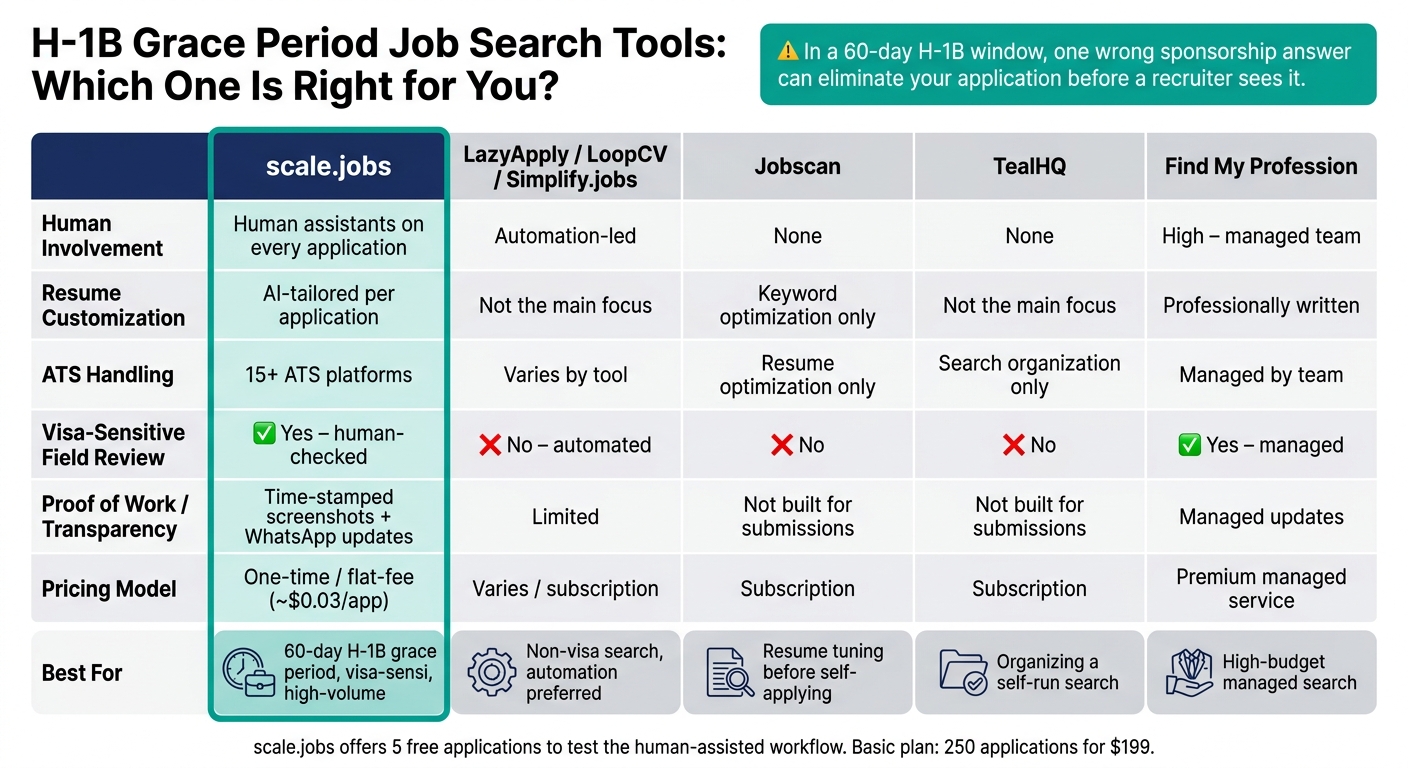
H-1B Grace Period Job Search Tools: Which One Is Right for You?
When you're in a 60-day grace period, this isn't just about sending more applications. It's about getting the right applications submitted correctly before time runs out.
That changes the whole comparison.
The weak point in most tools is the last mile: final submission. Sponsorship questions, employer-type filters, and portal-specific fields often need a person to check them. If a tool picks the wrong answer on work authorization, your application can get screened out before anyone reads your resume. For people trying to Apply for jobs under visa pressure, that's a big risk.
LazyApply vs scale.jobs, LoopCV vs scale.jobs, and Simplify.jobs vs scale.jobs
LazyApply
LazyApply cuts down manual work across job boards and can push out a high number of applications fast. That works fine for many searches. The problem is that it leans on automation for form fields, including work authorization questions. One bad selection can knock you out before a recruiter even sees your profile.
scale.jobs takes a different route. Human assistants check each sponsorship field before submission, which matters a lot in a visa-sensitive search.
Who should use LazyApply: Job seekers running a non-visa-sensitive search who want to spend less time on repeat form filling.
Who should choose scale.jobs: Job seekers inside a 60-day grace period who need careful handling of sponsorship fields on every submission.
LoopCV is useful for automated job matching and keeping your search moving. But it isn't built to sort employer types or flag cap-exempt versus cap-subject sponsors. In a cap-exempt H-1B transition, that gap matters.
scale.jobs adds human review before the application goes out, so employer fit can be checked first. If you're using a job search platform, that's the part you can't afford to gloss over.
Who should use LoopCV: Job seekers who want automated matching and don't need visa-specific review on each application.
Who should choose scale.jobs: Job seekers who need employer-type filtering and human-checked submissions during a tight filing window.
Simplify.jobs is strong at autofilling applications and keeping the search in one place. It's a solid pick for people who want a cleaner self-run workflow. What it doesn't add is human review for portal-specific sponsorship questions.
scale.jobs supports 50,000+ career pages and 15+ ATS platforms, with human assistants checking each form. That can make a big difference when the details are touchy and the deadline is close. If you need a Virtual Assistant for Job Applications, that's where the split shows up.
Who should use Simplify.jobs: Job seekers who want a cleaner self-managed workflow and aren't dealing with visa-sensitive fields.
Who should choose scale.jobs: Job seekers who need human review on sponsorship questions and time-stamped proof of each submission.
Switch to scale.jobs if:
- You are inside the 60-day H-1B grace period
- You need 300–800 applications submitted correctly under deadline
- You need human review on sponsorship questions and portal-specific fields
- You want one-time pricing instead of a recurring subscription
If your main problem is resume keywords or keeping your search organized, the tradeoff changes.
Jobscan, TealHQ, and Find My Profession vs scale.jobs
Here, the question isn't just speed. It's whether the tool helps you move from search to a filed application before day 60.
Jobscan vs scale.jobs
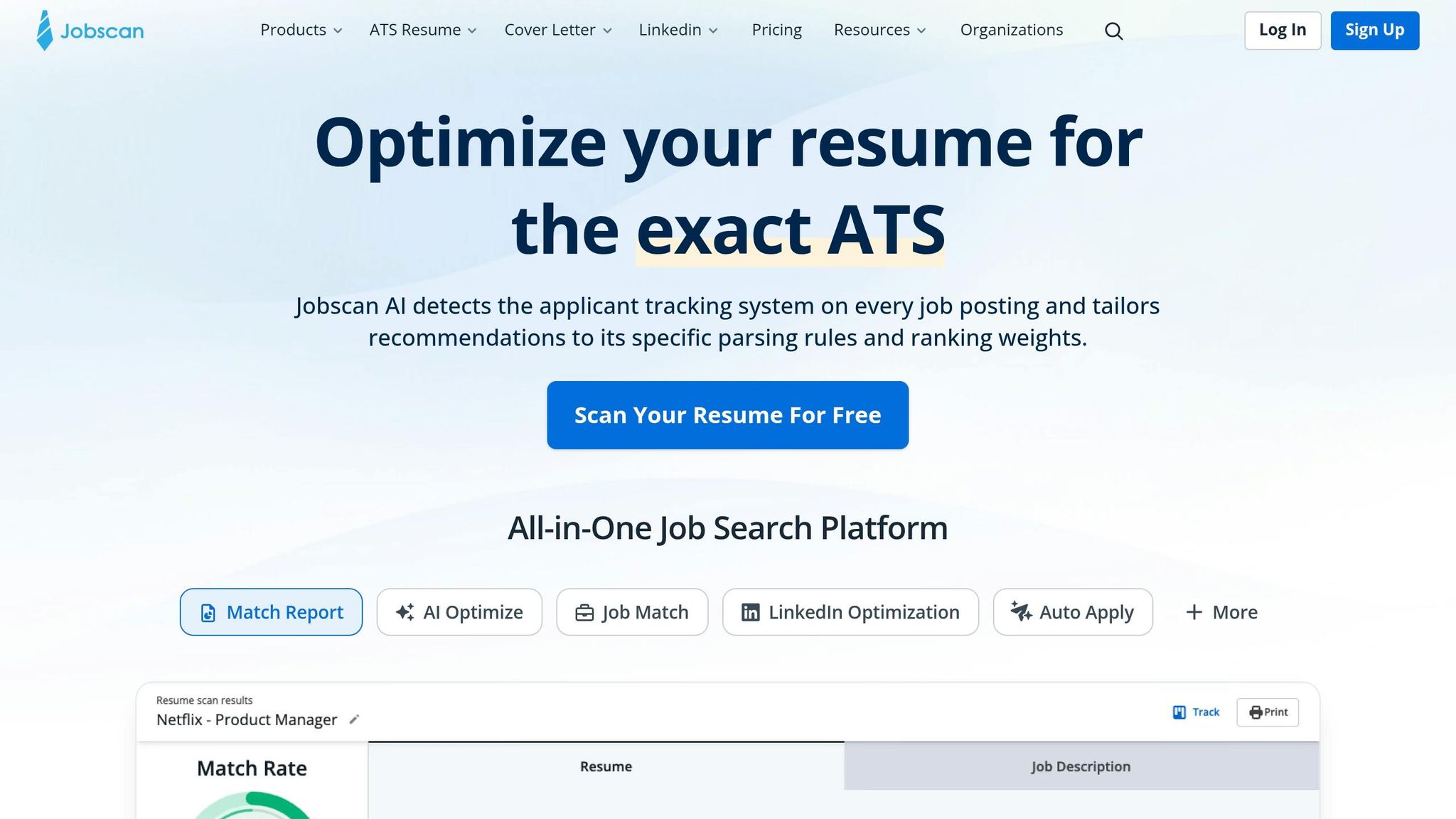
Jobscan is good at ATS keyword feedback and resume scoring. It helps you tune your documents, but it doesn't submit applications or check sponsorship fields.
scale.jobs covers both sides. Its AI Assistant Pro is $19/month for ATS-focused document help, and then human assistants handle the actual submission work. That mix can be useful if you want an ai resume builder but also need execution.
Who should use Jobscan: Job seekers improving their resumes before managing applications on their own.
Who should choose scale.jobs: Job seekers who need ATS-tuned documents and human-checked submissions in one workflow.
TealHQ vs scale.jobs
TealHQ is built for tracking and organizing a self-run job search. It's useful if your issue is process, not execution. But it doesn't submit applications or handle visa-sensitive fields.
scale.jobs replaces the tracking layer with a dashboard and adds human execution on top. For someone under deadline, that can be the difference between planning and getting applications out the door. This is where a job application service can do more than a tracker.
Who should use TealHQ: Job seekers managing their own applications who want a structured way to track progress.
Who should choose scale.jobs: Job seekers who need execution, not just organization, before a grace period ends.
Find My Profession vs scale.jobs
Find My Profession offers a managed search with a professional team. It's more hands-on and comes at a higher price. scale.jobs blends AI, software, and human assistants with flat-fee pricing, bringing the cost to about $0.03 per application.
That pricing model fits better when you need speed and volume under a visa deadline. If your main goal is to Apply for jobs at scale without taking on a premium managed-service bill, that's a meaningful difference.
Who should use Find My Profession: Candidates with a bigger budget who want a managed search and aren't under a tight visa deadline.
Who should choose scale.jobs: Job seekers who need ATS-tuned documents, human-checked submissions, visa-aware handling, and one-time pricing inside a grace period.
Comparison table and decision summary: which tool to use and when
Use the table below to separate automation tools, document-optimization tools, and managed execution services.
| Feature | scale.jobs | LazyApply / LoopCV / Simplify.jobs | Jobscan | TealHQ | Find My Profession |
|---|---|---|---|---|---|
| Human involvement | Human assistants on every application | Automation-led | None | None | High; managed team |
| Resume customization depth | AI-tailored per application + resume writing option | Not the main focus | Keyword optimization only | Not the main focus | Professionally written |
| ATS handling | 15+ ATS platforms | Varies by tool and portal | Resume optimization only | Search organization, not ATS optimization | Managed by team |
| Application execution method | AI + human + software | Automated / semi-automated | User-led | User-led | Professional-led |
| Transparency and proof of work | Time-stamped screenshots + WhatsApp updates | Limited proof of work | Not built for submission proof | Not built for submission proof | Managed updates |
| Pricing model | One-time / flat-fee | Varies by tool | Subscription | Subscription | Premium managed service |
Decision summary: Use LazyApply, LoopCV, or Simplify.jobs if you want automation for a non-visa-sensitive search. Use Jobscan or TealHQ if you want to tune and organize your own applications. Use Find My Profession if you want a managed search and can pay more for a higher-touch service. Choose scale.jobs when the transition is time-sensitive, visa-sensitive, and you need human-checked execution with clear tracking before the grace period runs out.