
Top #5 AI Certificate That Gets You Hired Faster in 2026

Sarah Mitchell
May 24, 2026

AI certifications are becoming essential in the 2026 job market, as employers increasingly prioritize candidates with proven AI skills over traditional experience. Certifications like Google AI Essentials, Microsoft Azure AI Fundamentals, AWS Certified AI Practitioner, IBM Generative AI Engineering, and Google Cloud Professional Machine Learning Engineer are some of the most sought-after credentials. These certifications not only improve your chances of passing applicant tracking systems (ATS) but also align with the skills employers are actively seeking.
Key highlights:
- Google AI Essentials: Ideal for non-technical roles like marketing or operations.
- Microsoft Azure AI Fundamentals: Suited for professionals in Microsoft ecosystems.
- AWS Certified AI Practitioner: Best for roles in AWS-centric organizations.
- IBM Generative AI Engineering: Focuses on deploying generative AI solutions.
- Google Cloud ML Engineer: Targets mid-level professionals managing ML systems.
Pairing these certifications with practical projects and optimized resumes can significantly boost your hiring potential. Services like Scale.jobs provide tailored resume optimization to ensure your credentials stand out in competitive job markets.
Quick Comparison
| Certification | Best For | Time to Complete | Cost | Key Skills Covered |
|---|---|---|---|---|
| Google AI Essentials | Non-technical professionals | 1-2 weeks | $49/month | Prompt design, AI workflows, responsible AI practices |
| Microsoft Azure AI Fundamentals | Business analysts, product managers | 3-6 weeks | $99-$120 | Azure AI services, responsible AI, ML lifecycle |
| AWS Certified AI Practitioner | Engineers, data analysts | 4-6 weeks | $100-$150 | AWS AI tools, generative AI, MLOps |
| IBM Generative AI Engineering | IT professionals with Python skills | 3-5 months | $49-$79/mo | LLM deployment, RAG pipelines, MLOps |
| Google Cloud ML Engineer | Mid-level cloud/data professionals | 4-8 weeks | $200+ | Vertex AI, ML pipelines, production monitoring |
To maximize your investment in these certifications, focus on building a strong career narrative, showcasing projects, and using tools like Scale.jobs for ATS-friendly resumes.
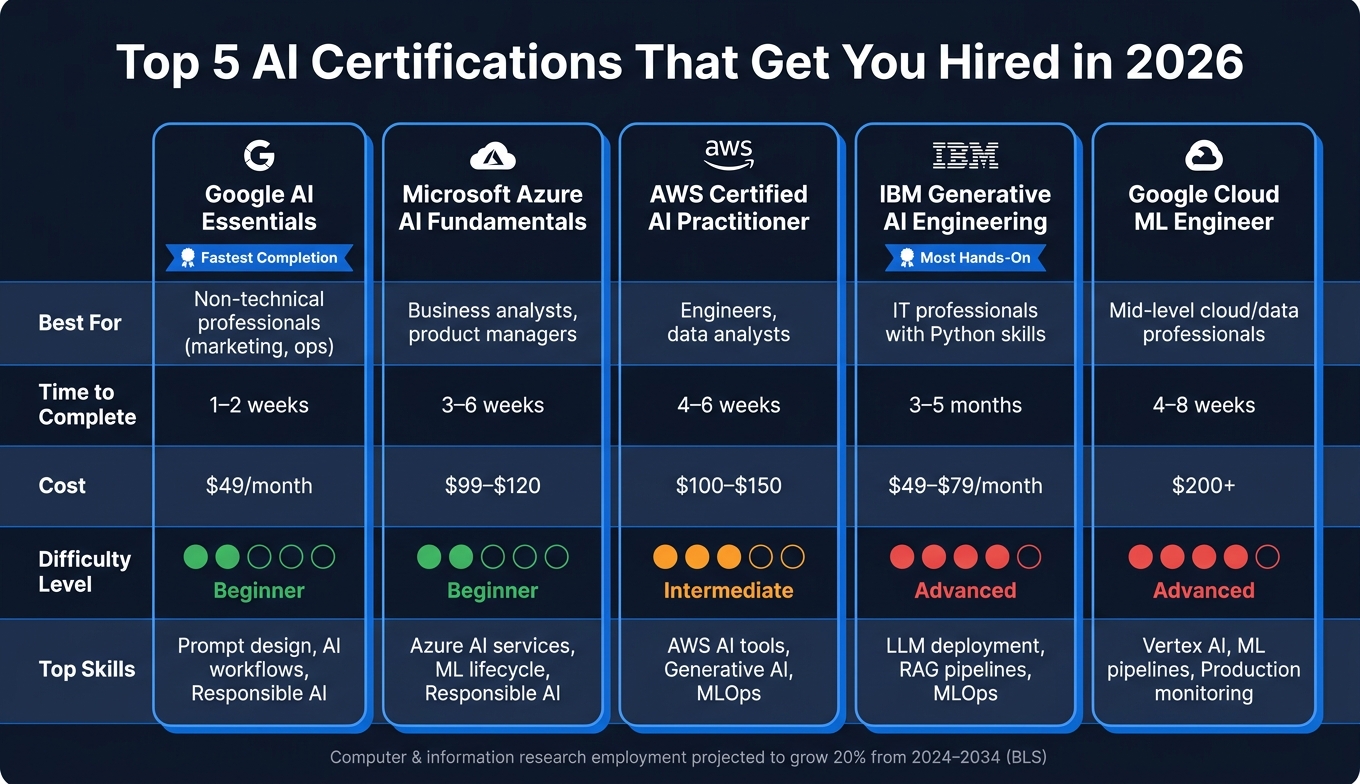
Top 5 AI Certifications in 2026: Side-by-Side Comparison
5 AI Certifications Worth More than a Degree in 2026
sbb-itb-564272e
1. Google AI Essentials
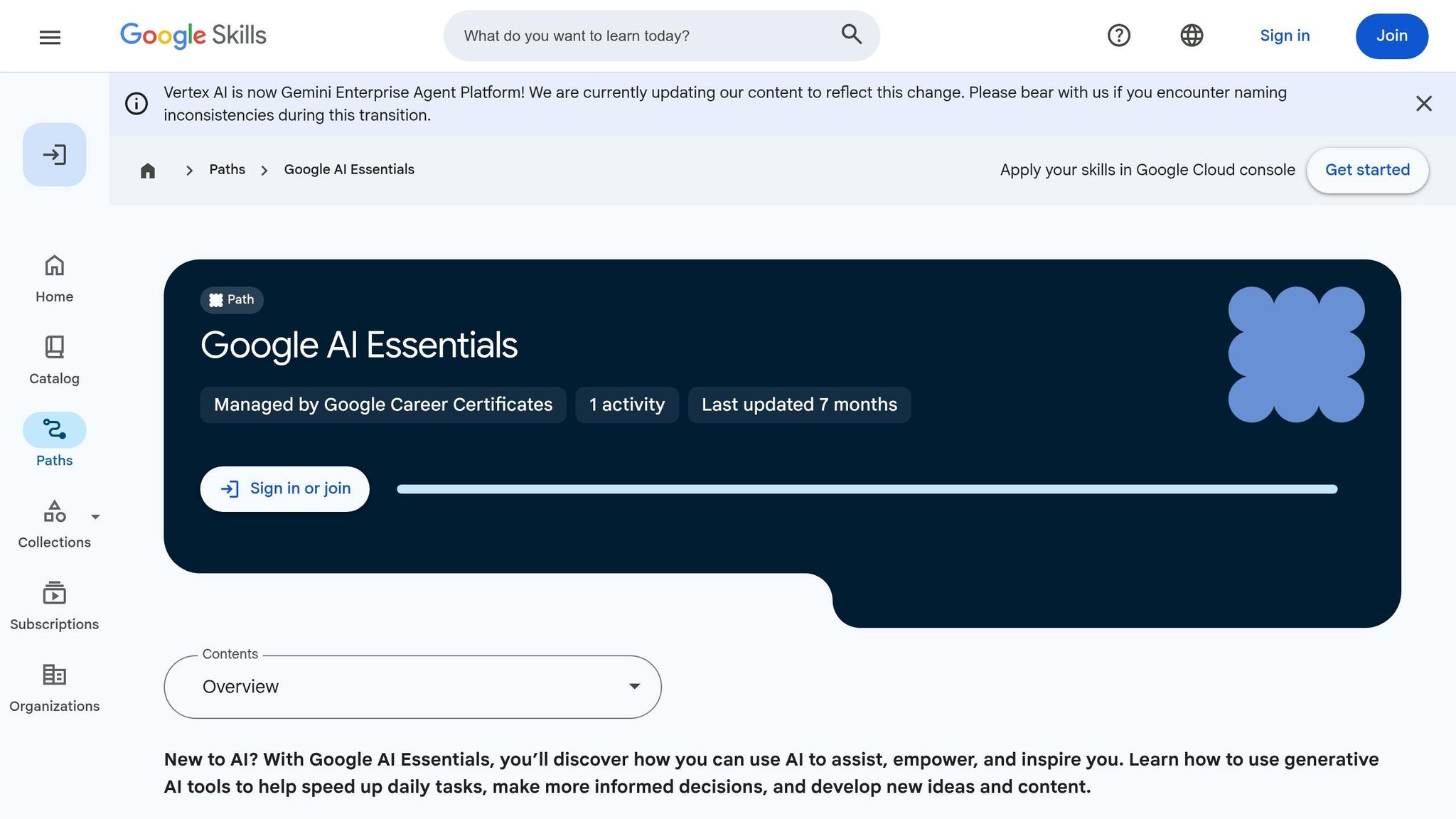
Best for: Non-technical professionals, career changers, and early-career job seekers seeking a quick, credible AI credential.
Google AI Essentials is designed to meet the growing demand for AI skills in the workplace. Offered through Coursera and developed by Google's AI teams, this certification focuses on practical, workplace-ready AI knowledge rather than technical model-building. With just 10 hours of content, most participants finish the course within 1–2 weeks, depending on their pace.
Meeting the Needs of AI-Augmented Roles by 2026
This certification aligns with the fastest-growing job segment for 2026 - AI-augmented roles. It’s particularly relevant for positions like marketing specialists, operations analysts, customer success managers, and project managers. Employers increasingly look for candidates with experience using AI tools such as ChatGPT, Gemini, or Copilot. With a surge in AI-related job postings, especially in non-engineering roles, Google AI Essentials equips learners with the skills hiring managers expect for these positions.
Employer Recognition and ATS Visibility
The Google name holds significant credibility with recruiters on platforms like LinkedIn, Indeed, and ZipRecruiter. The certification validates key skills like prompt design, generative AI workflows, and responsible AI practices - terms frequently prioritized by applicant tracking systems (ATS). To maximize visibility, include this certification in your ATS-friendly resume (e.g., "Google AI Essentials (Google)") and emphasize its practical applications. For example, highlight achievements like, "Designed AI prompts to streamline report creation." These details help align your resume with hiring trends.
Key Skills Covered
The course focuses on four practical skill areas:
- Using large language models like Gemini for tasks such as drafting and summarization
- Structured prompt engineering techniques
- Integrating AI-assisted workflows into everyday office tools
- Responsible AI practices, including managing hallucinations, bias, and data privacy
While it doesn’t cover advanced topics like MLOps, cloud deployment, or model training, it provides a strong foundation for building AI fluency. For those targeting roles like ML Engineer or Data Engineer, this certification serves as a stepping stone rather than a standalone qualification.
Quick Completion, Strong Hiring Potential
Finishing this certification in just two weeks can significantly boost your ATS performance and improve your chances for AI-augmented roles. With a Coursera rating of 4.7/5 from thousands of learners, the course is praised for its practical, office-ready examples. While it may not directly lead to senior technical roles, it can strengthen your job applications. Pairing this credential with ATS-optimized materials through services like Scale.jobs can further enhance your visibility and hiring potential.
2. Microsoft Azure AI Fundamentals
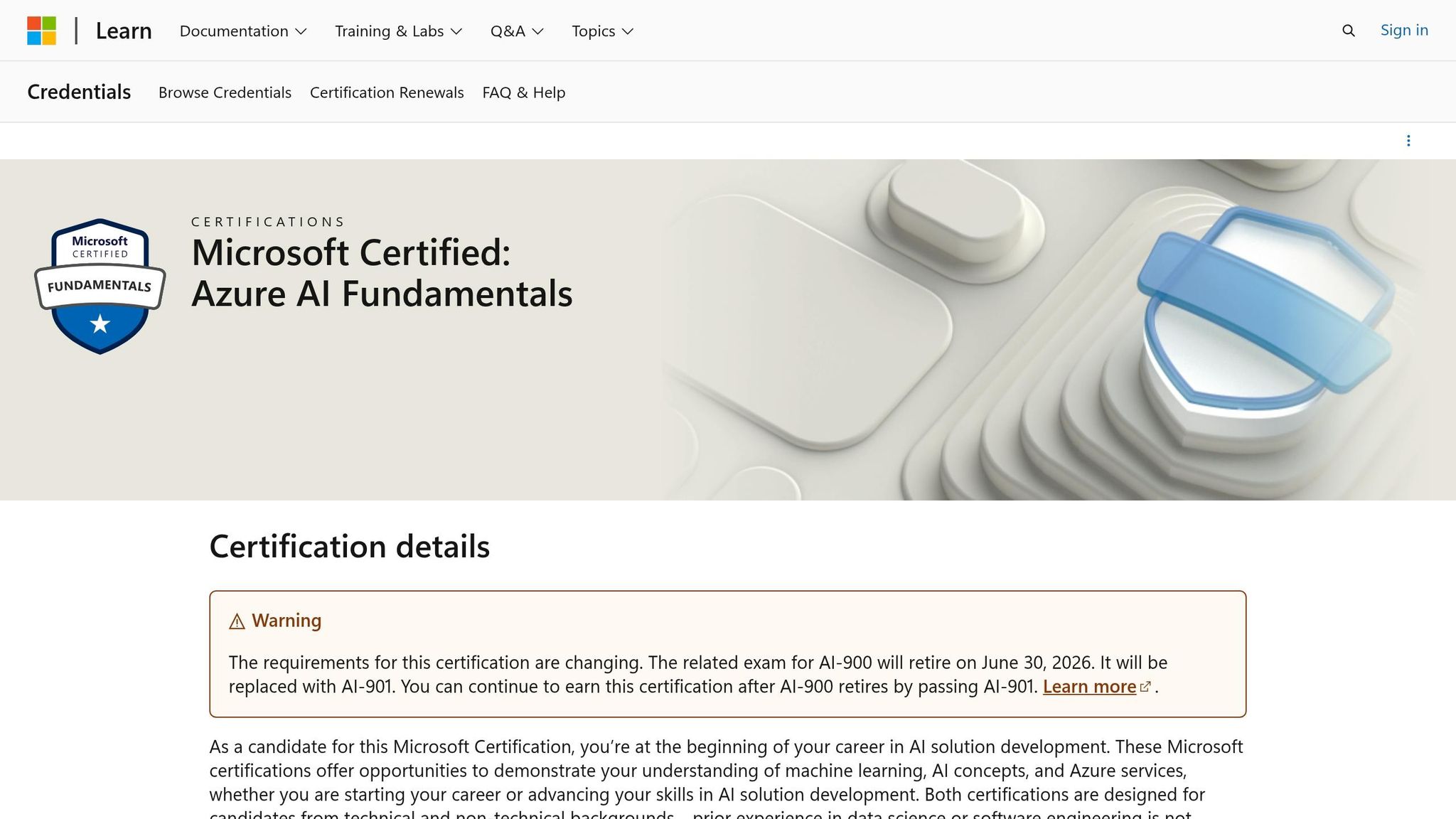
Best for: Early-career professionals, business analysts, product managers, and others seeking AI-related roles in organizations using Microsoft's ecosystem.
Alignment with In-Demand AI Roles in 2026
The Microsoft Azure AI Fundamentals certification (exam AI-900) is tailored for those starting out in AI-related fields, especially roles that combine business and technical expertise. It’s particularly relevant for positions like AI Product Coordinators, business analysts transitioning into AI, junior Cloud Architects, and Customer Success Managers in companies relying on Azure. These jobs typically don’t require deep technical skills like building models from scratch but do demand a solid understanding of Azure AI's features and limitations. By 2026, having a basic grasp of Azure AI will likely be a baseline expectation in such roles.
Employer Recognition in U.S. Job Postings
For organizations operating within the Microsoft ecosystem - leveraging tools like Microsoft 365, Azure Active Directory, Dynamics, or Power Platform - the Azure AI Fundamentals certification is a valued asset. It’s frequently mentioned alongside other Microsoft credentials like AZ-900 and DP-900 in industries such as enterprise IT, healthcare, finance, and government contracting. However, its value diminishes in workplaces that prioritize AWS or Google Cloud services. Still, the certification's emphasis on Microsoft’s AI capabilities aligns well with hiring trends in these sectors.
Skill Coverage Tied to Hiring Needs
The AI-900 exam introduces foundational concepts that match the skills employers are listing in job descriptions today. Topics include generative AI basics, applications of Azure OpenAI Service, Azure Cognitive Services, and principles of responsible AI - such as fairness, transparency, and data privacy - critical for roles in regulated industries. The certification also covers the machine learning lifecycle, from data preparation to deployment and monitoring, equipping candidates with the terminology needed to collaborate effectively with MLOps teams, even if they aren’t directly involved in building pipelines.
Time-to-Complete vs. Hiring Impact
If you already have some familiarity with cloud or data concepts, preparing for the AI-900 exam typically takes 3–6 weeks, or about 20–40 hours of study at 5–7 hours per week. The exam itself lasts around 60–90 minutes and costs between $99 and $120. Microsoft Learn offers free official preparation materials, keeping the overall cost low. To maximize hiring impact, consider pairing the certification with a practical Azure project. For example, you could build a document-summarization pipeline using Azure OpenAI Service and feature it on your resume.
According to Microsoft's Work Trend Index, 75% of knowledge workers use AI at work, yet only 15% have received formal training from their employers.
While the AI-900 certification is an excellent starting point, it’s not the end goal for those pursuing technical AI careers. Next steps might include advanced certifications like Azure AI Engineer Associate (AI-102) or Azure Data Scientist Associate (DP-100). For cross-functional roles, pairing this certification with services like scale.jobs' resume optimization and WhatsApp support can enhance your application’s visibility, especially for roles requiring hands-on Azure experience. Combining Azure AI Fundamentals with ATS-friendly materials ensures your resume makes it through recruiter screenings effectively - a strategy similar to pairing Google AI Essentials with practical job search tools for maximum impact. This is crucial because most AI-applied resumes are rejected by ATS due to formatting issues.
3. AWS Certified AI Practitioner
Best for: Software engineers, data analysts, cloud practitioners, and individuals transitioning into AI-related roles within AWS-centric organizations.
Alignment with Growing AI Roles in 2026
AWS continues to dominate as the most widely used cloud provider in North America. By 2026, a significant portion of AI-related job postings are expected to reference AWS services like Amazon SageMaker, Amazon Bedrock, and Amazon Q for positions such as Generative AI Engineer, Machine Learning (ML) Engineer, and AI Solutions Architect. The AWS Certified AI Practitioner (exam AIF-C01) validates foundational knowledge of these services, making it a practical choice for associate-level ML engineers, cloud engineers moving into AI, and data engineers working on AI workloads. However, it’s not ideal for research-heavy roles requiring advanced mathematics or custom model development expertise.
Employer Recognition in U.S. Job Postings
AWS certifications, particularly foundational ones, are often listed as "preferred" or "nice to have" qualifications in job descriptions. Credentials like AWS Cloud Practitioner and AWS Certified Developer – Associate have established this trend. Companies heavily invested in AWS, managed service providers meeting AWS partner requirements, and startups leveraging AWS infrastructure are likely to value this certification. A Lightcast/Burning Glass analysis highlights that demand for generative AI skills surged over 1,000% year-over-year, with roles blending AI and cloud expertise offering median salaries $10,000–$30,000 higher than similar positions without these skills. This demand underscores the relevance of this certification.
Skills Covered to Meet Hiring Demands
The certification focuses on four key areas:
- AI/ML and generative AI fundamentals
- AWS AI services and their applications
- Data security and responsible AI practices
- AI solution strategies on AWS
You'll learn to utilize Amazon Bedrock for working with foundation models (like Anthropic Claude and Amazon Titan), manage the ML lifecycle through SageMaker, and apply services such as Rekognition and Comprehend. The responsible AI component - addressing concerns like bias, data privacy, and governance - is especially important in regulated industries. This mix of LLM knowledge, MLOps skills, and cloud integration aligns closely with what hiring managers prioritize today.
Time-to-Complete and Career Impact
The time required to prepare depends on your background. For software engineers or cloud practitioners familiar with AWS, preparation typically takes 4–6 weeks with a commitment of 5–7 hours per week. Data analysts or those new to AWS might need 6–10 weeks. The exam costs between $100–$150 in the U.S., and AWS provides free preparation resources through Skill Builder, including modules on Bedrock, SageMaker, and Amazon Q.
While the certification demonstrates your potential, pairing it with hands-on projects amplifies your employability. Consider showcasing two or three portfolio projects, such as building an FAQ chatbot using Amazon Bedrock and Lambda or creating a SageMaker pipeline. Highlight these skills on your resume with the help of scale.jobs, which offers human-assisted resume optimization, transparent proof-of-work tracking, and ATS-friendly documents - all for a one-time payment. This ensures your AWS credentials stand out in a competitive job market.
A 2024 AWS Skills Guild survey revealed that organizations with at least one AWS-certified professional per team experienced up to 80% faster cloud adoption and a 20–30% improvement in project delivery timelines.
4. IBM Generative AI Engineering Professional Certificate
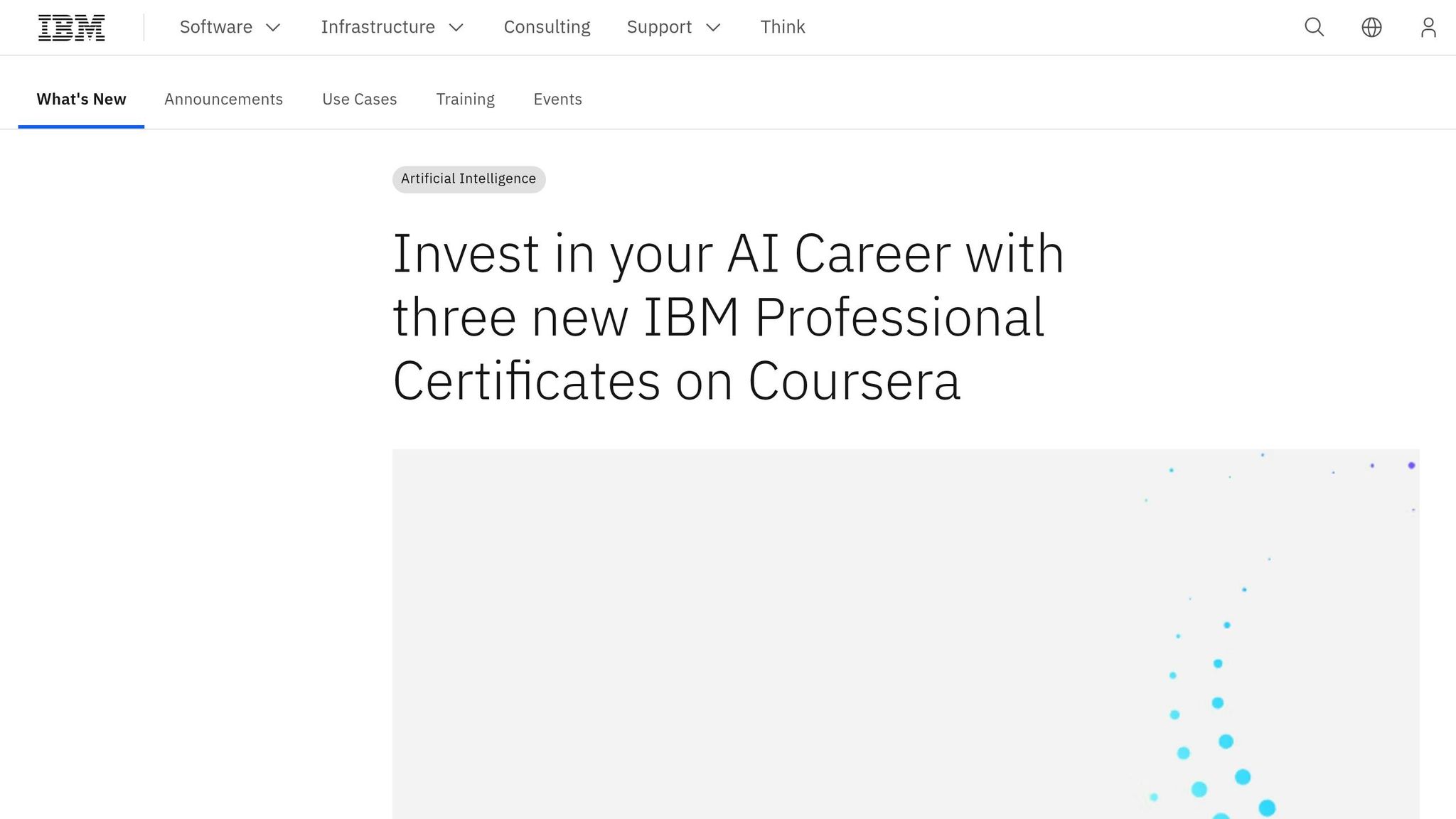
Best for: IT professionals skilled in Python who are aiming to transition into applied generative AI roles within enterprise-level organizations.
Alignment with In-Demand AI Roles in 2026
This certification is tailored for roles that combine software engineering with generative AI - a field seeing rapid growth in the U.S. By 2026, job titles such as Generative AI Engineer, AI Application Developer, and ML Engineer are expected to be among the fastest-growing positions. LinkedIn's 2024 Jobs on the Rise report highlights "AI engineer" and "prompt engineer" as some of the most sought-after roles. The program prioritizes hands-on skills like building and deploying LLM-based systems - such as RAG pipelines, fine-tuned models, and cloud-hosted endpoints - addressing what hiring managers mean when they emphasize "practical experience." Unlike automated tools like Jobscan, platforms such as scale.jobs combine human expertise with ATS-optimized documentation, ensuring your IBM-acquired skills are presented in a way that resonates with both recruiters and applicant tracking systems.
Employer Recognition in U.S. Job Postings
IBM's reputation carries significant weight in key U.S. industries, including finance, healthcare, and government contracting - sectors actively recruiting for AI roles while emphasizing governance and compliance expertise. According to IBM's Global AI Adoption Index (2023), 37% of IT leaders cite a lack of AI skills as the primary barrier to deployment. This highlights the urgent demand for professionals who can bridge that skills gap. Beyond signaling credibility, this certificate emphasizes responsible AI practices, governance frameworks, and compliance-aware deployments, making it especially relevant for regulated industries. For those targeting roles at IBM partner firms or large system integrators, this certification could serve as a standout qualification.
Skill Coverage Tied to Hiring Needs
The program offers a unique blend of LLM deployment techniques and MLOps, a combination not commonly found in other AI certifications. On the LLM side, participants gain expertise in transformer architectures, prompt engineering (zero-shot, few-shot, chain-of-thought), and retrieval-augmented generation using vector databases. Meanwhile, the MLOps component covers crucial topics like model packaging, API deployment, versioning, and drift monitoring - skills that align directly with job descriptions requiring "experience deploying LLMs into production." While the coursework uses IBM watsonx.ai, the skills - such as REST APIs, Python, and containerization - are transferable to other cloud platforms like AWS, Azure, or GCP. To help translate these advanced skills into job interviews, scale.jobs offers personalized resume support, ensuring your technical expertise is framed effectively for recruiters - something automated platforms like Jobscan or LazyApply often overlook.
Coursera’s 2024 Skills Report revealed that 86% of learners completing Professional Certificates experienced career benefits, such as new opportunities, promotions, or career changes, especially in IT and AI-related fields.
Time-to-Complete vs. Hiring Impact
Most professionals complete this certification in 3–5 months with a commitment of 3–4 hours per week, or in 6–12 weeks with an accelerated schedule of 5–7 hours weekly. This timeline fits well with a structured job search strategy: dedicate the first two months to coursework and building portfolio projects, then focus on targeted applications in the following months. Highlighting projects like a deployed RAG chatbot (e.g., a FastAPI app using FAISS and an LLM API) or a model deployment pipeline with performance monitoring can demonstrate production-ready skills to potential employers. The certification costs between $49–$79/month through Coursera or is included in the Coursera Plus subscription for about $399/year. Financial aid is available for eligible learners.
Who Should Use Jobscan or LazyApply
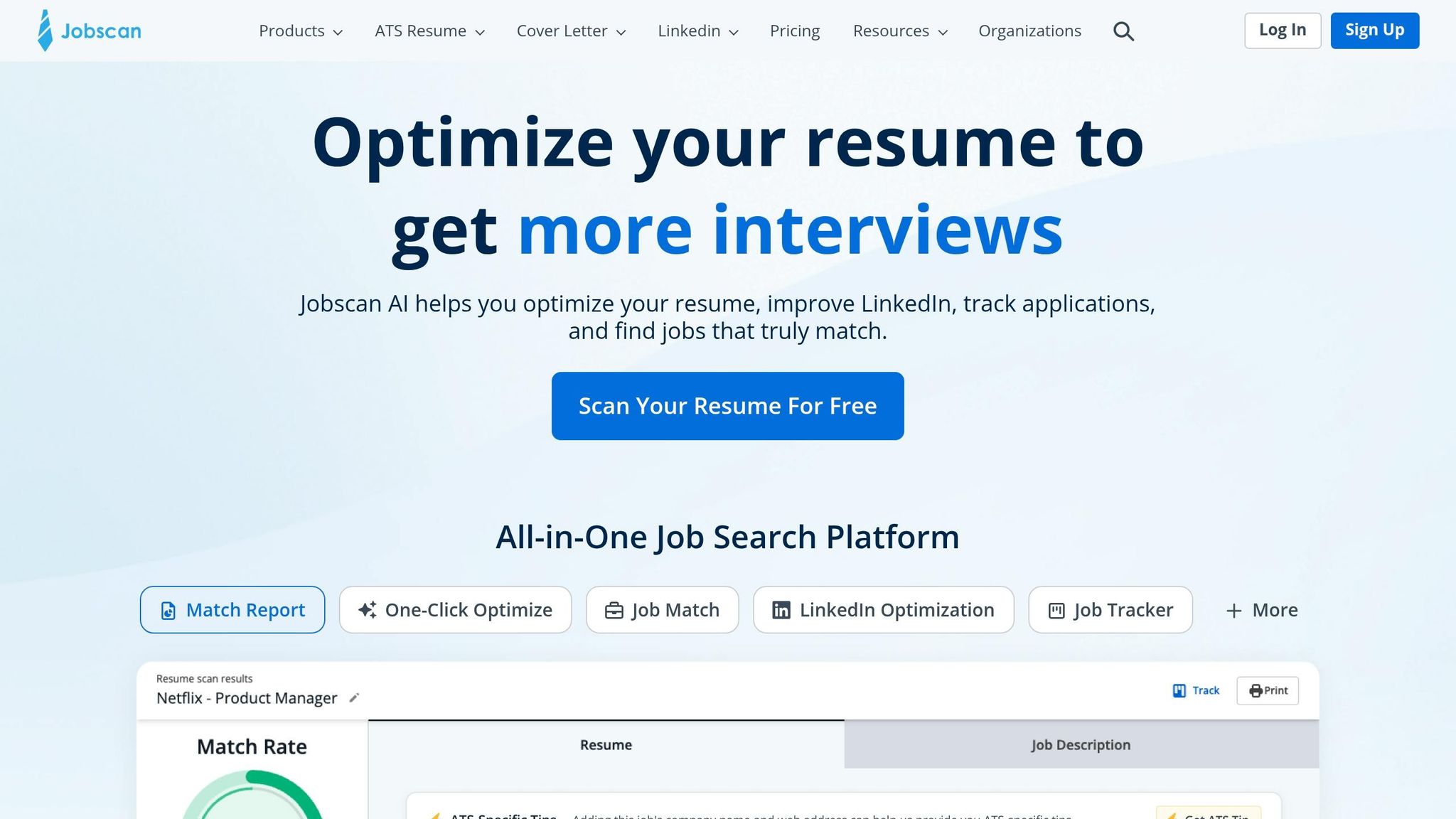
Automated platforms like Jobscan or LazyApply are suitable for candidates who need a quick, affordable resume scan, want immediate keyword analysis, or are applying to a large number of jobs with minimal customization. These tools are efficient for applicants with strong resumes who only need a final ATS check before submission.
Who Should Choose scale.jobs
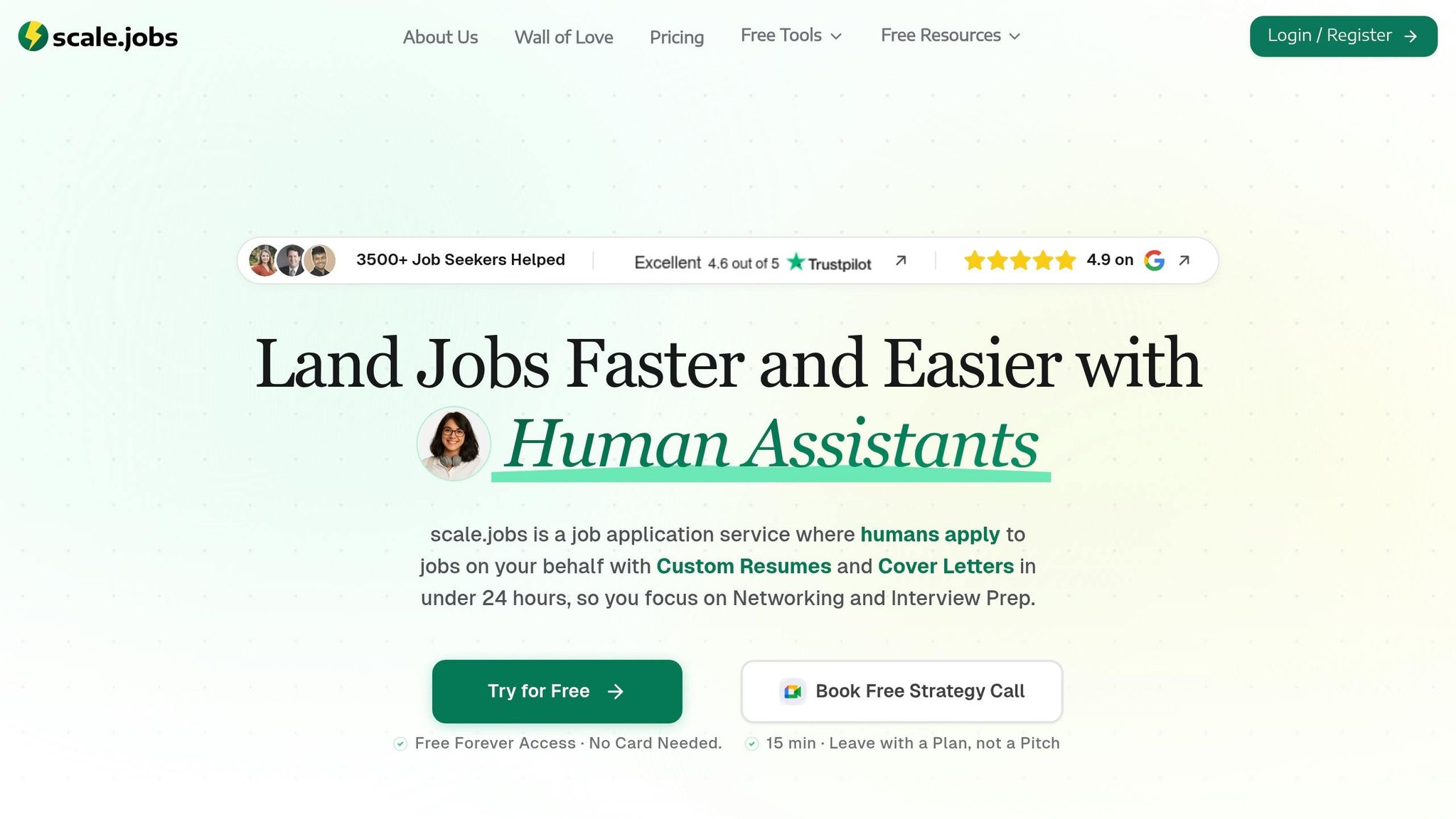
Opt for scale.jobs if your IBM certification includes advanced technical skills - like RAG pipelines, watsonx.ai deployments, or MLOps workflows - that require a nuanced presentation for non-technical recruiters. This platform is ideal if you need:
- Human-reviewed resume optimization tailored to AI engineering terminology
- ATS-optimized documents designed around specific credentials and roles
- One-time payment without recurring subscription fees
- Dedicated WhatsApp support throughout your job search
- Proof-of-work transparency so you know exactly what changes were made to your application
Comparison: scale.jobs vs. Automated Tools for IBM Certificate Holders
| Feature | Jobscan / LazyApply | scale.jobs |
|---|---|---|
| Human involvement | Fully automated | Human reviewers optimize resumes |
| Resume customization depth | Focused on keyword matching | Tailored framing of technical skills |
| ATS handling | Automated keyword analysis | Human-crafted, ATS-friendly documents |
| Application execution method | Self-service or auto-apply | Human-assisted, targeted applications |
| Transparency and proof of work | Limited reporting | Detailed proof-of-work documentation |
| Pricing model | Subscription-based | One-time payment |
Maximizing the Value of Your IBM Certification
Once you've completed your portfolio projects, simply linking to your GitHub profile isn't enough. Pairing your IBM certification with a professionally crafted resume that highlights the right keywords for AI engineering roles can make a significant difference. A resume writing service that combines human expertise with ATS optimization can help translate your watsonx.ai and RAG experience into language that not only passes automated filters but also grabs a recruiter's attention. This ensures your certification becomes a stepping stone to interviews and career growth in 2026.
5. Google Cloud Professional Machine Learning Engineer
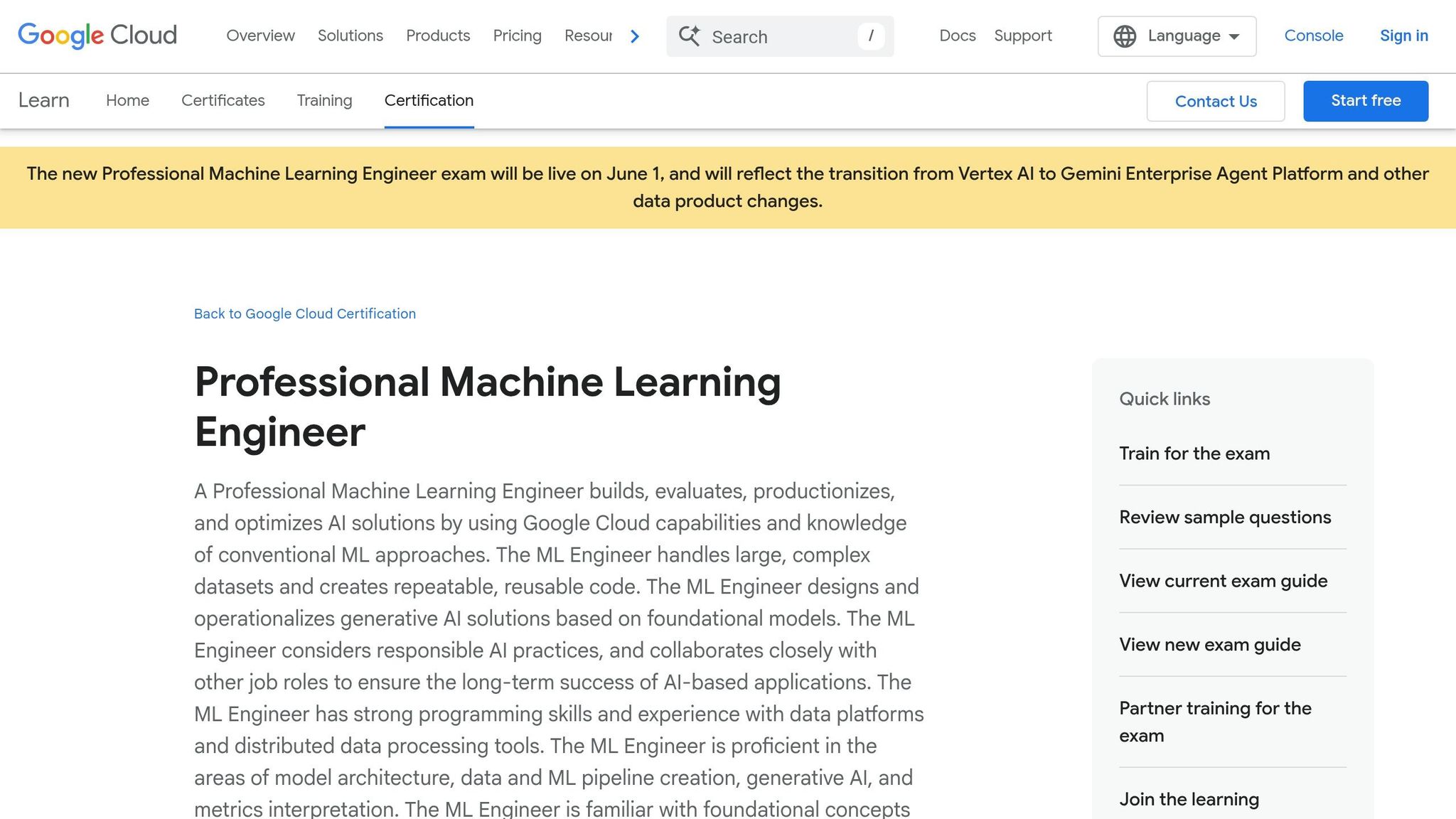
Best for: Professionals with mid-level expertise in Python, cloud platforms, or data science who aim to prove their ability to deploy and manage machine learning (ML) systems in production - not just grasp AI concepts.
Alignment with Emerging AI Roles by 2026
This Google Cloud certification showcases your ability to handle production-ready ML systems, a skill set increasingly sought after for roles like Machine Learning Engineer, MLOps Engineer, Applied AI Engineer, or Data Scientist with production tasks. As the demand for AI professionals grows, this credential demonstrates your expertise in deploying, monitoring, and managing AI solutions in live cloud environments, making your application more competitive in the evolving job market.
Recognition Among U.S. Employers
Employers in the U.S. highly regard this certification, especially in workplaces that utilize Google Cloud or hybrid multi-cloud setups. Job postings mentioning tools like Vertex AI, ML pipelines, feature stores, model monitoring, or containerized inference often align with the skills validated by this credential. It signals to employers that you have the practical engineering knowledge to meet their technical requirements.
Skills That Match Hiring Needs
This certification verifies your proficiency in deploying and managing Vertex AI solutions, covering tasks such as data preparation, feature engineering, model training, pipeline automation, deployment, and production monitoring. Employers value this expertise, especially for roles focused on scalable ML systems. Additionally, combining this certification with hands-on experience in areas like embeddings or prompt evaluation for large language models can further enhance your profile.
Preparation Time vs. Career Impact
Preparation time varies: experienced professionals may need 4–8 weeks, while those new to the field might require 3–4 months. The impact of this certification is amplified when paired with a portfolio of practical projects. Examples include deploying a customer churn model on Vertex AI, building an automated training pipeline with drift monitoring, or creating a small-scale LLM application with retrieval and cloud inference. Employers appreciate candidates who can explain their deployment decisions and trade-offs clearly.
Looking to maximize the potential of your certification? The next section explores how scale.jobs can help you craft a resume that effectively highlights your AI credentials.
Why Choose scale.jobs for This Certification?
To stand out with a Google Cloud ML certification, your resume must reflect your technical depth and project experience. scale.jobs excels at tailoring resumes for AI professionals, ensuring that your skills and accomplishments are presented effectively. Here's what makes scale.jobs the right choice:
- Expert human reviewers who understand ML pipelines, MLOps, and production monitoring, ensuring your resume resonates with technical hiring teams.
- Custom, ATS-friendly resumes that highlight your Vertex AI and ML engineering expertise.
- One-time payment model with dedicated WhatsApp support throughout your job search - no recurring fees.
- Transparent proof-of-work documentation, so you know exactly how your resume was optimized.
| Feature | Automated Tools | scale.jobs |
|---|---|---|
| Human involvement | Fully automated | Human reviewers |
| Resume customization depth | Keyword matching | Tailored for ML roles |
| ATS handling | Automated scans | Crafted for ATS |
| Application execution method | Self-service/auto | Human-assisted |
| Transparency and proof of work | Limited reporting | Detailed proof provided |
| Pricing model | Subscription-based | One-time payment |
For candidates with Vertex AI and ML pipeline experience, scale.jobs ensures your resume is optimized for both applicant tracking systems and hiring managers, giving you the edge in a competitive job market.
How to Pick the Right AI Certification for Your Career Goals
The best way to choose an AI certification is to start with the job you’re targeting, not the certification itself. Take a look at 10–20 recent U.S. job postings on platforms like LinkedIn or Indeed for roles you’re aiming to land in the next 6–12 months. Pay close attention to the tools, platforms, and skills that appear frequently in these listings. Then, select a certification whose curriculum aligns closely with those requirements. Unlike tools like LazyApply, which automate application processes without prioritizing strategic alignment, this approach ensures you focus on what employers are actually looking for. The most effective certification isn’t necessarily the most challenging - it’s the one that directly reflects the skills employers need.
Once you’ve identified the key skills, evaluate your current expertise to determine the best starting point.
- If you’re new to technical concepts, consider foundational certifications like Google AI Essentials or Microsoft Azure AI Fundamentals to quickly build credibility.
- If you already have experience with programming languages like Python or SQL, you might advance faster with certifications such as AWS Certified AI Practitioner or IBM Generative AI Engineering Professional Certificate.
The goal is to choose a certification that fills the gap between your existing skills and the job requirements, rather than opting for something that just sounds impressive.
Additionally, pairing your certification with a tangible project is a smart way to demonstrate your skills to potential employers. For instance, after earning the AWS Certified AI Practitioner, you could create a prototype using an AWS AI service. Document the project’s inputs, outputs, and business value, and upload it to GitHub. This combination of a certificate and a real-world project is far more impactful than a certificate alone.
Who Should Use Competitors vs. Who Should Choose scale.jobs
Platforms like LazyApply or FindMyProfession are ideal for candidates seeking rapid, automated resume scans or high-volume applications with minimal customization. These tools are efficient for job seekers who already have a strong resume and need a quick ATS (Applicant Tracking System) check before submitting applications.
On the other hand, scale.jobs is better suited for candidates making a career pivot, especially those with specialized AI certifications that require careful positioning. It’s also ideal for those who need consistent, human-executed applications across multiple platforms.
After earning your certification, the next hurdle is turning it into interviews - a step where many candidates struggle. Updating your resume with the right keywords, tailoring each application to specific job descriptions, and submitting applications manually can take over 20 hours a week. This is where scale.jobs steps in, offering trained human assistants to handle the entire application process. Unlike AI vs human job application services that rely solely on bots, their approach avoids ATS flags and ensures your applications are tailored to each job. They also provide resume writing services to help frame your certification within a compelling career story. With real-time WhatsApp updates and timestamped proof-of-work screenshots, you’ll always know the status of your applications.
Consider switching to scale.jobs if…
- You’ve earned an AI certification and need your resume updated to highlight specialized skills like RAG pipelines, Vertex AI, or MLOps for non-technical recruiters.
- You’re applying to 20+ jobs weekly and want human-executed submissions to avoid ATS issues.
- You need ATS-optimized documents that focus on precise credential keywords rather than generic keyword stuffing.
- You prefer a one-time payment model without recurring subscription fees.
- You value dedicated WhatsApp support and clear, timestamped proof-of-work to track progress.
Conclusion
Each of these certifications is designed with a specific audience in mind. Google AI Essentials is ideal for non-technical professionals looking to quickly gain AI skills for the workplace. If you're working in cloud environments like Microsoft or Amazon, Azure AI Fundamentals or AWS Certified AI Practitioner are excellent choices. For developers eager to dive into hands-on experience with LLMs and RAG systems, IBM Generative AI Engineering stands out. Meanwhile, the Google Cloud Professional ML Engineer certification is perfect for showcasing expertise in production-scale machine learning.
The best certification for you isn’t necessarily the one with the most prestige - it’s the one that bridges the gap between your current skills and the qualifications your target employers are actively seeking.
"An AI certification recognized by top tech companies in the US can help you pass resume screening - but pairing it with real-world projects and applied problem-solving is what truly secures the job in 2026." - Georgia Weston
While certifications can boost your qualifications, a well-crafted resume is equally crucial. Once you've earned your credential, ensure you build a resume that passes ATS filters and capture a recruiter’s attention. A professional resume writing service can help translate your certification into the specific terms hiring managers are looking for - whether it’s expertise in Vertex AI, SageMaker, or LangChain. Unlike automated tools such as Jobscan or LazyApply, scale.jobs uses human insights to refine your resume, ensuring it aligns perfectly with both ATS systems and recruiter expectations.
With computer and information research employment projected to grow 20% from 2024 to 2034, now is the time to take action. Select the certification that aligns with your career goals and ensure your application materials effectively showcase your new skills.
Decision Summary
Choose scale.jobs if you:
- Need a human-reviewed, ATS-optimized resume that highlights specialized AI credentials - such as RAG pipelines, Vertex AI, or MLOps - for both technical and non-technical roles
- Are applying to 20+ jobs weekly and want human-assisted submissions that avoid ATS errors
- Prefer a one-time payment model with dedicated WhatsApp support and clear, timestamped proof-of-work
Choose an automated tool (e.g., Jobscan, LazyApply) if you:
- Already have a strong resume and just need a quick, budget-friendly ATS keyword check before applying
- Are submitting applications in bulk with minimal customization and don’t require human intervention
FAQs
Which AI certificate should I choose for my target job title?
The most suitable AI certification for your desired job will vary based on your career stage and objectives. If you're a mid-career professional, prioritize certifications that emphasize practical skills, align with current AI job market demands, and adhere to industry benchmarks. These certifications are expected to significantly enhance job opportunities through 2026.
Do I need projects in addition to a certification to get interviews?
Yes, pairing projects with a certification can greatly enhance your prospects. Certifications validate your knowledge, but projects go a step further by highlighting your ability to apply that knowledge in practical, real-world situations. Employers appreciate seeing how you've turned theory into action, as it provides tangible proof of your skills and problem-solving abilities, making you stand out as a stronger candidate.
How should I list an AI certification on my resume to pass ATS?
When listing a certification on your resume, place it in a dedicated Certifications or Skills section. Use the official title of the certification, ensuring it aligns with the terminology used in the job description. This helps maintain consistency and boosts compatibility with Applicant Tracking Systems (ATS).
If the certification is central to the role you're applying for, consider briefly referencing it in your professional summary or experience section. For example, highlight how you’ve applied the knowledge or skills gained through the certification in a practical setting.
Keep the language clear and concise, and include any relevant tools or skills associated with the certification. This approach not only demonstrates your qualifications but also ensures your resume is optimized for ATS scanning.