
The exact % to ask for in salary negotiation (2026 data)

Sarah Mitchell
June 5, 2026

When negotiating your salary in 2026, the key is to use current market data and tailor your request based on your leverage and role. Asking for a specific percentage increase - typically between 5–20% - depends on factors like industry demand, competing offers, and your unique skill set. Here’s a quick breakdown:
- Low leverage (5–8%): No competing offers or generalist skills.
- Medium leverage (10–15%): Strong performance record or one competing offer.
- High leverage (15–20%+): In-demand skills or multiple offers.
To prepare, research salary benchmarks using tools like Glassdoor, LinkedIn Salary, or Levels.fyi, and calculate a target range based on your role, location, and experience. If base salary adjustments are limited, shift focus to benefits like bonuses, equity, or PTO. By backing your ask with data and aligning it with market trends, you’ll confidently secure a fair offer.
How to Negotiate a Higher Salary: 3 Evidence-Based Tips!
Setting Your Baseline: What Fair Pay Looks Like in 2026
Establishing a clear baseline is essential when determining the percentage increase to request during salary negotiations. By relying on accurate market data, you can confidently justify your expectations and avoid undervaluing your worth.
Where to Find Reliable Salary Data in 2026
To get a well-rounded view of salaries, it's important to consult multiple sources - at least three for accuracy. Here are some key tools in 2026:
- Glassdoor: Ideal for company-specific salary insights. If you're negotiating with a particular employer, their salary pages often provide narrower, more precise ranges compared to broader market data.
- LinkedIn Salary: This platform allows you to filter data by industry, ensuring you're comparing salaries within the correct context - e.g., healthcare project managers versus SaaS project managers.
- Robert Half's 2026 Salary Guide: A trusted resource offering salary ranges by role and location, including adjustments for specific cities.
- Levels.fyi: Especially useful for tech, product, and data roles. It breaks down compensation into base salary, bonuses, and equity, categorized by seniority levels (e.g., L4 vs. L5 Software Engineer), delivering a highly detailed view.
When analyzing the data, use the median as your benchmark for fair pay, the 25th percentile as the minimum acceptable rate, and the 75th percentile as a target for candidates with exceptional experience or rare skills.
How to Define Your Personal Salary Range
With data from multiple sources in hand, you can create a personalized salary range by identifying three key points: your floor, your midpoint, and your stretch target.
For example, let’s consider a mid-level software engineer in Austin, TX, with five years of experience and expertise in cloud technologies. Based on data from Glassdoor, LinkedIn, and Levels.fyi for 2026, the salary range might look like this:
- Floor: $120,000–$125,000
- Midpoint: $135,000–$140,000
- Stretch Target: $145,000–$150,000
Where you position yourself within this range depends on your experience, specialized skills, and measurable achievements. Candidates transitioning into a new role or field should aim for the 25th–40th percentile, while those with niche expertise - such as AI/ML, cybersecurity, or regulatory knowledge - can reasonably target the 65th–80th percentile. If you’re working with a resume writing service, they can help you present your accomplishments in a way that supports your case for higher compensation.
By setting a clear baseline, you’ll be better equipped to evaluate offers and identify when they fall short of market expectations.
Why Initial Offers Often Fall Below Market Rate
It’s common for companies to start negotiations with an offer that doesn’t reflect the market rate. This is because initial offers are typically anchored to internal pay bands and budget limits, rather than external salary benchmarks. Even with the rise of pay transparency laws in states like California, New York, and Colorado, posted salary ranges are often broad - spanning 20–30% - and companies usually aim to hire within the 50th–75th percentile of their internal range, rather than the top.
This discrepancy exists partly because many candidates don’t negotiate. According to Glassdoor, around 59% of job seekers accept the first offer without pushing back. Employers often anticipate counteroffers but benefit when they don’t occur. Understanding this dynamic - and having the data to back up your counteroffer - can turn a vague sense of being undervalued into a well-supported case for higher pay.
The Exact % to Ask For: 2026 Data and Recommendations
Low, Medium, and High Leverage: Choosing the Right %
The percentage you request during negotiations should align with your actual leverage, not just your desired salary. In 2026, U.S. candidates generally fall into one of three leverage tiers:
| Leverage Level | Ask Range | When It Applies |
|---|---|---|
| Low | 5–8% | No competing offers, generalist skills, internal raise requests, or during tight budget periods |
| Medium | 10–15% | One competing interview and a strong performance record |
| High | 15–20%+ | A written competing offer, specialized in-demand skills, or offers significantly below market value (15–25%) |
If you're content with the initial offer, aim for the lower end. Conversely, if the offer doesn't meet your expectations, target the higher range. The type of offer you're negotiating also influences these percentages.
Adjusting Your % Based on Role and Offer Type
The role and offer type play a critical role in determining how much to counter.
For external offers, employers often include some flexibility. A counteroffer of 10–15% is typical when the initial offer aligns with or is slightly below the market median. For example, if a senior software engineer in San Francisco is offered $180,000, but the market range is $190,000–$220,000, an appropriate counter might be $205,000–$215,000.
Internal raises are often more constrained due to company policies. Most organizations in the U.S. allocate 3–5% for annual merit increases. Asking for 5–8% already exceeds the norm in these cases. However, for internal promotions with expanded responsibilities, requesting a 10–15% increase is reasonable, particularly if the new role falls into a higher salary band.
Negotiating at startups or in government roles requires a tailored approach. Early-stage companies often have limited salary flexibility, so a 5–10% base increase request paired with a focus on equity or signing bonuses is more effective. Government positions, bound by rigid step-and-grade pay scales, leave little room for large increases. In these cases, requesting a higher step (resulting in a 2–4% raise) or enhanced non-salary benefits, such as telework flexibility or faster promotion timelines, is more practical. Similarly, for internships at large employers, where base pay is often standardized, it’s better to negotiate benefits like relocation stipends or housing support.
When to Focus on Benefits Instead of Base Salary
Once you've established clear percentage benchmarks, it’s essential to assess whether pushing for a higher base salary is the best move. If a company indicates that your base salary is already at the top of their internal range, persisting in that direction can backfire. Instead, shift the conversation toward total compensation.
Other components of the compensation package - such as bonuses, equity grants, signing bonuses, additional PTO, remote work flexibility, or expedited performance reviews - often offer more room for negotiation. Hiring managers typically have more discretion over these elements, making them easier to adjust.
If you've worked with a professional to refine your application materials and highlight your impact, you’ll be better positioned to negotiate these alternative benefits. A well-documented case for a signing bonus or an extra week of vacation can often provide as much value as a 5% base salary increase - and may be easier for the company to approve. These percentage guidelines are just one part of a broader negotiation strategy designed to help you secure the best possible offer.
sbb-itb-564272e
A Step-by-Step Framework to Calculate Your Exact Ask
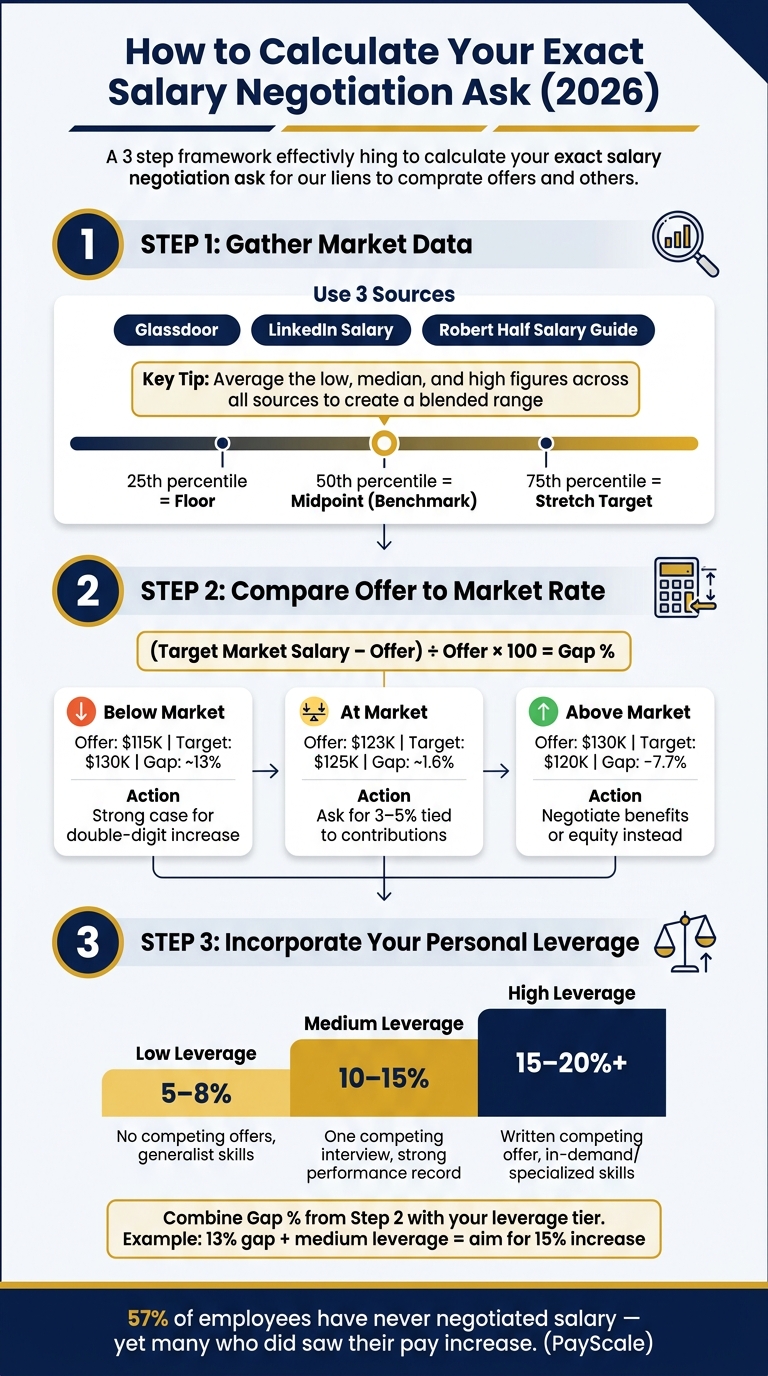
How to Calculate Your Exact Salary Negotiation Ask (2026)
Understanding the right salary ranges is just the beginning - you need a clear method to apply them to an actual offer. Here’s a simple three-step process to guide you each time.
Step 1: Gather Market Data
Start by researching salary benchmarks using Glassdoor, LinkedIn Salary, and the Robert Half Salary Guide.
- On Glassdoor, search your job title and city, filter by experience level, and note the 25th to 75th percentile base salary range.
- On LinkedIn Salary, refine your search by title, location, company size, and industry. Focus on the median and interquartile range for the most reliable data.
- For the Robert Half Salary Guide, locate your job family and role level, then adjust the national midpoint using their city multiplier. For instance, San Francisco has a +41% multiplier, while smaller Midwest markets might be around -10%.
Once you’ve collected salary data from all three sources, average the low, median, and high figures to create a blended range. Use the blended midpoint as your baseline for further calculations. From here, you can assess how the offer compares to the market rate.
Step 2: Compare the Offer to the Market Rate
Determine the gap percentage using this formula:
(Target Market Salary - Offer) ÷ Offer × 100
Here are examples of how to interpret the results:
- Below Market (Offer: $115,000, Target: $130,000, Gap: ~13%): You have a strong case for a double-digit salary increase.
- At Market (Offer: $123,000, Target: $125,000, Gap: ~1.6%): A modest 3–5% increase is reasonable, tied to specific contributions.
- Above Market (Offer: $130,000, Target: $120,000, Gap: -7.7%): Instead of focusing on base salary, consider negotiating benefits or equity.
For mid-career professionals, base your calculations on a target between the blended median and the 75th percentile. If you’re early in your career (0–2 years), aim closer to the median to keep your expectations realistic.
With the gap percentage in hand, it’s time to factor in your personal leverage and finalize your counteroffer.
Step 3: Incorporate Your Personal Leverage
Your leverage - whether low, medium, or high - can influence how much you adjust your ask. Use factors like competing offers or proven impact to justify aiming for a higher percentile.
- A formal competing offer gives you a concrete number to work with and strengthens your position.
- A documented history of measurable achievements - like revenue growth, cost savings, or successful project completions - can also push you toward the higher end of the range.
If you’ve partnered with a professional resume writing service to refine how your accomplishments are presented, your resume can serve as a powerful tool. Quantified achievements provide specific data points to back up your case for a higher salary, such as targeting the 70th or 75th percentile instead of the median.
To finalize your counteroffer, combine the gap percentage from Step 2 with your leverage. For example, if the gap is 13% and your leverage is medium, aim for a 15% increase above the offer. This approach allows room for negotiation while keeping you close to your target figure.
How scale.jobs Helps You Go Into Negotiations Better Prepared
Once you've determined your target salary percentage, the next step is ensuring your application materials reflect your value at that level. Negotiating effectively isn't just about the numbers - it’s about presenting yourself as someone worth the investment.
Where Automation-Only Tools Fall Short in Salary Positioning
Automation tools like LazyApply, Teal, and Rezi are great for streamlining applications or optimizing for ATS (Applicant Tracking System) keyword matching. However, they often miss the mark when it comes to positioning you for higher compensation. These tools focus on getting your resume past filters, but they rarely highlight your achievements in a way that justifies top-tier salary offers.
For example, a generic phrase like "improved processes" won’t carry the same weight as "reduced costs by 18% on a $2.5M budget." The former might secure you a middle-range offer, while the latter positions you as a top candidate deserving of a higher salary. This is where automation-only tools fall short - they lack the nuance to reframe your experience for maximum impact.
What human-powered optimization does differently:
- Extracts measurable achievements from your career history.
- Creates ATS-friendly resumes that also highlight high-value contributions.
- Uses tailored language to position you for higher compensation offers.
Studies show that customized resumes can increase callback rates by over 40%, which directly influences the number of competing offers you can generate. Without this level of precision, you might end up leaving money on the table.
How scale.jobs Uses Human Assistants to Strengthen Your Position
scale.jobs combines advanced AI tools with human expertise to ensure your resume and cover letter reflect the fullest scope of your achievements. Our trained human assistants analyze your career history and rewrite it to emphasize the largest possible impact for each role. For example, we turn vague statements like "improved processes" into quantified results such as "reduced API latency by 35% on a $2.5M budget." This level of detail helps recruiters see you as a top-tier candidate, increasing the likelihood of securing offers at the upper end of the salary range.
The same approach applies to cover letters. Our human assistants craft personalized documents that highlight your leadership experience, budget management, and other high-value skills. By the time you're negotiating an offer, asking for a 15–20% increase feels natural because your application materials have already set the expectation that you're worth it. This level of strategic positioning goes beyond what templates or AI prompts can reliably achieve.
For those aiming to target top salary bands, scale.jobs offers professional resume writing and application services. These services include human review, ATS-optimized formatting, and tailored cover letters - all designed to align with your desired salary range.
This human-focused approach doesn’t just polish your resume; it sets you up for measurable success, starting with a no-risk trial.
Start Free: Your First 5 Applications at No Cost
Experience the scale.jobs difference with our free trial: your first five applications are completely free. Simply provide up to five target roles, your current resume, your desired salary range in U.S. dollars, and any specific preferences like remote work or particular benefits. Our human assistants will then:
- Optimize your resume for ATS compatibility.
- Tailor it to each job posting.
- Align your application with the top end of the salary band for each role.
This gives you a chance to compare results. Are you seeing more responses from recruiters? Are initial offers closer to the higher end of the range? If so, that’s clear evidence that our approach works - before you spend a single dollar.
"Their cover letters are well crafted and I did get some positive responses." - Neha Sawant, scale.jobs user
Conclusion: Ask for What the Data Says You're Worth
When it comes to salary negotiation, your approach should rely on hard data rather than gut feelings. By 2026, most professionals in the U.S. are advised to counter with 10–20% above the initial offer if it falls short of market benchmarks. If your leverage is lower, sticking to the 5–10% range while focusing on benefits and bonuses is more practical. For high-demand technical roles with competing offers, a 15–25% increase is reasonable - provided you have solid market evidence to back it up.
As outlined earlier, the key to effective negotiation lies in combining robust market research with a clear understanding of your leverage. The process is straightforward: gather salary data from at least two or three reliable sources, identify the gap between the offer and market rates (whether at the midpoint or upper quartile for your role, level, and location), and then adjust based on factors like competing offers, employer urgency, and the scarcity of your skill set. This method ensures that your negotiation strategy is grounded in facts rather than assumptions.
A PayScale survey revealed that 57% of employees have never negotiated their salary - yet many who did saw their pay increase.
This statistic highlights that salary negotiation is a professional norm, not a confrontation. Employers in the U.S. rely on compensation bands and market surveys when determining offers. By referencing current data and presenting a specific figure - such as "I’m aiming for $115,000, which represents a 15% adjustment from your offer and aligns with market rates for this role in Austin" - you’re speaking their language and reinforcing your position with credibility.
If base salary adjustments aren’t possible, apply the same principles to the overall compensation package. Shift the focus to elements like signing bonuses, equity, additional paid time off, or professional development budgets. The aim is to maximize value across the entire offer, ensuring you come away with a package that reflects your worth.
FAQs
How do I pick a target salary when pay data sources disagree?
When pay data sources provide differing figures, it’s wise to blend several strategies to pinpoint a realistic target. Start by using tools like Scale.jobs' salary predictor to establish a baseline figure. Then, validate that number by comparing it with industry benchmarks and gathering insights from trusted contacts in your professional network. If you have strong, quantifiable accomplishments - such as boosting leads by 40% - consider positioning your ask toward the higher end of the verified salary range. Always focus on data that’s tailored to your specific role, geographic location, and the unique aspects of your industry.
What should I do if the company says the base salary is non-negotiable?
If a company mentions that the base salary is non-negotiable, it’s worth clarifying whether this restriction applies solely to the base pay or the entire compensation package. Ask about other components like performance bonuses, equity options, sign-on bonuses, or additional benefits that might still be open for discussion. When the base salary is fixed, shift your focus toward negotiating non-monetary perks. This could include options such as flexible remote work arrangements, funds for professional development, or expedited performance review cycles.
If, after these discussions, the offer still doesn’t meet your expectations, take a step back and evaluate whether the position aligns with your broader career goals and aspirations. Sometimes, the opportunity itself may outweigh immediate compensation concerns, especially if it offers growth potential or aligns with your long-term objectives.
How can I negotiate without a competing offer?
Negotiating without a competing offer relies on showcasing what makes you stand out. Start by using market benchmarks to support your salary or benefits request - this shows you're informed about industry standards. Highlight your specialized skills, such as proficiency in Python or AWS, and back them up with examples of measurable achievements. For instance, mention how your work directly addressed challenges or created value for your employer. By focusing on the impact and return on investment (ROI) you bring to the table, you can present a compelling case rooted in your track record, rather than relying on external offers.