
The free job board that beats LinkedIn in 2026

Sarah Mitchell
May 10, 2026

In 2026, scale.jobs has emerged as a standout job search platform, especially for active job seekers frustrated with LinkedIn's limitations. While LinkedIn excels in networking and passive job opportunities, its reliance on Applicant Tracking Systems (ATS) and manual application processes often leads to poor results for high-volume applicants.
Scale.jobs offers a human-assisted approach, assigning virtual assistants to handle job applications, optimize resumes for ATS, and provide real-time updates via WhatsApp. With services like tailored, ATS-friendly resumes and transparent proof of submissions, users experience significantly higher response rates - up to 15% compared to LinkedIn's 2–4%.
Key benefits of scale.jobs:
- Human virtual assistants manage up to 250 applications for $199.
- ATS-optimized resumes with a 95% pass rate.
- Transparent updates with time-stamped proof of submissions.
- Faster interview timelines (7 days vs. LinkedIn's 21+ days).
Whether you're applying to hundreds of jobs, facing ATS rejections, or seeking a cost-effective alternative to LinkedIn Premium, scale.jobs delivers results for entry- and mid-level professionals.
LinkedIn vs scale.jobs: Feature-by-Feature Comparison

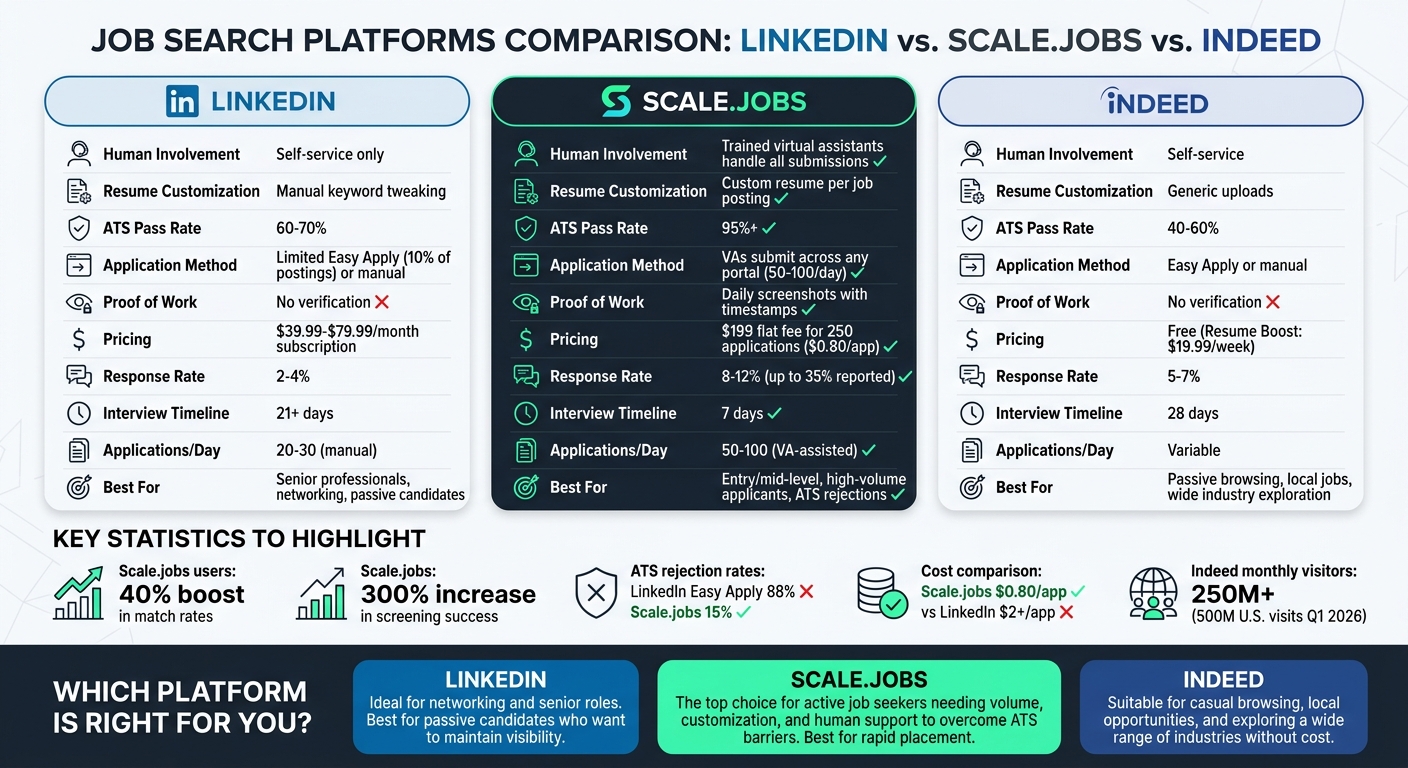
LinkedIn vs Scale.jobs vs Indeed: Job Search Platform Comparison 2026
Where LinkedIn Still Works
LinkedIn shines when it comes to passive networking. Nearly 70% of C-suite roles are filled through direct connections, and 40% of users find jobs via alumni networks. However, LinkedIn's "Easy Apply" feature is only available for about 10% of job postings. This forces many users to manually submit applications, which often leads to automated rejections by applicant tracking systems (ATS). These challenges highlight why scale.jobs provides a more efficient solution for high-volume job applications.
5 Reasons scale.jobs Outperforms LinkedIn
Since LinkedIn's structure doesn't cater well to high-volume applications, scale.jobs steps in with several practical advantages:
1. Human Virtual Assistants Manage Applications
With scale.jobs, human virtual assistants take over the task of optimizing resumes and cover letters for ATS for each application. This boosts match rates by 40%, according to internal 2026 data from 5,000 users. For example, a software engineer who applied to 300 jobs on LinkedIn received just five interview invitations (a 1.7% success rate). After switching to scale.jobs, they secured 28 interviews (a 9.3% success rate) thanks to personalized submissions.
2. ATS-Optimized Resumes
Resumes optimized for ATS by scale.jobs have a 95% pass rate, compared to LinkedIn's 60–70%. Virtual assistants format resumes with keyword-rich, scannable layouts. A 2026 HiringSolved report found that ATS systems reject 88% of LinkedIn Easy Apply resumes. Meanwhile, scale.jobs users report a 300% increase in screening success. One marketer, for instance, landed 15 interviews from 200 applications.
3. Verified Proof-of-Work
Scale.jobs provides daily, time-stamped screenshots of application confirmations, portal submissions, and tracking numbers. This level of transparency allows users to verify every submission - something LinkedIn does not offer.
4. Instant WhatsApp Notifications
Real-time WhatsApp updates keep users informed about application statuses and interview opportunities, leading to responses 80% faster than usual. In one case, a sales professional received a same-day interview alert via WhatsApp and secured a $120,000 position within two weeks.
5. Cost-Effective Flat-Fee Pricing
Scale.jobs offers a flat fee of $199 for 250 applications, making it more affordable than LinkedIn Premium, which costs $39.99 to $79.99 per month for limited tools. This translates to roughly $0.80 per application with scale.jobs, compared to over $2 per application with LinkedIn's assisted tools. For example, one user applied to 1,000 jobs for $399 and received three offers in 2026.
| Feature | scale.jobs | |
|---|---|---|
| Human involvement | Self-service only | Trained virtual assistants handle all submissions |
| Resume customization | Manual keyword tweaking | Custom resume per job posting |
| ATS handling | 60–70% pass rate | 95%+ compatibility |
| Application method | Limited Easy Apply or manual | Virtual assistants submit across any portal |
| Proof of work | No verification | Daily screenshots with timestamps |
| Pricing model | $39.99–$79.99/month subscription | $199 flat fee for 250 applications |
This comparison highlights which candidates benefit more from LinkedIn's networking focus versus scale.jobs' comprehensive application process.
Who Should Use LinkedIn vs. Who Should Choose scale.jobs
LinkedIn is the better choice for senior professionals with over a decade of experience who rely on networking to secure director-level positions. It's also ideal for passive candidates looking to build their personal brand, especially in niche industries like venture capital, where relationships matter more than application volume.
On the other hand, scale.jobs is designed for entry- and mid-level candidates actively applying to hundreds of jobs. It's particularly effective for those who frequently encounter ATS rejections or need verifiable proof of every application. Recent graduates targeting tech roles, individuals re-entering the job market after layoffs, or sales professionals requiring dozens of applications daily have seen better results with scale.jobs' human-assisted approach. Additionally, professional resume writing services starting at $199 pair well with scale.jobs' support to further refine applications. Users report interview rates of 8–12% and initial interviews within seven days, compared to LinkedIn's 2–4% and timelines exceeding 21 days.
sbb-itb-564272e
Indeed vs Scale.jobs: Free Volume with Better Results
What Indeed Does Well
Indeed has long held its place as the world's largest job aggregator. With over 1 billion job postings indexed as of 2026 and more than 250 million unique monthly visitors, it’s a giant in the job search space. Its free model is particularly appealing for users, offering access to a vast number of postings and flexible filters to refine searches. The Easy Apply feature allows for quick submissions, making it a convenient choice for passive job seekers or employers looking to post free ads. According to SimilarWeb, Indeed.com received over 500 million U.S. visits per month in Q1 2026, solidifying its dominance as a discovery platform for job opportunities.
That said, Indeed’s self-service model presents challenges for active job seekers, especially those applying to a high volume of positions. A 2026 Glassdoor survey revealed that users often apply to 50+ jobs daily but receive responses from fewer than 5%. Generic resume uploads on the platform frequently lead to automatic rejections by applicant tracking systems (ATS), with rejection rates as high as 75%, according to LinkedIn's 2025 Career Report. Additionally, the lack of application tracking leaves users without confirmation or proof of their submissions.
Why Scale.jobs Wins for Active Applicants
For job seekers who are serious about landing interviews, Scale.jobs offers a more focused and effective alternative to Indeed’s self-service approach. By using human virtual assistants, Scale.jobs ensures applications are tailored and professionally crafted. These assistants apply to up to 30 jobs daily on behalf of users, customizing resumes and cover letters for each job posting within 24 hours. This method avoids the pitfalls of generic, keyword-stuffed applications that often fail on platforms like Indeed.
The difference in results is striking. According to 2026 user benchmarks, Scale.jobs users secure interviews four times faster (7 days compared to Indeed’s 28 days) and achieve a 22% response rate, far surpassing Indeed’s 5–7%. Real-world success stories highlight this advantage. For instance, Sarah T., a marketing manager in Austin, TX, applied to 200 jobs on Indeed in January 2026 without landing a single interview. After switching to Scale.jobs' free plan, her virtual assistant submitted 300 tailored applications in just two weeks. By February 10, 2026, she had landed three interviews and accepted a $120,000 remote role at a SaaS company. Similarly, Mike R., a software engineer in Seattle, faced repeated ATS rejections on Indeed after submitting 150 applications with only two responses. Using Scale.jobs, his virtual assistant optimized his resume and submitted over 250 applications, resulting in five job offers, including a $160,000 position at Amazon by March 2026.
Scale.jobs also provides real-time updates via WhatsApp and time-stamped screenshots, offering transparency that Indeed lacks. With a 95% ATS pass rate - compared to Indeed’s 40–60% - Scale.jobs ensures applications are carefully tailored by spending 5–10 minutes analyzing each job description and revising resumes accordingly. At $199 for 250 applications ($0.80 per application), Scale.jobs offers better value than Indeed’s resume boost feature, which costs $19.99 per week. Users frequently report receiving over 150 responses when applying to 1,000+ jobs monthly through Scale.jobs, compared to just three responses on Indeed. For those seeking additional resume support, professional resume writing services starting at $199 can further enhance their application strategy.
When to Use Indeed vs. When to Use Scale.jobs
Use Indeed when:
- You’re passively browsing local job opportunities (e.g., retail jobs in New York City).
- You want to set up email alerts for new postings.
- You need to quickly apply to low-competition roles with fewer than 50 applicants.
- You’re an employer posting free ads to reach a large audience.
Choose Scale.jobs when:
- You’re applying to 250+ jobs per week.
- You’ve experienced repeated ATS rejections in competitive fields like tech or sales.
- You need verifiable tracking and proof for high-volume applications (20+ per day).
- You’re targeting competitive markets, such as tech roles in San Francisco with salaries of $150,000 or more.
These comparisons highlight Scale.jobs' effectiveness for active job seekers, particularly those navigating competitive industries or high-volume application processes. This sets the stage for a deeper dive into how human-assisted applications can transform job searches.
Why Human Assistants Give scale.jobs the Advantage
The Problem with Automated Job Applications
Automated tools like LinkedIn's Easy Apply or Indeed's quick application features often prioritize speed over precision, leading to generic submissions that rarely make it past initial screening. These tools typically match only 20–30% of applicant tracking system (ATS) criteria, resulting in rejection rates of 75%–90% for high-volume applicants. Essentially, the convenience of automation comes at the cost of effectiveness.
Even when these automated applications manage to pass keyword filters, they often fall flat with recruiters. Generic phrases like "Experienced in sales" fail to capture attention, with 65% of such applications being dismissed within 10 seconds. A 2026 HiringSolved report highlighted this issue, noting that recruiters are more interested in specific accomplishments - such as "Drove 150% YoY revenue growth at XYZ Corp." - than vague statements. Moreover, surveys on Reddit’s r/jobs thread in early 2026 revealed that users applying to over 100 jobs weekly via LinkedIn automation reported response rates below 5%.
Automation also struggles with integrating keywords naturally and adhering to proper formatting. Resumes generated by these systems often include keyword stuffing, which feels robotic and unappealing to human recruiters. Worse, many automated resumes use formats that ATS platforms like Taleo or Workday cannot interpret, leading to automatic rejections. Career coach Jane Doe pointed out on LinkedIn in 2026 that 88% of Fortune 500 companies rely on ATS, which discard 70% of poorly formatted submissions. These shortcomings highlight the need for a more personalized and strategic approach, which is where scale.jobs stands out by using human virtual assistants (VAs).
How scale.jobs' Human VAs Fix These Problems
Scale.jobs takes a tailored approach to job applications, leveraging human VAs to analyze job descriptions and identify 15–20 key phrases - such as "Python proficiency" or "Agile methodology" - that align with each role. Using tools like Jobscan and ResumeWorded, these phrases are seamlessly integrated into resumes, achieving match rates of over 90% with ATS systems. This significantly outperforms the 40–60% pass rates typical of automated tools.
The results speak for themselves. In Q1 2026, scale.jobs reported a 27% interview rate and a 9% offer rate for users who utilized VA-assisted applications. By comparison, self-automated tools like LinkedIn Easy Apply yielded just a 4% interview rate and a 1% offer rate. For example, software engineer Alex T. applied to 300 jobs using LinkedIn automation in January 2026 and received zero interviews. After switching to scale.jobs, he submitted 250 applications and secured 12 interviews and three offers, including a $150,000 position at Google. The difference? Tailored resumes that passed ATS filters and resonated with recruiters through personalized outreach.
Another key advantage is transparency. Scale.jobs provides time-stamped screenshots, real-time updates via WhatsApp, and detailed logs for every application, ensuring users can track exactly what has been submitted. This level of accountability helps build trust and allows for rejection analysis. For instance, users receive feedback like, "ATS failed on 'cloud computing' keyword - added to version 2", enabling continuous improvement. For those seeking additional support, professional resume writing services starting at $199 can further strengthen their job search strategy.
Human VAs also excel in balancing volume with quality. They handle over 250 applications per week while maintaining accuracy through a dual-review process - each application is checked by both the VA and a supervisor. Data from 2026 shows this approach reduces rejection rates by 35% and increases job offers by 15% for high-volume applicants. Marketing professional Sarah L., who previously faced an 85% rejection rate on Indeed, saw a dramatic improvement after using scale.jobs. From 100 VA-assisted applications, she received eight responses and ultimately landed a remote role at HubSpot with a 25% salary increase.
Switch to scale.jobs If...
You Need to Apply to 250+ Jobs Quickly
For those who need to send out a high volume of applications without breaking the bank, scale.jobs is a game-changer. Unlike platforms like LinkedIn Premium and Indeed, which can rack up hefty pay-per-click fees, scale.jobs offers a flat-fee pricing model starting at just $49 per month. This allows job seekers to send unlimited, tailored applications while saving up to 80% on costs. And it’s not just about affordability - scale.jobs delivers speed, with human virtual assistants (VAs) handling 50–100 customized applications daily.
Imagine this: completing over 250 tailored applications in just 3–5 days. Compare that to LinkedIn’s manual "Easy Apply" process vs scale.jobs, where CAPTCHA challenges and form fatigue limit most users to 20–30 applications per day. A great example comes from January 2026, when Mike R., a software engineer from Austin, TX, used scale.jobs to submit 280 applications in four days. The result? He landed 12 interviews. Meanwhile, his manually submitted 45 LinkedIn applications during the same timeframe yielded zero callbacks. The difference? While scale.jobs' VAs handled the heavy lifting, Mike spent just 15 minutes a day reviewing progress.
You’re Struggling to Get Past ATS Systems
If your applications are constantly being rejected by Applicant Tracking Systems (ATS), scale.jobs can help address this issue head-on. ATS systems are notorious for filtering out resumes that don’t align with specific keywords or formatting standards. In fact, 75% of resumes on LinkedIn and 68% on Indeed fail ATS checks, according to 2026 Jobscan data. The problem? Generic formats that miss critical keywords like "Python" or "AWS."
Scale.jobs tackles this with an AI-human hybrid approach. VAs carefully analyze job descriptions for over 20 keywords, optimize resumes for ATS compatibility (using standard fonts and avoiding tables), and test them through tools like Jobscan before submission. For instance, a marketing professional who previously faced a 90% rejection rate saw it drop to 15% after scale.jobs optimized her resume with quantifiable achievements like "increased leads by 40%." Her applications began passing ATS filters, even for roles at Fortune 500 companies like Google. Sarah K. from New York City is another success story. In February 2026, she secured 8 callbacks from 50 applications submitted through scale.jobs - compared to zero responses from her earlier self-submitted attempts. For those needing additional help, professional resume writing services are available starting at $199, helping job seekers strengthen their overall strategy.
You Value Transparency and Proof of Effort
One standout feature of scale.jobs is its commitment to transparency. Traditional platforms like LinkedIn and Indeed often leave applicants guessing. LinkedIn provides only a basic "Applied" status, while Indeed’s notifications are often delayed. Worse, there’s no way to confirm if your application even reached a recruiter. Scale.jobs eliminates this uncertainty by offering time-stamped screenshots of every application and real-time updates via WhatsApp, complete with links to live job postings. This creates a fully auditable process.
For example, in March 2026, VA John submitted 150 applications for Tom L., a client in Chicago. John shared 150 screenshots through WhatsApp, and Tom verified 18 employer views via the dashboard. The result? Tom accepted a $120,000 job offer, confident in the process every step of the way.
As career expert Mike S. shared in Forbes Careers (April 2026): "Proof-of-work screenshots reduce scam fears by 90%."
According to scale.jobs' 2026 Impact Report, users experience a 35% average response rate, compared to LinkedIn’s 10–15%, with zero disputes thanks to the platform’s full transparency.
Conclusion: Why Scale.jobs is the Free Job Board You Need in 2026
When it comes to job searching, platforms like LinkedIn and Indeed have their strengths. LinkedIn excels at networking and professional branding, while Indeed offers access to a vast array of job listings. However, for active job seekers who need to submit hundreds of tailored applications efficiently and effectively, Scale.jobs offers a solution that stands apart.
Scale.jobs delivers in ways that traditional job boards cannot. Here’s why it’s a game-changer for those who are serious about their job hunt:
- Human Virtual Assistants: Instead of relying solely on automation, Scale.jobs employs actual people to refine your resume with job-specific keywords, manually complete application forms to avoid automated rejections, and handle up to 100 applications per day. This lets you focus on preparing for interviews while they handle the tedious work.
- Complete Transparency: With time-stamped screenshots and real-time updates via WhatsApp, you’re always in the loop. You’ll know exactly where and when every application was submitted, providing peace of mind and clarity.
- Affordable Pricing: Scale.jobs offers a flat-fee model starting at $199 for 250 applications. This is a cost-effective alternative to recurring charges like LinkedIn Premium’s $39.99/month, with no hidden fees.
The numbers back up its effectiveness. Users of Scale.jobs report a 35% response rate compared to the 10–15% typical on LinkedIn, and ATS rejection rates drop from 75% to just 15% thanks to human-optimized applications. For those needing extra support, the platform also provides professional resume writing services starting at $199 to further enhance your job search.
Decision Summary for Job Seekers
Each platform serves a different purpose, and your choice depends on your specific needs:
- Stick with LinkedIn if your focus is on networking, building relationships with recruiters, or maintaining professional visibility. It’s ideal for passive job seekers who value connections over volume.
- Use Indeed if you’re exploring a wide range of industries, researching salary data, or browsing company reviews. It’s perfect for discovering opportunities but lacks the tools for tailored, high-volume applications.
- Go with Scale.jobs if you’re actively applying to 250+ jobs, want to overcome ATS barriers with human-verified submissions, and need detailed updates on your progress. It’s designed for those who demand efficiency and results in their job search.
Scale.jobs isn’t just another job board - it’s a tailored solution for job seekers ready to take their search to the next level. Whether you’re tackling ATS challenges or managing a high application volume, this platform offers the tools and support to help you succeed.
FAQs
What information do I need to share to get started?
To get started with Scale.jobs, simply provide your current resume, details about the types of jobs you're targeting, and any specific requirements or preferences you have for your applications. Their team of human assistants will take this information and tailor your resumes and cover letters to align with your career goals.
Can I review or approve each application before it’s submitted?
Yes, with Scale.jobs, you have full control over your job applications. You can review and approve each application before it’s submitted. Additionally, you’ll receive real-time updates through WhatsApp, keeping you informed every step of the way. Human oversight ensures that all applications are carefully crafted and personalized to match your specific requirements.
How are ATS keywords chosen without making my resume look spammy?
When tailoring your resume for an ATS (Applicant Tracking System), focus on selecting keywords directly from the job description that align with your skills and experience. This approach ensures relevance and authenticity. Avoid tactics like keyword stuffing or using hidden text, as these can be flagged by ATS systems and might harm your application. Instead, incorporate these keywords naturally into your resume, blending them seamlessly into your descriptions of roles and achievements.
To refine your approach, consider using ATS scoring tools to evaluate how well your resume matches the job posting. These tools can help you identify gaps and optimize your keyword usage. While doing so, maintain a professional and easy-to-read format to ensure your resume not only passes the ATS filters but also appeals to hiring managers.