
The Hidden ATS Problem International Applicants Face (And How to Fix It)

Sarah Mitchell
March 28, 2026

Struggling to get your resume noticed? If you're an international job seeker applying to U.S. companies, the issue may not be your qualifications - it’s likely the Applicant Tracking System (ATS). These automated tools often misread resumes with non-U.S. details, such as foreign phone numbers, degrees, or date formats, leading to your application being ignored before a recruiter even sees it.
Key Takeaways:
- Keyword mismatches: Terms like "CV" or "optimise" may not align with U.S. job descriptions.
- Formatting issues: Common formatting issues and international date formats confuse ATS systems.
- Regional bias: Degrees from non-U.S. institutions or foreign addresses are often undervalued.
Solution:
- Use ATS-compatible resume templates with simple layouts and standard headers.
- Match your resume language to U.S. job market terminology.
- Test your resume with ATS scanning tools to ensure compatibility.
For international applicants, services like Scale.jobs provide tailored solutions, including human-verified formatting and keyword optimization, ensuring your application gets seen by recruiters.
How to Write an ATS-Friendly Resume in 2026
3 Ways ATS Systems Reject International Applicants
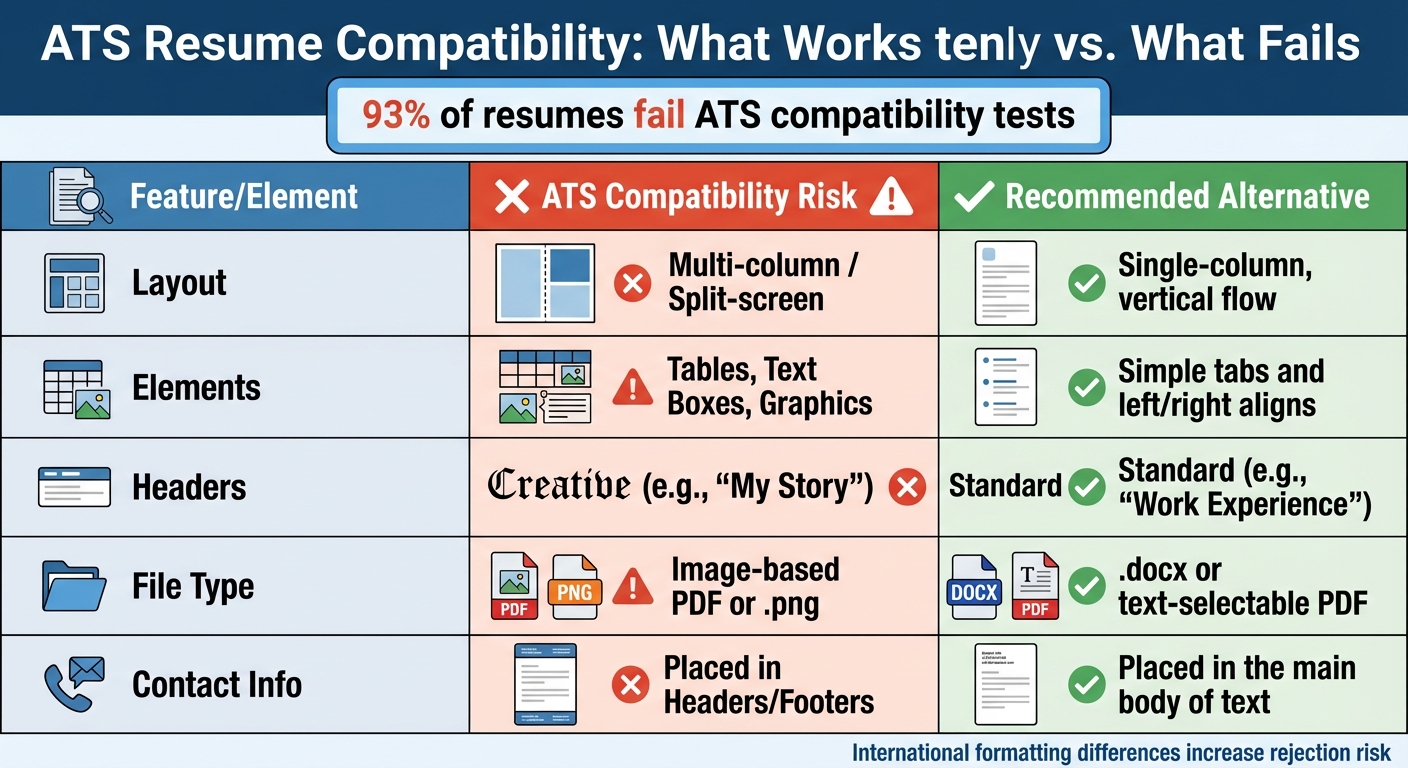
ATS Resume Compatibility Guide: Formatting Do's and Don'ts for International Applicants
Regional Keyword Differences That Trigger Rejections
ATS platforms rely on exact keyword matches, and regional language differences can lead to mismatches. For instance, a job title like "Managing Director" may not align with "CEO" in an ATS filter, and terms like "procurement" might be ignored if the system is set to search for "purchasing."
This challenge isn't limited to job titles. British English terms such as "CV", "holiday", or "redundancy" might not correspond to their U.S. equivalents like "resume", "vacation", or "layoff." Additionally, variations in spelling - such as "optimise" versus "optimize" or "analyse" versus "analyze" - can cause your application to be overlooked. ATS systems focus on exact text matches rather than interpreting synonyms or context, which puts applicants using non-U.S. terminology at a disadvantage.
Beyond these keyword issues, improper formatting can further hinder how ATS systems process your resume.
Formatting and Parsing Failures
ATS systems are designed to process resumes formatted according to U.S. standards. Using non-U.S. date formats can confuse these systems, potentially misrepresenting your work history. Similarly, international phone number formats may not be parsed correctly, leaving recruiters unable to contact you.
A staggering 93% of resumes fail ATS compatibility tests, and international formatting differences only make this more likely. For example, multi-column layouts often found in European CV templates can confuse ATS parsing algorithms. Elements like tables, text boxes, and decorative headers are often stripped out, which may result in missing or incomplete information. Even educational credentials, such as a degree from "University of Mumbai" or "Technical University of Munich", may not be recognized if they don't match the ATS database of U.S. institutions.
| Feature | ATS Compatibility Risk | Recommended Alternative |
|---|---|---|
| Layout | Multi-column / Split-screen | Single-column, vertical flow |
| Elements | Tables, Text Boxes, Graphics | Simple tabs and left/right aligns |
| Headers | Creative (e.g., "My Story") | Standard (e.g., "Work Experience") |
| File Type | Image-based PDF or .png | .docx or text-selectable PDF |
| Contact Info | Placed in Headers/Footers | Placed in the main body of text |
Built-in Regional Bias in ATS Algorithms
In addition to keyword and formatting issues, regional biases within ATS algorithms can further disadvantage international applicants. These systems are often trained on U.S.-centric employment data, which means that foreign credentials may be undervalued. For instance, degrees from prestigious institutions like IIT Delhi or Oxford might carry less weight than those from mid-tier U.S. schools because the ATS database is optimized for U.S. standards.
Location details can also lead to filtering issues. Resumes with addresses outside the U.S. may be deprioritized, even when they include clear statements about work authorization. While some resume writing services specialize in reformatting international credentials to align with U.S. standards, independent applicants often face these challenges alone. Tools like Scale.jobs and similar platforms can be helpful in navigating these obstacles, making it essential to evaluate how they handle ATS-related issues when choosing a service.
How to Fix ATS Compatibility Issues
Use ATS-Compatible Resume Templates
To ensure your resume passes through ATS (Applicant Tracking System) parsers without issues, stick to clean, single-column formatting. This format helps the system accurately read your contact details and work history. Use standard section headers like "Work Experience", "Skills", and "Education" - avoid creative alternatives like "My Journey", as these can confuse ATS systems and lead to skipped sections.
Save your resume as a .docx file for the best compatibility. If you prefer PDFs, ensure the text is selectable and copies correctly line by line. Stick to clean, professional fonts such as Arial or Calibri, which are easy for OCR (Optical Character Recognition) tools to process. Avoid using tables, text boxes, images, icons, or skill bars, as these elements are often ignored by ATS systems.
Pro tip: Test your resume by saving it as a .txt file. If the text appears jumbled or out of order, your layout may be too complex for ATS processing. Additionally, place your contact information in the main body of the document rather than in headers or footers, as ATS systems often skip those areas. When listing technical skills, use plain text separated by commas - for example, "Figma, Adobe XD, Python" - instead of graphical representations.
Once your layout is simplified, focus on aligning your content with what recruiters and ATS systems are looking for.
Match Keywords to US Job Market Language
After ensuring your resume's structure is ATS-friendly, tailor the language to align with US job market terminology. ATS systems process information literally, so it's crucial to match your wording to the job description. For example, if your previous title was "Marketing Ninja", update it to "Marketing Officer" to reflect standard job titles. Similarly, if you worked as a "Community Manager" in another region but the US job posting lists "Market Manager", adjust your title to match the role's responsibilities.
Separate your technical skills from your work experience. Dedicate a "Skills" section to list technical proficiencies like "Python" or "Salesforce", as ATS systems prioritize these over general soft skills. Highlight your most important, keyword-rich achievements in the top third of your resume to grab attention quickly - especially since recruiters spend an average of six seconds on an initial review. Aim for a match score of 80% or higher to increase your chances of advancing to the next stage.
Once your resume is tailored, the next step is to test its ATS compatibility.
Test Your Resume with ATS Scanners
After optimizing your resume's design and content, test its performance using ATS scanning tools. Platforms like Jobscan, Resume Worded, or Scale.jobs can simulate how systems such as Workday, Greenhouse, and Taleo process your resume. Strive for a match rate of 75% or higher to stay competitive.
These tools can help you identify issues like undetected contact information or improperly parsed sections. For example, if your phone number or email address doesn’t register during the scan, it’s likely an ATS will encounter the same problem. Double-check that your fonts and comma-separated skills are being processed correctly, and convert any graphical elements into plain text.
For international applicants or those who want additional assurance, Scale.jobs offers a hybrid solution. Their hybrid AI and human review service combines AI analysis with human expertise to refine formatting, optimize keyword placement, and ensure your resume is both ATS-friendly and appealing to recruiters. This approach is particularly useful for navigating complex submission portals and maximizing your chances of success.
Scale.jobs vs Jobscan and Wonsulting: Which Handles International ATS Issues Better
For international job seekers, navigating ATS (Applicant Tracking System) challenges often comes down to choosing between speedy AI tools and personalized human assistance. Jobscan provides rapid keyword analysis, comparing your resume against job descriptions to deliver a match percentage in seconds. Wonsulting emphasizes LinkedIn optimization and personal branding, which is especially helpful for career switchers aiming to craft a compelling professional narrative. Scale.jobs, on the other hand, offers a unique service: trained human assistants who manually format, customize, and submit applications. This approach ensures compatibility with ATS systems across a wide range of platforms, including regional and niche job boards. What sets Scale.jobs apart is its combination of human oversight, ATS-optimized documents, transparent proof-of-work, and real-time WhatsApp support, making it a standout choice for tackling ATS issues effectively.
Where Scale.jobs Stands Out
Unlike automated tools, Scale.jobs relies on human verification to address ATS challenges. Their dedicated assistants review resumes for formatting issues - like text boxes and non-standard headers - that could confuse ATS parsers. Applications are then manually submitted to avoid triggering automated rejections. To maintain transparency, users receive WhatsApp updates with time-stamped screenshots, providing clear evidence that their applications were successfully submitted.
Each application includes a customized resume and cover letter, tailored within 24 hours to match the specific job posting. This service is especially helpful for international candidates, as it ensures resumes align with U.S. job market terminology and expectations. Scale.jobs operates on a one-time flat fee, starting at $199 for 250 applications, with no recurring charges. Additionally, their service works across all job portals, from corporate platforms like Workday and Greenhouse to niche industry boards that automated tools often overlook.
For international applicants dealing with visa requirements or unfamiliar application processes, Scale.jobs' resume writing services combine professional document preparation with managed submissions, ensuring both ATS compatibility and hands-on support every step of the way.
What Jobscan and Wonsulting Bring to the Table
Jobscan is a quick and efficient tool for job seekers who want to optimize their resumes independently. By scanning resumes against job descriptions, it highlights missing keywords or skills, helping users improve their match rate. According to Jobscan, users can boost their chances of landing interviews by up to 50%. This tool is ideal for those who prefer a data-driven, do-it-yourself approach to resume optimization.
Wonsulting focuses on LinkedIn branding and career storytelling, making it a great choice for professionals looking to pivot industries. Their services help users create strong personal narratives and improve their online presence, which can be critical for networking and attracting recruiters. If your priority is building a standout LinkedIn profile rather than submitting a high volume of applications, Wonsulting’s coaching-led approach is a solid option.
Who Should Choose Jobscan or Wonsulting?
Jobscan is best for job seekers who are comfortable handling their own resume edits and want immediate feedback. It’s a great fit if you’re applying to a limited number of positions and prefer a DIY approach to optimizing your applications.
Wonsulting is ideal for those transitioning careers or focusing on LinkedIn visibility. If you have time to invest in personal branding and need help crafting a professional story, Wonsulting can guide you in creating a profile that resonates with recruiters.
Why Scale.jobs Is the Better Choice for International Applicants
While Jobscan and Wonsulting excel in their respective areas, Scale.jobs offers a more comprehensive solution for international job seekers. Its human-powered approach ensures that resumes are ATS-compatible and properly submitted, saving applicants time and effort. This service is particularly valuable for those applying to a large number of positions or navigating the complexities of international job markets.
Here’s a quick comparison of how these services handle ATS challenges for international applicants:
| Feature | Scale.jobs | Jobscan | Wonsulting |
|---|---|---|---|
| Primary Method | Human assistants + manual submission | AI-powered keyword/format scanning | LinkedIn branding & story development |
| User Effort | Low (Done-for-you) | High (DIY) | Moderate (Coaching-led) |
| Verification | WhatsApp updates & proof-of-work screenshots | Match rate percentage | Profile/brand growth |
| Pricing | One-time flat fee ($199–$1,099) | Monthly/quarterly subscription | Varies by service |
| Platform Reach | Any portal (niche, regional, corporate) | Primarily major corporate ATS | N/A |
| Best For | International/high-volume seekers | Technical DIY optimizers | Career changers/networking |
Decision Summary
Choose Scale.jobs if you’re an international applicant seeking human-verified submissions, transparent proof of work, and compatibility across any job portal. Opt for Jobscan if you prefer a DIY approach with instant AI feedback and are applying to fewer positions. Go with Wonsulting if your focus is on LinkedIn branding and career storytelling rather than high-volume application submissions. For those facing ATS challenges across multiple platforms, Scale.jobs provides the most thorough and reliable solution.
Which Service to Choose for Your Situation
When navigating the challenges of applicant tracking systems (ATS) and other hurdles, your choice of job application service should align with your specific needs. Factors like how many applications you’re submitting, your budget, and the level of control you need over formatting play a key role. For international applicants, additional complexities such as differing degree formats, regional keyword variations, and ATS issues with foreign addresses or certifications make choosing the right service even more critical.
Switch to Scale.jobs If You Need
Scale.jobs is ideal for those applying to 50+ positions per week and requiring human oversight to ensure international credentials are formatted correctly. When ATS risks are high, having a service that prioritizes manual review can make all the difference.
Why Scale.jobs is a strong choice for international applicants:
- Human verification – Their team manually adjusts non-standard formats, such as converting European date formats (DD/MM/YYYY) to U.S. standards (MM/DD/YYYY), and reformats certifications to avoid ATS parsing errors.
- Tailored resume customization – Each application includes resumes optimized with U.S. keywords, addressing challenges like IIT degrees, foreign names, or non-U.S. addresses that automated tools often misinterpret.
- Flat-fee pricing – For $199, you get 250 applications, avoiding recurring costs. This is especially helpful when testing the U.S. job market, where timelines can vary.
- Real-time WhatsApp support – You receive screenshots and timestamps as proof of each application, ensuring transparency across time zones.
- Manual submissions for blocked platforms – For companies like Google or Oracle, which restrict automated tools, Scale.jobs manually submits applications to ensure they reach hiring managers.
If you’re looking for both document preparation and managed submissions, Scale.jobs' resume writing services combine professional formatting with comprehensive application support.
When Competitors Make More Sense
While Scale.jobs is excellent for high-volume applicants, other services may suit different needs.
Jobscan is a better fit if you’re applying to 10–20 positions per week and working with a budget under $50/month. It uses AI to scan your resume against job descriptions, identifying missing keywords like "cloud computing" for tech roles. This DIY tool is perfect for those comfortable making manual adjustments and who don’t need human oversight for complex formatting.
Wonsulting is tailored for candidates focusing on LinkedIn branding rather than application volume. Their $297 packages revamp your LinkedIn profile with U.S.-style headlines and networking scripts, potentially increasing engagement by 7x. If you’re applying to fewer than 10 roles weekly and want to enhance recruiter visibility over ATS compatibility, Wonsulting’s coaching-driven approach is a good match. However, it doesn’t handle high-volume submissions or provide proof of individual applications.
| Feature | Scale.jobs | Jobscan | Wonsulting |
|---|---|---|---|
| Human Involvement | Dedicated assistants for formatting, customization, and submission | None (AI-only) | Coaching for branding |
| Resume Customization Depth | Custom resumes with U.S. keywords per application | User edits based on AI feedback | Profile and narrative development |
| ATS Handling | Manual verification and format conversion | Keyword match analysis | Not ATS-focused |
| Application Execution Method | Human-submitted to any portal | User submits independently | User submits independently |
| Transparency & Proof of Work | WhatsApp screenshots with timestamps | Match rate percentage | Profile engagement metrics |
| Pricing Model | One-time flat fee ($199–$1,099) | Monthly/quarterly subscription | Per-service packages |
Decision Summary
- Choose Scale.jobs if you’re an international applicant submitting 50+ applications weekly, need human-verified ATS compatibility, and value transparency with proof-of-work. This service excels at converting international credentials to U.S. standards and manually submitting applications to platforms that block automation.
- Go with Jobscan if you’re applying to 10–20 positions weekly, prefer a DIY approach with AI feedback, and have straightforward formatting needs on a budget under $50/month.
- Pick Wonsulting if you’re targeting fewer than 10 roles weekly and want to focus on LinkedIn branding and career storytelling rather than high-volume submissions. For complex ATS challenges across multiple platforms, Scale.jobs remains the most dependable solution.
FAQs
Should I use a U.S. address and phone number on my resume?
Including a U.S. address and phone number on your resume is a smart move. While a full address isn't necessary, listing your city and state is often enough, particularly for roles where your location could be a deciding factor. Providing this information not only meets common expectations but also makes it easier for recruiters to contact you.
How do I list foreign degrees so U.S. ATS systems recognize them?
To make sure your foreign degree is recognized by U.S. Applicant Tracking Systems (ATS), consider using a credential evaluation service. These services assess and translate your academic qualifications into their U.S. equivalents, ensuring they align with the standards commonly used by employers and agencies. By doing this, ATS systems can accurately process your educational background. Typically, you’ll need to submit your transcripts and diploma to an accredited evaluation service for review. This step is often a requirement for many U.S. job applications.
What should I change if an ATS scanner can’t read my resume correctly?
To ensure your resume passes an ATS (Applicant Tracking System) scanner, it's a good idea to test its compatibility with tools like Scale.jobs or Jobscan. Simplify your formatting by sticking to clean layouts, using standard section headers, and avoiding elements like tables, graphics, or text boxes that might confuse the system. Save your file in a .docx format or as a text-readable PDF to ensure proper parsing. Additionally, incorporate relevant keywords directly from the job description, especially for skills and certifications, to boost ATS readability and improve your chances of moving forward in the hiring process. For more tips, consider using an AI resume builder to refine your document.