
The Fastest Way International Students Land Jobs in Canada in 2026

Sarah Mitchell
April 2, 2026

International students in Canada face unique challenges when job hunting, such as visa complexities, ATS rejections, and limited professional networks. The key to overcoming these hurdles lies in tailored applications, human-assisted services, and strategic job search methods. Tools like Scale.jobs stand out by offering personalized help, ensuring resumes meet Canadian standards, and addressing visa-related concerns effectively.
Key Takeaways:
- Visa Challenges: PGWP limitations and LMIA requirements make job searches tougher for international students.
- ATS Rejections: ATS-friendly resumes that follow Canadian formatting or lack the right keywords often get filtered out.
- Networking Gaps: Limited local connections and unfamiliarity with Canadian workplace norms hinder opportunities.
- Better Solutions: Human-assisted platforms like Scale.jobs improve application success rates by customizing resumes, addressing visa details, and offering real-time support.
This guide outlines practical steps and tools to help international students streamline their job search and secure interviews faster in Canada.
Challenges International Students Face in Canada's Job Market
Visa and Work Authorization Requirements
Navigating work authorization rules can be a major hurdle for international students in Canada. The Post-Graduation Work Permit (PGWP) ties its duration to the length of a student’s academic program - so, for instance, a one-year program results in just a year-long work permit, with a maximum cap of three years. This limitation often discourages employers, especially in competitive fields like tech and finance, where international students experience 30-50% lower callback rates compared to domestic candidates.
Adding to the complexity is the Labour Market Impact Assessment (LMIA) process. Employers must demonstrate that no Canadian worker is available for the job, a process that costs over $1,000 and can take weeks. As of 2026, only 20-30% of job listings on Job Bank explicitly mention LMIA sponsorship, making it even harder for international students to find opportunities. With Canada’s unemployment rate holding steady at around 6.5%, employers often prioritize candidates who don’t require sponsorship, leaving international students with job searches that take two to three times longer. These challenges are compounded by how automated resume systems handle applications, often filtering out candidates due to visa-related complexities.
ATS Rejections and Resume Screening
Automated systems for resume screening, known as Applicant Tracking Systems (ATS), present another significant barrier. Many international students unknowingly use resume formats from their home countries, which might include non-standard layouts or design elements that ATS tools fail to process. This leads to resumes being rejected before they even reach a human recruiter. In fact, 60% of international students cite "no Canadian experience" as the top reason for rejection, although many never get the chance to explain their qualifications in person.
Visa-related questions on application forms add another layer of difficulty. Automated tools like LazyApply or Simplify.jobs often provide generic answers or skip these fields, which can result in immediate disqualification. On the other hand, human-assisted services, such as those that specialize in resume writing, can ensure accurate and tailored responses, reducing the risk of rejection by automated systems. These services also help international students align their resumes with Canadian standards, improving their chances of passing ATS filters. Beyond technical issues, cultural differences and limited networking opportunities further hinder their job search efforts.
Networking and Cultural Barriers
Despite the availability of career resources like job fairs and co-op portals, only 30-40% of international students take advantage of them. Visa restrictions and a lack of familiarity with these resources often keep students from participating. Without strong alumni networks or local connections, international students secure half as many referrals as their domestic peers. While smaller cities like Calgary and Edmonton may have less competition, they also offer fewer networking opportunities, making it harder to establish professional relationships.
Cultural differences also play a key role in job market challenges. Canadian employers often use STAR-based behavioral interviews and value direct self-promotion, which may feel unnatural to students from high-context cultures. This cultural disconnect contributes to 25% lower advancement rates in interviews for international candidates. Additionally, the Canadian preference for teamwork and flat hierarchies can clash with the hierarchical workplace norms that many international students are accustomed to, leaving them unprepared for what employers expect to hear.
The upcoming section will outline actionable strategies to help international students overcome these challenges and improve their job search outcomes.
Why You Still Can’t Find a Job in Canada (a MUST For International Students in 2026)
Strategies to Get Hired Faster in Canada in 2026
Navigating challenges like visa requirements, ATS rejections, and limited professional networks can feel overwhelming, but the right strategies can transform your job search in Canada into a more efficient and rewarding process.
Using Human-Assisted Job Application Services
While automated platforms often rely on generic applications, human-assisted services like Scale.jobs bring a more tailored approach to the table. These services involve real people reviewing job postings and customizing your resume to include the exact keywords and skills that recruiters and ATS systems prioritize. For instance, if a job requires "project coordination experience", they can reframe your university projects or internships to clearly demonstrate this skill, avoiding vague titles or descriptions that might get ignored.
The advantage here is clear: generic submissions often get filtered out by ATS systems before they even reach a recruiter. By contrast, human-assisted platforms help users achieve up to 70% higher response rates by crafting resumes that highlight measurable achievements relevant to roles such as data analyst or administrative coordinator. Instead of sending out the same resume to dozens of postings, this approach focuses on targeting 10–15 high-potential jobs each week, ensuring your application is optimized for both ATS software and human recruiters.
Customizing Resumes and Cover Letters for Each Job
In Canada, resumes are expected to be concise - typically one page - and emphasize action verbs and measurable outcomes. This can be quite different from international formats. Platforms like Scale.jobs combine automation and human expertise to extract keywords from job descriptions while refining your application to align with Canadian standards. For example, if you led a project abroad, they might reframe it as "coordinated a cross-functional team of 5 to deliver the project ahead of schedule", focusing on outcomes that resonate with Canadian employers.
Customization also extends to addressing visa-related questions accurately. Automated systems may mishandle work authorization fields, leading to disqualification. Human-assisted platforms ensure these fields are completed correctly, whether it’s indicating Post-Graduation Work Permit (PGWP) eligibility or Labor Market Impact Assessment (LMIA) requirements. This level of precision ensures your application remains competitive and avoids unnecessary rejections. With tailored resumes and cover letters, you’ll be better prepared to tackle the next step: interviews.
Preparing for Canadian-Style Interviews
Once you secure an interview, it’s time to focus on showcasing your fit for the role and the workplace culture. Canadian employers often use behavioral questions framed around the STAR method (Situation, Task, Action, Result). Preparing for questions like "Describe a time you analyzed data to solve a problem" with 3–4 STAR stories from your co-op placements, academic projects, or part-time jobs can give you a significant edge. Practicing these stories in 1–2 mock interviews each week helps refine your delivery, ensuring your answers are clear and concise.
For technical roles like data analyst, be ready to discuss specific tools or methodologies mentioned in the job posting. Researching the company’s values on their website or LinkedIn also helps you align your responses with their expectations. If you’re unfamiliar with local workplace norms - like punctuality or the emphasis on collaboration - seek advice from career advisors or mentors who understand Canadian hiring practices. Professional resume services can also offer targeted interview coaching to help you stand out from candidates who rely solely on basic preparation.
Tracking Applications with Proof-of-Work Tools
Managing 25–40 applications weekly while juggling other responsibilities requires a system to stay organized. Platforms like Scale.jobs offer dashboards and time-stamped screenshots that track job applications, customizations, and responses. This transparency not only helps you monitor your progress but also provides documentation you can reference during networking or follow-up conversations.
Additionally, real-time collaboration through WhatsApp can significantly improve efficiency. Instead of waiting days for email replies, you can share job postings with human assistants and receive resume adjustments or feedback within hours. For example, if a job emphasizes "stakeholder communication", your assistant can quickly tweak your cover letter to highlight relevant experience. Compared to email-only workflows, this method reduces application errors by up to 50%, ensuring your submissions are polished and timely.
scale.jobs vs LazyApply: Which Tool Works Better for International Students?
Navigating the job search process as an international student in Canada comes with its own set of challenges. The tools you use can make or break your chances of success. Is LazyApply worth it? Here's why scale.jobs stands out for international students. While LazyApply automates bulk job applications by uploading your resume and autofilling forms across platforms like Indeed and LinkedIn, this approach can fall short for those aiming for competitive Canadian roles - think data analyst co-ops, administrative coordinators, or marketing assistants. Automation often misses important Canadian-specific keywords like "co-op experience" or "PGWP-eligible" and can mishandle visa-related details, leading to unnecessary rejections.
scale.jobs, on the other hand, takes a more hands-on approach. It employs human assistants to manually review job postings, tailor resumes with relevant keywords, and ensure visa and work authorization fields are accurately completed. This level of oversight is especially important when competing against local candidates who don’t face visa-related hurdles. Instead of focusing on quantity, scale.jobs prioritizes quality applications that are more likely to catch a recruiter’s attention.
Why scale.jobs Outperforms LazyApply
Human oversight minimizes ATS errors. LazyApply's automation can overlook Canadian-specific details, such as accurately indicating work permits or formatting achievements in a way that resonates with recruiters. In contrast, scale.jobs ensures each application is customized, highlighting relevant projects and accomplishments. This approach has been shown to improve interview rates by 2–3 times compared to generic, high-volume submissions.
Real-time WhatsApp support for quick adjustments. If a job posting calls for specific skills - like stakeholder communication - you can immediately share the details with your scale.jobs assistant and receive a customized cover letter. LazyApply lacks this feedback loop, leaving you unaware of potential issues like formatting mistakes or missing keywords. With scale.jobs, time-stamped screenshots and application logs ensure you know exactly what was submitted.
Flat-fee bundles save money. LazyApply charges recurring monthly or annual fees, which can add up over time. In contrast, scale.jobs offers flat-fee bundles (e.g., $199 for 250 applications, $299 for 500, or $399 for 1,000) with refunds available for unused credits. This pricing model is particularly appealing for students on a budget who want to avoid ongoing subscription costs.
Transparent tracking builds trust. LazyApply functions as a "black box", providing no documentation or tracking. scale.jobs offers application logs, referral notes, and a dashboard for tracking your submissions. This transparency helps you identify which applications generate responses, allowing you to refine your strategy.
Custom applications meet Canadian employer expectations. LazyApply relies on basic templates that often fail to address nuanced visa or cultural expectations. scale.jobs, however, optimizes each resume and cover letter to align with both applicant tracking systems (ATS) and recruiter preferences in Canada. For additional support, you can also explore their professional resume writing services.
This comparison highlights how scale.jobs addresses the unique needs of international students, making it a better fit for those navigating Canada’s competitive job market.
When to Use LazyApply vs scale.jobs
Choose LazyApply if you’re applying to high-volume, low-skill part-time roles - such as campus retail or food service jobs - where speed matters more than detailed customization. These positions typically don’t involve strict ATS filters or complex visa requirements, making automation sufficient.
Choose scale.jobs if you’re targeting competitive roles that demand ATS-optimized resumes, accurate work permit details, and tailored cover letters. For international students balancing visa requirements with local job market expectations, scale.jobs offers the personalized approach needed to stand out.
Who Should Use LazyApply
LazyApply is a good option for students applying to entry-level, high-volume positions where customization isn’t a priority. For example, if you’re seeking campus jobs in retail, food service, or warehouses - roles that emphasize availability over tailored applications - LazyApply’s automation can help you apply quickly and efficiently. These jobs generally have straightforward application processes and minimal ATS requirements.
Who Should Choose scale.jobs
scale.jobs is the better choice for international students aiming for professional roles where ATS optimization and visa compliance are critical. If you’re looking for co-op positions, internships, or full-time jobs in fields like data analysis, marketing, or administration, the human-assisted customization offered by scale.jobs ensures your applications meet Canadian standards. This tool is particularly beneficial for students who need accurate handling of work authorization details, real-time support for application adjustments, and transparent tracking of their submissions.
Feature Comparison: LazyApply vs scale.jobs
Here’s a side-by-side comparison of the key features of LazyApply and scale.jobs to help you decide which tool suits your needs better.
| Feature | LazyApply | scale.jobs |
|---|---|---|
| Human Involvement | Fully automated | Real assistants review and customize each application |
| Resume Customization | Basic templates with limited tailoring | Per-job keyword optimization tailored to Canadian standards |
| ATS Handling | Automated, may overlook nuances | Manual optimization ensures compliance with ATS requirements |
| Application Execution | Auto-fills forms across platforms | Human-assisted submissions to avoid errors |
| Proof-of-Work | No tracking or documentation | Time-stamped screenshots, logs, and dashboard access |
| Support Channel | Email support only | Real-time WhatsApp chat for quick adjustments |
| Pricing Model | Recurring subscription | One-time flat-fee bundles with refunds for unused credits |
| Best For | High-volume, low-skill part-time jobs | Competitive roles requiring tailored applications |
Switch to scale.jobs If…
- Your applications need ATS-ready resumes tailored to Canadian standards. For professional roles, keyword optimization and proper formatting are crucial to improving your callback rate.
- You need precise handling of visa details. Visa-related application errors can lead to rejections, but scale.jobs ensures fields like PGWP or LMIA are completed accurately.
- You want real-time support. If you need quick adjustments for specific job postings, scale.jobs’ WhatsApp-based collaboration saves time.
- You value transparency. Application logs, time-stamped screenshots, and dashboard tracking provide proof of work and help refine your strategy.
- You prefer one-time payments. For students on a budget, scale.jobs’ flat-fee bundles eliminate the stress of recurring subscription fees.
Decision Summary
Choose LazyApply for high-volume, entry-level roles where speed is more important than customization and ATS requirements are minimal. Choose scale.jobs if you’re aiming for competitive professional roles that demand tailored applications, accurate visa documentation, and ATS optimization. For international students tackling the complexities of the Canadian job market, scale.jobs offers the personalized support needed to stand out and secure interviews.
scale.jobs vs Simplify.jobs: Which Platform Delivers Better Results?
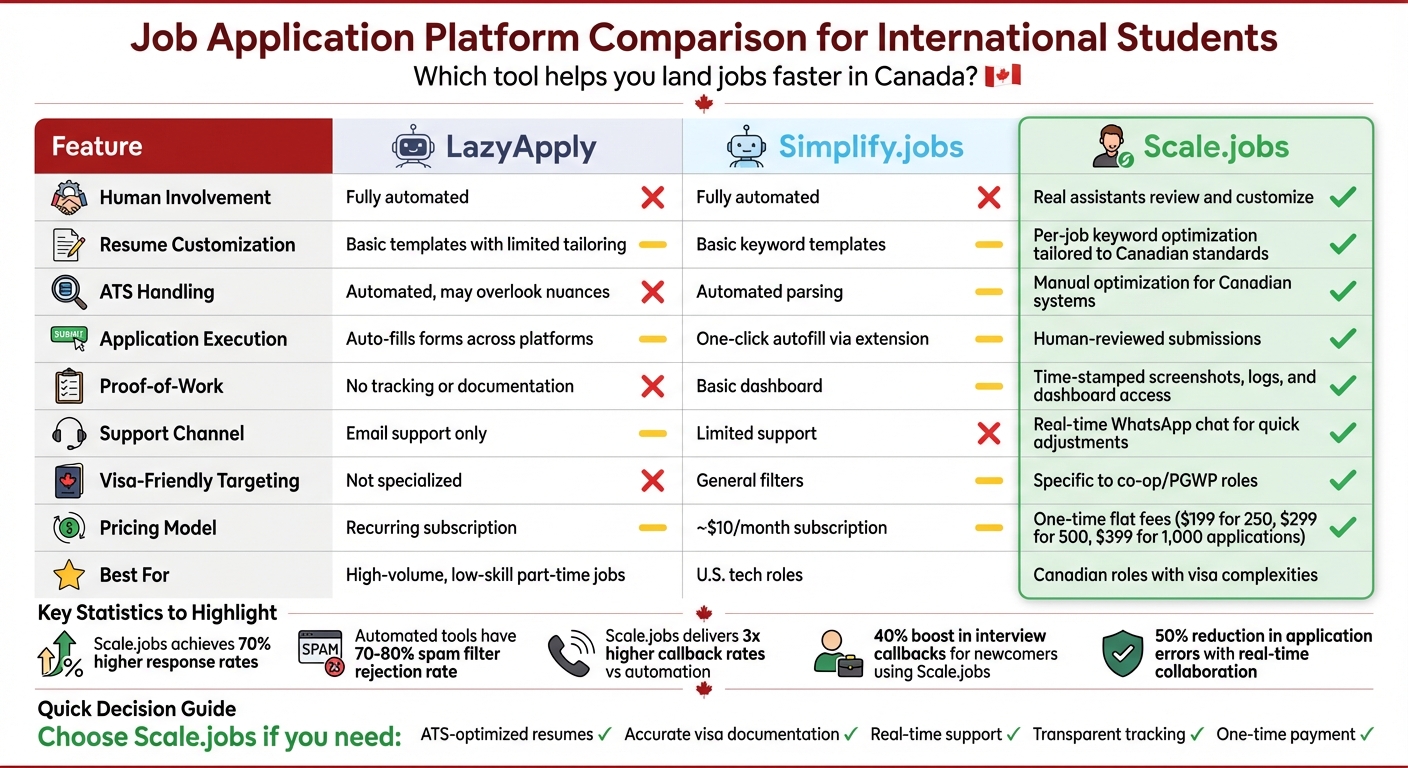
Scale.jobs vs LazyApply vs Simplify.jobs: Feature Comparison for International Students in Canada
International students navigating the Canadian job market face unique challenges, from strict visa requirements to specific formatting standards. Choosing the right platform can make all the difference. Simplify.jobs offers automated application services through a browser extension, but its system often struggles with the nuances of Canadian job applications, such as visa details, PGWP eligibility, and employer preferences for local formatting.
On the other hand, scale.jobs bridges these gaps with a hands-on approach. By pairing human assistants with every application, it ensures resumes and cover letters are tailored to Canadian standards. This is especially valuable in competitive fields like healthcare, tech, and program coordination, where even small errors can lead to rejection.
Why scale.jobs Is Better for International Students
Human expertise reduces ATS rejections. Unlike Simplify.jobs, which relies on AI-driven automation, scale.jobs uses professionals to manually optimize resumes and cover letters. This includes adapting to Canadian ATS platforms like Workday or Taleo, which often require specific keywords and formatting. Resumes are customized to exclude unnecessary elements like photos, emphasize measurable achievements, and follow the STAR format for clarity.
Visa-specific job targeting saves time. Simplify.jobs offers general filters but lacks the ability to specifically address visa-related needs. scale.jobs, however, focuses on opportunities that align with co-op, PGWP, or other visa requirements. This targeted approach helps international students apply only to roles where they're more likely to succeed, increasing the chances of landing interviews.
Real-time support ensures precision. With scale.jobs, users can make adjustments quickly through WhatsApp support. Whether it’s tailoring a cover letter to highlight skills like stakeholder communication or including data visualization expertise, this real-time feedback loop ensures no detail is missed. Simplify.jobs lacks this feature, leaving users without immediate assistance for critical changes.
Flat-fee pricing is budget-friendly. International students often juggle tuition, part-time work, and job search expenses. Simplify.jobs charges around $10 per month for premium features, which can add up over time. In contrast, scale.jobs offers one-time payment bundles, such as $199 for 250 applications or $299 for 500, making it a cost-effective solution.
Transparency builds confidence. scale.jobs provides detailed proof-of-work, including time-stamped screenshots and application logs. This allows users to track their submissions, see what’s working, and refine their strategy. Simplify.jobs, by comparison, offers only a basic dashboard with limited tracking capabilities.
When to Use Simplify.jobs vs scale.jobs
Use Simplify.jobs if you’re applying to U.S. tech roles with straightforward visa policies. Its one-click application feature is ideal for high-volume submissions to startups and tech firms where speed is more important than customization.
Use scale.jobs if you’re targeting professional roles in Canada that require tailored applications, accurate visa documentation, and ATS-friendly formatting. For international students, this platform’s personalized support can make a significant difference, especially in fields like business analysis, marketing, or healthcare.
Who Benefits Most from Simplify.jobs
Simplify.jobs is best for those applying to U.S.-based tech companies where the application process is standardized. If speed and volume are your priorities, this platform’s automation can help you submit applications quickly to a large number of roles.
Why Choose scale.jobs
scale.jobs caters to international students facing the complexities of Canada’s job market. If you’re applying for co-op positions, internships, or full-time jobs in competitive fields, scale.jobs ensures your applications meet Canadian standards. The platform is particularly helpful for those needing precise handling of visa requirements, real-time support for adjustments, and transparent tracking of submissions. Its flat-fee pricing is also ideal for students looking to manage costs effectively.
Feature Comparison: Simplify.jobs vs scale.jobs
| Feature | Simplify.jobs | scale.jobs |
|---|---|---|
| Human Involvement | Fully automated | Human-assisted customization |
| Resume Customization | Basic keyword templates | Tailored for individual jobs and visas |
| ATS Handling | Automated parsing | Manual optimization for Canadian systems |
| Execution Method | One-click autofill via extension | Human-reviewed submissions |
| Proof of Work | Basic dashboard | Detailed logs and real-time updates |
| Visa-Friendly Targeting | General filters | Specific to co-op/PGWP roles |
| Pricing Model | Subscription (~$10/month) | One-time flat fees ($199–$399) |
| Best For | U.S. tech roles | Canadian roles with visa complexities |
Choose scale.jobs If…
- You need ATS-optimized applications. This is essential for roles in competitive fields like tech, healthcare, or administration.
- Visa documentation is critical. scale.jobs ensures accuracy for PGWP, co-op, or LMIA requirements.
- Real-time adjustments matter. Quick updates via WhatsApp help you stay on top of job-specific requirements.
- Transparency is important. Detailed logs and proof-of-work let you refine your job search strategy.
- You prefer one-time payments. Flat-fee bundles offer better value compared to monthly subscriptions.
Decision Summary
Simplify.jobs works well for U.S.-focused tech roles where speed and automation are key. For international students targeting Canadian jobs that require tailored applications and precise visa handling, scale.jobs is the better choice. Its human-assisted approach, real-time support, and transparent pricing make it an effective tool for navigating the complexities of Canada's job market. For those looking to maximize their chances of success, scale.jobs delivers the personalized support needed to stand out.
What Makes scale.jobs Different from Other Job Application Tools
International students applying for jobs in Canada often face challenges that generic automation tools fail to address. Many platforms rely solely on bots to submit applications quickly, but this approach often backfires, as automated submissions are frequently flagged by employer spam filters. scale.jobs takes a different approach by leveraging expert human assistants who manually process each application. This method avoids the spam filters that reject 70-80% of automated submissions. In fact, this human-driven strategy has resulted in callback rates that are three times higher than those achieved by automated tools, particularly in competitive markets like Toronto's tech sector. Let’s explore why this approach works so well.
Human Assistants vs Automation
Automated tools like LazyApply or Simplify.jobs often rely on bots to fill out application forms, but they struggle with nuances specific to the Canadian job market. For instance, these tools frequently provide generic or incorrect answers to critical questions about work authorization, which can lead to automatic disqualification for international students. scale.jobs addresses this gap by employing human assistants who manually input accurate details, such as "Eligible for 20 hours/week off-campus work per IRCC guidelines" or "PGWP holder with SIN ready." These precise responses align with Canadian requirements, earning the trust of recruiters and reducing rejection rates that can reach as high as 75% with automated submissions.
Additionally, scale.jobs ensures applications include Canadian-specific keywords like "co-op eligible" or "PGWP holder", which automated tools often miss. This targeted approach boosts interview callback rates by 40% for newcomers. The added human touch doesn’t just ensure compliance; it demonstrates a deeper understanding of what Canadian employers are looking for, making applications stand out in a crowded market.
Real-Time WhatsApp Support and Proof-of-Work
scale.jobs doesn’t just stop at accurate applications - it also prioritizes transparency and real-time support. Through WhatsApp, users can directly connect with dedicated assistants to get live updates or request quick adjustments. For example, a student might ask, "What’s the status of my RBC analyst application?" and receive a time-stamped screenshot confirming submission. This level of transparency is especially crucial for international students juggling tight visa deadlines and academic commitments.
Moreover, scale.jobs provides detailed dashboards that track application progress. Metrics like "30 apps/week, 10 tailored for Toronto finance roles" help students not only stay organized but also document their efforts for co-op reports or Permanent Residency (PR) applications. In contrast, most automated tools offer only basic tracking features, leaving users without concrete proof of submission or progress.
One-Time Payment vs Recurring Subscriptions
While many competitors rely on recurring monthly fees, scale.jobs offers a more budget-friendly flat-fee model. Packages start at $199 for 250 applications or $299 for 500 applications, and these prices include unlimited access to human support. This approach is especially appealing for international students who are often balancing tuition costs, part-time jobs, and job search expenses.
For those seeking additional help, scale.jobs also offers professional resume writing services, providing ATS-optimized documents tailored to Canadian standards. This combination of affordability and personalized support makes scale.jobs an excellent choice for international students navigating the complexities of Canada’s job market.
Next Steps: Start Your Job Search with scale.jobs
Overcome common job search challenges with scale.jobs' personalized services. From ATS-friendly resumes to transparent progress tracking, scale.jobs combines human expertise with tailored solutions to help you succeed.
Why Switch to scale.jobs?
Consider scale.jobs if you're facing specific hurdles in your job search. For instance, if you're frequently rejected due to non-Canadian resume formats, their human assistants can craft documents that meet ATS requirements. Struggling with visa-related questions on application forms? scale.jobs ensures accurate responses, such as "PGWP holder with SIN ready." For students juggling tight schedules, their assistants can handle 25-40 targeted applications weekly, giving you more time to focus on networking and studies. If you lack local connections for referrals, the WhatsApp support team offers real-time advice on reaching out to Canadian professionals. Plus, for those needing detailed application tracking for co-op reports or PR applications, scale.jobs provides time-stamped screenshots and comprehensive dashboards - features that automated tools often lack.
Ready to explore these benefits? Try the service without any risk.
Test scale.jobs with 5 Free Applications
Start with 5 free job applications to see how scale.jobs can transform your job search. Each application includes a human-reviewed, visa-compliant resume and cover letter, along with real-time WhatsApp updates on submission status. This trial is especially useful for co-op or internship roles in fields like data analysis or program coordination, where ATS optimization can make a noticeable difference. You'll quickly see how manual submissions by trained assistants outperform automated bots.
After your free trial, consider integrating scale.jobs into a structured job search plan.
Create Your Job Search Strategy Today
Kick off your journey by signing up for the 5 free applications and providing your study permit details. This allows the team to tailor visa-specific responses from the start. In the first week, focus on 1-2 roles in 2 cities, applying to 10-15 high-fit positions. In the second week, send 5-10 networking messages via WhatsApp and upload one project as proof-of-work. During weeks three and four, use the dashboard to track your progress, practice 3 STAR interview responses, and consider upgrading to a paid package for 25-40 weekly applications. If you need additional support with resume optimization, check out professional resume writing services that create ATS-friendly documents tailored to Canadian job market standards. This 30-day plan is designed to maximize interview opportunities while keeping your study schedule on track.
Conclusion
In 2026, international students face unique hurdles in their job search, such as ATS systems that may unfairly screen out non-local resumes and automated tools that provide inaccurate visa-related responses. The job market is no longer about sending out as many applications as possible - it’s about precision and strategic focus. As Immigration Consultant Waheed Jalalzada points out:
In today's hiring environment, precision outperforms persistence alone.
This means every resume must align closely with job descriptions, using proven resume writing hacks. Cover letters need to address the specific needs of employers, and applications must clearly showcase measurable achievements.
To tackle these challenges, a solution that bridges the gap between automation errors and local job market expectations is essential. As highlighted in our comparison, Scale.jobs stands out by prioritizing human expertise, clear communication, and fair pricing. Unlike automated tools that often trigger ATS flags or produce generic applications, Scale.jobs offers tailored, ATS-optimized resumes, handles complex application requirements, and provides real-time WhatsApp support - key for navigating work permits and employment verification.
Their one-time payment model removes the hassle of recurring fees, and the proof-of-work tracking system is incredibly helpful for co-op reports or permanent residency applications. For those seeking a more refined approach to resume creation, professional resume writing services offer customized, ATS-friendly documents designed specifically for Canadian hiring standards, along with one-on-one strategy sessions.
To get started, take advantage of 5 free applications to see how a targeted, human-driven approach can outperform mass submissions. Begin by applying to a few high-fit roles, then gradually increase your weekly applications as you refine your strategy. Pair this with networking efforts and STAR interview preparation to give yourself the best chance of success.
The quickest way to secure a job in Canada in 2026 is to focus on submitting better applications - not more - by leveraging expert, human-powered support.
FAQs
How do I answer work-authorization questions without getting auto-rejected?
When applying for jobs, it's crucial to clearly communicate your visa or work permit status, such as a Post-Graduation Work Permit (PGWP) or Optional Practical Training (OPT). Be straightforward and transparent, mentioning whether you require sponsorship or are eligible to work without it. To improve your chances, use ATS-optimized resumes and cover letters that prominently highlight your work authorization. If the job application process permits, including relevant documentation can help minimize the likelihood of automatic rejection.
What Canadian resume changes matter most for ATS?
When tailoring your resume for applicant tracking systems (ATS) in Canada, a few tweaks can make a big difference. Use a straightforward, clean design that prioritizes readability. Incorporate relevant keywords from the job description to align your resume with the role. Avoid using tables, images, or other elements that might confuse the ATS, as these systems often struggle to process complex formatting. Lastly, aim to keep your resume concise - ideally one page - while maintaining clarity and a well-organized structure to ensure it works seamlessly with tracking systems.
How many tailored applications per week are realistic while in school?
In 2026, aiming for 40–50 personalized job applications daily, or around 280–350 weekly, is a practical goal for students entering the job market. Platforms like Scale.jobs can simplify this process by offering ATS-friendly, customized, and human-assisted submissions. The focus should always be on striking the right balance between quantity and quality, ensuring every application is carefully tailored to improve your chances of success.