
LinkedIn Easy Apply in the UK: Why 95% of Applications Go Nowhere

Sarah Mitchell
April 3, 2026

LinkedIn's Easy Apply feature promises convenience but often delivers frustration. 95% of applications fail to get responses, primarily due to generic submissions, poor ATS compatibility, and lack of personalization. With recruiters spending an average of just 12 seconds per application and automated systems filtering out most resumes, the odds are stacked against job seekers relying solely on Easy Apply.
This article breaks down why Easy Apply falls short, highlights common mistakes job seekers make, and compares automation tools like LazyApply and Simplify.jobs to human-powered services like Scale.jobs. If you're tired of sending countless applications with no results, this guide will help you choose the right strategy to improve your chances of success.
Key Takeaways:
- Why Easy Apply fails: Generic resumes, ATS rejections, and lack of customization.
- Alternatives compared: LazyApply and Simplify.jobs automate mass applications but have low success rates; Scale.jobs offers tailored, human-driven applications with better results.
- Who benefits from each tool: Automation tools suit entry-level roles; Scale.jobs is ideal for targeted, competitive job searches.
Read on for actionable insights to optimize your job search and stand out in today's competitive market.
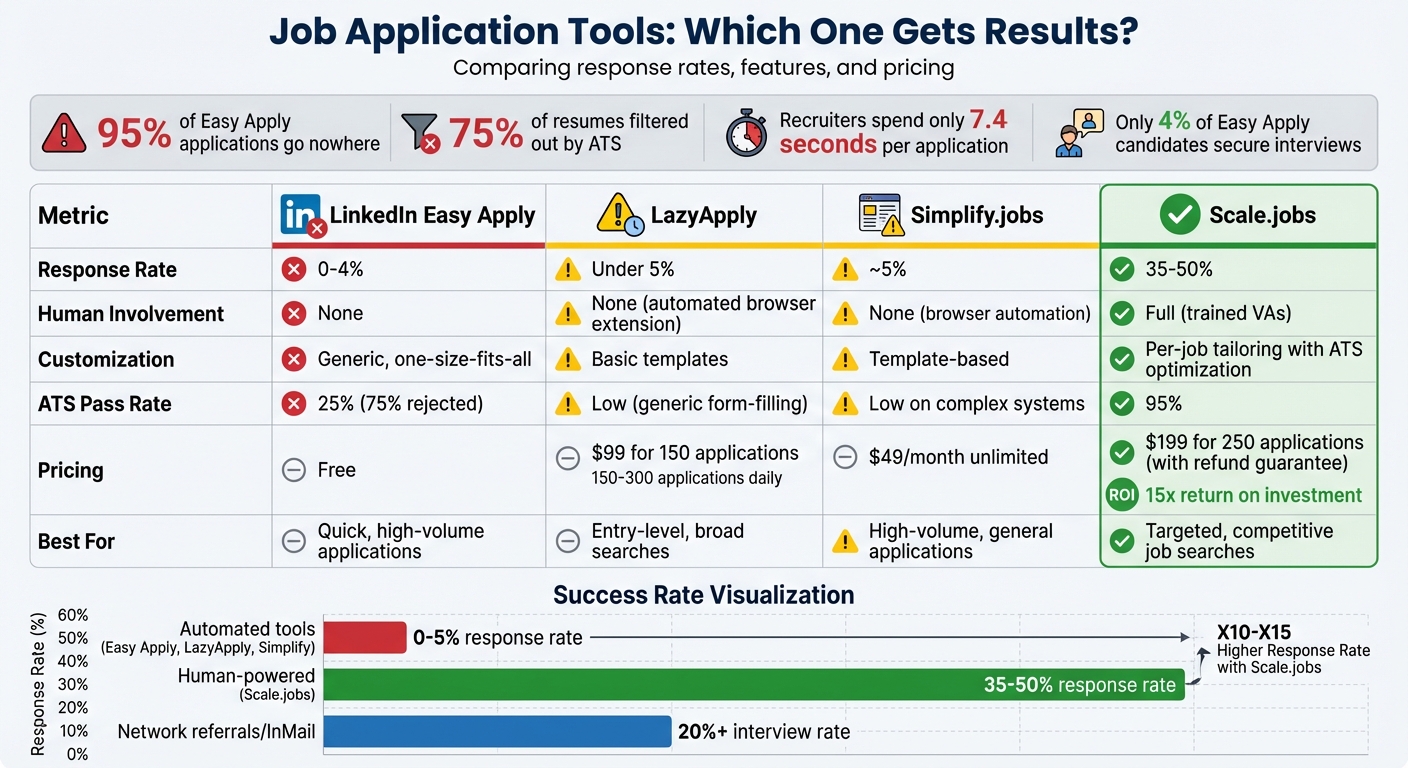
LinkedIn Easy Apply vs LazyApply vs Simplify.jobs vs Scale.jobs Comparison
Why LinkedIn Easy Apply Gets Poor Results

Problems with LinkedIn Easy Apply
LinkedIn's Easy Apply feature has three main flaws that can hinder your job search:
First, it relies on generic, one-size-fits-all resumes, which limits your ability to customize applications for specific roles. Whether you're applying for a marketing position or a sales role, the system forces you to use the same document. This approach prevents you from tailoring your resume to highlight achievements or include keywords that resonate with recruiters.
Second, poor compatibility with Applicant Tracking Systems (ATS) creates significant challenges. Resumes submitted through Easy Apply often have formatting issues, such as non-standard fonts or missing headers, which can confuse ATS software. Research indicates that 75% of resumes are filtered out by ATS before reaching a recruiter, and Easy Apply's formatting problems only increase the likelihood of rejection.
Finally, the lack of customization signals low effort to recruiters. On average, recruiters spend just 7.4 seconds reviewing an application. A generic submission, without a personalized resume or cover letter, stands out for the wrong reasons, making it less likely to move forward in the hiring process.
These issues highlight why tools that prioritize tailored applications, like scale.jobs, often deliver better results compared to automated systems.
Mistakes Job Seekers Make
Beyond these built-in flaws, job seekers often make errors that worsen their chances of success.
One common mistake is mass applying without personalization. Many candidates send the same resume to multiple roles, failing to include keywords that ATS systems prioritize. For instance, applying to tech roles without mentioning terms like "Agile methodology" can lead to automatic rejection, even if you're otherwise qualified.
Another error is ignoring Easy Apply's custom questions. Not tailoring responses to these questions can further decrease your chances of passing ATS screening. For example, a candidate who applied to 200 finance jobs without including keywords like "IFRS compliance" saw no interview invitations, despite having the necessary qualifications.
ATS Rejection Data
The impact of these mistakes is clear in ATS rejection statistics. Only 4% of Easy Apply candidates secure interviews, while UK-specific studies reveal that 95% of mass applications fail ATS screening. In contrast, applications sent via InMail or through network referrals have over a 20% success rate in landing interviews.
Since 2022, ATS systems have become even more advanced, leading to higher rejection rates. While Easy Apply submissions have increased by 40%, response rates have dropped by 25%. This trend underscores the importance of using tools and services, like professional resume writing services, that focus on creating tailored, ATS-friendly documents. These solutions not only improve your chances of passing ATS filters but also help you stand out to recruiters by delivering a personalized touch.
LazyApply vs scale.jobs: Why Human-Powered Applications Win
What LazyApply Does Well
LazyApply stands out for its ability to handle high volumes of applications at impressive speed. By automating the process, it allows users to submit hundreds of job applications across platforms like LinkedIn and other job boards. For instance, users can apply to over 100 positions daily, with the system processing between 150 and 300 applications daily at a 90% completion rate. For anyone looking to maximize reach in a short amount of time, LazyApply offers a straightforward solution with a one-time payment model - $99 for 150 applications - while also eliminating the tedious task of repetitive data entry.
However, while LazyApply prioritizes quantity, scale.jobs shines by focusing on personalized submissions that significantly improve response rates.
Why scale.jobs Beats LazyApply
LazyApply’s automation-driven approach may cover more ground, but scale.jobs takes a more thoughtful route, emphasizing quality over sheer numbers. Automation often falls short in delivering results, with response rates typically staying under 5% due to the lack of tailored, role-specific content. In contrast, scale.jobs employs trained human assistants who manually customize each application, resulting in response rates that range from 20–30%.
Here’s what sets scale.jobs apart:
- Personalized Applications: Every resume and cover letter is tailored to match the job description. Human assistants incorporate ATS-friendly keywords and highlight role-specific achievements - details that automated platforms often overlook. This approach ensures applications stand out to recruiters.
- ATS-Optimized Documents: Instead of relying on generic templates, scale.jobs creates custom formatting, adjusts headers, and fine-tunes keyword density for each submission. This reduces the risk of applications being rejected by ATS systems, which happens to 75% of automated submissions.
- Transparent Process: scale.jobs provides time-stamped proof-of-work screenshots for every submission. Through a dedicated application dashboard and real-time WhatsApp updates, users can track the progress of their campaigns with full visibility.
- Real-Time Support: The 24/7 WhatsApp support ensures users can make quick adjustments. Whether it’s tweaking a cover letter or updating a resume mid-campaign, scale.jobs assistants are ready to assist immediately.
- Fair Pricing with Guarantees: For $199, scale.jobs offers 250 applications, along with a refund policy if no results are achieved. This pricing model provides job seekers with added confidence compared to LazyApply’s $99 fee, which comes with no guarantees. Additionally, users can access resume writing services to ensure their documents are ATS-ready before starting their job search.
LazyApply vs scale.jobs: Feature Comparison
Here’s a quick comparison of the two platforms:
| Feature | LazyApply | scale.jobs |
|---|---|---|
| Human Involvement | None - fully automated browser extension | Full - trained VAs handle every application manually |
| Resume Customization | Basic templates; same document for all jobs | Per-job tailoring with ATS keyword optimization |
| ATS Handling | Generic form-filling; high rejection risk | Hand-optimized formatting and keyword density |
| Application Method | Automated browser clicks | Manual submission by human assistants |
| Transparency | Application logs only | Time-stamped screenshots, WhatsApp updates, and dashboard tracking |
| Pricing Model | $99 one-time for 150 apps; no guarantees | $199 for 250 apps with refunds for zero results |
With these distinctions, it’s clear that scale.jobs prioritizes a personalized and results-driven approach, making it a strong choice for job seekers aiming to improve their chances in today’s competitive market.
Simplify.jobs vs scale.jobs: When Automation Isn't Enough
What Simplify.jobs Does Well
Simplify.jobs offers a fast, automated way to manage job applications. With its browser-based extension, users can submit applications across various job boards with just one click, minimizing repetitive tasks. The platform also includes a job tracking dashboard that helps users stay organized, monitor application statuses, and even sends reminders for follow-ups. This setup can save job seekers up to 10 hours a week. For those looking to apply to a high volume of positions quickly, Simplify.jobs provides a straightforward solution, priced at $49/month for unlimited applications.
However, automation alone has its drawbacks. Many ATS (Applicant Tracking Systems) flag generic, automated submissions, reducing the likelihood of progressing to the next stage.
Why scale.jobs Is Better
While Simplify.jobs focuses on speed and volume, scale.jobs takes a more tailored approach, significantly increasing the chances of success. By combining human expertise with technology, scale.jobs ensures each application is customized to the job, bypassing the common pitfalls of automation. This method has been shown to deliver 3x higher response rates compared to automated tools, thanks to personalized resumes, cover letters, and proof-of-work screenshots.
Here’s where scale.jobs stands out:
- ATS Expertise: Every application is tailored to meet ATS requirements, resulting in a 95% pass rate.
- Personalized Outreach: Beyond submitting applications, scale.jobs includes LinkedIn messaging and follow-ups, which automation tools can't replicate effectively.
- Transparent Pricing: For a flat fee of $199, users receive 250 customized applications, complete with tracking and refund guarantees.
- Proven Results: Case studies highlight significant improvements, such as a software engineer increasing their response rate from 5% with Simplify.jobs to 25% with scale.jobs, alongside a rise in job match scores from 60% to 92%.
- 24/7 Support: Instead of relying on email, scale.jobs offers real-time WhatsApp support, allowing immediate adjustments to resumes or cover letters during campaigns.
For those who want to ensure their resumes are ATS-ready before applying, professional resume writing services are also available to refine your materials.
Simplify.jobs vs scale.jobs: Feature Comparison
The table below highlights why scale.jobs consistently outperforms Simplify.jobs in turning applications into interviews.
| Feature | Simplify.jobs | scale.jobs |
|---|---|---|
| Human Involvement | None – browser automation only | Full – recruiters handle every submission |
| Resume Customization | Template-based; same document for all jobs | Per-job tailoring with keyword optimization |
| ATS Handling | Basic automation; high rejection on complex systems | Expert tweaks resulting in a 95% ATS pass rate |
| Application Method | Automated browser clicks | Manual submission by human assistants |
| Transparency | Application logs and tracking dashboard | Time-stamped screenshots, real-time WhatsApp updates, and proof-of-work details |
| Pricing Model | $49/month subscription for unlimited applications | $199 one-time fee for 250 applications with performance guarantees and refunds |
| Response Tracking | Automated status updates | Human follow-up and personalized outreach |
| Success Rate | ~5% response rate (typical automation) | 35–50% response rate with interview callbacks |
The numbers speak for themselves. Research shows 90% of automated applications fail ATS screenings, while human-optimized applications, like those from scale.jobs, achieve response rates of 35–50%. A 2025 study further revealed that customized applications are 4x more likely to advance, with scale.jobs users reporting a 15x ROI on their investment.
This comparison highlights the clear advantage of human-powered, personalized applications in overcoming the limitations of automation.
Who Should Use LazyApply or Simplify.jobs vs Who Should Choose scale.jobs
Who Should Use LazyApply or Simplify.jobs
LazyApply and Simplify.jobs are ideal for job seekers who prioritize applying to a large number of positions quickly rather than focusing on personalized applications. These platforms are particularly helpful for early-career professionals or those conducting broad job searches across various industries. If your strategy is to cast a wide net and you're not targeting specific roles, these tools can save you a lot of time. However, keep in mind that automated applications typically result in responses for about 5% of submissions.
These platforms work best for candidates with general resumes that don’t need much customization. But if you’re not seeing results - like interview callbacks - it might be time to consider a service that emphasizes tailored applications over sheer volume.
Who Should Use scale.jobs
For job seekers who need a more targeted and personalized approach, scale.jobs is a better fit. Unlike the fully automated processes of LazyApply and Simplify.jobs, scale.jobs focuses on crafting applications that address specific job requirements. This is especially beneficial for professionals who frequently encounter issues with Applicant Tracking Systems (ATS) rejecting their resumes.
Here’s why scale.jobs stands out for focused job searches:
- Human-Driven Customization: Each resume and cover letter is tailored by trained assistants to align with the job’s specific requirements. This includes using ATS-friendly keywords and highlighting role-specific achievements - details that automated tools often miss.
- Higher ATS Success Rates: Automation tools often fail to ensure compatibility with ATS, leading to lower pass rates. Scale.jobs, however, boasts a 95% ATS pass rate compared to the typical 10% for automated submissions.
- Full Transparency: With time-stamped screenshots, real-time updates via WhatsApp, and a dedicated dashboard, you gain complete visibility into every application - a level of accountability that automation tools can’t provide.
- Increased Response Rates: Applications optimized by humans achieve response rates of 35–50%, significantly higher than the 5% seen with automation. This means you’re up to 10 times more likely to land interviews.
- Cost-Effective Investment: At a flat rate of $199 for 250 applications, scale.jobs offers better value compared to ongoing subscription fees. Users report up to a 15x return on investment, making it a smart choice for serious job seekers.
This platform is particularly suited for mid-to-senior level professionals, career changers, and individuals in competitive industries like tech, finance, or consulting. If you’ve been sending out hundreds of applications without results, chances are your resume isn’t optimized for ATS or tailored to specific roles. In such cases, combining professional resume writing services with human-powered applications can significantly improve your chances of success.
Switch to Scale.jobs If...
You're Sending Hundreds of Applications with No Responses
Have you been tirelessly submitting hundreds of applications through platforms like LinkedIn Easy Apply, only to hear nothing back? If so, you’re not alone. Take, for instance, a marketing professional in the UK who applied to over 300 roles using LinkedIn Easy Apply. The result? Zero interviews. After switching to Scale.jobs and submitting just 100 tailored applications, they managed to secure 12 interviews and 3 job offers in just four weeks.
Here’s why this works: Scale.jobs employs human experts who carefully review each job description and customize resumes to include the right keywords, ensuring they pass ATS (Applicant Tracking System) checks. This personal touch results in significantly higher response rates - 10–25% within the first 50 applications, compared to the dismal 0–2% typical of mass automation. Each application is tailored to highlight role-specific achievements, a level of precision that automated tools simply can’t match. This human-driven approach makes all the difference, as we’ll delve into further in the next section.
Automation Tools Are Getting You Rejected by ATS
If you’ve been relying on automation tools to send out applications, it’s worth knowing that many ATS platforms, like Workday and Taleo, are designed to detect and reject automated submissions. These systems flag applications based on patterns like identical phrasing, rapid submission rates, and repeated IP addresses. The result? Up to 80–90% of automated applications are filtered out before they even reach a recruiter’s desk.
Scale.jobs avoids these pitfalls by using human operators to manually complete applications. They log in individually, craft customized content for each role, and stagger submission timings to mimic natural applicant behavior. Recruiters, including those from firms like Robert Half, have noted that human-powered services deliver results that are four times better than automated methods. By combining technical know-how with a personal touch, Scale.jobs ensures your application stands out in a crowded field.
You Want Flat-Fee Pricing with Proof of Work
When it comes to pricing, Scale.jobs offers transparency and value that automation platforms can’t match. Let’s compare: LazyApply charges a monthly subscription fee of $49, which over 10 months amounts to $490 for about 500 automated applications. The catch? These tools provide no proof of submission, and users often report fewer than five responses from those efforts.
On the other hand, Scale.jobs charges a flat fee of $990 for the same volume of applications. What’s different? You get detailed proof of work, including time-stamped screenshots, submission logs, and recruiter notes. Users have reported more than 50 responses from the same number of applications, making it a far more investment with high ROI. Plus, there are no recurring subscriptions, and unused credits are refundable. With real-time updates via WhatsApp and thorough documentation for every application, Scale.jobs delivers a level of accountability and effectiveness that automation tools simply can’t provide.
Stop Using LinkedIn Easy Apply - How to Get Hired in 2025
Decision Summary
To select the right approach for your job application needs, weigh the advantages of automation versus human-powered tools based on your specific goals.
When to Use LazyApply or Simplify.jobs
These platforms are ideal for entry-level positions or industries where job descriptions are fairly uniform. If you're aiming to submit a large number of applications quickly without diving into extensive customization, LazyApply or Simplify.jobs can be effective. They are particularly useful for testing the waters across different industries or roles without the need for detailed tracking or accountability. With their focus on speed and volume, they also come at a lower cost.
When to Use Scale.jobs
Consider Scale.jobs if you face challenges such as:
- Sending over 100 applications with little to no success.
- Frequent rejections due to applicant tracking systems (ATS).
- The need for highly tailored, role-specific resumes and cover letters.
- A preference for detailed proof of submission, including time-stamped screenshots and updates via WhatsApp.
Scale.jobs stands out with its flat-fee structure and human-assisted service. Unlike subscription-based models, it offers a one-time payment option. Human assistants ensure each application is tailored to the job requirements, making it a great choice for competitive roles or when precision is key.
FAQs
How can I tell if ATS is rejecting my Easy Apply applications?
If you're not hearing back from employers, the issue might be with ATS (Applicant Tracking System) filtering. Many resumes get flagged or overlooked due to common mistakes like generic content, lack of relevant keywords, or formatting issues. To improve your chances, use standard fonts, clear and professional headings, and make sure your resume includes tailored keywords directly from the job description. Customizing your resume for each position is essential. Additionally, consider using tools or services like an AI resume builder to check for ATS compatibility and pinpoint areas that need fixing. These steps can significantly increase your likelihood of getting noticed.
What’s the fastest way to tailor my resume for each role without starting over?
The fastest approach is to start with an ATS-friendly resume template that emphasizes measurable achievements and relevant skills. From there, tweak the keywords and specific details to align with each job description. For added efficiency, services like Scale.jobs can help by delivering customized, ATS-optimized resumes within 24 hours. This allows you to reuse your core resume while ensuring it's tailored and effective for every job application.
When does a human-assisted applying service make more sense than automation?
When personalization, accuracy, and transparency matter most, a human-assisted job application service often proves to be the better choice. Automated tools tend to produce generic applications that can be riddled with errors, struggle to navigate ATS (Applicant Tracking System) filters, and fail to make a lasting impression. In contrast, human involvement ensures that your documents are tailored to the role, optimized for ATS, and crafted to stand out. This approach is particularly valuable for competitive positions, mid-career professionals, or candidates with unique or complex needs where quality and distinction are key to success.