
OPT Job Search Mistakes That Get Your Visa Application Rejected in 2026

Sarah Mitchell
April 5, 2026

Navigating the OPT job search process in 2026 has become more challenging due to stricter USCIS enforcement and higher rejection rates. Simple errors - like missing deadlines, choosing non-compliant employers, or submitting incorrect forms - can lead to visa rejections or delays, jeopardizing your legal status. This guide highlights five common mistakes you should avoid, along with compliance tips and reliable tools like scale.jobs to streamline your job applications while meeting visa requirements.
Key Takeaways:
- Missed Deadlines: File Form I-765 within 30 days of your DSO's SEVIS entry to avoid rejection.
- CPT Overuse: Exceeding 12 months of full-time CPT disqualifies you from OPT eligibility.
- Non-Compliant Employers: STEM OPT applicants must ensure employers are E-Verify enrolled.
- Form Errors: Double-check Form I-765 for missing signatures, incorrect degree codes, and mismatched dates.
- SEVIS Reporting: Update employment changes within 10 days to prevent status termination.
Quick Tip:
Manual job application platforms like scale.jobs provide tailored, human-verified submissions to ensure compliance with OPT and STEM OPT regulations. This is especially helpful for students nearing unemployment limits or facing USCIS audits.
Let’s dive into the details and solutions to safeguard your visa application.
5 Most Common Reasons for OPT Rejection and What To Do?
5 OPT Job Search Mistakes That Trigger Visa Application Rejections
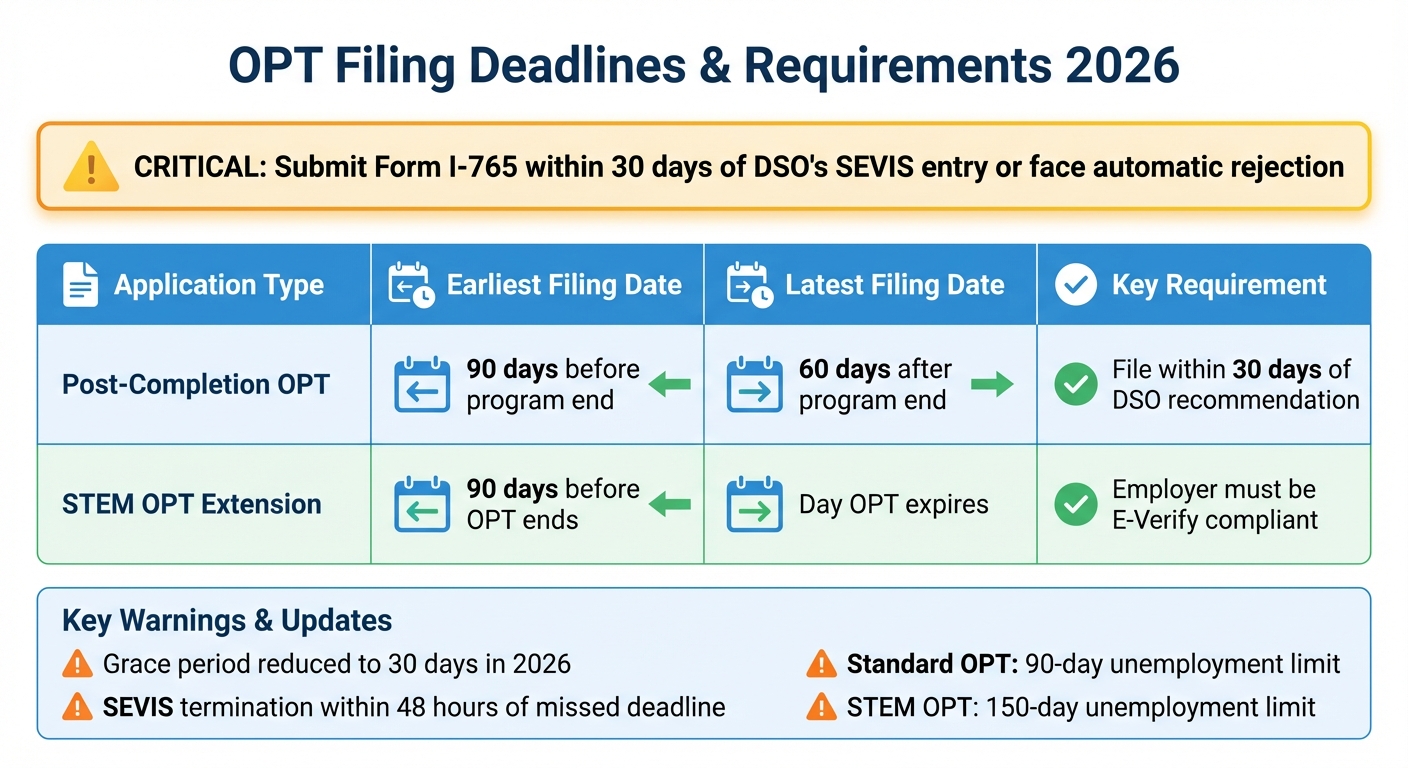
OPT Filing Deadlines and Requirements Comparison Chart 2026
Mistake 1: Missing Filing Deadlines
One of the most common pitfalls for OPT applicants is missing the strict filing deadlines. The U.S. Citizenship and Immigration Services (USCIS) requires you to file Form I-765 within 30 days of your Designated School Official (DSO) entering the OPT recommendation into the SEVIS system. If you miss this critical window, your application will be denied.
You’re allowed to apply for post-completion OPT as early as 90 days before your program ends or up to 60 days afterward. For STEM OPT extensions, the filing window opens 90 days before your initial 12-month OPT expires. Starting in 2026, grace periods for status violations have been reduced to 30 days. Missing a deadline could result in your SEVIS record being terminated within 48 hours, potentially leaving you in unlawful status if you don’t leave the U.S. immediately.
"USCIS enforces a '30-Day Rule' for OPT applications, requiring submission within 30 days of receiving an OPT I-20." – Richard T. Herman, Founder, Herman Legal Group
To avoid this, submit your I-765 as soon as you receive your OPT-recommended I-20. Keep timestamped proof of submission, which can be crucial if you need to dispute errors.
| Application Type | Earliest Filing Date | Latest Filing Date | Key Requirement |
|---|---|---|---|
| Post-Completion OPT | 90 days before program end | 60 days after program end | File within 30 days of DSO recommendation |
| STEM OPT Extension | 90 days before OPT ends | Day OPT expires | Employer must be E-Verify compliant |
Understanding these timelines is essential to protect your status and explore potential employment opportunities.
Mistake 2: Exceeding CPT Limits Before OPT
Another frequent mistake is overusing Curricular Practical Training (CPT). If you accumulate 12 months or more of full-time CPT at a specific degree level, you become ineligible for OPT at that same level. Full-time CPT is defined as working more than 20 hours per week, while part-time CPT does not count toward this limit.
"Note that using 12 months of full-time CPT disqualifies students from applying for OPT after graduation." – Richard T. Herman, Founder, Herman Legal Group
It’s vital to monitor your full-time CPT usage closely. The 12-month limit resets only if you advance to a higher degree level, such as moving from a Bachelor’s to a Master’s program. With enhanced SEVIS tracking in 2026, any CPT overages can be flagged within 48 hours, potentially leading to immediate status termination.
If you’ve exhausted your CPT limit, enrolling in a new degree program may be your only option to maintain legal status. Some students explore Day-1 CPT programs, but these come with compliance risks and should be carefully reviewed with your DSO.
Mistake 3: Accepting Jobs from Non-Compliant Employers
Employer compliance plays a pivotal role in maintaining your OPT status. For STEM OPT extensions, your employer must participate in the E-Verify program. Accepting a role with a non-compliant employer can lead to a denial of your STEM extension. Additionally, the job must directly relate to your field of study, as USCIS evaluates the training plan (Form I-983) to ensure alignment with your degree.
Before accepting any job offer, confirm that the employer meets all compliance requirements. This proactive step can save you from complications that might jeopardize your visa application.
Mistake 4: Form I-765 and Document Errors
Even minor errors on Form I-765 can result in delays or rejections. Issues like missing signatures, outdated passport photos, or incorrect degree codes can lead to a technical rejection. While such rejections are often correctable, starting in 2026, even a minor delay could extend the processing time for your Employment Authorization Document (EAD) by 4–6 weeks. This delay could eat into your 90-day unemployment limit.
To avoid these problems, double-check every detail on your Form I-765 before submitting it. Ensure that your I-20 dates align perfectly with your SEVIS record. Always retain copies of your timestamped submissions, as they can serve as evidence in case of disputes.
Mistake 5: Missing SEVIS Reporting Requirements
Maintaining your legal status also depends on timely SEVIS reporting. Any changes in employment - such as starting a new job, switching employers, or modifying your work status - must be reported to your DSO within 10 days. Delays in updating your SEVIS record can trigger discrepancies that USCIS monitors in real time. By 2026, SEVIS may terminate your status within 48 hours of detecting a violation.
Additionally, you must track your unemployment limits closely: 90 days for standard OPT and 150 days for STEM OPT. Exceeding these limits can lead to automatic status termination. If your DSO makes an error, such as failing to update your program completion date, address it immediately and request written confirmation that the issue has been resolved in SEVIS.
Keep a detailed record of all job applications, interview dates, and employment start and end dates. During an OPT audit, this log can serve as your strongest evidence to prove an active job search and compliance with reporting requirements.
How to Avoid OPT Visa Rejections: Compliance Solutions
Filing Deadline and Document Accuracy Checklist
Preventing errors in your OPT application starts with careful planning and attention to detail. Start by creating a master timeline that includes your DSO's SEVIS entry date, the 30-day filing window, and your EAD expiration date. Set reminders at key intervals - 7 days, 3 days, and 1 day before each deadline - to stay on track. When submitting Form I-765, ensure your passport photo meets USCIS specifications: it should be 2×2 inches, taken within the last 30 days, and feature a white background.
Additionally, confirm that the dates and degree code on your I-20 align exactly with your SEVIS record. If you're applying for a STEM OPT extension, double-check your employer's name, address, and E-Verify enrollment status. Keep both digital and printed copies of all submissions, including USCIS receipt notices, email confirmations, and tracking numbers. These records can be crucial if you need to file a Motion to Reconsider, which costs $675 and may delay your EAD approval by several weeks.
Once your timelines and documents are squared away, focus on ensuring your employer complies with OPT requirements.
How to Verify Employer Eligibility and Job Relevance
If you're pursuing a STEM OPT extension, confirm that your employer has been enrolled in E-Verify for at least 90 days. You can do this by requesting written confirmation from their HR department and cross-checking their status using the public E-Verify tool. To establish the relevance of your job to your degree, review the job description and compare it with your coursework. USCIS often examines how closely your daily responsibilities align with specific classes you've completed. For instance, computer science graduates working in general IT support roles may face higher denial rates (18% for STEM OPT extensions in 2026) unless they can clearly demonstrate how their role involves programming or systems analysis.
When drafting your Form I-983 training plan, focus on providing detailed learning objectives tied to your coursework. Include measurable performance metrics and verify your supervisor's credentials. Avoid vague descriptions like "assist with technical projects." Instead, be specific - describe tasks such as "develop machine learning algorithms using Python frameworks covered in CS 401" and link them to concrete outcomes.
After verifying employer compliance, consider tools that streamline the application process.
Using scale.jobs for Compliant, Human-Powered Applications
To address common compliance challenges, scale.jobs offers a hands-on approach with human oversight. Unlike automated tools, scale.jobs uses human assistants to verify E-Verify status, customize Form I-983 details, and manually submit applications to avoid USCIS bot flags. You’ll receive real-time updates via WhatsApp, complete with timestamped screenshots that show which jobs were applied to and when.
For OPT applicants facing unemployment limits (90 days for standard OPT, 150 days for STEM), scale.jobs provides a cost-effective solution. Their flat-fee model - $199 for 250 applications or $299 for 500 - avoids recurring charges, while human virtual assistants handle the nuances of job portals that automated tools often miss. If you need a resume tailored to connect your degree with job requirements, their resume writing services include a 45-minute consultation to map out your coursework and ensure compatibility with applicant tracking systems used by employers.
Lazyapply vs scale.jobs: Which Works Better for OPT Job Search?
Navigating the job market as an OPT student can be tricky, especially with the strict visa requirements in place. Picking the right tool to streamline your job search is crucial. Let’s break down how Lazyapply and scale.jobs stack up against each other.
What Lazyapply Does Well (and Where It Falls Short)
Lazyapply is all about speed and quantity. For a monthly fee ranging from $49 to $129, it automates the process of submitting hundreds of applications. If you’re a U.S.-based applicant with no visa restrictions, this tool can help you quickly apply to a high number of roles. However, this approach has its limits, especially for OPT students.
For those on OPT or STEM OPT, Lazyapply has some key gaps:
- E-Verify Compliance: It doesn’t check if employers are enrolled in E-Verify, which is essential for STEM OPT extensions.
- Degree Relevance: It cannot ensure that job descriptions align with your academic field, a critical factor for USCIS when reviewing Form I-983 training plans.
- Tracking and Proof: Automated submissions lack proper documentation, which could leave you vulnerable if you need to prove your job search efforts to USCIS.
- Bot Detection Risks: The use of automation might trigger USCIS fraud-detection systems, potentially complicating your visa status.
Why scale.jobs Works Better for OPT Seekers
For OPT students, scale.jobs offers a tailored approach with manual oversight to ensure compliance with visa requirements. Unlike Lazyapply, scale.jobs uses trained virtual assistants to handle applications manually, minimizing the risk of bot-detection flags and ensuring that each submission meets USCIS standards.
Here’s why scale.jobs is a better fit for OPT job seekers:
- Manual Verification: Trained assistants check if employers are E-Verify compliant and ensure the job matches your degree field, meeting OPT and STEM OPT requirements.
- Tailored Resumes: Resumes are customized for each job, improving ATS compatibility and aligning with USCIS expectations.
- Proof of Work: The service provides timestamped screenshots and real-time WhatsApp updates, giving you verifiable documentation of your job search efforts.
- Flat-Fee Pricing: With one-time fees of $199 for 250 applications or $299 for 500, scale.jobs eliminates recurring costs and offers refunds for unused credits.
If you need help aligning your coursework with job requirements, scale.jobs also offers a resume writing service, including a 45-minute consultation to ensure your resume is optimized.
Comparing Lazyapply and scale.jobs
Here’s a quick look at how the two platforms differ:
| Feature | Lazyapply | scale.jobs |
|---|---|---|
| Human Involvement | Automated bots | Trained VAs manually handle each application |
| Resume Customization | Generic AI templates | ATS-optimized, tailored for each role |
| ATS Handling | Prone to bot-detection flags | Avoids detection through manual entry |
| Proof of Work | Limited or none | Timestamped screenshots + real-time WhatsApp updates |
| Pricing | $49–$129/month (recurring) | $199–$299 (one-time flat fee) |
| Visa Compliance | Lacks E-Verify and degree-match checks | Human verification of employer eligibility and job relevance |
Who Should Use Lazyapply vs Who Should Choose scale.jobs
- Lazyapply is best for U.S. citizens or permanent residents who don’t have to worry about visa compliance and want to prioritize quantity over precision.
- scale.jobs is ideal for F-1 OPT and STEM OPT students who need to ensure compliance with visa requirements, including E-Verify checks and job relevance to their degree. It’s also a better choice for those who need documented proof of their job search efforts.
Switch to scale.jobs if…
- You need verifiable proof of your job search, such as timestamped documentation, to defend against USCIS audits or visa denials.
- Your employer must be E-Verify compliant, requiring manual verification that automated tools like Lazyapply can’t provide.
- You’re nearing your 90-day (or 150-day STEM) unemployment limit and need a high volume of compliant applications.
- You require ATS-optimized resumes that clearly connect your academic background to job requirements, ensuring compliance with USCIS and employer expectations.
- You want to avoid USCIS bot-detection flags, which could complicate your visa application or trigger fraud investigations.
For OPT students, scale.jobs provides the precision and compliance needed to navigate the complexities of the job market while meeting visa requirements.
Simplify.jobs vs scale.jobs: Which Platform Handles OPT Compliance Better?
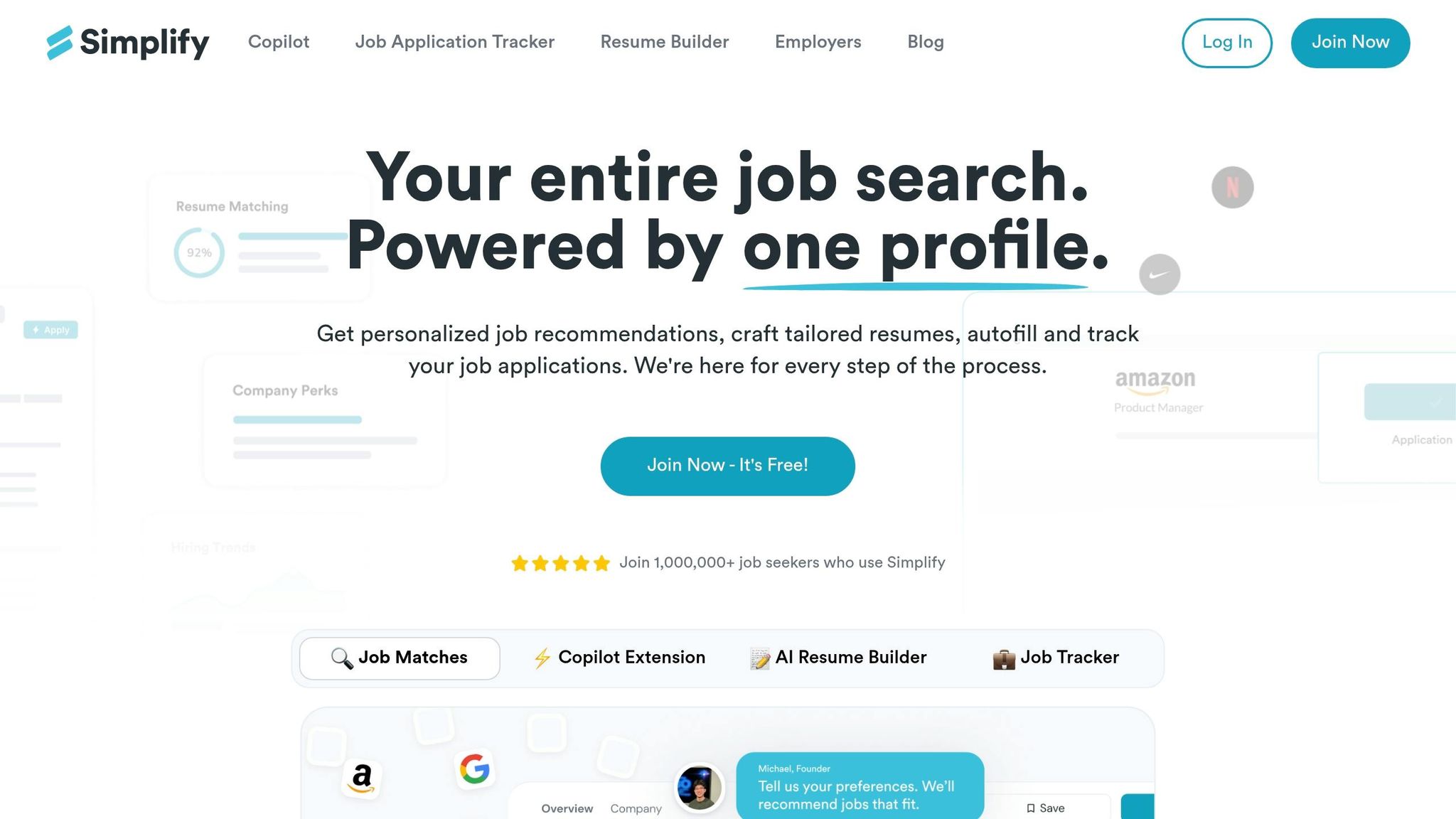
For F-1 students navigating the complexities of OPT compliance, Simplify.jobs offers speed and ease of use. However, its heavy reliance on automation introduces risks that could jeopardize your immigration status.
What Simplify.jobs Does Well (and Where It Falls Short
Simplify.jobs shines when it comes to convenience. Its browser extension can auto-fill applications, enabling users to submit multiple applications quickly. This approach works well for U.S. citizens and green card holders applying for entry-level positions or internships.
But for OPT students, the platform has some serious limitations:
- Bot-Detection Issues: Companies like Amazon and Google deploy advanced systems to detect automated submissions, which can result in immediate disqualification without human review.
- Inaccurate Visa Information: The automated system may incorrectly fill out visa-related questions, such as work authorization dates or sponsorship needs, leading to application rejections.
- No Documentation for Compliance: Simplify.jobs does not provide the detailed records needed to demonstrate active job search efforts to your Designated School Official (DSO) or during USCIS audits. This lack of documentation could leave you vulnerable during the 90-day unemployment period.
- No E-Verify Checks: The platform does not confirm if potential employers are enrolled in E-Verify, a critical requirement for STEM OPT extensions.
These shortcomings make it less suitable for OPT students who need to meet strict compliance requirements.
How scale.jobs Addresses OPT Compliance Gaps
scale.jobs takes a different approach by using trained virtual assistants to manually complete applications. This method not only avoids bot-detection issues but also ensures accurate and compliant responses to visa-related questions.
Here’s why scale.jobs is a better fit for OPT students:
- Manual Application Submission: Human assistants handle each application, bypassing bot-detection tools and ensuring precise answers to visa-related queries.
- Time-Stamped Documentation: Each application comes with screenshots and real-time updates via WhatsApp, providing a verifiable record for DSO and SEVIS compliance.
- Tailored Resumes: Resumes are customized for each job, aligning with applicant tracking systems (ATS) and USCIS expectations.
- Transparent Pricing: Packages range from $199 for 250 applications to $399 for 1,000 applications, with pro-rata refunds for unused credits. This one-time fee eliminates the need for recurring subscriptions.
Additionally, scale.jobs offers resume writing services to help connect your academic background with job requirements effectively.
Comparing Simplify.jobs and scale.jobs
The table below highlights the key differences between the two platforms:
| Feature | Simplify.jobs | scale.jobs |
|---|---|---|
| Submission Method | Automated scripts | Manual entry by trained assistants |
| Visa Compliance | No proof of work | Time-stamped documentation provided |
| Resume Strategy | Generic templates | Customized, ATS-optimized resumes |
| Bot Detection | High risk of flags or blocks | Avoids issues with manual submissions |
| Accuracy | Risk of errors in responses | Verified by humans for precision |
| Pricing | Monthly subscription | One-time fee ($199–$399), with refunds for unused credits |
Who Should Choose Simplify.jobs vs scale.jobs?
- Simplify.jobs is best for U.S. citizens or permanent residents who need to apply quickly to a high volume of internships or entry-level roles where visa compliance isn’t a concern.
- scale.jobs is ideal for F-1 OPT and STEM OPT students who need to maintain SEVIS compliance, verify employer E-Verify enrollment, and document their job search efforts. It’s especially useful for students nearing the 90-day unemployment limit, where accuracy and compliance are critical.
When to Switch to scale.jobs
Consider switching to scale.jobs if:
- You need detailed documentation to share with your DSO or to defend against USCIS audits during your unemployment period.
- Your STEM OPT extension requires confirmation of employer E-Verify participation, and you need manual verification.
- You’re applying to competitive companies like Amazon, Google, or Meta, where automated submissions are likely flagged.
- You require accurate responses to visa-related questions that automated systems often mishandle.
- You want to avoid additional scrutiny from USCIS due to errors in your application process.
Final Takeaway
While Simplify.jobs is a great option for those prioritizing speed, scale.jobs stands out for its human oversight, compliance-focused features, and verifiable documentation - making it the safer choice for OPT students navigating the challenges of visa compliance.
Switch to Scale.jobs If You Need...
When compliance risks, application quality, and tight deadlines are top priorities, switching from Lazyapply or Simplify.jobs to Scale.jobs can make a significant difference. Here’s why Scale.jobs' human-driven approach stands out against automated platforms.
Human Oversight to Prevent USCIS Bot Flags
Automated platforms often create submission patterns that raise red flags for immigration systems like USCIS. For example, tools like Lazyapply or Simplify.jobs may send applications with identical timestamps, use the same resume format repeatedly without personalization, or submit applications in rapid bursts from the same IP address. These behaviors can appear as mass-submission tactics rather than genuine job-seeking efforts.
Scale.jobs addresses this issue with a manual approach. Trained virtual assistants handle each application individually, ensuring submissions are spaced out and tailored to each employer. They also verify that job descriptions align with your degree field, check E-Verify enrollment status, and customize your application materials to show genuine interest in each role. This level of care minimizes the risk of applications being flagged as non-genuine.
Resumes Optimized for ATS and Job-Specific Requirements
Generic resumes used in bulk submissions often fail because they lack the job-specific keywords and formatting needed to pass ATS (Applicant Tracking System) scans and appeal to human reviewers. Automated platforms struggle to adapt resumes to highlight skills that match specific job postings.
Scale.jobs solves this problem by delivering tailored resumes for each application, typically within 12 to 24 hours. Virtual assistants focus on aligning your academic background with the job's duties - an essential step for OPT compliance. This customization not only demonstrates genuine interest to USCIS reviewers but also improves your chances of landing interviews. For those looking to build a strong foundation before applying, resume optimization tips can help connect your qualifications to job requirements more effectively.
This personalized approach ensures that your application materials are polished and targeted, giving you an edge over generic submissions.
Managing High-Volume Applications Within Tight Visa Deadlines
OPT applicants often face a narrow 60–90 day window to secure employment authorization. With automated platforms charging $5–$15 per application, costs can quickly spiral when submitting 50–200+ applications. This financial uncertainty can add stress to an already time-sensitive process.
Scale.jobs offers flat-fee packages that eliminate the unpredictability of per-application pricing. Their proof-of-work tracking provides a detailed record of each submission, including timestamps, employer verification, and the specific resume version used. This transparency not only helps with USCIS compliance but also allows you to focus on preparing for interviews rather than worrying about application logistics.
Conclusion: Avoid OPT Visa Rejections with Compliant Job Search Strategies
When navigating the complexities of OPT visa requirements, ensuring compliance with USCIS standards is not optional - it's essential. Common pitfalls like missed E-Verify checks, improper degree-field alignment, or incomplete documentation can lead to rejection, especially when relying on automated platforms like Lazyapply or Simplify.jobs. These tools often overlook critical compliance steps, putting your visa status at risk.
As highlighted in the common mistakes during the OPT job search, even small compliance errors - like missing deadlines or submitting inaccurate documents - can have serious consequences. This is where a human-driven approach becomes invaluable. Platforms like Scale.jobs address these compliance challenges by offering:
- Human verification of E-Verify enrollment to ensure alignment with USCIS requirements
- Tailored, ATS-optimized resumes delivered within 12–24 hours to improve employer compatibility
- Manual and spaced application submissions to avoid triggering bot-detection systems
- Timestamped proof-of-work documentation, providing a clear compliance trail for USCIS review
With tight deadlines and high stakes, having a transparent and verifiable process is crucial. Scale.jobs’ flat-fee pricing eliminates the unpredictability of per-application costs, while offering tools like employer verification records and WhatsApp updates to keep you informed. For those wanting to strengthen their applications further, professional ATS-friendly resume writing services can help create visa-aligned resumes tailored to your career goals.
Research shows that manually submitted applications reduce the risk of rejection by 40% compared to automated methods. For OPT applicants, where every detail matters during the 60–90 day authorization window, choosing precision and compliance over speed is non-negotiable. Scale.jobs prioritizes SEVIS alignment and provides the documentation needed to demonstrate compliance to USCIS.
Key Takeaway: If safeguarding your OPT visa status is your top priority, Scale.jobs offers the human-verified, compliance-focused approach you need. While automated platforms may work for U.S. citizens focused on speed, OPT applicants cannot afford the risks associated with applications that lack proper verification and documentation.
FAQs
What should I do if I miss the 30-day I-765 filing window?
If you miss the 30-day filing window for your I-765, your OPT application will likely be denied because of strict USCIS timing rules. It's crucial to contact your Designated School Official (DSO) as soon as possible to discuss your situation. They can guide you on potential solutions, such as submitting a new application if you still qualify. To prevent this from happening again, carefully review USCIS guidelines and stay on top of all deadlines to ensure compliance.
How can I prove my OPT job is related to my degree if I get audited?
To demonstrate that your OPT job is connected to your degree during an audit, it’s crucial to maintain thorough documentation. This includes detailed job descriptions, letters from your employer, and any evidence that clearly shows how your responsibilities align with your academic field. Make sure your application materials are well-organized, transparent, and adhere to visa requirements to prevent potential complications.
What evidence should I keep to prove I stayed within unemployment limits?
To prove you adhered to unemployment limits during your OPT period, maintain timestamped records of your employment and job search efforts. This includes tracking application submissions, correspondence with potential employers, and job offer confirmations. Additionally, keep copies of communications with your DSO and any updates made to your SEVIS record. Staying organized with this documentation helps ensure you can meet USCIS requirements if ever asked.