
How to Tailor Resumes & Cover Letters for ATS

Sarah Mitchell
June 25, 2026
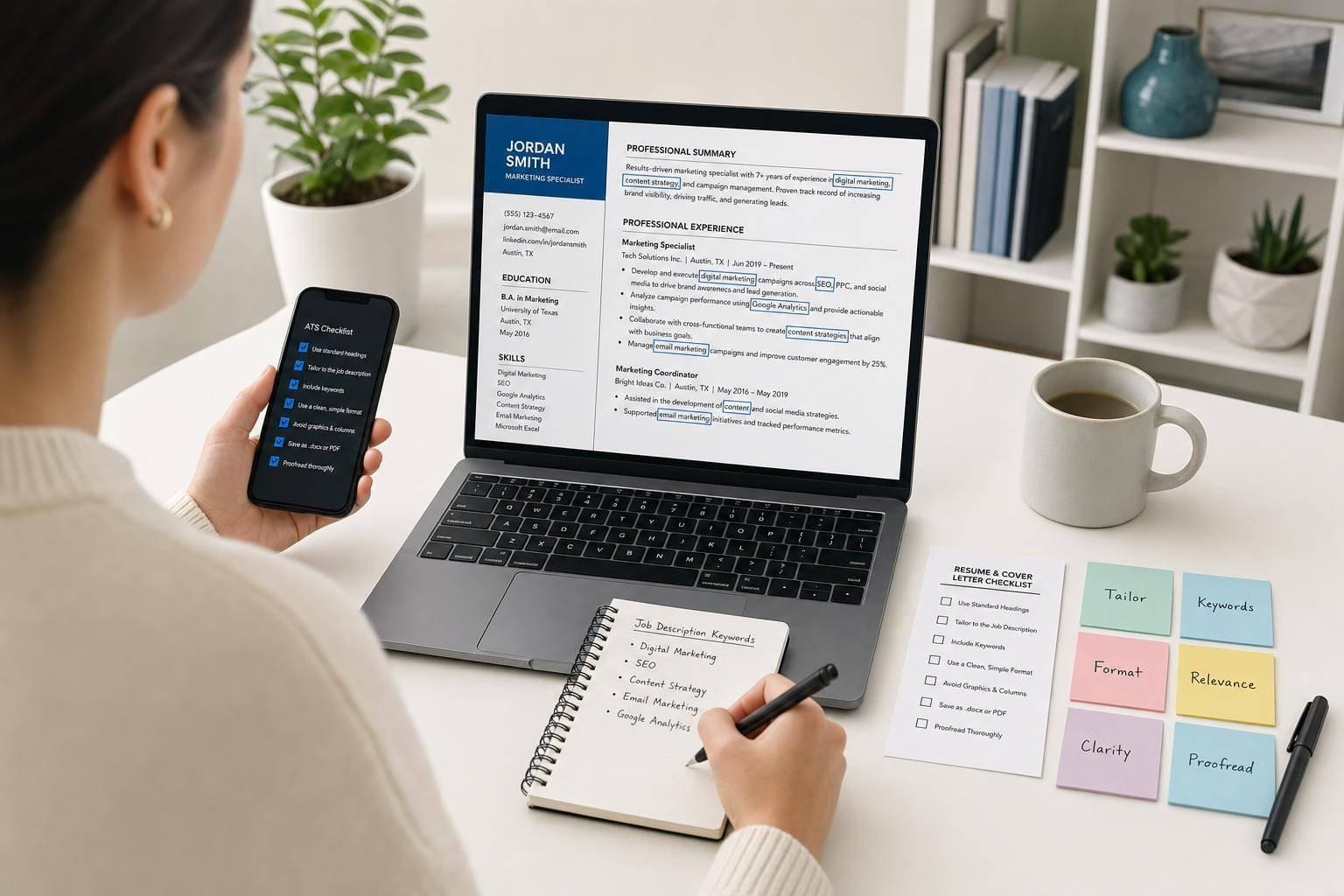
Applying to jobs can feel like shouting into a void. You tweak a few lines, upload the same resume to dozens of roles, maybe attach a cover letter if you have the energy - and still hear nothing.
One major reason is simple: most applications are screened twice. First by software, then by a person. If your resume isn’t easy for an applicant tracking system (ATS) to parse - or if it doesn’t clearly match the job posting - you may never reach the human review stage.
The workshop behind this article focused on a practical goal: helping candidates create resumes and cover letters that are ATS-friendly, tailored, and persuasive. But the bigger lesson goes beyond formatting. The real skill is learning how to translate your experience into the employer’s language without losing your own value.
This article breaks that down into a clear system you can use right away.
Key Takeaways
- Tailor every resume to the job posting by aligning your wording with the role’s required skills and responsibilities.
- Use simple, readable formatting so ATS software can scan your resume accurately.
- Focus on the two Rs: recent and relevant experience matters more than listing everything you’ve ever done.
- Write bullet points using a strong pattern: action verb + task + result.
- Quantify impact when possible with numbers, percentages, or outcomes - but don’t invent metrics.
- Keep your skills section focused on hard skills; demonstrate soft skills through examples in your experience.
- Submit a cover letter whenever possible, even if it’s optional, because it lets you explain fit and motivation.
- In a cover letter, connect your experience, the employer’s needs, and the company’s mission.
- If you work in a creative field, consider having two resume versions: one visually expressive and one ATS-safe.
- Before submitting, proofread for accuracy - especially job title, company name, and contact details.
sbb-itb-564272e
Why ATS Optimization Matters More Than Most Job Seekers Realize
ATS tools are designed to help employers manage large applicant pools. They scan resumes for skills, experience, and alignment with the job description. That doesn’t mean a robot "rejects" every candidate on its own, but it does mean your resume has to be built for machine readability first.
That creates a frustrating paradox for job seekers: the more "creative" a resume looks, the more likely it may be to confuse the system.
The workshop’s advice here is especially useful because it avoids the usual scare tactics. ATS optimization is not about gaming software with keyword stuffing. It’s about making your qualifications clear, structured, and easy to match.
A strong ATS resume does three things well:
- It uses a format software can read.
- It reflects the language of the job posting.
- It makes results visible quickly to a recruiter.
That last point matters just as much as the first two. Even if a resume passes the system, it still has to persuade a human in seconds.
Start With the Right Resume Format
If your current resume uses text boxes, graphics, columns, icons, or unusual layouts, it may look polished to you but fragmented to an ATS.
The workshop recommended a basic format as the safest option. That’s good advice for most applicants, especially if you’re applying through online portals.
What ATS-friendly formatting usually looks like
- Standard section headings such as Education, Experience, and Skills
- Clear chronological structure
- Simple fonts
- Minimal design elements
- Easy-to-scan bullet points
- One page for student or early-career resumes
This doesn’t mean your resume has to look dull. It means clarity should win over decoration.
If you’re in a creative field
The presenter made an important distinction: some industries do value visual presentation. If you’re in graphic design, arts, or a similar field, a portfolio-style resume may still be useful.
A smart compromise is to maintain two versions:
- an ATS-safe version for online applications
- a designed version for networking, direct outreach, or portfolio submissions
That’s a more realistic strategy than debating whether all creative resumes are "wrong."
Use the Two Rs: Recent and Relevant
One of the most practical ideas in the workshop was the reminder to prioritize recent and relevant experience.
This matters because many job seekers overload their resumes with old or disconnected roles, thinking more information equals more credibility. Usually, it has the opposite effect. A crowded resume hides the experiences that actually support your application.
Ask yourself these questions about each item
- Is this from the last 5 to 10 years?
- Does it connect directly or indirectly to the role I want?
- Does it demonstrate a skill the employer is seeking?
- Would removing it create more space for stronger content?
For students and early-career professionals, the presenter suggested that the last five years is ideal when possible. For mid-career applicants, the principle still holds: relevance should guide inclusion.
This is especially important if you’re changing careers. In that case, not every past role deserves equal space. The goal is not to tell your full life story; it’s to support a specific hiring decision.
Write Bullet Points That Show Results, Not Duties
A common resume mistake is listing responsibilities instead of accomplishments. Employers already know what a tutor, intern, analyst, or coordinator is generally supposed to do. What they need to know is how you performed in the role.
The workshop offered a useful structure:
Action verb + task + result
That formula works because it moves your bullet points from vague activity to evidence of value.
Weak example
- Worked on projects analyzing data
Stronger version
- Collaborated on data analysis projects to identify patterns and support evidence-based recommendations
Even stronger, if you have results
- Collaborated on data analysis projects that informed program recommendations and improved participant engagement by 15%
The difference is subtle but powerful. The stronger version tells a recruiter not only what you did, but why it mattered.
Make Your Resume Accomplishment-Oriented
The presenter emphasized using 3 to 5 bullet points per relevant experience entry. That’s a good range because it creates enough space to show impact without overwhelming the page.
To make those bullet points stronger:
Use strong action verbs
Examples include:
- Managed
- Researched
- Developed
- Streamlined
- Coordinated
- Implemented
- Analyzed
- Facilitated
- Collaborated
And avoid repeating the same verb over and over. Repetition makes a resume feel templated, even when the experiences are real.
Be specific
Instead of saying:
- Helped customers
- Supported projects
- Assisted with research
Try:
- Resolved customer concerns in a high-volume retail setting
- Supported cross-functional project tracking using Excel
- Conducted literature reviews for research on student outcomes
Quantify when you can
Metrics can strengthen credibility, such as:
- number of clients served
- percentage increases
- time saved
- revenue supported
- events coordinated
- records processed
But the workshop made an important ethical point: do not make up numbers. If the data isn’t available, leave it out and focus on the task and result.
Tailor Your Resume to the Job Description
This is where many applicants fall short. They may have relevant experience, but they don’t frame it in terms the employer is using.
The workshop’s guidance was clear: study the job posting closely and identify the skills, qualifications, and repeated language. Then, where truthful and appropriate, reflect those terms in your resume.
For example, if a research assistant role emphasizes:
- data collection
- collaboration
- survey design
- Excel
- SPSS
Then a tutor, intern, or student researcher with overlapping experience should try to surface those same themes.
That doesn’t mean forcing unrelated keywords into your document. It means translating your experience so the connection is obvious.
A practical way to do this
Create a quick matching list:
| Job Posting Needs | Your Matching Experience |
|---|---|
| Data collection | Designed and distributed class survey |
| Collaboration | Worked with faculty or peers on project teams |
| Excel | Organized datasets in coursework or internship |
| Research | Conducted analysis for academic or field projects |
This simple exercise can improve both your resume and your cover letter.
Don’t Undersell Academic Projects, Volunteer Work, or Campus Involvement
One of the most helpful parts of the workshop was its broader view of "experience." Too many candidates think only paid jobs count. That mindset is especially harmful to students, recent graduates, and career changers.
In reality, employers often care less about how you got the skill than whether you can demonstrate it.
Valuable resume sections beyond paid work
- Academic projects
- Student organizations
- Volunteer work
- Awards and honors
- Research
- Publications
- Performances or exhibitions
- Study abroad
- Certifications
This is an important point for applicants who feel they "don’t have enough experience." Often, they do - they just haven’t organized it effectively.
Academic projects can be especially powerful when:
- the project relates directly to the role
- you used relevant tools or methods
- you can explain your contribution clearly
- the project produced a concrete output
For example, a class project involving survey design, data analysis, and presentation may be highly relevant to roles in research, operations, marketing, or program evaluation.
Separate Hard Skills From Soft Skills
The workshop made a smart distinction here: hard skills belong in your skills section; soft skills should appear in your bullet points.
That advice is worth following.
Hard skills might include
- Excel
- SQL
- SPSS
- Python
- Adobe Creative Suite
- CRM software
- Bilingual language ability
- Industry certifications
These are concrete and easier for ATS tools and recruiters to identify.
Soft skills might include
- communication
- teamwork
- leadership
- problem-solving
- time management
- customer service
These matter, but listing them by themselves often adds little value. Anyone can type "excellent communicator." The stronger move is to prove it through context.
For example:
- Presented findings to a team of faculty and student researchers
- Resolved customer issues while maintaining service standards in a fast-paced environment
- Coordinated scheduling across multiple stakeholders to meet deadlines
Now the soft skill has evidence behind it.
How to Structure a Strong Resume
The workshop focused heavily on students, so it recommended placing Education near the top. That makes sense for current students and recent graduates. More experienced professionals may move education lower if work history is the stronger selling point.
A student-friendly resume structure might look like this:
Header
Include:
- name
- phone number
- professional email
- city and state
- LinkedIn URL
- portfolio link, if relevant
You do not need to include a full street address.
Education
Include:
- degree name
- school name
- location
- expected graduation date
- minor, if relevant
- GPA, if above 3.0 and worth showcasing
Relevant Coursework
Only include this if it supports the target role. And write out full course names rather than abbreviations or course codes.
Academic Projects
Use this when projects demonstrate relevant experience.
Work Experience
List your role, employer, location, dates, and accomplishment-focused bullet points.
Skills
Keep this section tight and technical.
Additional Sections
As relevant:
- involvement
- volunteer experience
- awards and honors
- certifications
- publications
- performances
- study abroad
The broader takeaway is that resume structure should reflect your strongest evidence of fit, not a rigid formula.
Why Cover Letters Still Matter
A lot of job seekers have stopped writing cover letters unless required. Given the time it takes, that’s understandable. But the workshop argued that a strong cover letter can only help - and for many applicants, that’s still true.
A resume shows what you’ve done. A cover letter explains why it matters here.
That distinction is crucial.
A cover letter gives you room to:
- connect your background to the role
- explain interest in the company
- show written communication skill
- add context that a resume can’t capture
- highlight especially relevant examples
For candidates who are changing industries, relocating, returning to work, or applying with nontraditional experience, cover letters can be particularly valuable.
How to Tailor a Cover Letter Effectively
The presenter suggested identifying roughly three skills or responsibilities from the job posting and matching them with your own experience. That’s one of the best ways to avoid generic cover letters.
Build a simple pre-writing grid
- Pull three important needs from the job description.
- Match each need to a project, job, internship, or volunteer experience.
- Use those matches to shape your body paragraphs.
This approach works because it keeps the letter focused. Instead of trying to summarize your whole resume, you’re building a case for fit.
A Simple Cover Letter Structure That Works
The workshop framed the cover letter almost like a short essay: introduction, body, conclusion. That’s a good mental model because it keeps the document organized and readable.
1. Header and greeting
Use the same header style as your resume so the documents feel consistent.
Address the letter to a real person if possible. If not, "Dear Hiring Manager" is a reasonable fallback.
2. Introduction paragraph
Your opening should quickly answer:
- who you are
- what role you’re applying for
- why you’re interested
- how you heard about it, if relevant
This paragraph should be short and specific. Avoid vague openings that could fit any company.
3. Body paragraphs
This is where you match your experience to the role.
Strong body paragraphs usually do three things:
- name a relevant experience
- explain what you did
- connect it to the employer’s needs
The workshop also encouraged candidates to reference the organization’s mission. That’s a smart move when done naturally. It shows you’ve done your research and understand the context of the work.
4. Conclusion paragraph
Your closing should:
- reinforce interest
- briefly summarize fit
- thank the reader for their time
Simple works better than dramatic.
Resume vs. Cover Letter: What Each Document Should Do
A helpful way to think about the two documents is this:
Resume
- Scannable
- Structured
- Achievement-focused
- ATS-optimized
- Evidence-rich
Cover letter
- Narrative
- Targeted
- Motivated
- Contextual
- Human
If your resume is the proof, your cover letter is the argument.
That’s why copying resume bullets into paragraph form usually fails. The letter should not duplicate the resume. It should interpret it.
Common Mistakes to Avoid
The workshop implied several pitfalls that are worth making explicit.
1. Using overly fancy resume designs
If readability suffers, both ATS systems and recruiters may miss key information.
2. Listing job duties instead of accomplishments
Responsibility alone doesn’t distinguish you from other applicants.
3. Applying with the same resume every time
A generic resume usually reads as lower-effort, even when you’re qualified.
4. Filling the skills section with soft skills
Words like "leadership" and "team player" need proof, not just placement.
5. Including irrelevant or outdated content
Old experience can dilute your strongest selling points.
6. Forgetting to proofread
A wrong company name or job title in a cover letter can undo all the work you put in.
7. Treating a cover letter like a biography
You don’t need to explain everything. You need to support one hiring decision.
What This Advice Means for Today’s Job Market
Although the workshop was presented in a university setting, its core lessons apply well beyond students.
In today’s hiring environment, many job seekers are caught between two bad strategies:
- mass-applying with generic documents
- over-automating with AI-generated content that sounds polished but empty
This workshop points toward a better middle path: customize strategically.
That means:
- using structure that works with ATS
- tailoring language to the role
- selecting only the strongest evidence
- writing with clarity instead of fluff
This approach won’t guarantee interviews - nothing can - but it does solve a major problem: many qualified candidates are invisible because their materials don’t communicate fit clearly enough.
Final Thoughts
A strong job application is not about sounding impressive in the abstract. It’s about making your relevance unmistakable.
The most useful idea from the workshop may be the simplest: focus on what is recent, relevant, and results-driven. Build your resume so software can read it, then shape it so a person wants to keep reading. Use your cover letter to explain the connection between your background and the employer’s needs.
In a crowded market, that combination still matters.
And for job seekers who feel stuck, that’s also good news. You may not need a complete reinvention. You may just need a clearer translation of the value you already have.
Source: "Write to Impress Resumes and Cover Letters That Work Fa 2025" - Coog Careers, YouTube, Dec 16, 2025 - https://www.youtube.com/watch?v=L5_ce7SjtHo