
#10 Tested and Unique Niche Jobs That Are in High Demand in 2026?

Sarah Mitchell
May 27, 2026

The U.S. job market in 2026 is evolving, with niche roles growing faster than traditional positions. High-demand jobs like Applied Machine Learning Engineers in Healthcare, Climate Risk Data Analysts, and Telehealth Nurse Practitioners are reshaping the landscape. These roles require specialized skills, certifications, and tailored applications to stand out. Relying on generic application tools often leads to missed opportunities, as they fail to address the specific needs of these positions.
Key insights:
- Data and AI roles are booming, with up to 35% growth predicted for data scientists.
- Healthcare and telehealth demand is surging, with nurse practitioners seeing a 45% growth rate.
- Climate-focused jobs are rising due to regulatory changes like the SEC's climate disclosure rules.
To succeed, job seekers must customize their resumes and applications to align with specific industry requirements. Services like scale.jobs offer human-assisted, ATS-optimized applications tailored for these competitive roles, ensuring better chances of landing interviews.
This guide explores 10 niche roles, their required skills, and how to position yourself effectively for these opportunities. For those in the technology sector, following a job search strategy for tech professionals is essential for navigating these shifts.
Here Are 25 Fastest-Growing Jobs in 2026 According To @LinkedIn | AI, Tech, Healthcare, Strategy etc
sbb-itb-564272e
1. Applied Machine Learning Engineer for Industry Verticals
Applied Machine Learning Engineers focus on deploying models tailored to specific industries like healthcare, finance, manufacturing, and retail. These professionals tackle challenges such as predicting patient readmissions using electronic health records or detecting fraud in real-time financial transactions. To excel in this role, a strong foundation in machine learning (ML) combined with domain-specific knowledge is essential. As industries increasingly adopt AI-driven solutions, the demand for these specialized roles is growing rapidly.
The numbers back this up. According to CompTIA, AI and data science job postings in the U.S. grew by about 33% year over year from 2023 to 2024, while the Bureau of Labor Statistics (BLS) predicts a 25% growth in software and ML developer roles by 2032 - three times the national average. By 2026, healthcare systems, fintech companies, industrial manufacturers, and major retailers are expected to lead the hiring surge. Salaries for ML engineers in the U.S. typically range between $130,000 and $160,000+, with specialists in finance and healthcare often earning at the higher end.
To stand out in this competitive field, your skill set needs to extend beyond basic tools like Python and scikit-learn. Employers prioritize candidates with expertise in MLOps tools (such as Docker, Kubernetes, and monitoring systems), cloud platforms like AWS SageMaker, Azure Machine Learning, or Google Vertex AI, and knowledge of domain-specific data formats - examples include HL7/FHIR for healthcare, IoT sensor data for manufacturing, and transaction data for fintech. Additionally, understanding relevant regulations such as HIPAA for healthcare or AML/KYC for finance is critical. Certifications like the AWS Certified Machine Learning – Specialty can also signal your readiness to work in production environments.
One common pitfall for candidates is submitting generic resumes. For instance, an "ML Engineer – Risk & Fraud" position at a bank requires a vastly different resume than a "ML Engineer – Clinical Decision Support" role at a hospital. Generic tools like LazyApply often fail to account for these differences, sending the same resume to vastly different roles and missing critical domain-specific keywords that applicant tracking systems (ATS) screen for. This often leads to rejection before your application even reaches a recruiter. Tailoring your resume with the right language and keywords can significantly improve your chances.
This is where professional resume writing support from scale.jobs can make a big difference. Their human-assisted services ensure your resume is customized to each role, increasing your chances of passing ATS filters and catching a recruiter’s attention. Here’s how scale.jobs compares to automated tools like LazyApply:
- human-reviewed job applications vs automation: scale.jobs assigns real assistants to review and submit applications, while LazyApply relies on bulk automation without reviewing individual job descriptions.
- ATS-optimized resumes: scale.jobs customizes your resume for each job, while LazyApply uses a single generic version across all applications.
- Transparent pricing and dedicated support: scale.jobs offers upfront, one-time payment options with dedicated WhatsApp support, unlike LazyApply’s subscription model, which lacks personalized assistance.
For specialized roles like these, tailored applications are essential. A customized resume and thoughtful submission process can mean the difference between being filtered out by an ATS and landing an interview.
2. Cybersecurity Threat Intelligence Analyst
A Cybersecurity Threat Intelligence (CTI) Analyst takes a proactive stance in the fight against cyber threats. Unlike a SOC analyst who primarily reacts to live alerts, CTI analysts focus on anticipating and understanding threats before they strike. This involves tracking malware campaigns, studying adversary behaviors using frameworks like MITRE ATT&CK, and transforming raw threat data into actionable insights for security teams and decision-makers. The role demands a mix of technical skill and sharp analytical thinking. Unlike tools like LazyApply, which rely on generic job applications, scale.jobs provides personalized, human-driven support tailored to the precision this field requires.
The demand for CTI analysts is on the rise. According to the Bureau of Labor Statistics (BLS), information security analyst roles are expected to grow by 32% from 2022 to 2032, significantly outpacing the national average. This growth translates to about 16,800 job openings annually. In May 2023, the median salary for this field reached $120,360, with specialized skills like threat intelligence adding a salary premium of roughly $13,000 compared to other cybersecurity roles. Industries such as financial services, healthcare, defense, and critical infrastructure are especially hungry for talent, driven by regulatory requirements like FFIEC, HIPAA, and the SEC's cybersecurity disclosure rules, which emphasize intelligence-led risk management.
Skills and Certifications to Stay Competitive
To stand out in this field by 2026, hands-on experience with tools like Splunk or QRadar is essential. Familiarity with threat intelligence platforms such as MISP, basic Python scripting skills, and proficiency in OSINT research (including dark web monitoring) are also critical. Certifications like the GIAC Cyber Threat Intelligence (costing between $979 and $1,299) and the beginner-friendly CompTIA Security+ (approximately $404) are highly valued, especially in federal and defense sectors where these often serve as mandatory qualifications.
Why scale.jobs Gives You an Edge
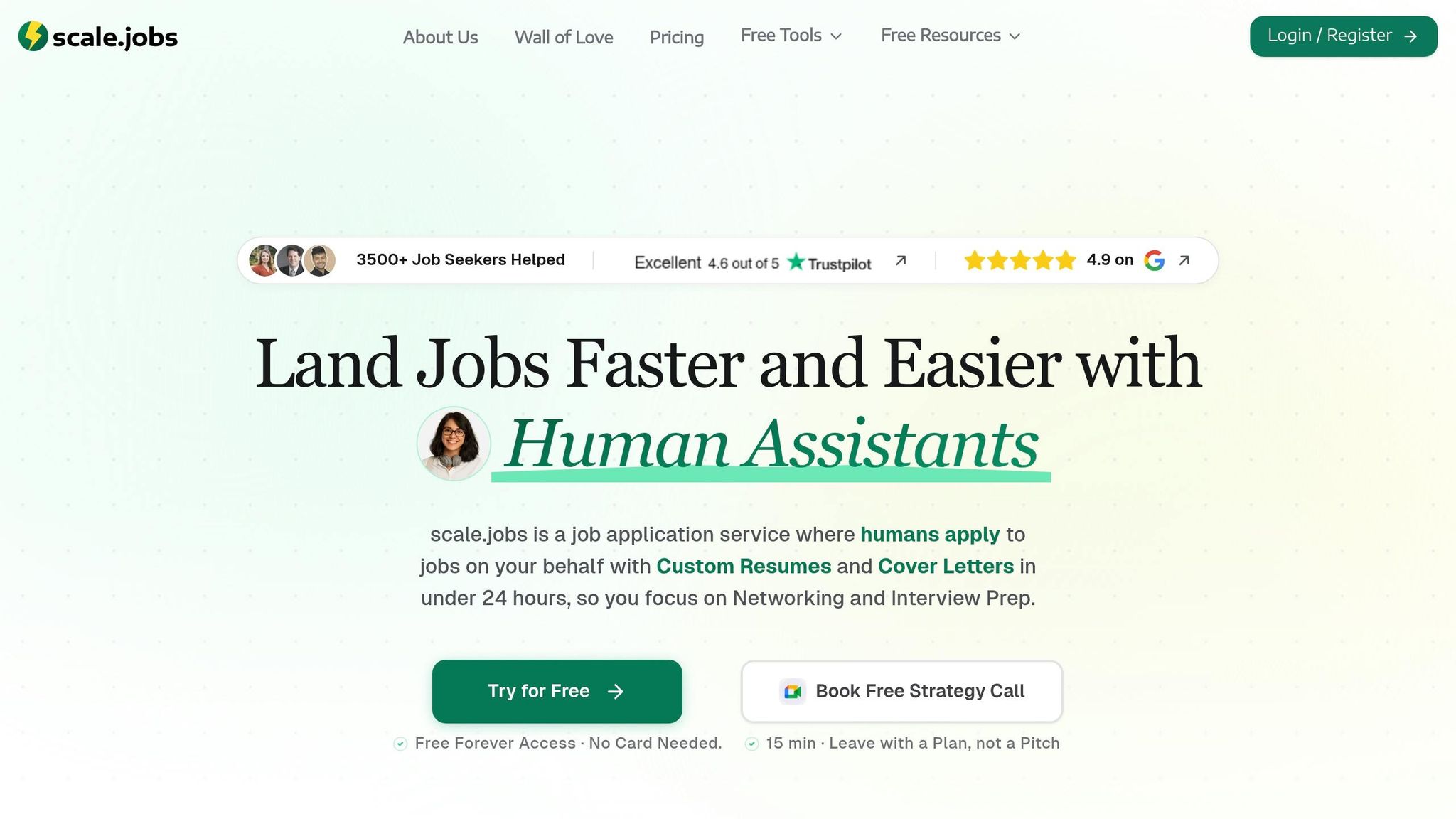
Applying for CTI roles can be challenging. Job postings in this field are highly specific, often listing exact tools, clearance levels, and intelligence disciplines like OSINT or digital forensics. Unlike bulk automation tools, scale.jobs ensures every application is customized to reflect the precise keywords and terminology required - think TTPs, IOC enrichment, campaign analysis, and threat modeling.
Here’s what sets scale.jobs apart:
- Human-Curated Applications: scale.jobs assigns real people to tailor your resume and application to each role, enhancing your chances of beating ATS filters.
- Keyword Alignment: Your SOC analyst experience can be reframed to match CTI-specific requirements, ensuring your skills and tools align with job descriptions.
- Proof of Effort: With real-time WhatsApp updates and time-stamped screenshots, you’ll know exactly where your applications stand.
For a role where a single misaligned keyword can cost you the opportunity, this level of precision can make all the difference.
Comparing LazyApply and scale.jobs for CTI Roles
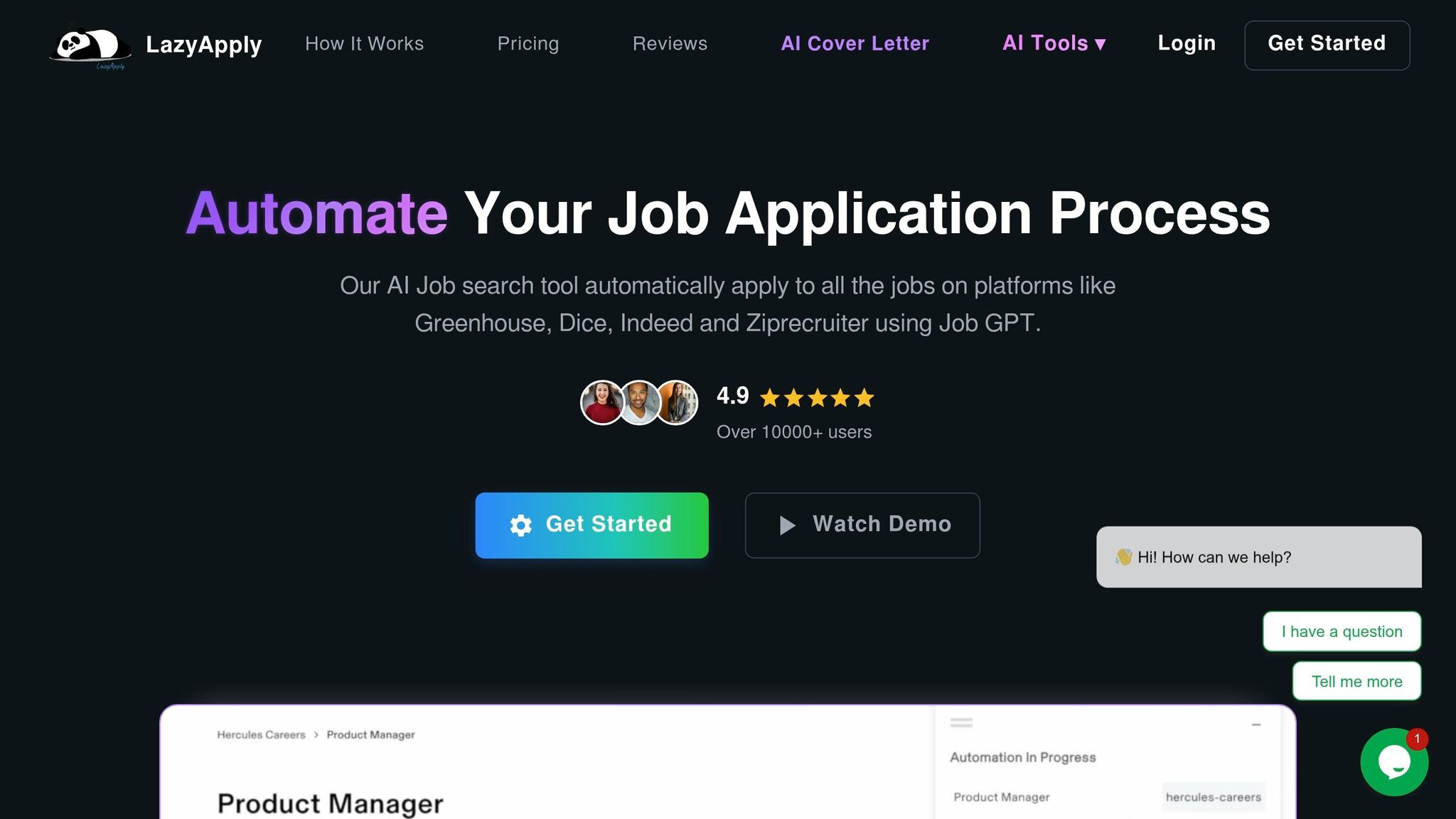
If you’re deciding between LazyApply and scale.jobs, here’s a quick breakdown:
| Feature | LazyApply | scale.jobs |
|---|---|---|
| Human involvement | Automated only | Dedicated human assistants |
| Resume customization depth | Generic, one-size-fits-all | Role-specific, ATS-optimized |
| ATS handling | Basic keyword matching | Deep alignment with job-specific language |
| Application execution method | Bot-driven bulk submissions | Manual portal submissions by assistants |
| Transparency and proof of work | Limited | Time-stamped screenshots provided |
| Pricing model | Subscription-based | One-time payment |
Who Benefits from Each Service?
LazyApply works best for:
- Job seekers applying to a high volume of general roles.
- Those experimenting with opportunities across various industries.
- Candidates comfortable with automated, less tailored applications.
scale.jobs is ideal for:
- Professionals targeting niche roles like CTI, where precision is key.
- Job seekers requiring ATS-optimized, role-specific resumes.
- Candidates who value human oversight and transparent updates.
- Those who prefer a one-time payment over recurring subscriptions.
For a field as detail-oriented as threat intelligence, the tailored approach of scale.jobs can give you the competitive edge needed to land your dream position.
Next, we’ll explore how similar strategies can be applied to roles in climate and healthcare data.
3. Climate Risk and Sustainability Data Analyst
This position blends data science expertise with environmental strategy, offering a unique opportunity to address the financial and operational challenges posed by climate change. A Climate Risk and Sustainability Data Analyst plays a critical role in helping organizations assess and quantify the effects of climate events - like hurricanes along the Gulf Coast or wildfires in the West - on their assets, operations, and bottom line. Typical responsibilities include creating physical and transition risk models, tracking emissions across Scopes 1, 2, and 3, and developing dashboards that translate climate scenarios into actionable financial insights for executives and regulators.
The demand for this role is on the rise. For instance, the SEC's finalized climate disclosure rule impacts approximately 7,000 U.S. public companies, while California's SB 253 mandates businesses with over $1 billion in annual revenue to report emissions starting as early as 2026. This regulatory momentum has spurred industries like financial services, insurance, real estate, and large corporations to establish dedicated climate analytics teams. Although the Bureau of Labor Statistics (BLS) predicts 6% growth in environmental scientist roles from 2022 to 2032, with around 6,600 job openings annually, this figure doesn’t fully capture the increasing demand for specialists in climate risk analytics - a niche that requires precise expertise and tailored applications.
To stand out in this field, candidates need strong skills in Python or R for modeling, SQL for data querying, and geospatial tools like QGIS or ArcGIS. Familiarity with frameworks such as TCFD, GHG Protocol, and ISSB/IFRS S2 is crucial, as these are the key terms hiring managers and ATS filters prioritize. Certifications like the GARP Sustainability and Climate Risk (SCR) Certificate or the SASB FSA Credential are highly regarded, signaling structured knowledge in climate risk within finance and corporate sectors.
Automated tools like LazyApply often fail to address the tailored keywords and industry language required for this role. ATS systems used by banks, consulting firms, and energy companies commonly filter resumes for phrases like "climate scenario analysis", "physical risk modeling," and "transition risk assessment." A generic resume template rarely includes these terms in the right context, leading to automatic rejections - even for qualified candidates.
This is where scale.jobs excels. Unlike automated platforms, scale.jobs assigns trained assistants to meticulously review job descriptions and align your resume with the exact terminology and qualifications sought. For example, they ensure that your GIS projects, TCFD reporting experience, and emissions modeling work are clearly highlighted with the right language. Their resume writing services combine expert writing with ATS optimization tailored to your sector. With real-time WhatsApp updates and proof-of-work screenshots, you’ll always know which applications have been submitted and when. Unlike LazyApply’s automated submissions, scale.jobs provides human-reviewed, ATS-optimized resumes backed by transparent, one-time payments and dedicated support. For specialized roles like this, where the right language and expertise make all the difference, scale.jobs offers a clear advantage over generic tools.
4. Healthcare Data Product Manager
The role of a Healthcare Data Product Manager brings together expertise in product management, data strategy, and healthcare systems. These professionals are responsible for creating and overseeing data-centric products, such as population health dashboards and clinical reporting tools. Their work directly impacts key outcomes like reducing hospital readmissions and improving metrics like HEDIS scores.
As the U.S. healthcare landscape evolves, the demand for this role is growing. Organizations are moving away from isolated analytics projects and focusing on building reusable, revenue-generating data products. Factors like value-based care contracts, interoperability requirements, and AI-driven clinical workflows are driving this shift. States like California, Massachusetts, New York, and Texas are at the forefront, with healthcare providers and payers seeking leaders who can connect clinicians, engineers, compliance teams, and business stakeholders.
To excel in this role, candidates need a specific skill set. Proficiency in SQL, BI tools, and interoperability standards like FHIR and HL7 is essential. Additionally, a strong understanding of U.S. healthcare reimbursement models and quality measures, such as HEDIS and STAR ratings, is highly valued. Educational qualifications like a Master’s in Health Informatics, MPH, or MHA, combined with Agile/Scrum certifications and HIPAA compliance training, can further bolster a candidate’s profile.
However, generic job application tools like LazyApply and Sonara.ai often fail to capture the specialized language required for healthcare roles. Keywords such as "risk stratification", "care gap closure", or "FHIR-based interoperability" are critical for passing healthcare ATS filters. Unlike these tools, scale.jobs provides human-assisted, ATS-optimized applications with personalized support via WhatsApp.
Healthcare Data Product Manager candidates benefit from scale.jobs in several ways:
- Precise keyword optimization to navigate healthcare-specific ATS filters.
- Customized resume updates that emphasize your achievements in healthcare.
- Outcome-focused revisions that quantify your contributions, such as "streamlined manual reporting processes by 40% for quality teams" or "improved care gap closure rates by 15% for Medicare Advantage populations."
For a tailored application that highlights your expertise in healthcare data management, consider using scale.jobs resume writing services. This personalized approach ensures your application reflects the specialized language and skills needed to stand out in today’s competitive healthcare job market.
5. AI-Augmented Instructional Designer for Corporate L&D
The role of instructional designers in corporate learning has evolved significantly. Companies now seek professionals who can integrate AI tools into learning and development (L&D) strategies, moving beyond traditional tasks like creating slide decks. These AI-augmented instructional designers are expected to design, manage, and validate AI-generated learning experiences while ensuring compliance, instructional quality, and alignment with brand standards. This shift highlights the growing importance of precision and adaptability in emerging tech roles.
In terms of compensation, corporate instructional designers with strong AI and data skills can expect salaries ranging from $80,000 to $110,000+, while training managers average around $120,000 annually. According to the U.S. Bureau of Labor Statistics, training roles are projected to grow by 6% through 2032, with approximately 36,700 openings each year. The demand for AI-augmented instructional designers is outpacing the supply, creating a significant opportunity for those with the right skills.
What sets this role apart is the ability to leverage generative AI tools for tasks like drafting course outlines, creating scenarios, and building quiz banks. These professionals refine AI-generated content to ensure it meets instructional standards and aligns with compliance requirements. Additionally, they analyze data from LMS (Learning Management Systems) and LXP (Learning Experience Platforms) - such as completion rates and assessment performance - to improve course design. A 2023 LinkedIn Workplace Learning Report noted:
"89% of L&D professionals say proactively building employee skills will help navigate the future of work."
AI is becoming a crucial tool in scaling these efforts effectively.
To stay competitive in this field by 2026, candidates should combine foundational instructional design knowledge (e.g., ADDIE, SAM, adult learning theories) with expertise in prompt engineering for L&D, learning analytics, and tools like Articulate 360 or Rise. Relevant certifications, such as CPTD or APTD from ATD, university-issued instructional design certificates, and short courses in AI for HR or learning technology, can enhance your qualifications. Agile or Scrum certifications are also increasingly valued as L&D teams adopt product-focused development cycles.
Generic auto-apply tools, like LazyApply, often miss critical L&D-specific keywords such as "xAPI analytics", "LXP configuration", "adaptive learning paths," and "GenAI-assisted content creation." Research shows that up to 75% of resumes may never reach a human reviewer if they lack role-specific terminology. In contrast, services like scale.jobs offer human-assisted applications that ensure precision and relevance, giving candidates an edge in these niche roles.
Why scale.jobs Outperforms LazyApply for This Role
- Human-assisted applications: scale.jobs assigns real assistants to tailor each submission, unlike LazyApply's fully automated approach.
- ATS-optimized customization: Resumes are aligned with specific L&D terminology - such as xAPI, LXP, and GenAI workflows - for better compatibility with applicant tracking systems.
- Transparent pricing: A one-time payment provides dedicated, personalized support, avoiding the recurring subscriptions of LazyApply.
- Direct support: Real-time updates and communication via WhatsApp ensure transparency and responsiveness.
- Proof of work: Time-stamped screenshots confirm each application, so you’re always informed about your job search progress.
Who Benefits from LazyApply
- Job seekers applying to a large number of general roles across various industries.
- Candidates comfortable with automated, less tailored applications.
- Those exploring opportunities where specialized language isn’t a key factor.
Who Benefits from scale.jobs
- Professionals targeting niche roles, like AI-augmented instructional design, where L&D-specific keywords are essential.
- Candidates who need ATS-optimized resumes tailored to their portfolio and impact metrics.
- Job seekers who value personalized, human oversight and transparent application processes without recurring fees.
LazyApply vs. scale.jobs: Comparison Table
| Feature | LazyApply | scale.jobs |
|---|---|---|
| Human involvement | Automated only | Dedicated human assistants |
| Resume customization depth | Generic, one-size-fits-all | Role-specific, ATS-optimized |
| ATS handling | Basic keyword matching | Deep alignment with L&D-specific language |
| Application execution method | Bot-driven bulk submissions | Manual submissions by assistants |
| Transparency and proof of work | Limited | Time-stamped screenshots provided |
| Pricing model | Subscription-based | One-time payment |
Choosing a service that offers professionally written, ATS-optimized application materials can make all the difference. These tools ensure your portfolio links, impact metrics, and L&D-specific terminology are presented effectively for each job application. Next, we’ll explore how similar precision applies to Virtual Care Nurse Practitioners navigating the telehealth industry.
6. Virtual Care Nurse Practitioner and Telehealth Specialist
Telehealth has evolved far beyond its initial pandemic-driven surge, becoming a core component of healthcare delivery in the U.S. According to McKinsey, telehealth usage increased 38 times compared to pre-pandemic levels before stabilizing at 13–17% of all office and outpatient visits. Behavioral health services have seen even greater adoption, with 40–60% or more of visits still conducted virtually. This sustained demand has led to a rise in telehealth-specific nurse practitioner (NP) roles, rather than merely adding telehealth duties to traditional positions.
The Bureau of Labor Statistics forecasts a 45% growth in nurse practitioner employment from 2022 to 2032, translating to approximately 118,600 job openings annually. This demand is reflected in compensation, with the median annual wage for NPs at $121,610 as of May 2023. Telehealth roles often come with additional perks, such as shift differentials for evenings or weekends and performance-based bonuses. Employers hiring for these positions include major healthcare systems managing virtual urgent care clinics, telehealth-only companies operating 24/7 platforms, health plans building virtual-first primary care models, and startups specializing in chronic disease management.
To stand out in the telehealth field by 2026, candidates need essential credentials like RN licensure, an MSN or DNP with NP specialization (FNP, PMHNP, or AGNP are particularly sought after), and national board certification through AANP or ANCC. However, telehealth roles demand additional qualifications. Multi-state licensure is becoming a must-have, with many employers favoring NPs licensed in 3–10 or more states. Employers also prioritize experience with leading EHR systems like Epic, Cerner, or Athenahealth, familiarity with remote patient monitoring tools, and the ability to establish trust and assess patients effectively through video - often referred to as a strong "webside manner."
When applying for telehealth roles, the right tools can make a significant difference. Services like LazyApply often miss crucial keywords such as "RPM workflows", "e-visits", "asynchronous telehealth," and "multi-state NP licensure," leading to misclassified applications. This issue is particularly pronounced for mid-career NPs transitioning from bedside care to virtual settings, where clinical experience must be reframed in a digital-first context.
This is where scale.jobs excels. Unlike automated tools, scale.jobs offers:
- Human-driven, role-specific resume customization that translates clinical experience into telehealth-focused language.
- ATS-optimized materials that include precise telehealth terms like "RPM workflows" and "multi-state NP licensure."
- Transparent application processes, featuring real-time updates via WhatsApp and proof-of-work screenshots.
Scale.jobs assigns dedicated assistants who research the employer, align your licensure and telehealth experience with job requirements, and manually submit applications. This allows you to focus on preparing for interviews and expanding your licensure while staying informed about every step of the application process.
Next, discover how tailored applications can enhance outcomes for sign language interpreter roles in remote settings.
7. Sign Language Interpreter for Remote Services
Remote sign language interpreting has emerged as a key service model, especially as platforms like LazyApply focus on mass application submissions. According to the U.S. Bureau of Labor Statistics, the demand for interpreters and translators is expected to grow by 20% from 2023 to 2033, with approximately 7,500 job openings annually. This rapid growth is fueled by the expansion of Video Remote Interpreting (VRI) and Video Relay Service (VRS) in sectors like telehealth, legal systems, education, and corporate environments. Compliance with the Americans with Disabilities Act (ADA) further ensures that healthcare providers, government agencies, and large corporations must provide accessible communication, creating consistent opportunities for certified remote ASL interpreters.
However, landing remote sign language interpreter positions requires more than just basic applications. Employers typically demand RID (NIC) certification, state licensure, and technical readiness. Candidates must be equipped with stable internet connectivity, professional-grade video setups, and familiarity with VRI/VRS platforms. Specialization also plays a critical role. For instance, healthcare interpreters must understand HIPAA regulations and medical terminology, while legal interpreters must adhere to strict ethical guidelines and maintain precision. Those who combine national certification with expertise in specific fields - such as telehealth, legal, or educational interpreting - often secure higher-paying and more stable roles.
Mass-application tools like LazyApply often fall short for these specialized roles. For example, submitting a generic application listing "ASL fluent" without detailing RID certification, state licensure, or platform experience can fail automated applicant tracking systems (ATS) before reaching a recruiter. This is where human-assisted application services, like those offered by scale.jobs, fill the gap by tailoring ATS-friendly applications for niche, credentialed positions.
A skilled assistant can restructure your resume to emphasize RID certification, state licenses, and specialized training, ensuring these credentials are prominently displayed and match the language of the job posting. They also showcase achievements through measurable outcomes, such as: "Conducted 15+ remote ASL sessions weekly for healthcare and behavioral health clients." This targeted approach helps applicants stand out in a crowded field.
Why Choose scale.jobs for Sign Language Interpreter Roles
- Tailored Applications: Human assistants align your certifications and experience with specific job requirements.
- ATS-Optimized Resumes: Key credentials like RID certification, state licensure, and terms such as "VRI workflow management" and "HIPAA-compliant interpreting" are highlighted effectively.
- Transparent Process: Time-stamped screenshots confirm every manual submission.
- One-Time Payment: No recurring subscription fees, with real-time updates provided via WhatsApp.
- Manual Submissions: Applications are submitted manually to ensure accuracy and proper representation of credentials.
LazyApply vs. scale.jobs: A Comparison
| Feature | LazyApply | scale.jobs |
|---|---|---|
| Human Involvement | Fully automated | Dedicated human assistants |
| Resume Customization | Generic templates | Role-specific, ATS-focused |
| ATS Compatibility | Basic keyword matching | Advanced credential alignment |
| Application Method | Bulk bot submissions | Manual submissions |
| Proof of Work | Minimal transparency | Time-stamped screenshots |
| Pricing Model | Subscription-based | One-time payment |
Who Benefits from LazyApply
- Job seekers applying to a large number of general roles without strict certification requirements.
- Candidates comfortable with automated, less personalized applications.
- Those exploring opportunities across various industries without specialized credential needs.
Who Should Opt for scale.jobs
- Certified ASL interpreters targeting roles in VRI/VRS where credentials like RID certification and state licensure are critical.
- Professionals transitioning to telehealth or legal interpreting who require tailored applications with domain-specific language.
- Applicants seeking ATS-optimized, human-reviewed submissions with transparent updates.
- Individuals preferring a one-time payment structure over recurring subscriptions.
When to Switch to scale.jobs
- Your application requires precise representation of RID certification, state licensure, or platform expertise.
- You’re shifting from in-person to remote interpreting and need your experience adapted for digital platforms.
- You’re targeting specialized roles in telehealth or legal interpreting where terms like "HIPAA-compliant interpreting" are essential.
- You want confirmation of manual submissions to the correct portals with accurate credentials.
- You prefer a single upfront payment rather than ongoing subscription fees.
With scale.jobs, you get a personalized experience where human assistants ensure your applications meet employer-specific requirements. They focus on aligning your credentials with job postings and manually submitting applications, providing real-time updates and proof of submission. This allows you to focus on enhancing your skills and expanding your licensure while your job search is in expert hands.
Next, learn how specialized expertise is shaping opportunities in green construction and renewable energy project management.
8. Green Construction and Renewable Energy Project Manager
Green construction management is evolving rapidly, blending traditional construction expertise with modern sustainability practices. According to the Bureau of Labor Statistics, construction manager roles are expected to grow by 5% between 2024 and 2034, with project management specialists seeing a 6% increase. However, the need for professionals skilled in combining conventional construction with renewable energy systems far surpasses these growth rates. With the Inflation Reduction Act injecting billions into clean energy tax credits, grid upgrades, and efficiency improvements, the demand for managers with expertise in areas like solar interconnection, battery storage commissioning, and compliance with green building standards has skyrocketed. The U.S. solar industry alone employed over 255,000 workers in 2023, but the management layer remains under-resourced as the market continues to expand.
Employers are now seeking candidates with a mix of credentials such as PMP® certification, LEED AP, and NABCEP PV, which validate their ability to deliver sustainable projects. Beyond certifications, hiring managers prioritize portfolios showcasing measurable results - like reducing energy use intensity through HVAC upgrades or overseeing large-scale rooftop solar installations compliant with California Title 24 standards. Effective communication with stakeholders, including architects, permitting offices, and utility representatives, along with technical skills in energy modeling tools, is also highly valued.
Using generic auto-apply services like Sonara.ai or LazyApply often results in resumes that fail to bridge the gap between traditional construction experience and the specialized sustainability language green developers require. To improve your chances of mastering the ATS game, tailor your application with keywords like "LEED-certified project delivery", "utility interconnection coordination", "embodied carbon tracking", and "PPA financing structures."
Human-assisted platforms like scale.jobs excel at addressing this gap. Their trained assistants analyze job postings to identify the exact credentials and project-specific terms employers are looking for. They then rewrite your application content to align with these requirements, whether your background is in commercial construction, facilities management, or electrical contracting. With scale.jobs, you can receive up to 30 customized applications daily, complete with time-stamped screenshots for transparency. If your resume needs a complete overhaul, their expert resume writing services ensure an ATS-optimized document tailored to green construction and renewable energy roles.
| Feature | Generic Auto-Apply Tools | scale.jobs Human-Assisted |
|---|---|---|
| Credential matching (LEED, PMP, NABCEP) | Weak - broad keyword only | Strong - matched to each posting |
| Regional/regulatory language | Often missing | Aligned to state codes, utility terms |
| ATS optimization | Frequently flagged | Expertly crafted per role |
| Proof of submission | Minimal | Time-stamped screenshots |
| Pricing model | Recurring subscription | One-time flat fee |
What sets scale.jobs apart is its human-assisted customization, ATS-optimized materials, transparent one-time pricing, dedicated WhatsApp support, and proof-of-submission screenshots. These features make it particularly effective for roles that require specialized credentials, where generic applications often fail to make it past the initial screening.
Next, take a look at how HR Analytics and People Insights Specialists also benefit from precise, tailored applications.
9. HR Analytics and People Insights Specialist
The need for data-savvy professionals in HR is growing at a rapid pace. According to Gartner, by 2025, 90% of large organizations will have a dedicated people analytics team. The global HR analytics market is also projected to expand significantly, from $2.7 billion in 2023 to over $6.3 billion by 2030, with annual growth rates hovering between 12% and 15%. This surge in demand is particularly evident in the U.S., where industries such as tech, healthcare, finance, and consulting are vying for talent capable of turning workforce data into actionable strategies. Glassdoor estimates that People Analytics Specialists earn a median base salary ranging from $80,000 to $110,000 annually, with senior roles in major cities often exceeding $130,000.
This role represents a blend of HR expertise and technical skills. It’s no longer about managing onboarding processes; instead, you might be creating attrition prediction models using platforms like Workday or Visier, analyzing pay equity with SQL, or crafting dashboards with Power BI. Employers typically look for advanced Excel skills, SQL expertise, and experience with visualization tools such as Tableau or Power BI. Familiarity with HRIS platforms like SAP SuccessFactors, Oracle HCM, or UKG is also highly valued. Certifications such as SHRM-CP, SHRM-SCP, PHR, or SPHR, along with specialized analytics credentials, can give candidates a competitive edge. To stand out, applicants should emphasize measurable outcomes, like reducing turnover rates or shortening hiring timelines, rather than just presenting raw data.
Deloitte's Bersin research highlights that companies with advanced people analytics are 3.1 times more likely to outperform their competitors financially. Yet, only 9% of organizations feel they truly understand which talent factors drive performance.
Given the specialized nature of HR analytics, precision in job applications is critical. This is where scale.jobs excels. Unlike tools such as LazyApply or Sonara.ai, which rely on uniform resumes, scale.jobs uses human assistants to tailor each application to the specific requirements of HR analytics roles. These assistants review job postings, align resumes with the analytics tools and terminology mentioned, and ensure applications use ATS-optimized resumes. For those needing a resume overhaul, scale.jobs also provides a professional resume writing service designed for data-intensive HR roles. This service incorporates proven resume writing hacks to ensure your experience stands out to recruiters.
Why scale.jobs Outperforms LazyApply and Sonara.ai
- Human-reviewed applications: Each job posting is carefully analyzed to align your resume with the specific tools, titles, and metrics the employer seeks.
- Adaptability to varied titles: From "People Insights Partner" to "Workforce Analytics Manager", scale.jobs ensures your application matches the exact role.
- Focus on measurable results: Applications highlight quantifiable achievements, such as cutting turnover rates or improving recruitment timelines.
- Manual submission transparency: Time-stamped screenshots confirm every application, providing peace of mind.
- One-time payment: No subscription fees - just a single upfront cost for personalized service and dedicated WhatsApp support.
Comparing scale.jobs to Generic Auto-Apply Tools
| Feature | Generic Auto-Apply Tools | scale.jobs Human-Assisted |
|---|---|---|
| Handling varied job titles | Limited, template-based | Tailored to each posting |
| Matching analytics tools/HRIS terms | Generic | Customized for each role |
| Emphasizing measurable outcomes | Rarely included | Integrated into each app |
| ATS optimization | Often misses filters | Designed to pass filters |
| Pricing model | Subscription-based | One-time flat fee |
Who Should Choose LazyApply vs. scale.jobs?
LazyApply might work for you if:
- You’re applying to a high volume of general HR or business roles with standardized titles and requirements.
- You’re okay with automated submissions and less personalization.
- Your job search spans multiple industries without a specialized focus.
On the other hand, scale.jobs is ideal if:
- You’re targeting niche HR analytics roles like "People Insights Partner" or "HR Data Analyst", where title variations and ATS filters are a challenge.
- You’re a hybrid professional blending HR knowledge with data analysis skills.
- You want personalized, manually reviewed applications with real-time updates and no recurring fees.
Consider scale.jobs if…
- Your applications to HR analytics roles aren’t leading to interviews, possibly due to ATS keyword mismatches.
- The roles you’re pursuing use diverse job titles that a static resume template fails to address.
- You need to showcase quantifiable achievements - like reducing turnover or improving hiring timelines - directly in your applications.
- You prefer knowing that each application is manually submitted and tailored to the specific job requirements.
- You value a one-time payment model over ongoing subscription costs for a more personalized approach.
Decision Summary
For general HR roles where volume matters more than precision, tools like LazyApply or Sonara.ai might suffice. However, for specialized HR analytics positions, where tailored applications and ATS optimization are crucial, scale.jobs offers a clear advantage. If you’re aiming for data-heavy HR roles, the human-assisted approach of scale.jobs ensures your application not only gets noticed but also stands out for its precision and relevance.
10. Technical Solutions Architect for Cloud and AI Platforms
This position blends cloud infrastructure expertise, AI/ML systems knowledge, and strategic business insight. It's a role that's increasingly sought after by U.S. employers. According to the Bureau of Labor Statistics (BLS), Computer and Information Systems Managers are expected to see 15% growth through 2032, with approximately 46,900 openings annually. Meanwhile, Gartner reports that global public cloud spending will climb to $678.8 billion in 2024, up from $563.6 billion in 2023. This surge in spending has fueled demand for architect-level professionals. In major U.S. tech hubs, base salaries for this role typically range from $140,000 to $200,000+, with total compensation often exceeding these figures in larger enterprises and hyperscale cloud providers.
What sets a Technical Solutions Architect apart from a standard cloud engineer is the broader scope of responsibilities. These professionals align business objectives - like reducing customer churn by 15% - with technical solutions. This involves designing end-to-end architectures that integrate data pipelines, model inference endpoints, IAM policies, and observability systems. They also weigh the pros and cons of platforms like AWS, Azure, and Google Cloud, guiding cross-functional teams through implementation. As businesses move from AI pilot programs to production-grade AI systems, there's a growing need for architects capable of building scalable MLOps pipelines, Retrieval-Augmented Generation (RAG) architectures, and multi-cloud governance frameworks. These advanced responsibilities make certifications a key component of the role.
Certifications such as AWS Certified Solutions Architect – Associate/Professional, Microsoft Certified: Azure Solutions Architect Expert, and Google Professional Cloud Architect are frequently listed in job postings. For roles with a strong AI focus, credentials like AWS Machine Learning Specialty or Azure AI Engineer Associate can highlight hands-on experience with managed AI/ML services. Employers often use these certifications as both applicant tracking system (ATS) filters and indicators of competency. To ensure your resume passes these filters, certifications need to be integrated into the document contextually, rather than simply listed.
Given the complexity of this role, generic application tools often fall short. For example, an "AI Solutions Architect" role in healthcare will require different keywords and expertise than a similar role in fintech. A static resume is unlikely to meet these varied demands, often leading to ATS rejection before your application is reviewed by a human. If your resume needs to be tailored to cloud-specific terminology and measurable achievements, a professional resume writing service designed for technical roles can help bridge this gap effectively.
Why scale.jobs Stands Out Compared to LazyApply and Sonara.ai
- Human-Driven Review: Each job posting is analyzed individually to align your resume with the employer's specific cloud provider, industry, and architecture needs.
- Tailored ATS Optimization: Ensures certifications and technical terms are presented in the right context, increasing your chances of passing ATS filters.
- Flat Fee with Personalized Support: Offers dedicated WhatsApp assistance without recurring subscription costs.
- Proof of Work: Provides time-stamped screenshots of submissions, ensuring transparency and accountability for high-stakes applications.
- Manual Submissions: Avoids errors common with bot-driven tools by having human assistants handle portal submissions for roles like "Cloud Solutions Architect" or "Pre-Sales Solutions Engineer."
When LazyApply or Sonara.ai Might Be a Better Fit
- If you're applying to a high volume of generic IT or cloud positions with consistent requirements.
- For candidates who are comfortable with automated processes and less personalized applications.
- When exploring roles across multiple industries without a focus on specialized technical expertise.
Why scale.jobs Is Ideal for High-Stakes Roles
- Perfect for professionals targeting cloud and AI architect positions that require precision in aligning keywords with specific providers, industries, and architecture patterns.
- Best suited for senior-level candidates who can't risk losing interview opportunities due to ATS mismatches.
- Appeals to applicants who value human oversight, customized ATS optimization, and transparent application tracking without ongoing fees.
LazyApply and Sonara.ai vs. scale.jobs: A Quick Comparison
| Feature | LazyApply / Sonara.ai | scale.jobs |
|---|---|---|
| Human involvement | Fully automated | Dedicated human assistants |
| Resume customization depth | Generic, one-size-fits-all | Role-specific, ATS-optimized per posting |
| ATS handling | Basic keyword matching | Detailed alignment with cloud/AI-specific language |
| Application execution method | Bot-driven bulk submissions | Manual portal submissions by assistants |
| Transparency and proof of work | Minimal | Time-stamped screenshots provided |
| Pricing model | Subscription-based | One-time flat fee |
scale.jobs ensures your application reflects the precise technical language, certifications, and architecture expertise that employers demand. This level of attention to detail is essential for roles as specialized and competitive as those discussed here.
Auto-Apply Tools vs. Human-Assisted Services: A Direct Comparison
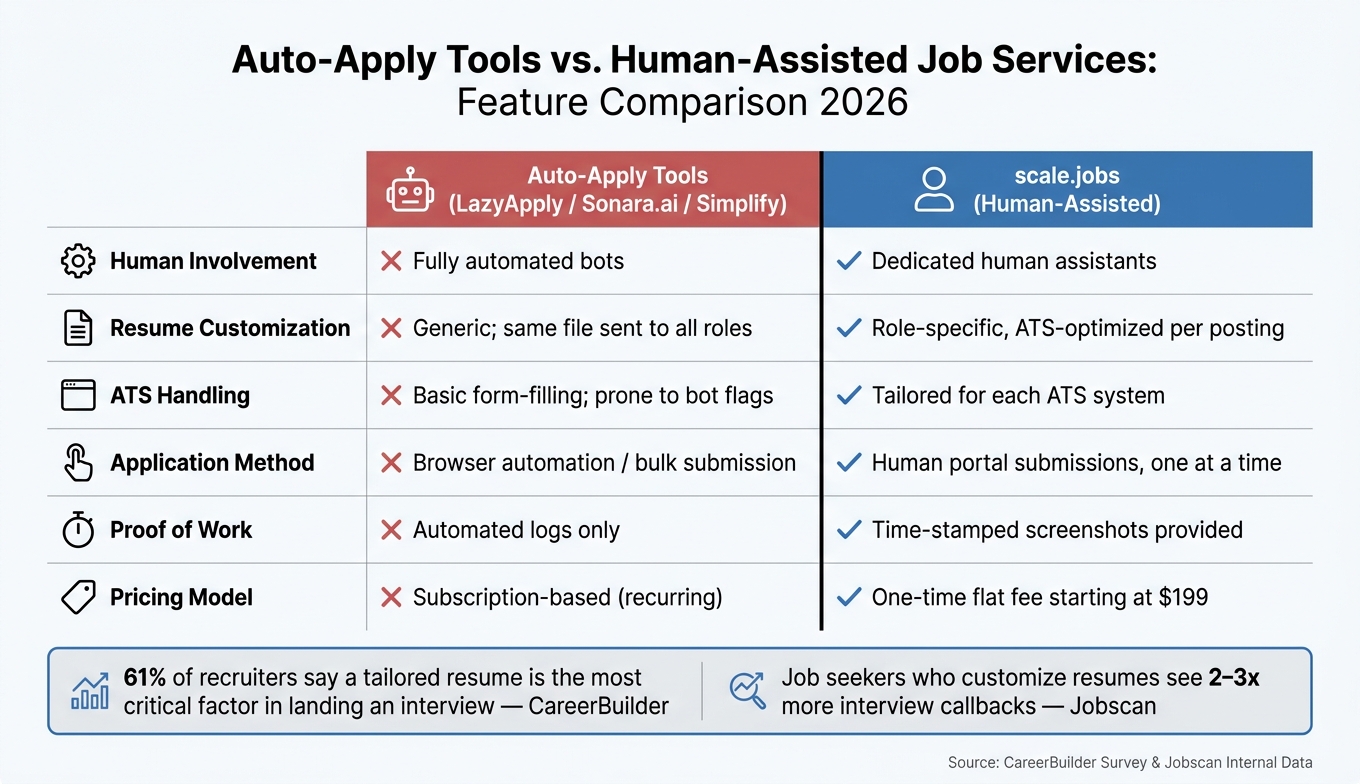
Auto-Apply Tools vs. Human-Assisted Job Services: Feature Comparison 2026
When you look at the 10 roles discussed earlier, one thing stands out: they demand a level of precision and customization that generic approaches can't deliver. This is where the contrast between auto-apply tools and human-assisted services becomes clear. Let’s break it down to see how human-powered support from scale.jobs can make a difference.
Competitors like LazyApply, Sonara.ai, and Simplify excel in one area: volume. They’re designed to send out dozens of applications daily by auto-filling forms on platforms like LinkedIn and Indeed using a stored resume. For entry-level or broadly defined roles, this speed can be helpful. But if you’re aiming for a role like Climate Risk Data Analyst or Technical Solutions Architect with a $160,000+ salary, sending the same resume to 200 openings isn't just ineffective - it could harm your chances. Many HR teams and ATS platforms, such as Workday and Greenhouse, are now identifying and filtering out overly generic applications before they even reach a hiring manager.
A CareerBuilder survey highlights that 61% of recruiters say a tailored resume is the most critical factor in landing an interview. Similarly, Jobscan’s internal data reveals that job seekers who customize their resumes to match specific job descriptions experience up to a 2–3x increase in interview rates compared to those using a single, static resume. These stats are particularly important when applying for niche roles, where only a handful of candidates might meet the qualifications.
This is where scale.jobs steps in. Instead of relying on automated bulk submissions, they use trained human assistants to research, tailor, and manually submit each application. They even provide time-stamped screenshots as proof of submission. If you’re making a career shift into one of these specialized roles or aiming for a senior position requiring precise keyword alignment, this hands-on approach can be a game-changer. For those needing a complete resume overhaul, their professional resume writing services are specifically designed to help job seekers transition into niche roles.
| Feature | LazyApply / Sonara.ai / Simplify | scale.jobs |
|---|---|---|
| Human involvement | Fully automated bots | Human assistants |
| Resume customization depth | Generic; same file sent to all roles | Role-specific, ATS-optimized per posting |
| ATS handling | Basic form-filling; prone to bot flags | Tailored for each ATS |
| Application execution method | Browser automation / bulk submission | Human portal submissions, one at a time |
| Transparency and proof of work | Automated logs only | Time-stamped screenshots provided |
| Pricing model | Subscription-based (recurring) | One-time flat fee starting at $199 |
Who Should Use LazyApply, Sonara.ai, or Simplify
These tools are ideal for:
- Job seekers applying to a high volume of general or entry-level roles with standardized requirements.
- Candidates who are okay with automated submissions and less personalized application materials.
- Individuals exploring opportunities across multiple industries without a need for specialized credentials.
Who Should Choose scale.jobs
This service is better suited for:
- Professionals targeting niche or high-value roles, such as the ones discussed earlier, where employer-specific language and certifications are critical.
- Job seekers navigating a career pivot or with experience across multiple domains, requiring a coherent and tailored narrative for each application.
- Those who want documented proof of correct application submissions.
- Applicants aiming for roles in specialized fields like AI, cybersecurity, climate science, or telehealth, where context-specific framing and precise keyword integration are essential.
When to Switch to scale.jobs
Consider choosing scale.jobs if:
- You’re applying for roles paying over $100,000, where generic resumes are likely to be filtered out.
- Your career path involves a pivot or varied experience that requires a well-crafted, specific narrative.
- You want proof of submission to ensure your applications were sent correctly.
- You’re targeting niche positions where employer-specific terminology and certifications need to be seamlessly incorporated into your application.
Decision Summary
For general job searches where speed and volume matter more than precision, LazyApply, Sonara.ai, or Simplify can be a good starting point. However, for specialized, senior, or credential-intensive roles - like those discussed in this article - scale.jobs provides a human-assisted, ATS-optimized service with transparent proof of work. With a one-time flat fee, it’s a more effective choice when the quality of your application directly impacts your chances of landing an interview.
Conclusion
The roles highlighted in this article - from Applied Machine Learning Engineer to Technical Solutions Architect - all demand a specific set of skills and expertise. Employers are not just seeking generalists; they want candidates who bring role-specific knowledge, proficiency with relevant tools, and a proven track record of measurable achievements. Sending out a generic resume to hundreds of postings simply won’t make the cut in these competitive fields.
By 2026, success in landing these positions will depend on approaching each application as a personalized pitch. This means tailoring your resume for ATS to reflect the job's specific requirements, incorporating relevant certifications (like HIPAA, MITRE ATT&CK, or MLOps), and showcasing quantifiable results - whether it's cost reductions, efficiency improvements, or project delivery metrics. These elements are critical, particularly when targeting senior or specialized roles. This is where platforms like scale.jobs excel, offering a level of precision and human oversight that generic tools, such as LazyApply, often fail to deliver.
For professionals considering a career shift or aiming for high-level niche positions, the difference between a well-crafted, targeted application and a generic one can be the deciding factor in getting that callback. Investing in a customized resume and application service is especially worthwhile when pursuing roles with six-figure salaries or more.
With a 4.8/5 satisfaction rating from over 1,500 reviews and a 90% success rate in helping clients secure jobs within 90 days, scale.jobs stands out for its focus on human expertise, ATS-friendly customization, and strategic targeting.
The roles discussed here are not just aspirational - they’re achievable. But success belongs to those who prioritize quality over quantity in their job applications. Precision, not volume, will define career success in 2026.
FAQs
How do I pick the best niche role for my background?
When planning your next career move, it's essential to assess where you stand professionally and align your goals with what the job market needs right now. If you're a mid-to-senior-level professional or considering a career change, focus on positions where your transferable skills can shine in high-demand industries. In such cases, platforms like Scale.jobs can be incredibly helpful. They offer human-assisted services to create ATS-friendly applications tailored to specialized roles, giving you an edge in a competitive market.
For those aiming for entry-level positions, automated tools might work well for creating resumes and applications. However, if you're targeting roles in competitive fields, it's worth investing in a more personalized and detail-driven approach to make yourself stand out.
Which certifications are most important for these 2026 roles?
In 2026, the article stresses the importance of customizing resumes and cover letters for each position as a critical step in landing interviews. While specific certifications aren't singled out as mandatory for niche roles, the focus shifts to professional expertise, crafting ATS-friendly applications, and strategically aligning your documents with job-specific keywords. This approach is essential to stand out, especially in competitive mid-to-senior level roles.
How do I tailor my resume to pass ATS for niche jobs?
To navigate Applicant Tracking Systems (ATS) effectively for niche roles, it’s essential to use job-specific terminology and align your keywords closely with the job description. Steer clear of generic templates and stick to standard fonts, uniform formatting, and avoid using graphics or tables that ATS software might struggle to process. Platforms like Scale.jobs can assist by having skilled virtual assistants fine-tune your resume and cover letter. They focus on adding role-specific keywords and measurable achievements while steering clear of elements that might hinder ATS compatibility.