
Why are you not getting any job interviews: Top 5 Reason

Sarah Mitchell
May 12, 2026

Struggling to land job interviews despite sending countless applications? The issue might not be your qualifications but how you're presenting them. Most resumes fail to pass Applicant Tracking Systems (ATS), or lack the personalization recruiters expect. Here's a quick breakdown of why your applications might be falling short and how to fix them:
- ATS Rejection: 75% of resumes are filtered out due to poor formatting or missing keywords.
- Generic Applications: Sending the same resume to different jobs signals a lack of effort.
- Wrong Job Targets: Applying for roles where you meet less than 70% of requirements wastes time.
- Invisible Networking: Up to 80% of jobs are filled through referrals, not postings.
- No Follow-Up: Failing to track or follow up on applications can leave your efforts unnoticed.
To improve, focus on ATS-friendly resumes, tailor applications for each role, network actively, and follow up systematically. If you're feeling overwhelmed, services like Scale.jobs offer tailored application support, ensuring your resume gets noticed by recruiters.
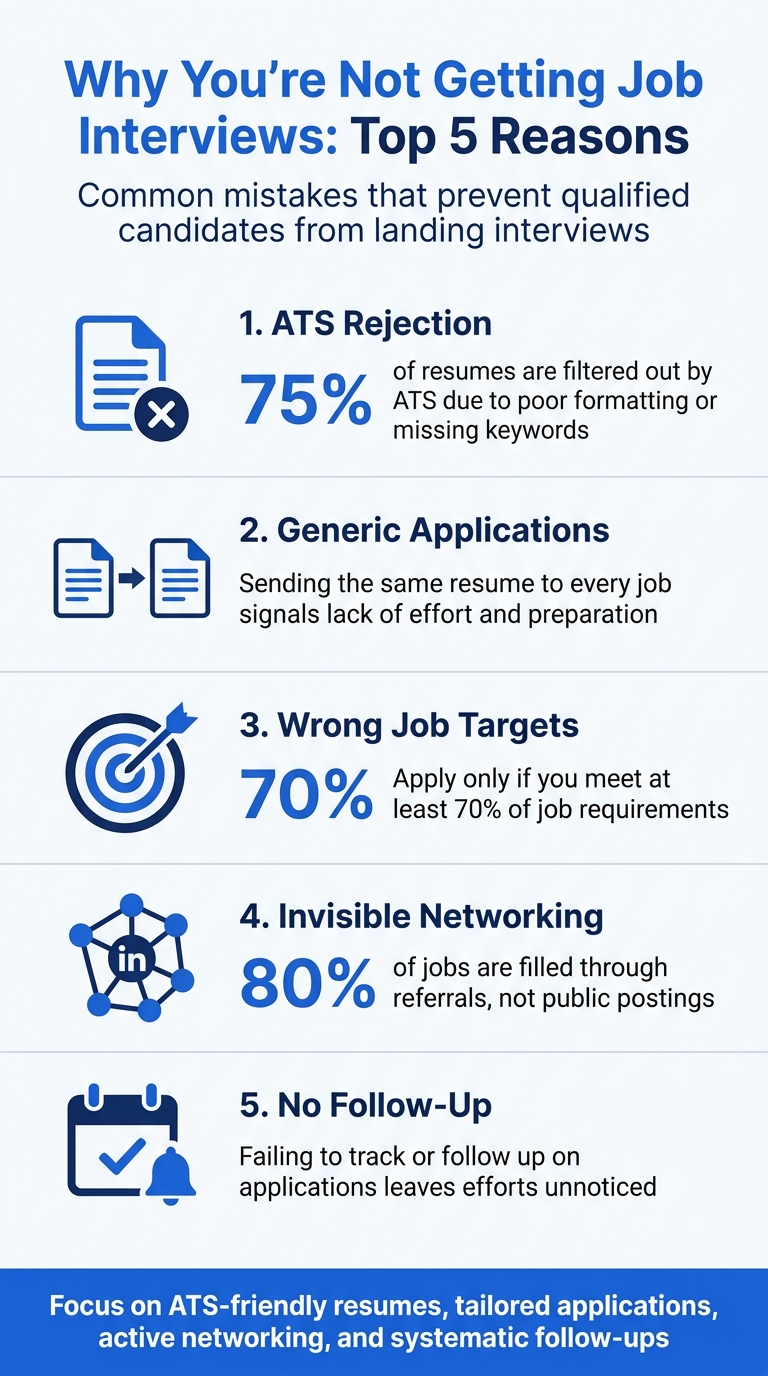
Top 5 Reasons You're Not Getting Job Interviews - Key Statistics
10 Reasons Why You are Not Getting Interviews
sbb-itb-564272e
1. Your Resume Fails ATS Screening
Did you know that 75% of candidates are rejected before a recruiter even sees their resume? The reason? Applicant Tracking Systems (ATS). These systems are designed to scan resumes for specific keywords, organize details into categories like "Experience" and "Education", and rank candidates based on how well their resumes align with the job description. If your resume isn’t optimized for ATS, it may never make it past this initial filter - no matter how qualified you are.
Think of your resume as more than just a career summary - it’s a targeted marketing tool. Modern ATS software relies on Natural Language Processing (NLP) to understand context, not just keyword repetition. For example, simply listing "SEO" in your skills section isn’t enough. Instead, provide evidence like: "Boosted organic traffic by 40% using Search Engine Optimization (SEO) strategies." Including both the acronym and its full form ensures the system recognizes it.
Formatting issues can also undermine a strong resume. Avoid tables, graphics, text boxes, or unconventional headers, as these can confuse ATS software. Stick to a single-column, reverse-chronological layout with clearly labeled sections. Save your contact information in the main body, as many ATS platforms ignore headers and footers. Use file formats like .docx or clean PDFs - resumes created in tools like Canva or Photoshop often fail to parse correctly.
Automation tools like LazyApply or Simplify, which rely on generic submissions, often lead to poor ATS compatibility. Why? Because each job description acts as a guide for the keywords and formatting the ATS expects. To improve your chances, use ATS scanners to check your resume’s compatibility. Aim for a score between 70 and 90 out of 100 - anything below 70 is unlikely to reach a recruiter.
Scale.jobs offers a solution with human-crafted, ATS-optimized resumes tailored to each job posting:
- Personalized optimization over generic automation – Our trained experts analyze job descriptions and naturally integrate high-priority keywords, ensuring your resume is ATS-friendly.
- Real-time updates via WhatsApp – Stay informed about progress with 24-hour turnaround notifications and direct communication with your assistant.
- Proof-of-work transparency – We provide screenshots showing exactly how your resume was optimized and submitted, so there’s no guesswork involved.
If you prefer to take the first step yourself, our resume writing services start at $199. This includes a 1-on-1 strategy session and three free job applications to test your new, ATS-optimized resume.
2. You Send the Same Resume to Every Job
Sending the same resume to every employer is like showing up to a meeting without knowing your audience - it signals a lack of preparation. Recruiters can spot this approach immediately, and it often works against you. Unlike platforms such as LazyApply, which rely on generic, automated submissions, Scale.jobs focuses on creating resumes tailored to each job opportunity.
Customizing your resume isn’t just about making it look polished - it’s about aligning your experience with the employer’s needs. A generic resume might list responsibilities, such as "Managed social media accounts", while a tailored resume reframes that into measurable achievements, like "Boosted Instagram engagement by 30% through data-driven strategies." This shift demonstrates how you’ve delivered results in ways that resonate with what the hiring manager is looking for, often mirroring the language used in their job descriptions.
You don’t need to rewrite your entire resume for every application. Instead, spend 15 minutes adjusting key sections to align with the job description. Keep a document of your accomplishments - your "wins" - to quickly pull relevant examples. For instance, if teamwork is a priority in the job posting, highlight a project where collaboration led to success. If the role emphasizes budget management, include a bullet point about how you delivered a project under budget or saved costs.
Your cover letter should also reflect this level of personalization. Research the company’s mission, recent news, or competitors, and weave that into your letter to show genuine interest. Even small changes, like customizing the greeting and closing, can make a big difference. Be meticulous about company details - mistakes here can lead to instant rejection.
If the thought of tailoring every application feels overwhelming, professional resume services might be worth considering. Here’s how Scale.jobs stands out compared to generic automation tools like LazyApply:
- Human-crafted resumes – Real people create customized bullet points that align with specific job requirements, avoiding generic automation.
- ATS-friendly formatting – Resumes are optimized with keywords and phrases that match the job description naturally.
- Proof-of-work transparency – You receive screenshots showing how your materials were customized and submitted, ensuring quality.
Scale.jobs' resume services take the hassle out of tailoring applications. Their human assistants fine-tune both your resume and cover letter for each job, providing proof-of-work screenshots to show exactly how it was done. This ensures your application is professional, targeted, and stands out from the generic submissions often seen with tools like LazyApply.
Next, we’ll look at how focusing on the right job opportunities can further improve your chances of landing interviews.
3. You're Targeting the Wrong Positions
Applying for roles that don't align with your qualifications can waste time and send the wrong message to hiring managers. When you go after positions where your background doesn't match the requirements, it can raise concerns about your attention to detail and ability to assess fit - two qualities that are crucial in any job.
A good rule of thumb is the 70% rule: if you meet less than 70% of the qualifications listed in a job description, it's probably not worth applying. Instead of spreading yourself thin with 50 generic applications, focus your energy on 10 well-matched roles. This targeted approach increases your chances of landing interviews and allows you to refine your strategy based on responses.
Take the time to identify transferable skills - like communication, leadership, and problem-solving - that can apply across different roles. Look for recurring keywords in job descriptions, such as "budget management", and align these with your achievements. For instance, if you've successfully managed a project that came in 15% under budget, highlight that in your application.
Don Sjoerdsma, Senior Content Writer at LiveCareer, emphasizes, "If your employer can't see how your skills align with the job description, they will not spend time looking at your resume, and you won't get a callback."
If you're unsure how to tailor your applications, professional assistance can be a game-changer. Scale.jobs' resume services provide expert guidance to help you match your experience with the right opportunities. Their human assistants analyze job descriptions and ensure your applications are tailored and strategic, unlike generic tools that rely solely on automation.
For additional insights, ask former managers or mentors to identify strengths you might overlook. Use industry-specific terms like "ROI", "accounts payable", or "B2B" to demonstrate expertise. Don't forget that applicant tracking systems (ATS) often scan for exact phrases from job descriptions, so mirroring that language is key. Remember, quality always trumps quantity when applying for roles that align with your skills.
Lastly, make sure your professional network is active and visible to hiring managers - it can open doors you didn't even know existed.
4. Your Professional Network is Invisible
Did you know that up to 80% of jobs are never posted online? This hidden job market thrives on referrals and internal recommendations, which means if your LinkedIn profile is outdated or you’re not actively engaging with your professional network, you could be missing out on countless opportunities. Recruiters are constantly scouring LinkedIn, and if your profile headline still says "Seeking Opportunities" rather than highlighting your unique skills and accomplishments, you’re essentially invisible to them.
Think of your LinkedIn profile as your professional elevator pitch that’s always live. To make it stand out, focus on including specific, value-driven details. For example, instead of a generic headline like "Marketing Professional", try something like, "Marketing Manager | Scaled SaaS ARR from $5M to $12M in 18 months." Use keywords aligned with your target roles and rewrite your summary to reflect the language recruiters use when searching for candidates in your industry. Also, take a moment to audit your online presence - remove any unprofessional content that might raise eyebrows.
"Networking isn't about who you know. It's about who remembers you when an opportunity arises." - Priyank Ahuja, AI Product Leader
Engagement is key to visibility. Don’t just scroll passively through your feed - leave thoughtful comments on industry posts, join niche communities like Slack groups or relevant forums, and attend virtual events to connect with others in your field. When sending connection requests, avoid generic messages. Instead, personalize each one by referencing a specific project, shared interest, or mutual connection. And when you reach out, focus on learning about someone’s career journey rather than jumping straight to job requests. A single meaningful conversation can often lead to more opportunities than dozens of cold applications.
If networking feels overwhelming, consider tools like Scale.jobs' resume services, which include LinkedIn profile optimization. Their experts can fine-tune your profile to attract recruiters while you focus on building authentic connections. After connecting with someone, follow up after a week - perhaps by sharing an article or insight that aligns with their interests. This keeps you on their radar without coming across as pushy.
The goal of networking isn’t just to gather contacts - it’s to be remembered when opportunities arise. Once your network is active, focus on refining your follow-up strategy to keep the momentum going.
5. You Don't Follow Up or Track Applications
Submitting job applications without following up can leave your efforts unnoticed. With hiring managers often juggling hundreds of applications for a single role, it’s easy for yours to get lost in the shuffle. A lack of response doesn’t necessarily mean you’re not qualified - it could be due to internal factors like budget constraints, internal hires, or shifting priorities.
To stay organized and reduce uncertainty, keep a log of your applications. Record details such as the company name, job title, application date, and follow-up status. Additionally, save a copy of each job description when you apply, as postings may be removed later. This simple system prevents the frustration of wondering, "Did I already apply there?" and helps you identify which roles are generating responses.
Plan to follow up about a week after submitting your application. A short, polite email can make a difference. Reiterate your interest in the position and ask if the hiring team needs any additional information. This gentle reminder can draw attention to your application without seeming intrusive. If you’re managing a high volume of applications and find it hard to keep up with personalized follow-ups, consider using a job application service. Such services can handle the tracking and tailoring for you, freeing up your time to focus on networking and interview prep. This is one area where scale.jobs sets itself apart from tools like LazyApply, offering a more personalized and efficient approach.
If follow-ups still don’t yield responses, use your application log to review your strategy. Check if your resume aligns with the job requirements and includes the right keywords. Instead of treating job hunting as a numbers game, focus on tailoring each application to make a stronger impression.
Next, explore how scale.jobs compares to competitors like LazyApply and Simplify in helping you streamline tracking and follow-ups.
Tool Comparison: scale.jobs vs LazyApply vs Simplify
If you're struggling to land interviews, the tool you're using might be part of the problem. LazyApply, Simplify, and scale.jobs all aim to streamline the job application process, but their methods differ significantly. Let’s break down how they work and why scale.jobs offers a distinct advantage.
LazyApply focuses on high-volume automation. It uses bots to send out hundreds of applications on platforms like LinkedIn and Indeed, often with minimal customization. While this approach prioritizes speed, it can result in generic applications that struggle to pass Applicant Tracking Systems (ATS). This tool is better for those who prioritize quantity over quality and are okay with the risk of ATS rejections.
Simplify, on the other hand, adopts a more user-driven approach. Its browser extensions autofill application forms and provide basic resume tailoring tools. While this saves time on repetitive tasks, most of the effort still falls on the user. Without significant customization, ATS success can be hit or miss.
scale.jobs stands out by blending human expertise with technology. Instead of relying solely on automation, trained virtual assistants personally handle each application. They tailor resumes and cover letters to align with specific job descriptions, ensuring ATS compatibility. Features like real-time WhatsApp updates, proof-of-work screenshots, and a transparent dashboard add an extra layer of accountability. Plus, with flat-fee pricing (e.g., $199 for 250 applications, $299 for 500, or $399 for 1,000), users avoid recurring subscription costs, making it a predictable and efficient option for job seekers.
Why scale.jobs Stands Out
- Personalized Submissions: Every resume and cover letter is tailored to match the job requirements.
- Manual Process: Applications are hand-submitted, reducing the risk of ATS rejection.
- Transparency: Users get real-time updates via WhatsApp and proof-of-work screenshots.
- Flat-Fee Pricing: Predictable costs with no recurring charges.
The table below highlights the key differences between these tools:
| Feature | scale.jobs | LazyApply | Simplify |
|---|---|---|---|
| Human Involvement | Trained VAs manage every application | Minimal; bot-driven | User-driven with autofill assistance |
| Resume Customization | Tailored per job by humans + AI | Generic templates | Semi-automated suggestions |
| ATS Handling | Manual submission; avoids bot flags | High risk of ATS flags | Dependent on user input |
| Application Method | Hand-filled forms on any portal | Fully automated process | Browser extension autofill |
| Proof of Work | Screenshots + WhatsApp updates | Limited tracking | User-managed records |
| Pricing Model | Flat-fee (e.g., $199–$1,099) | Subscription-based | Subscription-based |
Who Should Consider LazyApply or Simplify?
- LazyApply: Perfect for those just starting their job search who want to apply to a large number of roles quickly and are less concerned about application quality.
- Simplify: Best for individuals who prefer to stay hands-on but appreciate tools that reduce repetitive tasks like form filling.
Why scale.jobs Might Be the Better Choice
If you've already sent out dozens of applications without hearing back, scale.jobs could be the solution. It’s particularly effective for competitive roles or niche job boards where tailored applications are essential. The personalized, ATS-optimized approach ensures your applications stand out. Plus, the transparent process and flat-fee pricing make it a reliable option for job seekers who want results without ongoing costs.
Decision Recap
- LazyApply: Great for speed and volume but less effective for tailored, high-quality applications.
- Simplify: Offers a mix of automation and manual effort, though success depends on user input.
- scale.jobs: Combines human oversight with technology for personalized, ATS-friendly applications, making it ideal for those who need a more strategic approach.
When to Switch to scale.jobs
- You’ve sent 50+ applications without any interview callbacks.
- You want real-time updates and proof-of-work screenshots for every submission.
- You need ATS-optimized applications to avoid bot-related rejections.
- You prefer flat-fee pricing over recurring subscriptions.
- You’re targeting competitive or niche roles that demand tailored applications.
If you're ready to take your job search to the next level, scale.jobs could be the game-changer you need. For those who value tailored applications and a transparent process, this platform offers a clear edge.
Conclusion
Achieving success in your job search often comes down to tackling a few common but fixable mistakes. If you’re not hearing back after submitting applications, it’s typically due to issues like resumes that don’t align with ATS requirements, generic applications, poorly targeted job choices, limited networking, or failing to follow up.
Fortunately, these are all areas you can improve right now. Start by focusing on positions where you meet at least 70% of the qualifications and personalize your resume to highlight measurable achievements. Make sure to optimize your LinkedIn profile, and always follow up within a week of applying. Replace vague job descriptions with specific accomplishments backed by numbers for a more compelling application. These small but meaningful changes can lead to noticeable results.
If you’ve sent out numerous applications without success, it may be time to rethink your strategy. Once you’ve adjusted your approach, you might also consider using a specialized service to streamline the process. For example, Scale.jobs offers hands-on support by assigning trained assistants to customize your resume for each role, manually submit applications to bypass ATS issues, and provide proof-of-work screenshots for full transparency. Starting at $199 for 250 applications, this service can save you over 20 hours a week, giving you more time to focus on networking and interview preparation.
Here’s why Scale.jobs stands out:
- Human-assisted applications tailored for each job
- ATS-friendly documents designed to pass automated filters
- Flat-fee pricing with no hidden or recurring costs
- Transparent updates via screenshots and WhatsApp communication
If you feel your resume needs a stronger foundation, consider professional resume writing services to give your applications the best possible start.
FAQs
How do I know if my resume is ATS-friendly?
To make sure your resume is ATS-friendly, focus on including keywords that match the job description. Stick to a clean, straightforward layout - avoid graphics, tables, or multi-column formats - to ensure it’s easy for the system to read. Tools like ATS scanners can help you assess how well your resume aligns with keyword requirements and formatting guidelines. For better chances of passing these automated systems, aim for a score of at least 70% in ATS evaluations.
What parts should I tailor for each job without rewriting everything?
When tailoring your resume, zero in on keywords and specific accomplishments that align directly with the job description. Emphasize relevant skills, responsibilities, and experience that match the role. Update your professional summary or brand statement to showcase why you're an ideal candidate, focusing on what sets you apart. There's no need to overhaul your entire resume; instead, refine these targeted sections to ensure your application is both ATS-friendly and appealing to the hiring manager.
What’s the best follow-up timeline after applying?
When it comes to following up on a job application, timing is everything. Aim to check in about one to two weeks after applying. Reaching out after a week demonstrates your enthusiasm without seeming overly eager, while waiting up to 14 days respects the company's process and sets clear boundaries.
This window allows employers enough time to review applications while keeping your name fresh in their minds. Adjust your follow-up strategy based on the company's typical response time, and always maintain a professional tone to increase your chances of landing an interview.