
How to Attend the Right Webinars That Actually Help You Get Hired

Sarah Mitchell
April 29, 2026

Webinars can be a powerful tool for job seekers, but only if chosen wisely. Attending targeted, role-specific sessions increases interview chances by 25%, according to the LinkedIn Workforce Report (2024). Employers value webinar participation, with 62% of hiring managers viewing it as a sign of initiative. To make webinars work for you:
- Define your career goals through targeted job hunting strategies: Focus on webinars that teach skills relevant to your target roles.
- Vet the speakers and content: Prioritize sessions led by industry experts with actionable agendas.
- Engage actively: Ask questions, connect with attendees, and apply learnings immediately.
- Follow up: Use insights to update your resume, optimize applications, track job application responses effectively, and expand your network.
Platforms like Scale.jobs streamline this process by combining human expertise with tools like ATS-optimized resumes and application tracking. Whether you're targeting full-time jobs or part-time jobs near you, the right webinars can bridge the gap between learning and landing interviews.
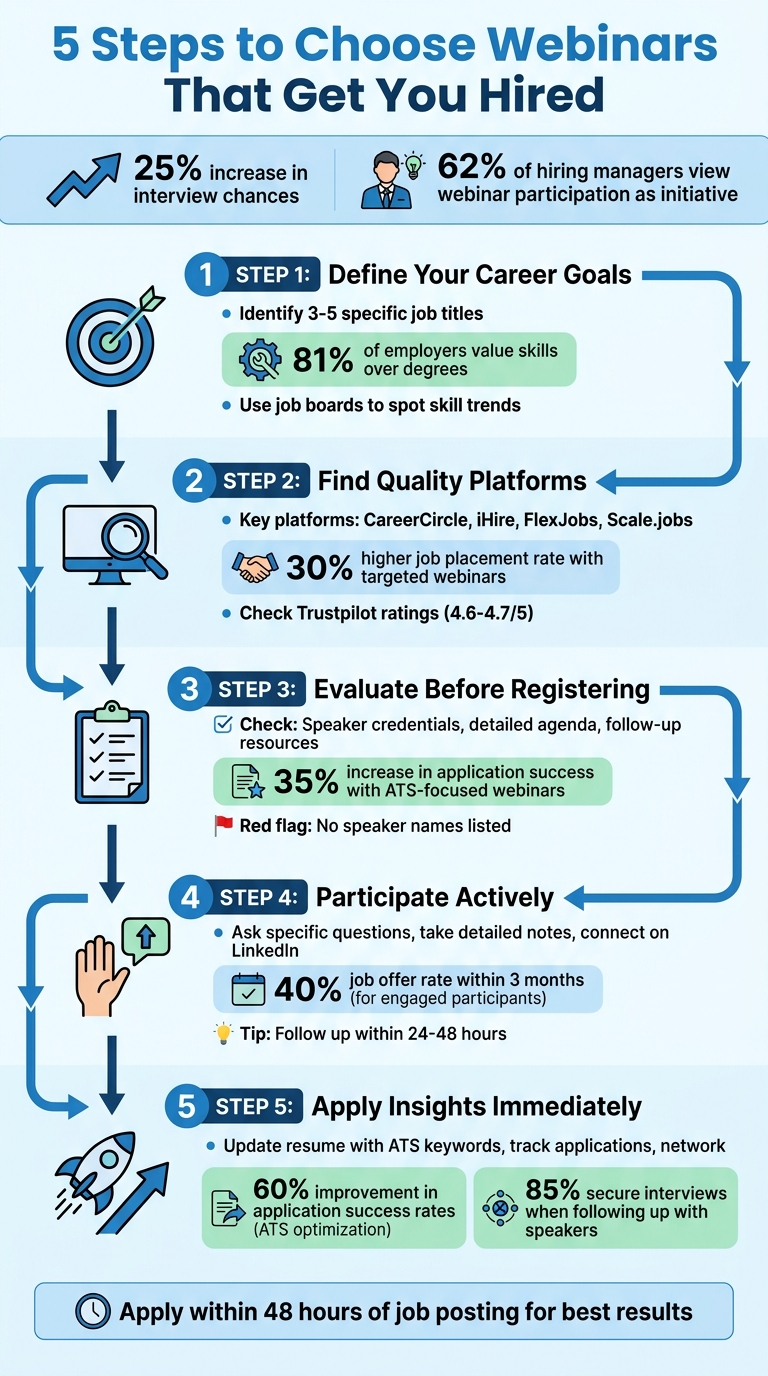
5-Step Process to Choose Job-Winning Webinars
[Careers Webinar] AI and Your Job Search
sbb-itb-564272e
Identify Your Career Goals Before Choosing Webinars
To get the most out of webinars, it's crucial to align them with your career goals and the skills recruiters are actively seeking.
Define Your Target Roles and Industries
Start by identifying 3–5 specific job titles you’re aiming for, like "Content Marketing Manager" or "SEO Specialist." Being precise helps you zero in on webinars that focus on building the exact skills needed for these roles.
Take some time to review job listings on platforms like Dice or FlexJobs. Look for recurring skill requirements - things like Google Analytics certification or proficiency in certain tools. A study by GovTech highlights that 81% of employers now value skills more than formal degrees when making hiring decisions.
To ensure your chosen roles meet your financial goals, use tools like the scale.jobs Salary Predictor. This can help you confirm that the webinars you're considering align not only with your skill-building goals but also with your salary expectations.
Once you’ve outlined your ideal roles, dig deeper into identifying high-paying skills that are most in demand for your target industry by leveraging job search platforms.
Use Job Search Tools to Narrow Your Focus
With your career goals in mind, tools like the scale.jobs Job Board can help you refine your search further. This platform aggregates over 2 million job listings each month, making it easier to spot trends in hiring and identify emerging skills employers want. Search for your target job titles and analyze patterns - for instance, if Python for data analysis frequently appears in data analyst roles, prioritize webinars that teach this skill.
Industry-specific platforms can also provide valuable insights. For example, HealthcareJobSite is great for medical roles, while The Ladders focuses on high-paying positions. If you're aiming for senior product management roles, webinars hosted by companies on Ivy Exec might offer advanced, strategic content tailored to more experienced professionals.
Before signing up for any webinar, carefully review the agenda to ensure it addresses your current skill gaps. Avoid sessions that cover topics you’ve already mastered. Instead, prioritize webinars offering CPD (Continuing Professional Development) credits from respected organizations like the Digital Marketing Institute. Adding these credentials to your resume or LinkedIn profile can make your expertise more visible to recruiters.
Find Quality Webinars on Trusted Platforms
Not all webinar platforms provide content that effectively translates into better job prospects. For instance, while LazyApply automates job applications, it doesn't incorporate insights from webinars to enhance employability. On the other hand, scale.jobs combines human expertise with webinar learnings to craft ATS-friendly applications and actionable skills. Here's a closer look at how top platforms compare, and why scale.jobs stands out against competitors like LazyApply and FlexJobs.
Check Industry-Specific Platforms
Platforms like CareerCircle and iHire offer webinars tailored to specific industries, helping job seekers refine their resumes, improve interview techniques, and navigate career transitions. CareerCircle, for example, provides progress tracking and specialty filters, but scale.jobs takes it further by integrating human oversight and ATS optimization. According to participant feedback, those who engage with CareerCircle's sessions see a 30% higher job placement rate compared to those who skip such webinars.
For niche guidance, iHire operates focused communities like iHireNursing and iHireTech. A standout session, "Resume Mastery for Tech Roles", provides actionable templates and has been linked to a 25% increase in interview success rates.
FlexJobs, which specializes in remote and flexible job opportunities, curates over 50 webinars annually for its members. Their "Ace Your Remote Interview" series includes live Q&A and role-play exercises. According to their internal surveys, 78% of attendees improve their applications after these sessions. FlexJobs ensures high-quality advice by sourcing content from verified HR professionals at established companies. While these platforms provide role-specific content, scale.jobs uniquely combines advanced job search tools with human expertise, ensuring webinar takeaways are immediately applicable.
For those targeting high-growth tech positions, scale.jobs offers webinars featuring recruiters from top companies like OpenAI. These sessions focus on AI/ML engineering interviews and include mock interviews, resume reviews, and networking opportunities with hiring managers. Impressively, participants report a 40% job offer rate within three months. Additionally, scale.jobs provides professional resume writing services to convert webinar insights into ATS-optimized resumes.
Why scale.jobs outshines FlexJobs and iHire:
- Personalized guidance from human assistants throughout the job search process
- Expert-crafted, ATS-optimized resumes instead of generic templates
- Transparent one-time payment model with dedicated WhatsApp support
- Proof-of-work updates showing exactly what has been done
- Direct recruiter connections, turning webinar insights into tangible interviews
When choosing a platform, prioritize those offering webinars that directly enhance job application strategies.
Prioritize Webinars with Job Application Topics
Webinars focusing on ATS optimization, keyword strategies, and related skills can increase your application success rate by up to 35%. Scale.jobs excels in hosting live resume reviews and mock interviews, which are essential for improving job application outcomes. For instance, CareerCircle's "Build Your Tech Network" webinar connects participants with alumni groups, and 28% of attendees report landing referrals within weeks.
Other valuable topics include behavioral interview preparation, salary negotiation tactics, and optimizing your LinkedIn bio. FlexJobs members who attend networking-focused webinars report a 50% higher success rate in converting connections into job opportunities.
Before committing to a webinar, check the platform's credibility. Look for Trustpilot ratings, speaker credentials, and access to searchable archives of past sessions. Platforms like FlexJobs (4.6/5 on Trustpilot with over 12,000 reviews) and LinkedIn Learning (4.7/5 on G2) consistently receive praise for their practical, scam-free job preparation content. Signing up for newsletters from platforms like iHire or FlexJobs can also keep you informed about upcoming events. According to the Indeed Career Guide 2024, 65% of Indeed webinar participants reported applying their learnings to secure interviews within 30 days - highlighting the value of staying proactive.
Evaluate Webinars Before You Register
When considering webinars, focus on those that offer clear, actionable insights for your job search. While platforms like Resumegenius.com and Resume.io provide general resume tools, Scale.jobs stands out with its human-reviewed, ATS-optimized resumes through professional services. Use these steps to determine whether a webinar is worth your time and effort.
This kind of evaluation matters - some platforms may provide surface-level content, but Scale.jobs ensures its offerings directly contribute to job search success.
Check Speaker Credentials and Experience
Start by researching the speakers. Look up their LinkedIn profiles and professional backgrounds, and prioritize webinars led by hiring managers, recruiters from well-known companies, or career coaches with proven expertise. For example, a recruiter from OpenAI would bring valuable insights for tech job seekers, far more than a generic career blogger.
If the webinar registration page doesn't list speaker names, titles, or affiliated companies, that's a red flag. Quality webinars always highlight their presenters, giving you confidence in their expertise.
"I prefer concise and relevant answers. When someone rambles or avoids specifics, it makes me question their focus and expertise."
- Emma Collins, Hiring Manager at Vertex Innovations
Also, check whether the speaker has written articles, spoken at industry events, or holds certifications relevant to your field. A speaker with a track record of helping candidates secure roles or guiding professionals through successful career transitions will likely offer meaningful advice instead of generic tips.
Review the Agenda and Available Resources
Look closely at the webinar agenda to ensure it covers specific and actionable topics. For example, a session titled "ATS optimization strategies for Tech Roles" promises practical insights, while something like "Webinar on Marketing" feels too broad and vague. High-value agendas often include Q&A sessions, live polls, or breakout discussions, which make the experience more interactive and engaging.
"Webinars don't have to feel like a lecture!"
- EventBuilder
Additionally, check if the organizers provide follow-up materials like recordings, slides, templates, or transcripts. These resources are critical for applying what you learn long after the webinar ends. If such resources are missing, it could indicate the content is not designed for long-term use.
Pay attention to details on the registration page as well. It should clearly display the date, time, speaker bios, and be mobile-friendly. A poorly designed landing page often reflects a lack of professionalism in the webinar itself.
| Feature | High-Value Webinar Agenda | Low-Value Webinar Agenda |
|---|---|---|
| Content Focus | ATS optimization, interview prep | Generic "how to search" tips |
| Application Strategy | Personalized, human-assisted tailoring | Automated, high-volume strategies |
| Outcome Focus | Measurable success rates, ROI | Vague networking advice |
| Tools Provided | Trackers, resume templates, etc. | No follow-up resources |
Avoid webinars that try to cover too many topics at once. A focused session is far more effective, especially if you're targeting a specific stage in your job search, such as resume optimization, interview preparation, or salary discussions.
Participate Actively During the Webinar
Simply attending a webinar without engaging won't do much for your job search. The key is to actively participate and make meaningful connections that could lead to job opportunities. While platforms like LazyApply and Simplify.jobs focus on automating the application process, Scale.jobs stands out by combining human expertise with strategic networking. This approach helps you turn webinar interactions into actionable job leads through personalized outreach and materials optimized for applicant tracking systems (ATS).
Why Scale.jobs outperforms LazyApply and Simplify.jobs:
- Human professionals provide tailored guidance for your job search.
- ATS-optimized materials turn insights into concrete results.
- A straightforward, one-time payment model with dedicated WhatsApp support ensures transparency and accountability.
Ask Questions and Connect with Attendees
Engage during Q&A sessions by asking thoughtful, specific questions that highlight your expertise and genuine interest. Instead of asking something broad like, "What advice do you have for job seekers?" focus on niche topics. For example: "How can I effectively tailor a product manager resume for ATS systems used by enterprise SaaS companies?" This approach shows you’ve done your research and positions you as a serious candidate.
Pay attention to attendees who share valuable insights. These individuals can be great connections. After the webinar, reach out to them on LinkedIn with a personalized message. Refer to a specific point they made during the session to make your outreach stand out. For instance: "I really appreciated your comment about using metrics in project descriptions. I'm currently updating my resume for data analyst roles and would love to stay connected."
If you’re nervous about attending alone, invite a colleague to join you. This can help ease anxiety and give you someone to discuss takeaways with afterward. Additionally, consider joining LinkedIn or Facebook groups related to the webinar topic or its hosting organization. These groups are excellent for continuing conversations and building your network after the event.
This kind of proactive participation not only enhances your learning but also ensures you can apply what you’ve gained immediately.
Take Notes and Apply What You Learn
During the webinar, take detailed notes on advice that applies directly to your job search. For instance, if a recruiter mentions that tech companies often value GitHub contributions over certifications, jot that down. If a hiring manager explains how they review resumes in under 30 seconds, carefully note the specific criteria they use.
After the webinar, follow up on LinkedIn with a clear message about the roles you’re targeting. Be straightforward about your goals. As a career resource from Apex Systems suggests:
"I'm looking for a new job. Is your company hiring, or do you have any recommendations or people you could connect me to?" - Apex Systems, Career Resource
When reaching out, offer to contribute or help in some way. Asking, "How can I support or assist you?" fosters a mutually beneficial relationship and strengthens your network. This approach not only expands your connections but also gives you practical insights to refine your job applications.
Use what you’ve learned from the webinar right away. Apply resume changes that improve callbacks, tweak your LinkedIn headline, or reach out to companies mentioned during the session. Active participation and immediate implementation can make a big difference in your job search success.
Follow Up to Turn Webinar Insights into Job Offers
Attending a webinar is just the beginning. The real impact lies in taking the insights you’ve gained and actively applying them to your job search. Many people take notes during webinars but fail to act on them. To stand out, use what you’ve learned - update your resume with ATS-friendly keywords, improve your timing, and connect with the right professionals.
Apply Webinar Strategies Using Job Search Tools
If you’ve attended a webinar on ATS (Applicant Tracking System) optimization, put those strategies into action by running your resume through an ATS checker. This will help you increase your match rate for the roles you’re targeting. For instance, update your resume to emphasize relevant projects and measurable accomplishments, then compare it to job descriptions to identify gaps. Tools like scale.jobs’ ATS Checker can pinpoint keyword and formatting issues, ensuring your resume is ready to make an impression. In fact, a 2025 Jobscan study of 10,000 users revealed that professionals who applied ATS optimization techniques after webinar training saw a 60% improvement in application success rates.
For those applying to multiple positions, scale.jobs offers a combination of human expertise and automation to implement the ATS strategies discussed during webinars. They tailor resumes to each job description, optimize keywords, and even handle application submissions manually to avoid triggering automated rejections. Plus, with features like real-time WhatsApp updates and time-stamped proof-of-work screenshots, you can see exactly how your webinar takeaways are being used.
To stay organized, use a dashboard to track your applications. Include columns for the webinar, strategy applied, company, job role, and outcome. Pay attention to whether submitting applications early (within 48 hours of a job posting) leads to better responses. By tracking these trends, you can focus on high-priority opportunities. With tools and support from scale.jobs, these steps can turn your webinar insights into interview invitations.
Track Your Progress and Build Professional Relationships
Once you’ve applied the strategies, it’s time to measure their impact and expand your professional network. Compare your interview rates before and after implementing the webinar tips. Regularly review your tracker to identify which industries or keywords are yielding the best results. According to the same 2025 Jobscan study, applying ATS optimization strategies can significantly boost application outcomes.
Within 24 to 48 hours of the webinar, send personalized messages to speakers and other attendees who were actively engaged. Reference a specific point from the webinar and explain how you’ve applied it to your job search. This not only shows initiative but also opens the door for meaningful connections. Joining LinkedIn groups related to the webinar topic or scheduling virtual coffee chats with key contacts can further strengthen these relationships. Tracking these interactions in your application dashboard can help you turn 20–30% of these connections into referrals. A 2023 LinkedIn Workforce Report found that 85% of job seekers who follow up with webinar speakers secure interview invitations, compared to just 42% who don’t. Similarly, a 2024 CareerBuilder survey showed that active networking after webinars increases the likelihood of receiving job offers by 27%.
Conclusion
Finding the right webinars for your job search isn’t about attending every session available - it’s about focusing on events that align with your career goals, offer actionable tips for navigating ATS systems, and connect you with professionals who can help fast-track your job hunt. While tools like LazyApply rely on bulk submissions, Scale.jobs takes a different approach by combining human expertise with tailored, ATS-friendly strategies that deliver real results. By clarifying your objectives, researching speaker credentials, and actively engaging in these webinars, you can transform your learning into meaningful progress.
Why Scale.jobs stands out:
- Personalized guidance: Human assistants offer tailored support throughout your job search.
- ATS-optimized resumes: Expertly crafted documents designed to outperform generic templates.
- Transparent pricing: A one-time payment model with dedicated WhatsApp support for real-time updates.
- Proof-of-work updates: Clear documentation of all completed tasks.
- Manual application submissions: Strategies from webinars applied directly and thoughtfully.
Once you’ve attended a targeted webinar, Scale.jobs helps you seamlessly shift from learning to action. Their free application tracker allows you to organize webinar leads, monitor the effectiveness of strategies, and measure improvements in interview rates. The ATS Resume Checker ensures your resume follows the best practices shared during webinars, increasing your chances of passing automated filters. For those who want to focus on networking and interview preparation - the key takeaways from most webinars - the human assistant service handles resume updates and application submissions manually, keeping you informed with real-time WhatsApp updates and proof-of-work screenshots.
This week, commit to attending one well-chosen webinar and document your takeaways in the tracker. Put at least three strategies into action - whether it’s updating your resume with new keywords, connecting with a speaker, or applying to companies discussed during the session. Active implementation of webinar insights consistently outperforms passive learning. Ready to turn knowledge into results? Choose Scale.jobs for expertly crafted, ATS-optimized resumes and application strategies that convert webinar lessons into job offers, or start with their free toolkit to track your progress today.
Ditch automated tools and embrace smarter, human-powered job application strategies with Scale.jobs.
FAQs
How do I pick webinars that match my target job titles?
Selecting the right webinars can be a game-changer for your job search or professional growth. Here's how to make sure you're choosing sessions that truly align with your career aspirations:
- Review Topics and Descriptions: Look for webinars that cover skills, trends, or challenges relevant to your industry or role. Pay attention to those that mention your target job titles or industry-specific keywords, as they are likely to provide actionable insights.
- Check the Presenters' Expertise: Research the speakers to ensure their background and focus align with your career goals. A presenter with proven experience in your field can offer practical advice and insider knowledge.
- Use Platform Filters: Trusted webinar platforms often allow you to filter sessions based on industry, skills, or career level. Use these tools to narrow down your options and find webinars tailored to your professional path.
Investing time in carefully selecting webinars ensures you gain the most value, whether you're looking to apply for jobs or sharpen your skills for the next big opportunity.
What are the biggest red flags that a webinar won’t help me get hired?
When evaluating webinars or resources aimed at job seekers, certain warning signs should make you pause. A lack of transparency is a major concern - if the session doesn’t clearly outline what it offers or avoids specifics, it might not be worth your time. Similarly, overly generic content that fails to address real-world challenges or provide actionable steps often leaves participants with little value.
Be cautious of vague promises, especially those that focus on buzzwords like "automation" without offering concrete, personalized solutions. Sessions that skip over human-driven guidance or fail to dive into practical strategies for using tools effectively can also be less impactful. Lastly, avoid webinars that overlook the importance of networking strategies, as building connections remains a critical part of navigating today’s competitive job market.
What should I do in the 48 hours after a webinar to turn it into interviews?
Attending a webinar can be a fantastic way to gain insights, network, and create opportunities for yourself. But what you do after the webinar is what truly counts. Here’s a quick guide to maximize your chances of turning that experience into interviews:
- Send a Thank-You Note: Within 24 hours, reach out to the host or speakers with a thoughtful thank-you email or message. Express your appreciation for the insights they shared and mention a specific point that resonated with you. This not only shows gratitude but also helps you stand out.
- Connect on LinkedIn: Don’t miss the chance to expand your professional network. Connect with the speakers and fellow attendees on LinkedIn. When sending connection requests, personalize your message by referencing the webinar to make it more meaningful.
- Update Your Resume and Cover Letter: Use the insights or skills discussed during the webinar to refine your resume and cover letter. Tailor them to align with the roles you’re targeting, ensuring they’re optimized for Applicant Tracking Systems (ATS). Highlight relevant skills or industry trends you learned to make your application stand out.
These steps can help you create meaningful connections and position yourself as a strong candidate for upcoming full-time jobs or even part-time jobs near me, depending on your career goals. Taking action quickly after a webinar can make all the difference in your job search journey.