
Best Provinces for LMIA Sponsor Jobs in 2026 (You'll Be Surprised)

Sarah Mitchell
April 1, 2026

In 2026, Canada’s LMIA (Labor Market Impact Assessment) policies saw notable changes, creating fresh opportunities for job seekers. Key cities like Vancouver, Winnipeg, Halifax, and Montréal reopened for low-wage LMIA processing due to unemployment rates dropping below 6%. However, eligibility is updated quarterly, with the next review on April 10, 2026, making timing critical for applicants.
Here’s what you need to know:
- Vancouver, BC: High wage threshold ($36.60/hour), strong demand in healthcare technology and engineering.
- Winnipeg, MB: Lowest wage threshold ($30.16/hour), efficient processing times, and demand for nurses, electricians, and tech roles.
- Halifax, NS: Affordable wage threshold ($30/hour) with demand in healthcare, trades, and hospitality.
- Montréal, QC: Mid-range wage threshold ($34.62/hour), with growing opportunities in aerospace, tech, and healthcare.
- Kingston, ON: High wage threshold ($36/hour), focused on healthcare and skilled trades.
For low-wage jobs, targeting reopened cities with lower wage thresholds like Winnipeg and Halifax can improve chances. High-wage roles bypass unemployment restrictions but must meet provincial thresholds. Tools like scale.jobs offer personalized application assistance, helping applicants navigate these complexities with ATS-friendly resumes tailored for 2026.
Pro Tip: Focus on exempt industries like construction, food manufacturing, and healthcare to avoid unemployment-related refusals. Stay updated on quarterly changes to avoid losing the $1,000 non-refundable LMIA fee.
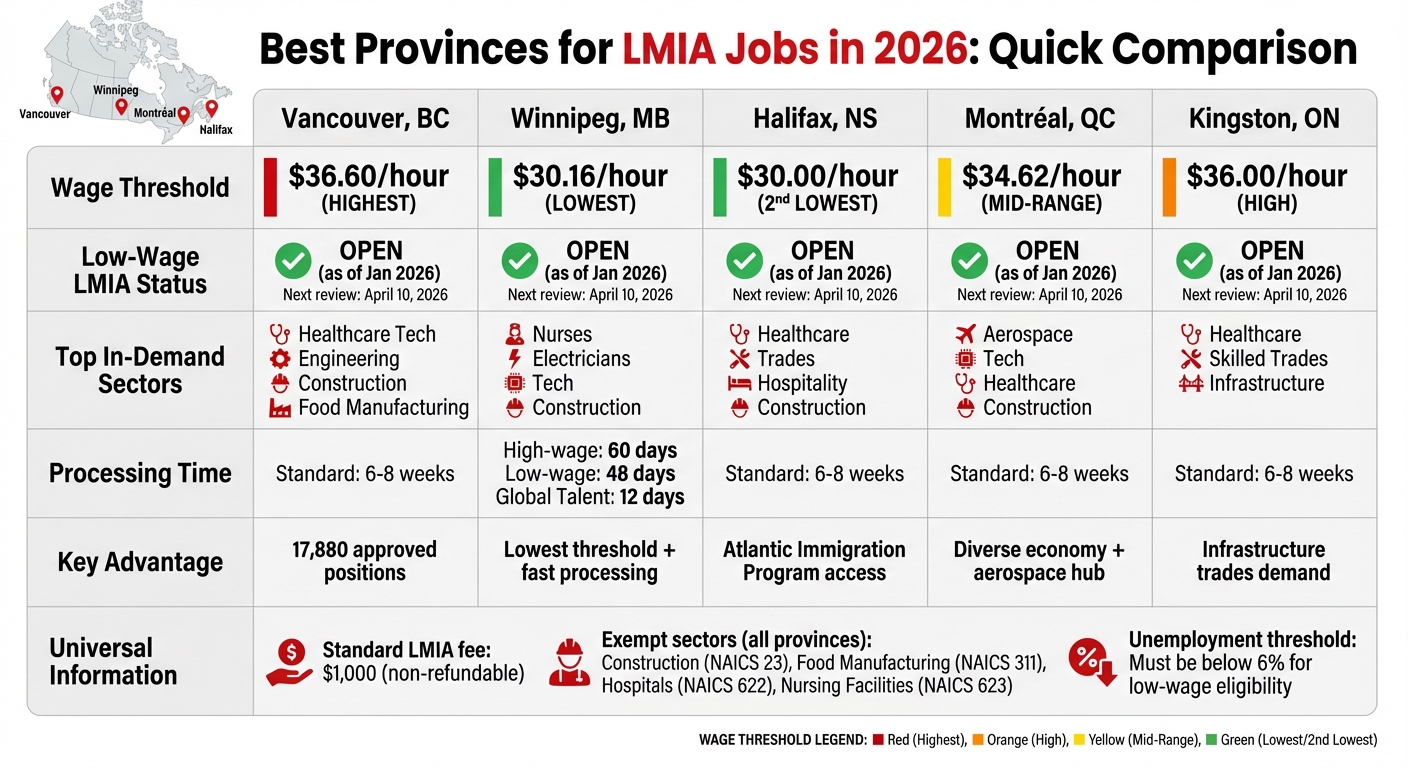
2026 Canada LMIA Province Comparison: Wage Thresholds and Key Sectors
15 Kazi Canada 2026 🇨🇦 | LMIA & AIP Jobs for Foreign Workers
1. Vancouver, British Columbia
Vancouver's unemployment rate dipped below the 6% threshold in early 2026, reopening opportunities for low-wage LMIA processing after a period of restrictions. This change makes British Columbia's largest city a viable destination for foreign workers seeking entry-level and mid-tier roles. However, this eligibility window may close with the next unemployment update on April 10, 2026, if the rate rises again.
Median Wage Threshold
British Columbia sets the highest LMIA wage threshold in Canada at $36.60 per hour. Jobs paying less than this fall under the low-wage stream and are subject to the 6% unemployment rule. On the other hand, positions paying above $36.60 qualify for the high-wage stream, which bypasses regional unemployment restrictions. For comparison, Ontario and Alberta have thresholds of $36.00, while Manitoba's is significantly lower at $30.16. These figures highlight the competitive wage environment in British Columbia.
High-Demand Sectors
Healthcare technology and specialized tech services are leading areas for LMIA approvals in Vancouver. Talent-acquisition expert Sajithkumar Swaminathan explains:
"roughly 72 per cent of health-related occupations currently show a positive outlook, driven by Canada's aging population and ongoing staffing shortages."
In addition to healthcare roles, information systems specialists and engineering managers are in high demand, even as artificial intelligence reshapes routine web development positions. Meanwhile, construction and food manufacturing continue to be exempt from low-wage refusals, regardless of unemployment trends.
Vancouver reported 17,880 approved LMIA positions in the latest data cycle, ranking second nationally behind Surrey. Employers such as Tap & Barrel Olympic Village, Plato Filipino, and Sidhu Concrete Pumping Ltd are active in sponsoring foreign workers. Registered Nurses in Vancouver can expect annual earnings between $65,000 and $110,000+, while Software Engineers typically earn between $80,000 and $140,000. To stand out in this competitive market, consider using tools like an AI resume builder to optimize your applications.
As of January 1, 2026, employers must provide proof of advertising and are prohibited from recovering recruitment costs from workers. Non-compliance with these rules can result in automatic refusals and compliance audits.
2. Winnipeg, Manitoba
With changes to the LMIA framework in 2026, Winnipeg's reopening for low-wage LMIA processing offers a fresh opportunity for applicants. This eligibility was restored early in the year after the city's unemployment rate dropped below the 6% threshold that previously restricted applications. Unlike Vancouver's competitive wage environment, Winnipeg's lower wage threshold provides a distinct advantage. This shift positions Manitoba's capital as a more accessible alternative to provinces like Ontario and Alberta, where higher unemployment rates still limit low-wage applications. However, with the next labor market review slated for April 10, 2026, this window of opportunity could change based on updated data. These factors make Winnipeg a standout option compared to more crowded markets.
Median Wage Threshold
Manitoba boasts the lowest LMIA wage threshold among major provinces at $30.16 per hour. Jobs paying above this rate qualify for the high-wage stream, while those below fall under low-wage processing. In comparison, British Columbia's threshold is $36.60, while Ontario and Alberta both sit at $36.00. This lower threshold in Manitoba makes it easier for employers to access the high-wage stream and bypass restrictions tied to local unemployment rates.
High-Demand Sectors
Several key industries are driving LMIA applications in Winnipeg. Construction project managers, industrial electricians, and registered nurses are in particularly high demand. For example, registered nurses in the city earn an average of $85,000 annually, while industrial electricians see similar earnings. Winnipeg's growing tech sector also offers opportunities, with software developers earning approximately $78,000 per year. Administrative assistants, another essential role, typically make $45,000 annually. Additionally, logistics and transportation companies, such as 5Tracks Cargo Inc., are actively sponsoring foreign workers to address ongoing labor shortages. Competitive wages and efficient processing timelines make Winnipeg an appealing option for workers considering their next move.
Processing Timeline
Winnipeg offers efficient LMIA processing times across different streams:
- High-wage applications: 60 business days
- Low-wage applications: 48 business days
- Global Talent Stream (specialized tech roles): 12 business days
The city's eligibility ensures applications are processed without the automatic refusals affecting other regions. However, applicants should note the non-refundable $1,000 processing fee, which underscores the importance of submitting well-prepared applications. Starting January 1, 2026, employers must also provide proof of advertising and are prohibited from recovering recruitment costs from workers. These requirements highlight the need for careful planning to maximize success in Winnipeg's LMIA landscape.
3. Halifax, Nova Scotia
Halifax's removal from the ineligible list on January 9, 2026, along with its unemployment rate dropping below 6%, has reopened opportunities for low-wage LMIA processing in Atlantic Canada. This creates a short window of opportunity before the next update on April 10. Halifax stands out as an appealing option compared to provinces grappling with higher unemployment rates. Below, we’ll explore the wage criteria, key industries, and processing details that make Halifax a standout choice.
Median Wage Threshold
In Nova Scotia, the LMIA wage threshold is $30.00 per hour, making it the second-lowest among provinces currently processing applications. This lower threshold allows employers to pursue low-wage LMIA applications more affordably. Jobs offering $30.00 or more fall under the high-wage category, while those below qualify for low-wage processing. For businesses looking to sponsor foreign workers without incurring higher costs, Halifax provides a more accessible path.
High-Demand Sectors
Halifax boasts several high-demand industries that make it a hub for LMIA applications. The healthcare sector continues to lead, with roles like registered nurses, personal support workers, and medical technologists in high demand. Additionally, the tech and engineering fields are growing, with information systems specialists and civil engineers becoming increasingly sought after as infrastructure projects expand.
In the hospitality sector, positions like facility supervisors and operations managers are critical, especially as tourism begins to recover. Skilled trades, including electricians and carpenters, are also essential to support housing construction initiatives. For example, food counter attendants in Halifax earn an average annual salary of $40,405. If you're aiming for these specialized roles, consider using professional resume services to ensure your application meets employer expectations.
Processing Timeline and Exemptions
While Halifax offers streamlined processing, timelines can vary depending on the wage stream. Employers should note the standard $1,000 non-refundable processing fee per position. Additionally, certain industries enjoy exemptions from unemployment-based restrictions, even if Halifax's unemployment rate rises above 6% in the future. These industries include:
- Construction (NAICS 23)
- Food manufacturing (NAICS 311)
- Hospitals (NAICS 622)
- Nursing facilities (NAICS 623)
These exemptions provide stability for applicants targeting these sectors. However, employers hiring for primary agriculture roles should be aware of the reinstated requirement, effective January 1, 2026, to provide proof of advertising efforts. Proper documentation will be essential to avoid processing delays.
4. Montréal, Quebec
Montréal's reinstatement on the LMIA eligibility list has opened new doors for job seekers in Quebec. As of January 9, 2026, the city's unemployment rate dropped below 6%, making low-wage LMIA applications viable again. This change provides a window of opportunity for applicants to get ahead before the next update on April 10. With a median wage threshold of $34.62 per hour, Montréal stands out as a hub for high-wage roles across various industries, offering a way to bypass unemployment rate restrictions. For those navigating this evolving market, leveraging job application services can provide a competitive edge.
Median Wage Threshold
Quebec's LMIA wage threshold is set at $34.62 per hour, placing it in a mid-range compared to other provinces. For instance, British Columbia and Ontario have higher thresholds at $36.60 and $36.00, respectively, while Atlantic and Prairie provinces tend to be more affordable. Jobs paying $34.62 or more qualify for the high-wage LMIA stream, which is not affected by the 6% unemployment restriction. On the other hand, roles below this threshold fall into the low-wage stream and are subject to provincial unemployment caps. Employers hiring for high-wage positions benefit from fewer restrictions, while low-wage applicants should keep an eye on quarterly updates to ensure eligibility. This wage benchmark places Montréal in a unique position, balancing affordability and opportunity compared to other markets.
High-Demand Sectors
Montréal's diverse economy continues to attract talent across several key industries. The aerospace sector, led by firms like Bombardier, is actively hiring engineers and technicians for specialized roles in manufacturing. The city's growing tech industry also demands skilled professionals in software development and cloud engineering. Meanwhile, the healthcare sector is addressing staffing shortages with a focus on hiring registered nurses and pharmacy technicians for hospitals and residential care facilities.
Construction and food manufacturing also stand out, benefiting from exemptions under NAICS codes 23 and 311. These exemptions allow these industries to process low-wage LMIAs even if the unemployment rate exceeds 6% in future quarters. Other frequently sponsored roles include administrative assistants, accounting technicians, and customer service representatives. For specialized positions in sectors like aerospace or tech, working with a virtual assistant for job seekers can help tailor your application to meet employer and ATS standards.
Processing Timeline and Exemptions
A $1,000 processing fee applies to each LMIA application, and employers must ensure wages meet the $34.62 threshold. High-wage applications generally face fewer hurdles, while low-wage applications must adhere to provincial unemployment caps and quarterly eligibility updates.
Certain industries enjoy exemptions from unemployment-based restrictions, providing more stability for applicants. These include construction, food manufacturing, hospitals (NAICS 622), and nursing facilities (NAICS 623). Even if Montréal's unemployment rate rises above 6% in the future, these industries can continue processing low-wage LMIAs. However, recent changes require primary agriculture roles to include proof of advertising efforts starting January 1, 2026, adding an extra step for employers.
For those targeting Montréal, using a job search virtual assistant can streamline the process and help you stay competitive in this fast-changing market. Scale.jobs offers tools and expertise to navigate regional fluctuations, standing out among competitors like findmyprofession.com and lazyapply.com.
5. Kingston, Ontario
Kingston aligns with Ontario's $36.00 per hour median wage threshold, a figure that matches Alberta's and surpasses Quebec's $34.62 and Manitoba's $30.16. This threshold plays a key role in determining whether positions are classified as high-wage or low-wage. High-wage roles avoid unemployment restrictions, while low-wage positions face potential refusals if Kingston's unemployment rate hits 6% or higher during the next review. This condition is critical for employers and applicants planning their LMIA submissions.
Current LMIA Processing Status
Kingston's LMIA eligibility is tied to quarterly unemployment rate updates. The most recent data was published on January 9, 2026, with the next update set for April 10, 2026. If the unemployment rate reaches or exceeds 6%, Service Canada will refuse to process low-wage applications unless they qualify for specific exemptions. Employers should note that standard processing fees are required for each position, and these costs cannot be passed on to foreign workers. Low-wage applicants should keep a close eye on the April update to ensure they meet eligibility requirements. Like other regions, Kingston undergoes quarterly reassessments, making precise timing essential for a successful LMIA application.
Now, let’s explore the industries fueling Kingston’s job market.
High-Demand Sectors
Kingston’s job market is thriving in sectors such as healthcare, construction, and skilled trades. Hospitals (NAICS 622) and nursing facilities (NAICS 623) are actively recruiting registered nurses, who benefit from exemptions allowing their LMIA applications to proceed regardless of local unemployment rates. Ian Howcroft, CEO of Skills Ontario, points out a shift in demand:
"We're not seeing as many houses built…so some of those traditional trades are not in as high a demand as trades in the infrastructure area."
Skilled trades like industrial electricians, welders, boilermakers, truck mechanics, and machinists/millwrights are particularly sought after. With 50% to 60% of the current skilled trades workforce expected to retire within the next five to ten years, these roles offer long-term opportunities. Additionally, food manufacturing (NAICS 311) remains exempt from unemployment restrictions, providing another avenue for low-wage applicants.
For those considering platforms such as findmyprofession.com or lazyapply.com, it’s worth noting the advantages of using a service like scale.jobs. With its human assistants and ATS-optimized documents, scale.jobs provides tailored support for specialized roles in these high-demand sectors. Leveraging resume writing hacks can also help applicants meet employer expectations and navigate applicant tracking systems effectively.
Province Comparison: Advantages and Drawbacks
Building on our detailed province reviews, here's a comparison highlighting key trade-offs for LMIA job seekers in 2026.
British Columbia presents an interesting mix of opportunities and challenges. Its higher wage requirements are favorable for high-wage streams but can be a hurdle for mid-level earners. With Vancouver reopening for low-wage LMIA processing - thanks to its unemployment rate dropping below 6% - both streams are now viable. However, the $36.60 wage threshold can push roles earning between $32 and $35 per hour into the low-wage category, which comes with stricter caps and additional employer obligations.
Manitoba and Nova Scotia stand out for their lower wage thresholds ($30.16 and $30.00 respectively), making it easier for more roles to qualify as high-wage and bypass regional unemployment restrictions. Winnipeg and Halifax reopened for low-wage LMIA processing in January 2026, with Halifax also benefiting from pathways under the Atlantic Immigration Program. These lower thresholds reclassify roles that might be mid-range in other provinces as high-wage, offering more accessible entry points for applicants.
Montréal, with a wage threshold of $34.62, reopened for low-wage applications recently, offering a middle-ground option. On the other hand, Kingston faces stricter conditions. While its threshold is similar to Alberta's at $36.00, many Ontario Census Metropolitan Areas still have unemployment rates above 6%, making most low-wage applications ineligible. The next update on April 10, 2026, will determine if Kingston’s status changes.
Across all provinces, certain key sectors - construction (NAICS 23), food manufacturing (NAICS 311), hospitals (NAICS 622), and nursing facilities (NAICS 623) - are uniformly exempt from these restrictions. The standard $1,000 processing fee and 6–8 week processing time also remain consistent, providing a degree of stability for applicants in these industries. For competitive fields like technology or administrative support, focusing on provinces with reopened low-wage access and lower wage thresholds could increase your chances. Using tools like resume writing services can help align your application with provincial wage requirements and employer expectations, especially for high-wage stream positions.
This complex provincial landscape highlights why switching from automated tools like lazyapply.com to scale.jobs can be a game-changer for LMIA applications. Unlike automated platforms, scale.jobs offers human oversight and a transparent process, ensuring your application is tailored to meet specific provincial requirements. For a detailed comparison of scale.jobs versus competitors like findmyprofession.com and lazyapply.com, explore our breakdown below.
Conclusion
Unlike platforms such as LazyApply and Simplify, which depend heavily on mass automation, scale.jobs takes a personalized approach by combining human support with ATS-optimized application processes specifically designed to meet LMIA requirements. As we look ahead to the 2026 LMIA landscape, it’s clear that success lies in strategic targeting rather than sheer volume. Cities like Winnipeg and Halifax stand out as accessible entry points with wage thresholds of $30.16 and $30.00, respectively. Meanwhile, Vancouver and Montréal offer broader industry opportunities, especially now that both cities have reopened for low-wage LMIA processing. On the other hand, Kingston remains a viable option primarily for high-wage roles and exempt sectors, at least until the unemployment update on April 10, 2026.
This provincial targeting strategy is just one part of the process. The next step is understanding how scale.jobs's human-powered approach stacks up against automated alternatives.
To make the most of your efforts, start by identifying which provincial wage threshold aligns with your salary expectations. Then, focus your applications on the five exempt sectors - primary agriculture, construction, food manufacturing, hospitals, and nursing facilities - if you're pursuing low-wage streams. For high-wage positions, ensure your hourly rate meets or exceeds the provincial threshold to avoid complications with regional unemployment restrictions.
While automated platforms such as LazyApply and Simplify might send out hundreds of applications, scale.jobs stands apart by customizing each submission. With human oversight and ATS-ready documentation, scale.jobs ensures compliance with employer LMIA approval status and provincial wage documentation requirements - critical details that automated tools often miss.
Who Should Choose scale.jobs

Compared to mass-application platforms, scale.jobs is the perfect choice for candidates who:
- Need province-specific customization: Tailored applications that address varying wage thresholds and sector exemptions across provinces.
- Require LMIA verification: Human assistants who confirm employer sponsorship history and positive LMIA approval.
- Value ATS optimization: Documents crafted to pass applicant tracking systems used by Canada’s 160,686 LMIA-approved employers.
- Want proof of work transparency: Dedicated WhatsApp support and full visibility into every application submitted on your behalf.
- Prefer one-time payment: No subscriptions or hidden fees - just straightforward application management.
With its human oversight, transparent process, and one-time payment structure, scale.jobs offers a reliable solution for LMIA applications.
Switch to scale.jobs if…
- You’re applying across multiple provinces with varying wage thresholds ($30.00–$36.60/hour) and need tailored documentation for each.
- Your target positions require confirmation of employer LMIA approval before submission.
- You’ve wasted time on automated tools that overlook provincial unemployment restrictions.
- You need ATS-optimized resumes that address sector-specific qualifications in industries like healthcare, construction, or tech.
- You value transparency and human oversight over automated processes that lack accountability.
Stay on top of quarterly ESDC unemployment updates, focus on provinces with lower wage thresholds if you’re in the $30–$36/hour range, and always verify that employers hold positive LMIA approvals before applying. By prioritizing quality applications with proven sponsors over high-volume submissions, you can increase your chances of success. Explore more about our professional services at scale.jobs resume writing services.
FAQs
How can I check if a city is still eligible for low-wage LMIA processing?
To determine if a city qualifies for low-wage LMIA (Labor Market Impact Assessment) processing in Canada, consult the latest updates from Employment and Social Development Canada (ESDC) and provincial immigration authorities. Keep an eye on the most recent LMIA wage tables and regional policies, as these are adjusted based on labor market demands. Provinces such as Ontario and British Columbia might have specific criteria tied to particular areas. For the most accurate and reliable details, check official government resources or reach out to local employment agencies.
What hourly pay qualifies as 'high-wage' in my province?
In your province, a job is considered "high-wage" if its pay meets or exceeds the median wage specific to your province or territory. This benchmark can differ based on the region and the industry in question.
How can I verify if an employer can sponsor an LMIA?
To verify if an employer can sponsor an LMIA (Labor Market Impact Assessment), start by checking their status as an LMIA-approved employer through official government resources or trustworthy job boards. You can also look into their LMIA approval history using tools or employer lists provided by Canadian immigration authorities. Always ensure the information comes from reliable and up-to-date sources to avoid any misinformation.