
9 Things to Do Before Quitting for a Career Change in 2026

Sarah Mitchell
April 26, 2026

In 2026, transitioning careers requires careful preparation to avoid financial strain or prolonged unemployment. This guide outlines nine steps to help you plan effectively, from building a financial safety net to refining your resume and networking strategically.
Key highlights include:
- Financial Planning: Save 6–12 months of expenses to reduce financial risks.
- Target Role Clarity: Identify specific roles and industries aligned with your skills and goals.
- Skill Gap Analysis: List transferable skills and address gaps through certifications or training.
- Resume & LinkedIn Updates: Tailor your materials for ATS compliance and industry relevance.
- Networking: Engage with industry professionals and attend niche events.
- Research Companies: Study job postings and company values to ensure alignment.
- Timeline & Milestones: Set measurable goals and track progress to stay focused.
- Interview Preparation: Practice explaining your career change with clear, results-focused examples.
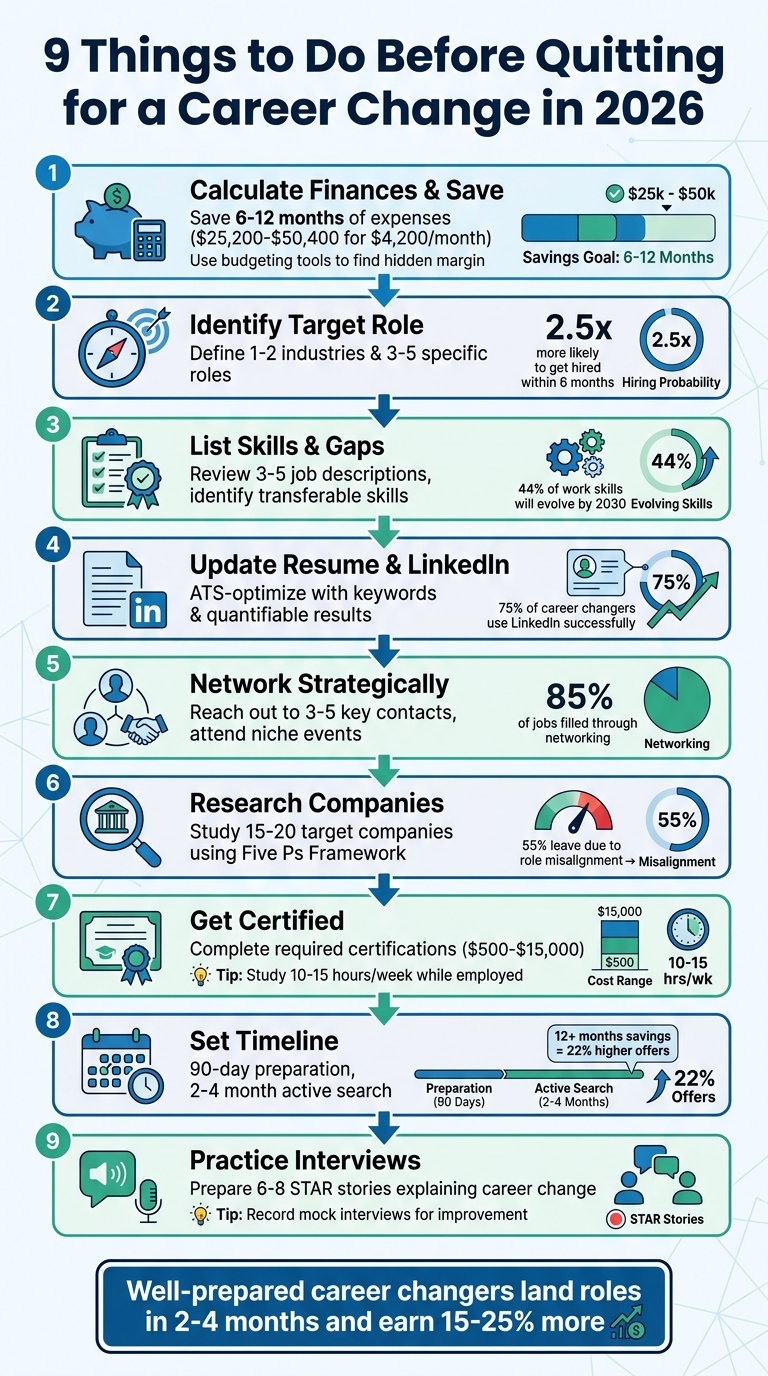
9-Step Career Change Preparation Checklist for 2026
BEST Tips for Career Changers (Complete Guide)
sbb-itb-564272e
1. Calculate Your Finances and Save 6–12 Months of Expenses
Before making the leap to a new job or career, it's crucial to assess your financial situation and build a savings cushion that can cover 6–12 months of expenses. Without this safety net, you might feel forced to settle for a lower salary or a role that doesn't align with your goals.
Start by tracking every dollar you spend over the course of a month. Budgeting tools like YNAB, EveryDollar, or Monarch Money can help you create a zero-based budget, where every dollar is assigned a purpose. For instance, EveryDollar premium users have shared that they uncovered over $3,000 in "hidden margin" within just 15 minutes of analyzing their spending habits. This kind of clarity can be a game-changer.
Once you have a clear picture of your monthly expenses, multiply that amount by 6–12 to determine your savings target. For example, if your monthly expenses are $4,200, aim to save between $25,200 and $50,400. To free up extra cash, cancel unnecessary subscriptions using tools like Rocket Money, which can help identify and eliminate wasteful spending. You can also automate transfers to a high-yield savings account, ensuring your savings grow without the temptation to spend.
Financial risks go beyond just dipping into your savings. For example, subscription services like LazyApply, which charge recurring fees, can drain your budget while offering low callback rates (1–3%) and risking bot flagging. In contrast, professional resume services, which operate on a one-time fee, deliver significantly higher callback rates - ranging from 25–47% - without adding subscription-related stress to your finances.
"A budgeting app should support your plan, not replace it. If it does everything for you, you're not building the habits you need to win with money." - Rachel Cruze, Financial Expert, Ramsey Solutions
To stay on track, set up a monthly "money date" to review your financial progress and adjust for any unexpected expenses. This habit will help you maintain a buffer that empowers you to make thoughtful and strategic decisions.
Once your financial safety net is secure, you can confidently shift your attention to identifying your ideal role and industry, ensuring your career transition is both deliberate and well-planned.
2. Identify Your Target Role and Industry
Once your finances are squared away, the next step is to pinpoint the specific role and industry you want to pursue. According to LinkedIn's 2024 Economic Graph data, individuals who clearly define their target role before making a career change are 2.5 times more likely to secure a new job within six months. On the flip side, a lack of focus can weaken your applications and slow your progress.
Start by using structured self-assessment tools like the O*NET Interest Profiler or Myers-Briggs. These resources can help you align your personality, values, and strengths with roles that suit you. For example, if you're considering a shift from teaching to corporate training, assess whether your communication skills match the requirements for roles like corporate trainer. Additionally, keep an eye on growth trends in various industries. The U.S. Bureau of Labor Statistics predicts a 10% growth rate for data analysts and a 13% growth rate for nurse practitioners through 2032 - both promising fields if your transferable skills align.
Narrow your focus to 1–2 industries and 3–5 specific roles. Evaluate how well each industry aligns with your goals and priorities. For instance, if you're transitioning from finance to sustainability consulting, ensure there’s active hiring in your target sector before diving in. Monitor job posting trends for at least 30 days to gauge demand. Tools like Glassdoor can help you review salary data specific to cities like San Francisco or Austin, allowing you to set practical salary expectations (e.g., $60,000+ for entry-level roles). If you're unsure whether your resume effectively communicates your qualifications, consider using a professional resume service to refine it for your target roles.
To gain deeper insights, test your chosen roles through shadowing opportunities, attending webinars, or taking on freelance projects. These experiences can help you avoid common pitfalls, like pursuing trendy roles without the necessary skills or underestimating salary realities. For example, while the median salary for U.S. software developers is $127,260, entry-level positions often start lower.
Finally, create a list of 15–20 target companies that align with your career aspirations. Follow their LinkedIn pages, engage with their posts, and connect with employees currently working in your desired roles. Take time to explore their social media and LinkedIn activity to ensure their values and day-to-day practices resonate with you. This focused research will set the stage for skill-building and preparing for the next step in your career transition.
3. List Your Current Skills and What You Need to Learn
Understanding the gap between your current abilities and what’s required in your target field is a crucial step in any career shift. Workforce trends reveal that 44% of work skills are expected to evolve by 2030, making this analysis even more essential for a smooth transition.
Start by reviewing 3-5 job descriptions in your desired industry. Look for recurring keywords such as "project management", "data visualization", or "stakeholder communication." These phrases often highlight the core skills employers are seeking. From there, create two lists: one for the skills you already have that can transfer to the new role (e.g., communication, problem-solving, leadership) and another for areas where you need to grow (like learning specific software, earning certifications, or mastering new methodologies). For instance, if you’re transitioning from retail management to corporate HR, your experience in staff training and conflict resolution is highly relevant, but you might need to learn HRIS platforms like Workday or obtain a SHRM-CP certification.
Feedback can be a valuable tool here. Ask former managers or colleagues to share their perspectives on your strengths and areas for improvement. Complement this with insights from AI-driven tools like Jobscan or O*NET to get a clearer picture of your skillset. If you’re unsure how to effectively position your existing skills for a new industry, consider using a professional resume service to craft a resume or career change cover letter tailored to your goals.
Don’t overlook the importance of "human premium" skills - qualities like emotional intelligence, adaptability, and ethical judgment. Research indicates that 89% of hiring failures stem from a lack of these soft skills rather than technical shortcomings. As automation increasingly handles routine tasks, employers are placing greater emphasis on these human-centered abilities alongside technical know-how.
Once you’ve identified your skill gaps, take actionable steps to address them. Use the 30-30-30 rule to make steady progress: spend 30 minutes a day learning about your new field through courses or reading, another 30 minutes practicing with relevant tools or working on sample projects, and the final 30 minutes networking with professionals in your target industry. This balanced approach ensures you’re not just identifying gaps - you’re actively closing them while keeping up with your current responsibilities.
4. Rewrite Your Resume and Update Your LinkedIn Profile
After laying the groundwork with financial planning and a focused skills assessment, it’s time to align your LinkedIn profile and resume with your career shift. While tools like LazyApply can seem convenient, they often fall short in customization and may struggle with Applicant Tracking Systems (ATS). Considering that 75% of career changers recently used LinkedIn to land new opportunities, this platform is a must-have for your job transition strategy.
To start, refine your LinkedIn headline using industry-relevant keywords and a clear value proposition. For example, instead of a generic title like "Marketing Manager", go with something more targeted: "Enterprise Sales Executive | SaaS Solutions | Proven Client Retention Expert." This approach boosts your visibility in recruiter searches. Your "About" section should act as a succinct, 60-second personal pitch. Use 3–5 short paragraphs to highlight your key strengths, career goals, and the roles you’re aiming for. When listing your experience, focus on quantifiable results. Instead of writing "managed a team", say "increased team retention by 15% through mentorship initiatives."
Your resume requires an equally thoughtful update. Highlight transferable skills that align with your new field and reorganize your work history to prioritize relevant accomplishments. For instance, if you’re transitioning from retail management to corporate HR, spotlight achievements in training, conflict resolution, or performance management - even if these weren’t your primary responsibilities. Don’t overlook the importance of presentation - profiles with professional photos receive up to 21x more views than those without.
If you’re unsure how to reposition your background or want to avoid ATS pitfalls, consider working with a professional resume writing service that specializes in career transitions. Unlike automated tools like LazyApply - which often result in low callback rates (1–3%) and are prone to ATS bot flagging - services like scale.jobs deliver tailored, manual submissions with callback rates ranging from 25–47%.
Why Choose scale.jobs Over LazyApply?
- Better Callback Rates: Human-reviewed submissions achieve 25–47% callbacks compared to LazyApply's 1–3%.
- Avoid ATS Issues: Manual processes reduce the risk of bot flagging common with automated tools.
- Tailored Resumes: Fully customized and ATS-optimized resumes instead of basic keyword adjustments.
- Transparency: Real-time updates via WhatsApp and proof-of-work screenshots keep you informed.
Here’s a side-by-side comparison of LazyApply and scale.jobs:
| Feature | LazyApply (Automated) | scale.jobs (Human-Assisted) |
|---|---|---|
| Human Assistance Level | Automated bots | Manual, human-verified submissions |
| Resume Customization | Limited keyword swapping | Fully tailored for career pivots |
| ATS Handling | High risk of bot flagging | ATS-compliant with manual checks |
| Application Execution | Automated submissions | Human-assisted, multi-platform |
| Transparency | Low visibility | Real-time updates and screenshots |
| Pricing | Recurring subscriptions | One-time, flat-fee packages |
Who Should Use LazyApply?
- Those seeking a quick, automated application process.
- Job seekers comfortable with minimal customization and higher bot-flagging risks.
- Applicants prioritizing speed over detailed ATS optimization.
Who Should Opt for scale.jobs?
- Professionals making a career change and requiring a tailored resume for a new industry.
- Job seekers aiming to avoid ATS issues with human-verified, customized applications.
- Candidates who value transparency, real-time updates, and a one-time fee over recurring costs.
Why Switch to scale.jobs?
- You want higher callback rates through a human-assisted process.
- You’re frustrated with the risk of automated tools being flagged by ATS systems.
- You need a resume tailored to your transferable skills and career goals.
- You value clear communication and transparency during the application process.
In Summary: While LazyApply may appeal to those who prioritize speed and automation, scale.jobs is the better choice for career changers who need personalized, ATS-optimized resumes and applications. With scale.jobs, you benefit from human expertise, higher visibility, and a more transparent process.
Once your LinkedIn profile and resume are polished, you’ll be well-positioned to tap into your network and engage with professionals in your desired field.
5. Reach Out to Contacts in Your Target Industry
Once your profile and resume are polished, it’s time to activate your network. Did you know that 85% of jobs are filled through networking, and over 70% come from personal connections? This means effective networking isn’t just about scrolling through LinkedIn but actively reaching out with purpose.
Start by identifying 3–5 key contacts in your target industry. Use LinkedIn to find mutual connections who can introduce you or directly message them with a personalized note. When reaching out, don’t rely on generic templates. Instead, reference shared interests, their recent work, or something specific that caught your attention. For example, you might say, “I saw your recent article on sustainable packaging and found it insightful. I’d love to hear more about your approach.” If possible, schedule informational interviews and ask thoughtful questions like:
- “What does your day-to-day work look like?”
- “What do you wish you had known before entering this field?”
- “What backgrounds or skills do successful career changers in your industry typically have?”
Focus on quality over quantity when networking. It’s not about collecting hundreds of LinkedIn connections but fostering meaningful conversations. Consider attending smaller, niche events like “sustainable packaging designers in the beverage industry” rather than massive conferences. Another idea? Try activity-based networking, such as joining a running club, coding sprint, or even “net_walking” sessions. These create a more relaxed environment for natural conversations.
"Movement disarms people. Ideas land differently when your body's moving, and your brain isn't trying so hard." - Ben Malvin, Design Lead at Morrama
To stay consistent, apply the 30-30-30 rule each day: spend 30 minutes learning the language of your target industry, 30 minutes building relevant skills, and 30 minutes connecting with others. Regularly attending monthly events or smaller curated gatherings also helps you become a familiar face, which builds trust over time. If you’re finding it challenging to break into conversations or need help telling your career change story, consider working with top resume writing services. These services often include LinkedIn updates and strategic advice tailored to career changers.
This kind of intentional outreach lays a strong foundation for your next career move.
6. Study Job Postings and Research Hiring Companies
Once you've tapped into your network, it's time to take a closer look at job postings and dig deeper into understanding potential employers. Job postings are more than just listings - they offer a window into what companies genuinely need. Start by identifying 15–20 companies in your target field and collect 5–10 relevant job postings. Carefully analyze the purpose of these roles, along with the essential functions and responsibilities, to grasp the key expectations.
Pay special attention to the difference between "required" and "preferred" qualifications. Required qualifications are non-negotiable, like specific certifications for healthcare jobs or a minimum number of years of experience. Preferred qualifications, on the other hand, often indicate skills or experiences that could set you apart but aren't mandatory.
When researching companies, apply the Five Ps Framework to get a comprehensive view:
- Purpose: Understand the company’s mission and vision.
- Philosophy: Look into their core values.
- Priorities: Identify their current initiatives and challenges.
- Practices: Learn how they operate on a daily basis.
- Projections: Assess their growth and future direction.
Don’t stop at reading a company’s mission statement - confirm it. Check Glassdoor reviews, follow their LinkedIn updates, and consult trusted sources. Be cautious if employee reviews contradict the company’s stated values. It’s worth noting that 55% of employees have left jobs because the actual role didn’t align with the job description, so thorough research now can save you future frustration.
AI tools can help you spot patterns in job postings, such as recurring keywords that highlight the most sought-after skills and qualifications for a role. Use this information to build a portfolio of accomplishments that align with market demands. For example, unlike automated tools like LazyApply, platforms like scale.jobs combine human expertise with technology to craft tailored resumes that address these specific needs. If you're unsure about how to tailor your resume or interpret industry-specific requirements, consider using professional resume services to create ATS-friendly documents that appeal to hiring managers.
To stay organized, track your research in a spreadsheet. Include details like company names, job titles, required qualifications, cultural insights, and application deadlines. This structured approach allows you to customize each application effectively and showcase your achievements in ways that resonate with employers. Tools like scale.jobs can further refine your applications, ensuring they highlight the skills and experiences that matter most.
7. Complete Certifications or Training for Your New Field
Before leaving your current job, it’s smart to close any skill gaps with targeted certifications or training. Many career changers underestimate how much formal credentials can matter, particularly in fields like healthcare, finance, or skilled trades, where they’re often essential. Start by distinguishing between certifications that are mandatory and those that are simply beneficial. For instance, a CompTIA Security+ certification is often required for cybersecurity roles, while a Google Digital Marketing certificate might be more of a bonus for marketing positions.
Costs for certifications can vary widely. Basic IT support or digital marketing programs might range from $500 to $3,000, while more specialized certifications in areas like healthcare or advanced IT could cost $3,000 to over $15,000. Before investing, think about the return on investment: will this certification significantly boost your earning potential or open up opportunities you couldn’t access otherwise? To find out, look at job postings in your target industry and note which certifications are listed as "required" versus "preferred."
Balancing study time with a full-time job can be tricky, but it’s doable. Most professionals can carve out 10–15 hours per week for studying by eliminating unproductive activities. Use high-energy times, like early mornings, for tackling challenging concepts, and reserve lower-energy periods, such as commutes or lunch breaks, for simpler tasks like reviewing flashcards or watching videos. A manageable plan might include 1–2 hours of study on weekdays and 3–4 hours on weekends for more intensive work, like practice exams or hands-on labs.
"Consistency beats intensity for working professionals. A sustainable plan that takes longer beats an aggressive plan you abandon." - PrepForCerts
Take advantage of employer resources, like tuition reimbursement or flexible work arrangements, to support your professional growth. You might also volunteer for projects that align with your certification goals to gain practical experience on the clock. If you’re unsure how to create a study plan or translate your new skills into a compelling resume, consider using a professional resume service. They can help position your emerging qualifications in a way that grabs a hiring manager’s attention, even before you’ve completed your certification.
8. Set a Timeline with Specific Milestones
When you're ready to pivot careers, having a structured timeline with clear milestones can make all the difference. Without specific targets, you risk losing momentum. Many successful career changers dedicate around 90 days to preparation, focusing on measurable progress rather than endless research. For example, during Week 1, assess your readiness by scoring yourself across five key areas: financial runway (25%), skills transferability (20%), motivation quality (20%), market demand (18%), and support network (17%). By Week 4, aim to conduct at least five informational interviews with professionals in your target field to validate your assumptions and adjust your strategy.
Set a clear resignation threshold to avoid premature decisions. Ideally, you should have 9–12 months' worth of living expenses saved, a bridge income plan to cover 30–50% of your costs, and at least one validation signal - such as a paid freelance project or a late-stage interview. Data shows that individuals with 12+ months of liquid savings secure job offers that are, on average, 22% higher than those with less than 4 months of savings. Once you're fully prepared, your active job search will likely take 2–4 months, compared to the 5–8 months it can take for those who start without a solid plan.
A well-defined timeline also helps you stay competitive in a busy job market. For instance, during your job search, set aside 30 minutes each week to review your progress. Track metrics like your application-to-interview ratio and ensure your application materials are updated within 24 hours of identifying a new opportunity. If you've sent over 50 applications without securing an interview, take a step back and perform a keyword gap analysis instead of sending more applications. Aim for a 75% keyword match on your resume before submitting it, and monitor LinkedIn outreach response rates to fine-tune your approach based on data rather than guesswork.
If you're struggling to tailor each resume and cover letter to specific roles, consider using a professional resume service to create ATS-friendly documents quickly and effectively. This can save you time while ensuring your materials meet today's hiring standards.
Additionally, build an evidence bank of 6–8 STAR (Situation, Task, Action, Result) stories. These will make it easier to customize applications and prepare for interviews. Always save your resume in .docx format instead of PDF to ensure compatibility with older applicant tracking systems (ATS). By hitting these milestones, you'll position yourself as a strong candidate ready to stand out in a competitive market.
9. Practice Explaining Your Career Change in Interviews
Recruiters will often ask why you're transitioning to a new career, and this question typically comes up early in the interview. Your response needs to be clear, confident, and focused on the skills you bring to the table. Show how your past achievements connect directly to the challenges of the role you're pursuing.
A great way to prepare is by creating 6–8 STAR (Situation, Task, Action, Result) stories that highlight how you've handled similar challenges in the past. For instance, if you're moving from teaching to corporate training, you might share an example of redesigning a curriculum that significantly improved student outcomes. Be specific - mention measurable results like "boosted engagement by 34% over six months" to make your impact tangible. Practice these stories until they feel natural and conversational.
To strengthen your narrative, research the company beyond its mission statement. Dive into resources like Glassdoor, LinkedIn posts from employees, or recent news articles to understand the company’s culture and priorities. Look for insights into their goals and values, and tailor your story to align with what you learn.
If you're getting interviews but not landing offers, it might be time to focus on improving your interview performance rather than casting a wider net. Mock interviews can be incredibly helpful - record yourself answering common career-change questions like, "Why are you leaving your current field?" Analyze your responses and refine them to sound genuine and engaging. If you're finding it hard to craft a compelling narrative, working with a job search coach or interview coaching service could make a difference. They can help ensure your story aligns with your updated resume and cover letter.
Once your delivery feels polished, fine-tune the language you use. Incorporate industry-specific terms and keywords from job descriptions or LinkedIn profiles. This shows that you're not only prepared but also familiar with the language of your new field. If you've conducted informational interviews, mention insights you gained to demonstrate your commitment to understanding the industry.
With a well-practiced and tailored explanation, you'll be ready to approach interviews with confidence and make a strong impression in your career transition.
Conclusion
Making a career change in 2026 isn’t just about enthusiasm - it’s about deliberate preparation across financial, professional, and strategic areas. Unlike automated tools such as LazyApply, scale.jobs offers a human-centered approach with ATS-optimized documents, clear one-time pricing, and dedicated WhatsApp support, ensuring better outcomes. The nine steps outlined earlier create a solid foundation, helping you reduce risks and approach opportunities with confidence rather than urgency. From building a financial safety net to refining your resume and expanding your network, every step plays a role in securing the right role for you.
"Readiness is not a feeling. It is a specific set of conditions being met: enough financial runway to weather the transition period without desperation, enough skills transferability that you are a credible candidate in the new field..." - Samir Messaoudi
Statistics show that well-prepared career changers typically land new roles within 2–4 months and earn 15–25% more than those who rush into transitions. This success stems from a systematic approach that emphasizes finding the right fit over simply speeding through the process. By combining this methodical preparation with scale.jobs' transparent and human-driven services, you position yourself for a smoother and more confident career transition.
Before taking the leap, ensure you've met critical readiness milestones: a solid financial cushion, multiple informational interviews, a polished and targeted resume, and at least one validation signal from your new field. If your application materials or transferable skills need improvement, consider working with professional resume writers to ensure your documents meet ATS standards and effectively highlight your qualifications. For those who prioritize personalized guidance and clear deliverables, scale.jobs is a strong choice. Meanwhile, tools like LazyApply may appeal to users who prefer basic automation.
Think of this checklist as a requirement, not a recommendation. Career changes made without proper preparation often lead to setbacks, including financial strain or a return to your previous field within two years. By preparing thoroughly, you’ll approach your new role with confidence, leverage, and the flexibility to make decisions that align with your long-term aspirations. Take the time to assess your readiness against these benchmarks before making your move.
FAQs
How do I know I’m financially ready to quit?
To figure out if you're financially prepared to leave your current job for a career change, start by evaluating your savings. Aim to have enough set aside to cover living expenses for at least 6–12 months. Don’t forget to account for additional costs, such as fees for courses, certifications, or other job search-related activities. Take a close look at your overall financial situation, including income stability and monthly expenses, to ensure you won’t face unnecessary stress during this transition. Having a solid financial plan in place will give you the freedom to focus on finding the right opportunity without the burden of immediate financial worries.
What if I don’t have direct experience in my new field yet?
Making a career change without direct experience can feel daunting, but it’s all about focusing on your transferable skills. Interestingly, most career changers already possess around 60–80% of the skills required for their new role. The key is to identify these skills and present them effectively.
Start by using tools to map out your existing skill set and identify how they align with the requirements of your target role. When updating your resume, emphasize relevant achievements and experiences that demonstrate your ability to succeed in the new field. If there are noticeable gaps, consider bridging them with online training programs or certifications.
Additionally, networking can play a pivotal role in easing your transition. Building connections within your desired industry can open doors to opportunities and provide valuable insights. To improve your chances further, consider using ATS-friendly, human-assisted application services to ensure your applications stand out both to automated systems and hiring managers. A little strategic preparation can go a long way in making your career shift a success.
When should I start applying - before or after I resign?
You should start applying for jobs before you hand in your resignation. Taking this proactive approach while still employed gives you the chance to craft an ATS-friendly resume, customize your applications, and organize your job search effectively. By lining up interviews and potential offers ahead of time, you can reduce the risk of unemployment and make the transition much smoother. Plus, maintaining your current job security helps minimize employment gaps and ensures financial stability during your career shift.