
Didn't Get Selected in the H-1B Lottery? What to Do Next

Sarah Mitchell
August 16, 2026

Missed the H-1B lottery? Don’t send more random applications. If FY 2026 selection stayed under 35%, I’d spend the next 7–14 days on three things: check my work status, pick one visa path plus one backup, and target employers that can support that path.
Here’s the short version:
- Check my EAD and grace period dates first
- Stop broad applying if the employer can’t support my visa route
- Use STEM OPT, cap-exempt H-1B, TN, E-3, H-1B1, O-1, or L-1 if I qualify
- Build a tighter employer list instead of chasing volume
- Use tools or support that match visa timing, not just mass apply
If I need to Apply for jobs now, I’d focus on fit, timing, and legal work status before anything else.
My first move after missing the lottery
I’d treat this like a deadline problem, not a motivation problem.
My first checklist would be:
- EAD end date
- STEM OPT filing deadline
- 60-day grace period end
- Whether I qualify for TN, E-3, H-1B1, O-1, cap-exempt H-1B, or L-1
- Which employers can support those paths
That gives me a short list of what is still open.
sbb-itb-564272e
What path I’d look at first
If I still have OPT time left, I’d check STEM OPT right away. I would also use a visa-friendly job finder to identify companies open to sponsorship.
If I have a passport that fits TN, E-3, or H-1B1, I’d move that ahead of waiting for another lottery cycle.
If I’m aiming at universities, hospitals, or research groups, I’d look at cap-exempt H-1B roles and other sponsoring employers. If I work for a multinational firm, I’d review whether an L-1 setup is possible.
If I’ve built a strong record with awards, press, judging, or major-impact work, I’d ask an attorney whether O-1 is in reach.
How I’d change my job search
I would not use the same search process I’d use for a general market search.
Instead, I’d:
- Pick Plan A and Plan B
- Build an employer list around visa fit
- Use ATS-friendly resumes for each role
- Track every application, recruiter reply, and deadline in one sheet
- Use a job search platform or a job application service only if it helps me narrow the list and stay on schedule
A broad search can waste time if my work clock is already running.
Quick comparison: what I’d use for execution
If I were deciding between tools, I’d match the tool to the problem.
| Tool | Best use | Main limit |
|---|---|---|
| LazyApply | Bulk applications | Less control for visa-sensitive cases |
| Jobscan | Resume keyword checks | I still do all submissions myself |
| scale.jobs | Done-for-you applications with human help | Best when I need tighter employer targeting |
If I’m comparing options, I’d ask: Does this help me find employers that fit my visa path, or does it just help me apply more with an optimized resume?
My simple playbook
- Confirm status and deadlines today
- Choose one main route and one backup
- Build a visa-fit employer list
- Apply only where work authorization aligns
- Use help like a job search coach, virtual assistant for job seekers, or Virtual Assistant for Job Applications if I’m struggling to keep up
FAQ-style answers
Can I keep working if I was not selected in the H-1B lottery?
Only if I still have valid work authorization, such as OPT or STEM OPT. Once that work authorization ends, I cannot keep working unless a new status or work permit is active.
Does cap-gap apply if I was not selected?
No. If I was not selected, cap-gap does not apply.
What is the best fallback after missing the H-1B lottery?
It depends on my timing and status. For many people, the first places to check are STEM OPT, TN, E-3, H-1B1, cap-exempt H-1B, O-1, or L-1.
Should I keep applying broadly?
Usually no. I’d focus on employers that match my visa route. A smaller, tighter list often works better than a high-volume search.
What I’d do today
If I had to keep it simple, I’d do four things today:
- Check my dates
- Pick one route
- Build a short employer list
- Start applying with visa fit in mind or get help from a human VA to speed up the process
If I need better application materials, I might use an ai resume builder or ai cover letter builder. If I need more places to search, I’d review the best job boards after I know which employer type I’m targeting.
That’s the core move: don’t wait, don’t spray applications, and don’t guess on status.
Step 1: Check Your Status, Work Authorization, and Filing Deadlines
Know Where You Stand: OPT, STEM OPT, Dependent Status, or Another Visa
Start with your current work authorization and the date it ends. That date defines how long you can keep working in the U.S.
If you're on OPT, check whether STEM OPT is still open to you. If it is, file before your current EAD expires.
If you're on H-4, confirm both your base status and your EAD expiration date.
If you may qualify for TN, E-3, or H-1B1, put those options ahead of H-1B. They can be easier to move on than waiting for another lottery cycle.
This is the point where a lot of job seekers lose time. They apply broadly, hope something works out, and only later look at whether the employer can support their visa path. It’s better to sort that out now. If you plan to Apply for jobs, focus on roles tied to a path you can actually use.
The Dates You Need to Track Right Now
Three dates matter most:
| Date to Track | Why It Matters |
|---|---|
| EAD expiration date | Work must stop on this date unless a new authorization is active |
| 60-day grace period end | Last day to change status, transfer to a new school, or depart the U.S. |
| STEM OPT filing deadline | Must be filed before your initial OPT EAD expires |
Cap-gap does not apply if you were not selected.
If STEM OPT gives you enough time, track the next annual registration window so you can re-enter the lottery.
A simple way to think about it: your visa clock decides your search strategy. If your work window is short, you need the fastest workable fallback. If you have more runway, you can target a broader set of employers through a job search platform or narrow your list to firms that have sponsored before.
Pick One Plan A and One Plan B
Choose one main path and one backup based on:
- Eligibility
- Timing
- Employer support
For example, if you qualify for STEM OPT, that can be your bridge while you review TN, E-3, H-1B1, or a cap-exempt H-1B role. If you work for a multinational company, an overseas transfer could also set up an L-1 later.
This matters for your search. Once you lock in those two paths, target employers that can support at least one of them. That keeps you from wasting effort on roles that look good on paper but go nowhere once immigration comes up.
If you need help staying organized, this is where a job search coach or virtual assistant for job seekers can help you track deadlines, employer fit, and follow-ups without the usual chaos.
Next, use those two paths to narrow which employers are worth targeting. Use Step 2 to compare them against the fastest viable fallback options.
Step 2: Choose the Best Fallback Visa or Status Option
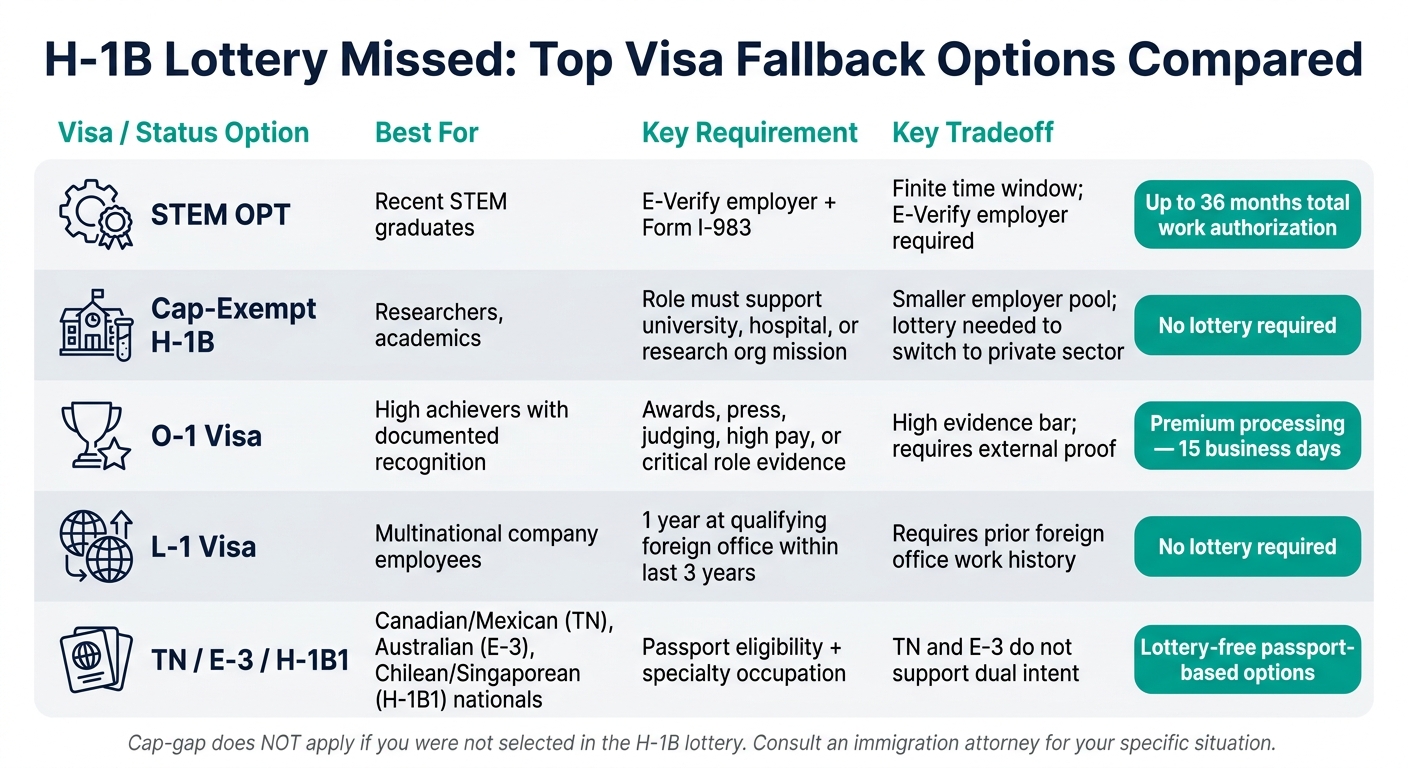
H-1B Lottery Missed: Top Visa Fallback Options Compared
Once you know your work authorization window and you’ve locked in a Plan A and Plan B, the next move is simple: match those plans to the options you can use right now.
Use your EAD timeline and status review from Step 1 to rule out anything that won’t fit your deadline. That saves time and keeps your search focused. It also changes the kind of employers you should go after when you apply for jobs.
Stay and Reapply: STEM OPT, Next Lottery Cycle, and Cap-Exempt H-1B Roles
For most STEM grads, the most practical move is a 24-month STEM OPT extension. With initial OPT plus STEM OPT, you may get up to 36 months of work authorization. That can give you another H-1B lottery cycle or two.
Your search should center on E-Verify employers that will complete Form I-983. That point matters. A company may like your profile, but if it won’t handle the compliance side, it’s not a fit. This is where a focused job search platform can help you narrow the list faster.
If you want to skip the lottery, cap-exempt H-1B roles deserve serious attention. Universities, university-affiliated nonprofits like teaching hospitals, and government research organizations can file year-round without going through the H-1B lottery.
Target places where your role directly supports the institution’s mission, such as:
- Universities
- Hospitals
- Research organizations
There is a tradeoff. The employer pool is smaller, and if you later move to a private company, you go back into the lottery.
Other Ways to Maintain Status: Day 1 CPT, Returning to School, O-1, and L-1
Day 1 CPT can extend work eligibility, but it comes with more scrutiny. USCIS may take a harder look at programs that seem built around work first and school second. Use this route only if there is a real academic reason behind it.
Returning to school is often the lower-risk bridge. But let’s be honest: it also means more time, more cost, and a real school commitment. It’s not something to do just to buy a few extra months unless the program itself makes sense for your goals.
O-1 is stronger than many people think. There’s no lottery, no annual cap, and premium processing is available for a decision within 15 business days. The catch is the evidence. You need proof such as awards, press, high pay, judging work, or a critical role at a respected organization.
If O-1 might fit, target employers that are open to a high-evidence case. Then get a straight answer from an immigration attorney before you rule it out. In some cases, this can be a better path than people expect, especially if you’ve built a strong record and have the right job search coach or legal support helping you frame it.
L-1 makes sense if you work for a multinational company and have spent at least one year at a qualifying foreign office within the last three years. No lottery is required, and it can also line up well with green card planning.
That means multinational employers with offices abroad move up your list. If you’re open to a short move outside the U.S. first, this path can set up a later transfer back.
Use this table to match the option to your situation:
| Option | Best For | Key Tradeoff |
|---|---|---|
| STEM OPT | Recent STEM grads; target E-Verify employers | Finite time; E-Verify employer required |
| Cap-Exempt H-1B | Researchers, academics; target universities, hospitals, research orgs | Smaller employer set; lottery needed to switch to private sector |
| O-1 | High achievers with documented recognition; target employers willing to support a high-evidence filing | High evidence bar; requires external proof |
| L-1 | Multinational employees; target companies with foreign offices | Requires 1 year of previous work at a foreign office |
| Day 1 CPT | Immediate work bridge with a genuine academic plan | High USCIS scrutiny and future visa risk |
If you’re sorting through several of these at once, a virtual assistant for job seekers or job application service can help keep employer lists organized by visa fit instead of sending the same resume everywhere.
Move the Search Abroad: Canada and Other Markets With Clearer Work Visa Paths
If no U.S. status route fits your timeline, shift to markets with faster visa paths.
Before you commit to a full relocation plan, check your nationality. This step can save you a lot of wasted effort. Some passport-based options are much simpler:
- TN for Canada and Mexico
- E-3 for Australia
- H-1B1 for Chile and Singapore
These are lottery-free options if you qualify. Canadian and Mexican nationals should focus on roles that match USMCA professional categories. Australians should focus on specialty occupation roles that fit E-3 rules.
If green card timing matters, be careful here. TN and E-3 do not officially support dual intent, so your long-term plan needs to be mapped out with care.
If your passport makes one of these routes available, move it to the front of your search before you start a broader relocation push. If none of them apply, working remotely from abroad or relocating to markets like Canada can still be a solid fallback.
At that point, rebuild your target list around employers that can support your location or remote work setup. This is also where a job search virtual assistant can help you filter for companies that hire across borders instead of wasting time on employers that only hire inside the U.S.
Once you lock in the fallback, Step 3 is about targeting employers who can support it.
Step 3: Change How You Job Search So Employers Can Actually Support Your Visa Path
Once you’ve picked your fallback path, your job search needs to change. At this stage, the goal isn’t to spray applications everywhere and hope something sticks. The goal is to target employers that match your visa route, send resumes that can pass ATS screening, and keep every date in one place so nothing slips.
If you’re using a job search platform, this is where it should help you narrow the field, not just send more applications.
Build an Employer List That Matches Your Immigration Option
Start with your Plan A and Plan B, then build your employer list around them. Your target companies should line up with the visa path you chose in Step 2.
For example:
- STEM OPT: focus on E-Verify employers
- Cap-exempt H-1B: focus on cap-exempt institutions
- L-1: focus on multinational companies
If TN, E-3, or H-1B1 is already part of your plan, those employer types should already be in your mix. Use LinkedIn filters or filters on the best job boards to sort by employer type and location. That filter should decide where you Apply for jobs, not the other way around.
That one shift can save a lot of wasted time. It’s the difference between sending 100 applications that go nowhere and sending 20 that actually fit your work status.
Use Job-Specific, ATS-Friendly Resumes Instead of Generic Mass Apply
A generic resume won’t do much here. Each resume should match the job you’re applying for and reflect your actual visa situation.
Pull key terms from the job description. Use visa-related wording where it fits. And for work authorization, add a short status line near the top of the resume. Something like "Currently on STEM OPT with 24 months of remaining U.S. work authorization" gives recruiters a clear read on where you stand.
Keep the formatting plain and easy to parse:
- standard fonts
- clear section headings
- no heavy graphics
- no multi-column layouts that may confuse ATS
If you want help speeding this up, an ai resume builder can help tailor each version without turning the process into a full-time project. The same goes for an ai cover letter builder if the role asks for a letter.
Track Applications, Interviews, and Deadlines in One Sheet
When you’re balancing a visa deadline with a job search, small misses can hurt. A forgotten follow-up, a missed recruiter reply, or an interview date buried in your inbox can slow everything down.
Keep one sheet with the details that matter:
- employer name
- visa fit
- application date
- recruiter contact
- interview status
- work authorization end date
This gives you a working system, not just a pile of applications. A good job application service or Virtual Assistant for Job Applications can also help keep this process organized if you’re applying at scale.
Once your employer list and tracking system are set, the next step is picking a job-search tool that supports visa-fit targeting instead of blind volume.
LazyApply vs scale.jobs vs Jobscan: Which Tool Fits an H-1B Backup Strategy?
Once your employer list is set, the next issue is execution. Do you need automation, resume scoring, or a done-for-you system for a visa-sensitive search? If your backup path is narrow, like STEM OPT, cap-exempt H-1B, or a passport-based visa route, the tool you pick matters just as much as the list itself.
If you're trying to Apply for jobs under time pressure, the wrong setup can waste hours on low-fit roles, missed portal steps, or weak submissions.
Is LazyApply Worth It? Reviews, Tradeoffs, and Why Some International Applicants Switch
LazyApply is built for speed and bulk applications. That works best when volume matters more than control. It cuts repetitive data entry, and its subscription or lifetime-deal pricing is easy to understand. For domestic applicants with no visa limits, that can be a decent trade.
But visa-sensitive searches are a different game.
With scale.jobs, human assistants submit applications by hand. That makes it easier to follow employer instructions, tailor ATS-friendly resumes and cover letters, and deal with portal-specific requirements. You also get timestamped screenshots and dedicated WhatsApp support, so you can see what was sent and when. If you want a job application service instead of a bot, that difference is hard to ignore.
Why scale.jobs wins over LazyApply
- Human assistants follow visa-specific instructions and employer lists
- Documents are tailored for each role, not template-based
- Complex portals are handled manually, not by bot
- Timestamped screenshots add submission transparency
- One-time bundles avoid monthly fees
| Feature | LazyApply | scale.jobs |
|---|---|---|
| Human involvement | None; automated bot | Human assistants |
| Resume customization | Generic or template-based | Job-specific, ATS-optimized per role |
| ATS handling | Bot-submitted; less flexible for complex portals | Manual submission with ATS-safe formatting |
| Application execution | Automated mass apply | Human-powered, portal-by-portal |
| Transparency and proof of work | Dashboard logs | WhatsApp updates + timestamped screenshots |
| Pricing model | Subscription or lifetime deal | One-time flat-fee bundles |
Who should use LazyApply: Applicants who want bulk applications and are fine reviewing results on their own.
Who should choose scale.jobs: International applicants who need targeted submissions, accurate sponsorship handling, and proof of submission.
Switch to scale.jobs if…
- Your EAD expires in less than 6 months and you need to cut wasted effort
- You're targeting cap-exempt institutions or visa-friendly employers that need careful portal handling
- You need proof of submission for your own records or immigration tracking
- You want a one-time payment instead of a recurring subscription
A simple way to look at it: LazyApply helps you send more applications. scale.jobs helps you send the right applications with fewer avoidable mistakes. For many international candidates, that trade matters more than raw volume.
Jobscan vs scale.jobs: ATS Score Analysis or Done-for-You Human-Powered Apply?
If your biggest bottleneck is resume quality, not submission speed, Jobscan belongs in the mix. Jobscan helps improve resume-match quality, but it does not submit applications for you. If you have time to tailor each resume and handle every portal yourself, it can be a useful self-serve tool.
That said, a score alone doesn't finish the job. You still have to rewrite, upload, answer screening questions, and track everything on your own.
scale.jobs handles the submission side too, with human assistants, job-specific documents, timestamped screenshots, and WhatsApp support. If you want help beyond an ai resume builder or ai cover letter builder, this is where the gap shows.
Why scale.jobs wins over Jobscan
- Done-for-you submission instead of user-only optimization
- Human assistants handle portal complexity
- Documents are tailored per role
- One-time bundles avoid monthly fees
| Feature | Jobscan | scale.jobs |
|---|---|---|
| Human involvement | None; user-driven | Human assistants |
| Resume customization | Keyword suggestions for you to implement | Human-tailored, ATS-optimized per role |
| ATS handling | Scoring and gap analysis only | Manual submission with ATS-safe formatting |
| Application execution | You submit manually after optimization | Human assistant submits on your behalf |
| Transparency and proof of work | Not provided; user manages own tracking | WhatsApp updates + timestamped screenshots |
| Pricing model | Monthly or quarterly subscription | One-time flat-fee bundles |
Who should use Jobscan: Applicants who want full control over each application and need help spotting resume keyword gaps.
Who should choose scale.jobs: Applicants who need both document quality and submission execution handled, especially when a visa deadline makes manual application work harder to manage.
Decision Summary: Choose Jobscan if you want resume scoring and full control. Choose LazyApply if you want bulk automation. Choose scale.jobs if your H-1B backup plan depends on visa-aware targeting, manual submission, and proof of work.
You can also think of it this way:
Jobscan helps you tune the engine.
LazyApply steps on the gas.
scale.jobs puts a person behind the wheel.
For applicants managing tight deadlines, that human layer can matter more than another dashboard. If you're looking for a job search platform that does more than track roles, the main question is whether you want software alone or hands-on execution.
scale.jobs Free Trial: First 5 Job Applications at No Cost
If you want to test the workflow before paying, start with the free trial. scale.jobs offers the first 5 job applications at no cost, handled by human assistants, so you can see how the process works before you commit.
That trial is useful if you want to check the handoff, document quality, communication speed, and screenshot tracking for yourself. For job seekers who need a virtual assistant for job seekers, it gives you a low-risk way to see whether the setup fits your search.
Conclusion: Act Fast, Pick a Realistic Path, and Use a Job Search Process That Fits Your Visa Timeline
Missing the lottery is common. What matters now is speed, not waiting around for the next cycle. The first 7–14 days matter most. Once you know your deadline, the next call gets much simpler.
Use that timeline to sort your options. If you qualify for a passport-based route, move that ahead of another lottery round. If you're on STEM OPT and still have time left, keep working while treating O-1 or L-1 as backup routes worth preparing for.
Your employer list should match the visa path you picked. That's where your search method starts to matter. Human review and visa-fit targeting beat sending a huge number of applications.
If you need help staying organized, use a process that keeps your search tight and focused. That might mean using a job search platform to track leads, getting support from a job search coach, or using a job application service if your deadline is close and you need help to Apply for jobs in a more focused way.
Today, keep it simple:
- Confirm your status
- Pick one path
- Build a targeted employer list
- Apply only where the visa fit is real
Pick the path. Then work that plan with a process that fits your timeline.