
What the New H-1B Weighted Lottery Means If You're Job Hunting in 2026

Sarah Mitchell
July 5, 2026

The short answer: in 2026, more applications do not mean better H-1B odds. The new rule weights H-1B selections by wage level, and DHS projected selection rates of 15.29% for Level I, 30.58% for Level II, 45.87% for Level III, and 61.16% for Level IV. If I’m job hunting with visa risk, I need to care about role level, pay band, employer history, and timing before I hit submit.
Here’s the playbook I’d use:
- Target higher-wage roles first
- Check title + location before I apply
- Keep cap-exempt roles active
- Avoid blind mass-apply tools for top-priority roles
- Start early for the next March registration cycle
If I’m using a job search platform, I’d want it to help me sort roles, not just send more applications. And if I need help with execution, I’d compare that with a job application service or a Virtual Assistant for Job Applications.
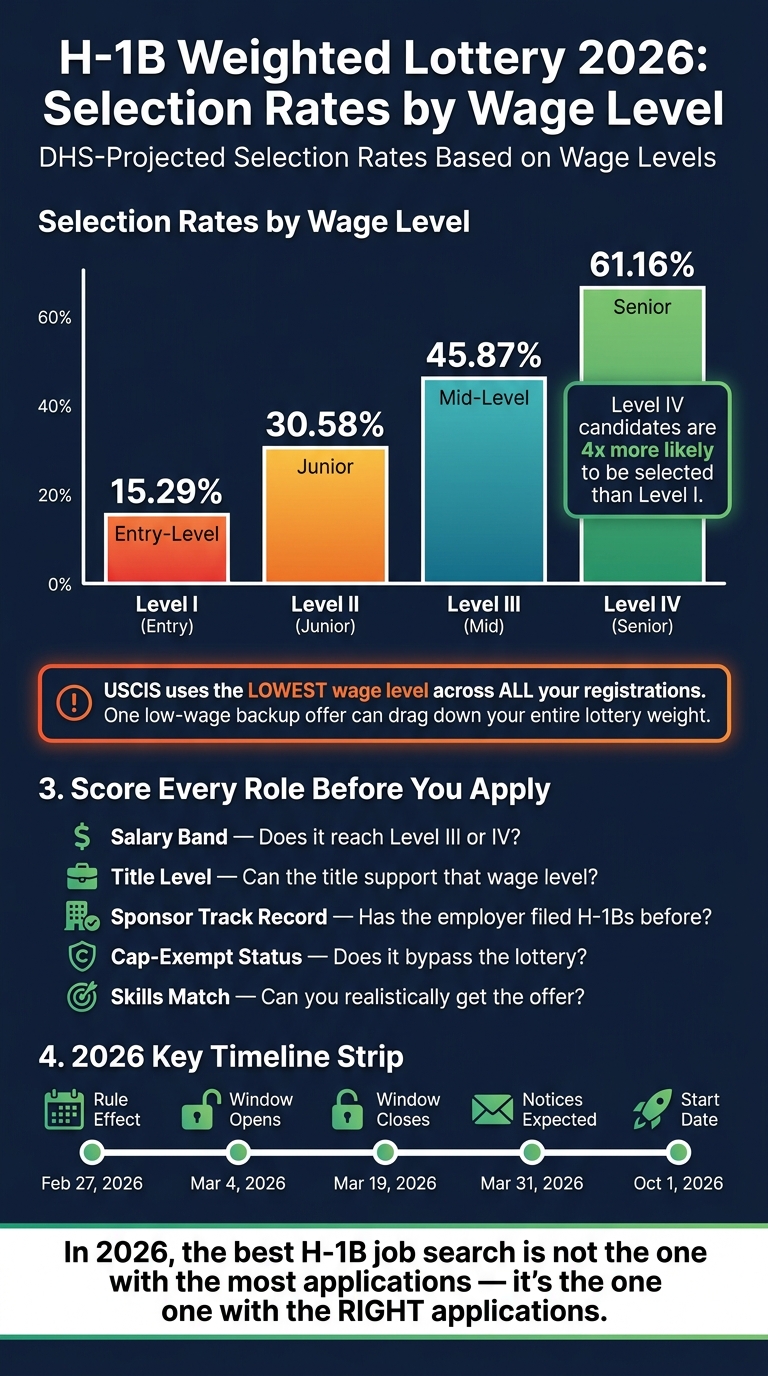
H-1B Weighted Lottery 2026: Selection Rates by Wage Level
H-1B Lottery 2026: What to Do While You Wait
sbb-itb-564272e
Quick Comparison
| Option | Best for | Main gap for H-1B candidates |
|---|---|---|
| LazyApply / Loopcv / Simplify | High-volume applying | No wage-level screening before submission |
| Jobscan / Teal | Resume tuning and tracking | You still track H1B sponsoring companies and do submissions yourself |
| Human-led support like scale.jobs | Visa-sensitive searches | Higher-touch process, less volume-first using a daily job search system |
What I’d do differently now
The new weighted lottery changes the order of my job search.
Instead of trying to Apply for jobs everywhere, I’d score each role on:
- Salary band
- Title level
- Location
- Sponsor track record
- Cap-exempt status
That helps me spend my time on roles that may support a better H-1B outcome, not just a bigger application count.
A simple plan I’d follow
1) Build three buckets
I’d split openings into:
- Top cap-subject roles: roles that may land at Level III or IV
- Cap-exempt roles: universities, research groups, and similar employers
- Location backups: cities where the same pay may map to a higher wage level
2) Use tools by job type
For lower-priority roles, automation may still help.
For top-priority roles, I’d want cleaner review, better answers to sponsorship questions, and fewer filing mistakes. That’s where a job search virtual assistant or virtual assistant for job seekers can make more sense than one-click volume.
3) Start earlier than before
For FY 2027 planning, I would not wait until late winter.
The article’s core point is simple: if timing, pay, and employer type shape my odds, then I need to search earlier, screen harder, and submit fewer weak-fit applications.
Is mass applying still worth it?
Sometimes, yes - but not for every role.
If I’m chasing full time jobs with H-1B risk, blind volume is a weak plan. Instead, focus on roles that sponsor H-1B most frequently. If I’m applying for roles without visa pressure, automated job application platforms can still save time. That’s the line.
FAQ-style takeaways
Does a higher salary improve H-1B lottery odds in 2026?
Often, yes. The weighted system favors higher prevailing wage levels, not raw application volume.
Should I avoid entry-level sponsor roles?
Not always. But I would rank them lower if they likely sit at Level I and I have other options.
Are cap-exempt employers more useful now?
Yes. They stay a strong backup because they skip the cap lottery.
Which tools fit this kind of search?
If I only need document help, an ai resume builder or ai cover letter builder may be enough. If I need help sorting, screening, and submitting the right roles, I’d look at human-led support before relying on pure automation.
That’s the main shift: in 2026, the best H-1B job search is not the one with the most applications. It’s the one with the right applications.
What the Weighted Lottery Actually Changes in a 2026 Job Search
Your odds now depend on the wage level tied to the role, not how many registrations get filed for you. Each beneficiary is counted once. So the old spray-and-pray approach no longer helps by volume.
Under the rule that took effect on February 27, 2026, DHS projects selection rates of 15.29% at Level I, 30.58% at Level II, 45.87% at Level III, and 61.16% at Level IV. That’s a big split between entry-level and senior-level offers.
In plain English: the kind of role you get matters more than the number of chances attached to your name.
That shifts three parts of your search:
- who you target
- which roles you go after
- when you start
There’s another detail that can trip people up. USCIS uses the lowest wage level across all your registrations. So if more than one employer registers you, your weighting is based on the lowest wage level in that group.
A backup offer at $95,000 that lands in Level II can drag down the value of a stronger Level III registration at $135,000. That means more registrations are not always better. Sometimes they can work against you.
If you're trying to Apply for jobs, this rule changes the game. It pushes you to be more selective, not more frantic.
Employer targeting: which sponsors become more useful and which become less worth your time
Once wage level drives selection, sponsor history starts to matter in a much more direct way. It’s no longer just a trust signal. It becomes a screening filter.
Sponsors that often file at Level II, III, or IV wages are more useful than employers whose postings don’t show clear pay ranges. Amazon is a good example. It filed 15,524 LCAs for FY 2025 with an average salary of $157,259. That kind of filing pattern gives you a better shot at landing in a higher wage level.
On the flip side, roles with unclear salary ranges, junior titles, or limited H-1B filing history carry more risk. If a posting hides pay, keeps the title vague, and comes from a sponsor with little filing history, you’re walking in with less information and less control.
Cap-exempt employers are still the cleanest fallback if you can’t get into a higher wage band. They avoid the cap lottery and skip the March registration window entirely. For some job seekers, that’s the smarter lane.
This is where a job search platform or a job search coach can help. You’re not just hunting for sponsorship anymore. You’re sorting for better-positioned sponsorship.
Role choice and salary positioning: how title, location, and level may affect your lottery odds
The same offer can fall into a higher or lower wage level based on title and location. That’s why you should screen postings before you apply, not after you get an interview.
Prevailing wage thresholds shift by metro area. A $150,000 salary might be Level II in San Francisco but Level III or IV in Raleigh or Austin. Same pay. Different lottery math.
That’s a huge deal.
If your background supports a mid-level or senior title, it’s worth having that conversation during the hiring process. Not in a pushy way. Just clearly and early. A title change can affect the wage level, and the wage level can affect your odds.
The DOL Occupational Employment and Wage Statistics (OEWS) data is useful here. It can show where the line sits between Level II and Level III for your occupation and metro area. Think of it as a map before you start the drive.
A smart workflow looks like this:
- check the job title against your years of experience
- compare the pay range to the metro-area wage bands
- look at whether the role reads as junior, mid-level, or senior
- prioritize jobs where the filing has a better chance of landing at Level III or IV
If you're using a Virtual Assistant for Job Applications or a job application service, this is the kind of filter they should be helping you apply. Sending more applications without wage-level screening is just noise.
Application timing: plan backward from the March 2026 window instead of applying blindly
For the March 2026 registration window, employers needed enough time to confirm wage level and prepare the registration. Offers secured in January or early February 2026 gave employers room to do that work.
Working backward, active searching should have started in Q3 or Q4 of 2025.
That’s the part many people miss. A last-minute February or March application sprint doesn’t give employers much room to prepare an accurate registration or line up the wage level the right way. By then, you’re often too late for careful planning.
Here’s the timeline:
| Milestone | 2026 Date |
|---|---|
| Weighted lottery rule takes effect | February 27, 2026 |
| Registration window opens | March 4, 2026 (noon ET) |
| Registration window closes | March 19, 2026 (noon ET) |
| Selection notices expected | By March 31, 2026 |
| H-1B employment start date | October 1, 2026 |
For many candidates, this means job searching needs to start months earlier than it used to. Not because the market got harder in some vague way, but because timing now connects directly to wage-level setup.
That also changes how you use tools. An ai resume builder and ai cover letter builder can help you move faster, but speed only helps if you start early enough to target the right roles.
A last-minute mass-apply sprint in February or March doesn't give employers enough time to prepare an accurate registration or align the wage level correctly.
That makes the next question practical: which roles, sponsors, and tools help you target higher-wage filings without wasting applications.
How to Build a Visa-Aware Application Plan Instead of Applying Blindly
Use the wage-level filter from the previous section to sort each application into a bucket before you hit submit.
This matters because not all roles give you the same shot. If you're trying to apply for jobs with an H-1B path in mind, sending the same application everywhere is a weak plan. A better move is to sort roles by wage level, employer type, and how likely the role is to work for your status.
Building your target list: top cap-subject roles, backup roles, and cap-exempt options
Sort applications into three buckets.
Bucket 1 - Top cap-subject roles are jobs where the salary lands at Level III or IV for your SOC code and metro area. These roles give you the strongest selection weight. Large, frequent H-1B sponsors belong near the top of this bucket when the role level fits.
Bucket 2 - Cap-exempt employers include universities, nonprofit research organizations, and government research labs. Real examples include the Broad Institute, Mayo Clinic, Johns Hopkins University, and Mass General Brigham. Treat cap-exempt roles as a parallel pipeline.
Bucket 3 - Location backups are roles in mid-sized cities where a lower-cost metro can move the same salary into a higher wage level.
In plain English: same skill set, same general pay, different metro, better wage-level positioning. That shift can change how you rank your target list.
If you're using a job search platform or a job application service, this is the kind of sorting it should help you do. If it can't, you're stuck doing blind outreach at scale, and that's rarely the best use of your time.
Hypothetical candidate scenarios: how a new grad, a mid-career hire, and a status-sensitive applicant would each adjust
These scenarios are illustrative. Each shows how the same lottery rule changes what gets submitted first.
Scenario 1 - New grad on STEM OPT. A computer science new grad on STEM OPT should prioritize Level II and III roles rather than chasing any sponsoring employer. She should highlight her change-of-status eligibility to every recruiter because she may qualify for change-of-status filing. Cap-exempt university research roles are a strong parallel track while she waits on lottery results.
Scenario 2 - Mid-career software engineer. A backend engineer with 7 years of experience has been applying to mid-level roles to stay conservative. Under the weighted lottery, that can work against him. If the offer can support Level III instead of Level II, pursue the higher wage level. He should verify the SOC code and wage level with each employer before accepting any offer, not after.
Scenario 3 - Laid-off analyst preserving status. An analyst who has lost a job has a 60-day grace period starting the day employment ends. The priority is to find a new sponsor quickly. Keep cap-exempt roles active and maintain a backup status path.
A job search coach or virtual assistant for job seekers can help here, especially when timing is tight and each application needs a clear reason for being in your pipeline.
A simple scoring framework for deciding where each application should go
Before sending any application, score the role on five factors.
| Factor | Question |
|---|---|
| Salary band | Does the range reach Level III/IV? |
| Title level | Can the title support that wage level? |
| Sponsorship track record | Has the employer filed H-1Bs before? |
| Cap-exempt status | Does it bypass the lottery? |
| Skills match | Can you realistically get the offer? |
A role that scores well on all five is a Bucket 1 application. A role that scores well on cap-exempt status alone is a Bucket 2 application. Anything else should be lower priority. The goal is fewer, better applications.
Think of this like triage. Not every opening deserves the same effort. Some belong in your top stack for custom outreach. Others can sit in a lower-touch flow, even if you're using a Virtual Assistant for Job Applications.
If a tool cannot support this filtering, it belongs only in the low-priority bucket. Use this score to decide which roles deserve human review and which should stay low priority.
Tool Comparison for 2026: LazyApply, Jobscan, Teal, Loopcv, and Simplify vs. scale.jobs
H-1B applications in 2026 need role-by-role screening, not mass submission. The tools you pick need to match that. Here’s how LazyApply, Jobscan, Teal, Loopcv, and Simplify compare with scale.jobs for candidates whose visa outcome depends on getting the right roles submitted the right way.
For this group, tool choice isn’t just part of a job search platform. It’s part of the visa plan.
Is LazyApply worth it for H-1B candidates? Reviews, alternatives, and when to switch to scale.jobs
LazyApply’s main edge is speed. It’s built for high-volume, one-click automation, which can help when your search is driven by quantity instead of visa-sensitive targeting.
For H-1B candidates, that approach is often a weaker fit. LazyApply helps you apply fast, but it doesn’t screen for sponsor quality or wage level. That work still lands on your plate.
By contrast, scale.jobs uses human-reviewed execution. Human assistants review each role before submission, check verified H-1B sponsorship history, make sure the salary band supports the target wage level, and answer sponsorship-related questions correctly.
Why scale.jobs wins:
- Human assistants screen for sponsorship and wage fit before submission
- Manual portal handling cuts down on bad auto-fills
- ATS-optimized documents are tailored for each role
- WhatsApp updates and screenshots show what was filed
- One-time bundles avoid recurring subscription costs
| Feature | LazyApply | scale.jobs |
|---|---|---|
| Human involvement | None | Dedicated human assistants |
| Resume customization depth | Standardized auto-fill | ATS-optimized, tailored per role |
| ATS handling | Generic application automation | Manual portal submission |
| Application execution method | One-click automation | Human-reviewed manual submissions |
| Transparency and proof of work | Automated confirmation | Time-stamped screenshots, WhatsApp updates |
| Pricing model | Subscription-based | One-time flat-fee bundles |
Who should use LazyApply: Candidates who want fast, high-volume applying and don’t need visa-aware screening on each role.
Who should choose scale.jobs: H-1B candidates, STEM OPT holders, and anyone who wants human review before submission.
If you want to refine your job search strategy with prep tools instead of auto-apply volume, the next section looks at Jobscan and Teal.
Jobscan and Teal vs. scale.jobs: resume optimization and tracking versus end-to-end execution
Jobscan helps with keyword analysis. It compares your resume against a job description and points out gaps before you apply, which can help with ATS alignment. Teal is strong on organization. It tracks applications, saves job listings, and gives you a clean view of your pipeline.
That sounds useful, and it is. But for H-1B candidates, there’s a catch: both tools help before the application is sent, yet neither controls the submission itself. Neither submits roles for you, and neither filters openings by sponsor quality or wage level. Self-service prep only solves part of the problem.
scale.jobs covers the full workflow. Its human assistant tier submits tailored resumes and cover letters manually across corporate ATS portals, niche boards, and direct employer sites, with WhatsApp check-ins and screenshot logs along the way. If you’re looking for a job application service instead of just an ai resume builder, that difference matters.
Why scale.jobs wins:
- Human review before submission, not just keyword analysis
- Manual application execution instead of user-managed submission
- Sponsor and wage-level screening before roles enter the pipeline
- Screenshot proof and WhatsApp support during the process
- One-time flat-fee bundles instead of recurring subscription management
| Feature | Jobscan / Teal | scale.jobs |
|---|---|---|
| Human involvement | None (self-service) | Dedicated human assistants |
| Resume customization depth | Keyword matching, user-edited | Human-reviewed, ATS-optimized per role |
| ATS handling | Keyword gap analysis | Custom-tailored documents + manual portal submission |
| Application execution method | User submits manually | Human assistants submit on your behalf |
| Transparency and proof of work | User-managed tracking | Time-stamped screenshots, WhatsApp updates |
| Pricing model | Subscription-based | Flat-fee bundles from $199 |
Who should use Jobscan/Teal: Candidates who want to self-manage their search and improve keyword match or pipeline tracking.
Who should choose scale.jobs: Candidates who need end-to-end execution, not just resume prep.
If you want faster execution instead of prep-only tools, Loopcv and Simplify are the next comparison.
Loopcv and Simplify vs. scale.jobs: one-click automation versus hands-on application control
Loopcv and Simplify focus on speed and one-click automation. That can help if you want to move fast, but it doesn’t give you much control over sponsorship questions or wage-level targeting. In 2026, that matters because automation only helps after a role has passed sponsor and wage screening.
scale.jobs keeps the process manual and human-reviewed from screening through submission. Human assistants read each form, answer sponsorship questions correctly, and flag any role that doesn’t meet your wage-level threshold before it gets sent. That’s a big deal for people trying to Apply for jobs without making avoidable visa-related mistakes.
Why scale.jobs wins:
- Human assistants catch sponsorship issues before submission
- Manual review prevents blind one-click sending
- ATS-optimized docs can be adjusted for each role
- Proof-of-work screenshots confirm submissions
- One-time bundles fit a longer H-1B search better than recurring automation
| Feature | Loopcv / Simplify | scale.jobs |
|---|---|---|
| Human involvement | None (AI/bot) | Dedicated human assistants |
| Resume customization depth | Auto-fill, limited tailoring | ATS-optimized, role-specific documents |
| ATS handling | Automated form submission | Manual portal submission |
| Application execution method | One-click automation | Human-reviewed manual submissions |
| Transparency and proof of work | Automated confirmation | Time-stamped screenshots, WhatsApp updates |
| Pricing model | Subscription-based | One-time flat-fee bundles |
Who should use Loopcv/Simplify: Candidates who want speed and are comfortable managing visa-sensitive checks themselves.
Who should choose scale.jobs: H-1B and OPT candidates who need manual review, sponsor filtering, and proof of submission.
For candidates who need screening, execution, and proof in one workflow, the choice usually comes down to scale.jobs rather than a bot-first tool or a self-serve job search coach. If you need a more hands-on setup, it sits closer to a Virtual Assistant for Job Applications than a standard automation app.
Decision Summary: When to Keep Your Current Tool and When to Switch to scale.jobs
Automation, DIY, or scale.jobs: choosing based on visa risk and time available
Use the wage-level scorecard from the prior section to pick the option that fits your visa risk and the way you search. The same five-factor score can help you match each application to the right tool.
This is the key filter: does the tool help you file the right applications, or does it just help you send more of them?
| Your situation | Best fit |
|---|---|
| No visa risk, volume-first search | Automation tools (LazyApply, Loopcv, Simplify) |
| Managing your own search and need resume keyword tuning | DIY tools (Jobscan, Teal) |
| H-1B or OPT candidate targeting Level II+ wages, need sponsor vetting and accurate submissions | scale.jobs |
Automation tools still work fine when visa status is not part of the problem and your goal is pure volume. DIY tools like Jobscan or Teal fit people who want to run their own pipeline and mainly need resume feedback, keyword help, or support from an ai resume builder.
But under the 2026 wage-weighted lottery, broad low-precision applications can work against visa-dependent candidates. Salary band, sponsor quality, submission accuracy, and the time you can put into the process all shape whether an application helps your odds.
If you're comparing categories, think of it this way:
- Automation helps you apply for jobs at scale
- DIY tools help you improve documents and track your search
- scale.jobs is built for cases where each application needs wage checks, sponsor review, and careful filing through a job application service
Switch to scale.jobs if your search depends on salary band, sponsor quality, and accurate manual submissions
If you're still on the fence, these are the clearest signs it's time to switch.
- Level II/III targets that need wage checks - each role is checked against DOL wage thresholds.
- Verified sponsor history - not just a sponsorship checkbox; scale.jobs human assistants cross-check the USCIS H-1B Employer Data Hub before submitting.
- ATS-optimized documents and actual submissions - end-to-end execution, not prep work you still have to do yourself.
- Flat-fee pricing - one-time bundles instead of recurring subscriptions during a longer search.
- Proof of work - time-stamped screenshots and WhatsApp updates for each filing.
This is where the gap becomes clear. Many tools are fine for people hunting for full time jobs or even Part time jobs near me without visa pressure. But if your search lives or dies on wage level and sponsor history, a general job search platform may not be enough.
A simple rule of thumb: if one bad submission can waste a good opportunity, manual review matters. That’s the case for many H-1B and OPT candidates, especially when job titles, pay bands, and employer history need a second look.
If your resume needs work before the search starts, scale.jobs also offers resume writing services with a 1-on-1 Zoom call. And if you also need help tailoring outreach materials, pairing that with an ai cover letter builder can cut down prep time.
For a low-risk trial, scale.jobs includes 5 free applications so you can check the sponsor-screening process before you commit.