
Resume Gaps 2026: How to Explain Them Without Getting Rejected

Sarah Mitchell
April 17, 2026

Resume gaps are no longer deal-breakers in 2026, but how you explain them can make or break your chances. With 91% of hiring managers now open to candidates with career breaks, the key is addressing gaps directly while showcasing growth. Whether caused by layoffs, caregiving, or personal reasons, a well-framed explanation can turn potential concerns into strengths.
Key Takeaways:
- Label gaps clearly: Use terms like "Career Break" or "Professional Development" and include dates.
- Show productivity: Highlight certifications, freelance work, or volunteer contributions with measurable results.
- Choose the right format: Use a hybrid resume to balance skills and work history.
- Prepare for interviews: Practice concise, confident explanations to pivot focus to your qualifications.
- Optimize for ATS: Use consistent date formats and keywords to ensure your resume passes tracking systems.
Platforms like Scale.jobs offer personalized guidance to craft resumes that address gaps effectively. By focusing on transparency and emphasizing growth, you can position yourself as a strong candidate in today’s skills-focused job market.
How to Explain Career Gap in Interview and Resume
sbb-itb-564272e
How to Reframe Resume Gaps
The way you present a gap on your resume can make all the difference. A gap can either raise concerns or highlight personal and professional growth - it all depends on how you describe it and what you accomplished during that time. Here's how to approach it effectively.
Label Gaps Clearly Without Overexplaining
Use straightforward, professional terms like "Career Transition" or "Professional Development" to describe your time away from traditional work. For gaps lasting over a year, treat them like formal roles by including dates and bullet points that emphasize what you achieved during that period.
For shorter gaps (less than a year), consider using a "years only" format (e.g., "2024 – 2024") to minimize visual disruption. However, when submitting resumes to applicant tracking systems (ATS), stick to the "Month Year – Month Year" format to ensure your experience is calculated accurately. Modern ATS tools, like Greenhouse and Bullhorn, don’t automatically reject gaps but flag them for review. A well-documented entry, such as "Career Break, January 2024 – August 2024", is read as work experience, helping to maintain continuity and avoid unnecessary scrutiny.
Highlight Certifications and Skills Acquired
Show that you used your time productively by listing certifications, freelance projects, or volunteer work. Avoid generic phrases like "took online courses" and instead be specific: "Completed 40+ hours of training in data analysis, earning Excel and SQL certifications." Certifications from reputable organizations like AWS, Google, or HubSpot can demonstrate your commitment to staying current in your field.
Freelance work is another great way to fill gaps. For example, you might include: "Freelance Marketing Consultant: Boosted organic traffic by 35% in six months." According to a survey, 79% of hiring managers are open to hiring candidates with gaps if the time is explained productively. Showing evidence of continued learning or professional contributions helps meet that expectation.
If you volunteered, frame it with measurable results. For instance, "Treasurer, Local PTA: Managed a $10,000+ annual budget" conveys leadership and financial skills. For roles in tech or creative fields, consider building a portfolio or contributing to open-source projects on GitHub. Concrete examples, like freelance outcomes or project contributions, can add substantial value to your resume.
After documenting your gap activities, the next step is choosing the right resume format to tie everything together.
Select the Best Resume Format for Your Situation
The hybrid resume format is ideal for addressing gaps. It combines a skills summary with chronological work history, balancing ATS compatibility with clarity for recruiters. This format ensures keyword optimization while providing transparency about your career timeline. On the other hand, functional resumes (focused solely on skills) are often discouraged because they obscure job history and may perform poorly with ATS systems.
For gaps shorter than six months, a standard chronological resume is usually sufficient, as most recruiters won’t flag brief breaks. For longer gaps, include a dedicated "Career Break" entry in your work history section with dates and a concise description of your activities. If you're unsure which format suits your situation best, consider using a professional resume writing service to craft a polished document. Scale.jobs, for example, offers personalized support to ensure your resume not only passes ATS checks but also provides the context recruiters need to see your potential.
Addressing Gaps in Cover Letters and Interviews
Once your resume is polished, the next step is tackling employment gaps in your cover letters and interviews. The key is to acknowledge the gap briefly and then steer the focus toward your qualifications and enthusiasm for the role.
### Write an ATS-Friendly Cover Letter
In your cover letter, address the gap in one or two sentences after your introduction. For instance: "In 2024, I took time off for family caregiving, during which I earned my PMP certification and managed volunteer initiatives." Keep the tone direct and confident. A cover letter gives you the opportunity to provide context that a resume cannot. According to recent data, 79% of hiring managers are open to candidates with career gaps, provided the time was used productively.
Prepare Interview Scripts for Gap Questions
When it comes to interviews, rehearse a concise, 30-second response. Start by briefly explaining the gap, then pivot to your achievements and readiness for the role. For example, if you were laid off, you could say: "My position was eliminated during a company-wide restructuring. I used the time to earn my AWS certification and worked with two startups as a freelancer. I’m excited about this role because it aligns with my recent cloud infrastructure training."
For caregiving gaps, you might say: "I stepped away to care for a family member. During that time, I completed several digital marketing courses and am eager to apply my SEO expertise in this position." Practice your response to sound assured rather than defensive. Unlike automated tools like Rezi.ai, which may not optimize your narrative for interviews, platforms like Scale.jobs offer human guidance to craft clear and confident explanations.
Match Keywords for ATS Systems
Applicant tracking systems (ATS) don’t automatically disqualify resumes with gaps, but they do analyze dates to calculate total experience. Formatting errors can lead to date parsing issues, which may distort your timeline. Use a consistent format, such as "Month Year – Month Year" (e.g., January 2024 – August 2024), to avoid errors.
To improve ATS compatibility, include relevant keywords from the job description in your gap explanation. For example, if "project management" is emphasized in the posting, you might write: "Career Break, January 2024 – August 2024: Completed 40+ hours of project management training and earned PMP certification." Adding a "Core Competencies" section at the top of your resume can also help ATS systems recognize your qualifications immediately.
How scale.jobs Handles Resume Gaps
When it comes to addressing resume gaps, scale.jobs takes a hands-on, personalized approach to help you stand out. Instead of relying on generic AI-generated templates or spending endless hours tweaking your resume for each job, the platform pairs you with skilled virtual assistants who craft tailored, ATS-friendly applications that effectively address any career breaks in a positive light.
Human Assistants Create Custom Applications
At scale.jobs, every application is crafted by a dedicated human assistant who carefully reviews the job description and your unique background, including any employment gaps. Their goal is to turn those gaps into opportunities for showcasing growth or transferable skills. For instance, if you took time off for caregiving, your assistant might frame it like this:
"Career Break, March 2024 – November 2024: Completed Google Data Analytics Certificate and managed household operations."
Why Choose scale.jobs Over Competitors Like Rezi and Jobscan?
- Real human expertise ensures your story is presented authentically, not through cookie-cutter templates.
- No recurring subscriptions - just a one-time payment with WhatsApp support for quick communication.
- Resumes are ATS-optimized and crafted by professionals, giving you an edge over automated tools.
- Transparent proof-of-work with timestamped screenshots of submitted applications.
- Real-time updates keep you informed every step of the way.
The results speak for themselves. According to scale.jobs' internal data, 95% of resumes optimized by their assistants successfully pass ATS filters, and 93% of their users secure jobs within three months. Consider the case of consultant Hang Zou, who, after a layoff, faced a 60-day H1B visa deadline. By using scale.jobs, Hang secured three job offers within four weeks and earned a 75% salary increase. Another success story involves software engineer Aubrey Smith, who revamped her resume through scale.jobs in January 2025 and received five interview requests in just two weeks.
Proof-of-Work and Real-Time Updates
Transparency is a key part of the scale.jobs process. They provide timestamped screenshots of every application they submit on your behalf, giving you a clear view of how your career story is being told. Real-time updates via WhatsApp ensure you’re always in the loop, which is especially helpful when addressing resume gaps. This documentation gives you a solid foundation to confidently discuss your career break during interviews.
First 5 Applications Free
If you’re curious about how scale.jobs can help, they offer a trial where your first five job applications are completely free - no credit card required. During an onboarding call, you’ll share your resume and career goals, and your virtual assistant will get to work submitting customized applications. This trial is perfect for those with resume gaps who want to see how a personalized narrative can make a difference.
For more extensive support, scale.jobs offers flat-fee packages starting at $199 for up to 250 applications. Impressively, 70% of customers receive pro-rata refunds after landing a job. Whether you’re looking for a professionally written resume, LinkedIn makeover, or a strategy to address career breaks, scale.jobs provides a human-powered solution that automated tools like Rezi and Jobscan simply can’t match.
Decision Summary: When to Use scale.jobs
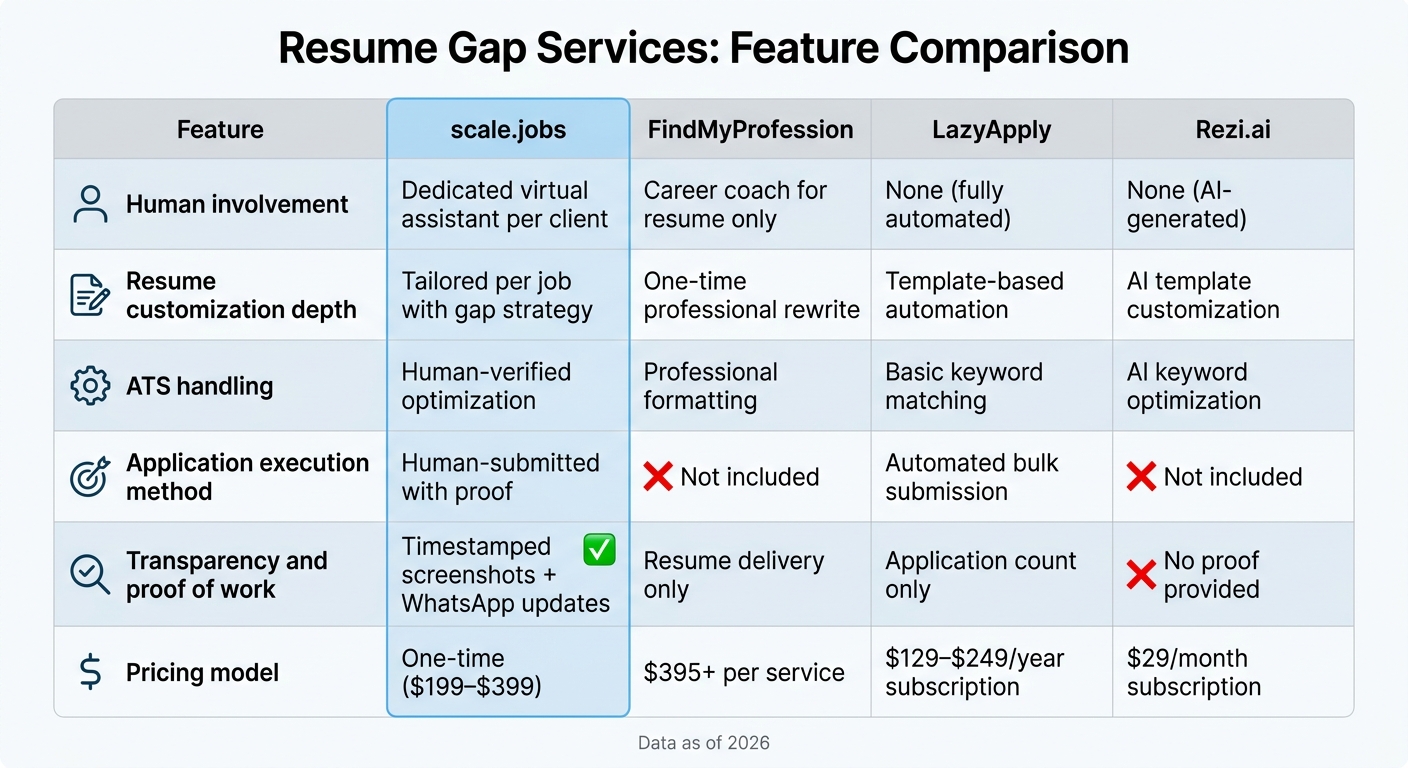
Scale.jobs vs Competitors: Resume Gap Services Comparison 2026
When deciding between scale.jobs and other tools like FindMyProfession, LazyApply, or Rezi, it's important to consider your specific needs and challenges. Here’s when scale.jobs might be the solution you're looking for.
Choose scale.jobs If You Have These Needs
Scale.jobs is particularly helpful for job seekers dealing with extended career breaks, especially those lasting over a year. If you're facing challenges with Applicant Tracking Systems (ATS) rejecting your resume despite being qualified, this platform provides a tailored approach to ensure your application gets through. Often, the issue lies in how gaps or transitions are presented, and scale.jobs specializes in reframing these situations to align with ATS requirements.
The platform is also ideal if you're pressed for time and need to handle a high volume of applications - up to 30 or more daily - without sacrificing quality. This is especially relevant for those navigating visa deadlines, such as H1B, F1-OPT, or TN status, where timing is critical. Additionally, career changers benefit from the human oversight provided, which can transform a gap in a different industry into an asset by highlighting transferable skills.
For individuals with gaps due to health or caregiving responsibilities, scale.jobs offers a professional way to address these without over-disclosing personal details. Their virtual assistants create concise "Career Break" entries that meet ATS standards while maintaining professionalism. Plus, if you require resume writing services to tackle complex employment histories, the $199 package includes a 45-minute consultation to strategize how best to present your background.
Switch to scale.jobs if…
- You’re dealing with long career gaps: Extended breaks need careful framing that generic templates can’t provide.
- ATS rejections are a recurring issue: If your applications aren’t making it through, the problem might be with how your timeline is interpreted.
- You need to process a high volume of applications: Managing 30+ applications daily with consistent quality is difficult without assistance.
- Your gaps require professional judgment: Sensitive situations demand human oversight that automated tools lack.
- You value transparency: Real-time updates and timestamped screenshots provide accountability that competitors don’t match.
Competitor Comparison
Here’s how scale.jobs compares to other services:
FindMyProfession caters to senior professionals with executive-level resume writing and career coaching. While effective for strategic career guidance, their services are expensive, starting at $395, and they don’t include application submission.
LazyApply and Rezi.ai are budget-friendly options focused on automation. LazyApply charges $129–$249 annually, while Rezi costs $29 per month. These tools are great for quick, straightforward job applications but lack the depth and human involvement needed for complex situations.
What sets scale.jobs apart: Human assistants thoroughly review each application, ensuring gaps are addressed with context rather than relying on automation. The platform also provides proof of work through timestamped screenshots and WhatsApp updates. Unlike subscription models, scale.jobs offers a one-time payment option, and 70% of users receive pro-rata refunds after securing a job.
| Feature | scale.jobs | FindMyProfession | LazyApply | Rezi.ai |
|---|---|---|---|---|
| Human involvement | Dedicated virtual assistant per client | Career coach for resume only | None (fully automated) | None (AI-generated) |
| Resume customization depth | Tailored per job with gap strategy | One-time professional rewrite | Template-based automation | AI template customization |
| ATS handling | Human-verified optimization | Professional formatting | Basic keyword matching | AI keyword optimization |
| Application execution method | Human-submitted with proof | Not included | Automated bulk submission | Not included |
| Transparency and proof of work | Timestamped screenshots + WhatsApp updates | Resume delivery only | Application count only | No proof provided |
| Pricing model | One-time ($199–$399) | $395+ per service | $129–$249/year subscription | $29/month subscription |
Core Benefits of scale.jobs
Scale.jobs combines personalized human oversight with ATS optimization to ensure each application is tailored to the job. Resumes and cover letters are crafted by trained assistants rather than generated by templates, making them more effective for addressing employment gaps. You’ll also receive timestamped proof-of-work screenshots and real-time WhatsApp updates, so you’re always informed about the progress.
The platform’s flat-fee pricing - $199 for 250 applications, $299 for 500, and $399 for 1,000 - eliminates the need for recurring subscriptions. This transparency and focus on human involvement make scale.jobs a reliable choice for those with unique employment histories or time-sensitive needs.
Who Should Use Each Option
- FindMyProfession: Ideal for senior executives requiring career coaching without needing application submission. Best for those with higher budgets.
- LazyApply or Rezi: Suitable for straightforward work histories with minimal gaps. Perfect if speed and affordability are your priorities.
- scale.jobs: Best for addressing career gaps, managing high application volumes with human oversight, ensuring transparency, or meeting visa-related deadlines.
FAQs
How long can a resume gap be before it hurts my chances?
In 2026, a resume gap of three months or more is typically seen as acceptable, provided it is addressed with confidence. Both hiring managers and ATS systems increasingly recognize that career breaks are a normal part of many professionals' journeys and are not inherently problematic when presented in a constructive way.
What’s the best way to list a career break so ATS reads it correctly?
To make sure an ATS (Applicant Tracking System) handles a career break appropriately, include it as a separate entry on your resume with a clear label like "Career Break" or "Sabbatical." Provide a short explanation of how you used that time productively - mention any skills you developed, courses you completed, or volunteer work you participated in. Stick to simple date formats, such as listing only the years, to avoid any misunderstandings. This method allows the ATS to recognize the gap while showcasing your ongoing professional development.
How can I explain a sensitive gap without sharing personal details?
When addressing a career gap, it’s helpful to frame it as a period of growth, learning, or constructive activity. For example, you could mention time spent on caregiving, recovering from health challenges, or pursuing education, but keep the explanation brief. Highlight how you stayed engaged during this time - perhaps by developing new skills, gaining certifications, or volunteering. The key is to focus on positive outcomes that demonstrate your readiness and enthusiasm for the next opportunity, while avoiding overly personal details.