
Teaching Hospital H1B Jobs: Cap-Exempt Openings 2026

Sarah Mitchell
July 26, 2026
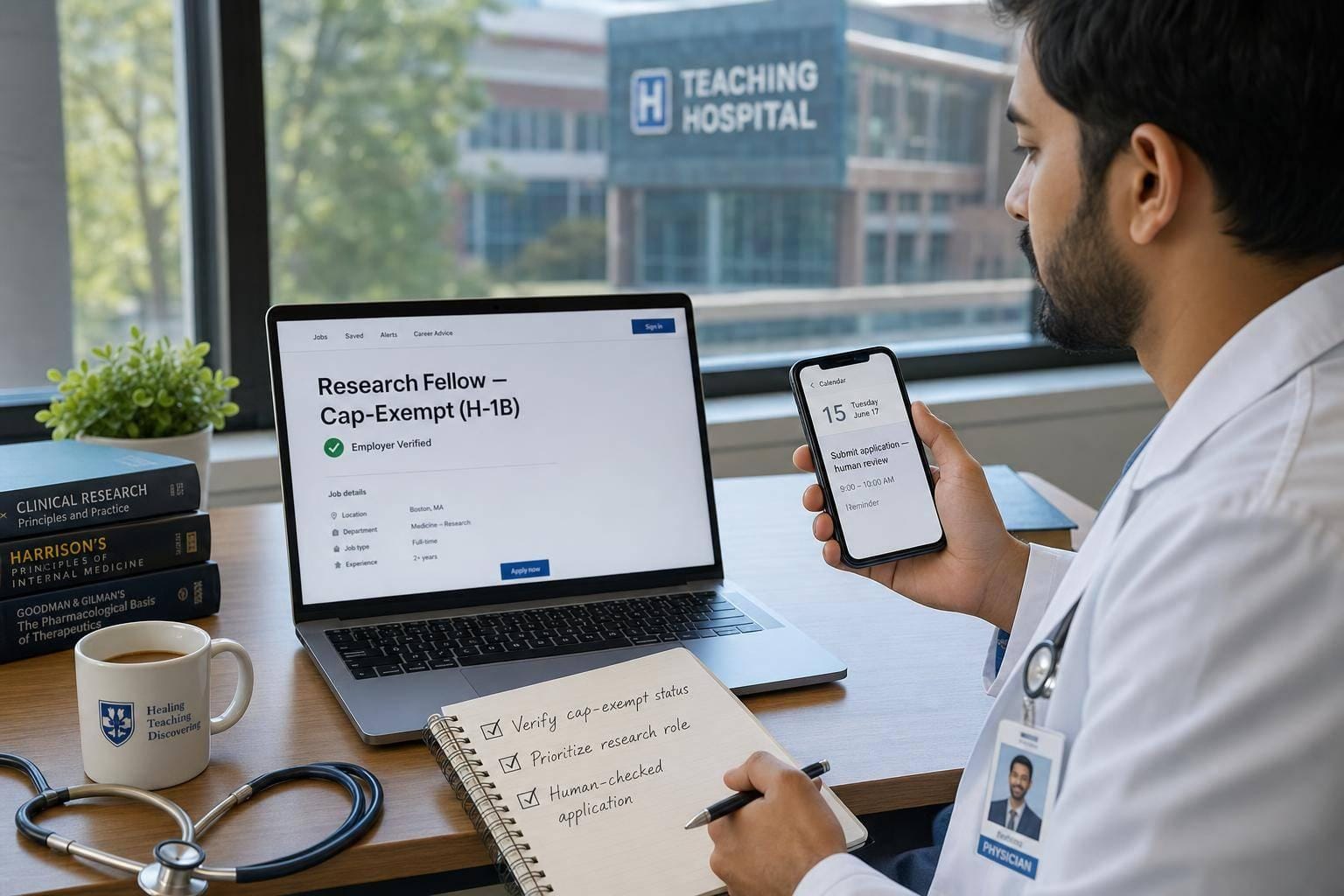
If I’m on OPT or STEM OPT in 2026, teaching hospitals are one of the few H-1B paths that can move outside the lottery. That matters because post-completion OPT allows 90 unemployment days, and STEM OPT allows 150 total days across 36 months.
Here’s the short version:
- Cap-exempt teaching hospitals can file H-1B petitions year-round
- Not every “teaching hospital” is cap-exempt
- The hard part is tracking H1B sponsoring companies, not just finding openings
- Automation tools help with volume, but visa-sensitive searches need tighter review
- A human-assisted workflow can make more sense when timing is tight
If I were trying to Apply for jobs fast, I would filter for sponsor type before title, pay, or city. That cuts wasted applications and protects unemployment days. This requires a daily job search system tailored for visa-sensitive roles.
What I’d do first
- Build a list of university-linked hospitals and nonprofit affiliates
- Check whether the hiring entity can identify companies that truly sponsor H-1B with cap-exempt status
- Focus on roles tied to research, academic medicine, labs, data, and clinical support
- Use a job search platform for reach
- Add human review if the employer’s H-1B status is unclear
sbb-itb-564272e
Quick comparison
| Option | Good for | Main limit |
|---|---|---|
| Simplify / LazyApply / LoopCV | Broad application volume | Employer verification stays on me (H1B job search checklist required) |
| Teal / Jobscan | Tracking and resume prep | No end-to-end submission help |
| scale.jobs | Visa-sensitive applying with proof of work | Best fit when target checking matters |
My takeaway
For a broad search, automated job platforms can be enough. For cap-exempt teaching hospital H-1B roles, I’d use a process that checks the employer first, then submits with care.
What this means for me on OPT
The main lesson is simple: a good-looking role is not enough. I need the right employer type and a workflow that does not waste time. This requires using human-checked applications to ensure quality over automated volume.
The decision in plain English
If I’m applying to general full time jobs, software tools may be enough. If I’m targeting cap-exempt hospital roles and each missed day matters, I’d lean toward a Virtual Assistant for Job Applications or a job application service that can handle checks before submission.
A simple playbook I’d follow
1. Start with employer type, not job title
This is the first screen I’d use.
A hospital may train residents and still not qualify for cap-exempt H-1B filing. The name on the posting is not the legal answer. I’d check the hiring entity, nonprofit status, and university link before I spend time on the application.
2. Keep my list narrow and active
I would not apply to every hospital opening I see.
I’d keep a short list of targets that fit my visa path and then track active openings daily. That is more useful than a giant spreadsheet full of weak leads.
3. Use automation for search, not for blind submission
A job search virtual assistant or software tool can help me find more openings. But I would not let automation submit visa-sensitive applications without review.
That is where errors happen:
- wrong legal entity
- bad work-auth answer
- missed upload
- poor resume fit
4. Watch response patterns early
If I send 25 to 40 applications and get no recruiter interest, I would not assume the market is impossible.
I’d check:
- Are these employers cap-exempt in practice?
- Does my resume match the role?
- Am I applying to the right mix of research, hospital, and university-linked jobs?
- Am I using the right documents from an ai resume builder or ai cover letter builder, then editing them for fit?
scale.jobs vs automation tools
If I compare tools for this type of search, I care about one thing more than anything else: who checks the details before the application goes out?
Automation-first tools do well when:
- I need reach
- I’m applying to many general roles
- sponsorship is not the first issue
scale.jobs fits better when:
- I need human submission
- I want screenshots or proof of work
- I need closer review on employer fit
- I do not want to guess whether the application was sent right
That makes it less of a generic tool and closer to a done-with-me apply workflow.
Is scale.jobs worth it?
If my search is broad, maybe not.
If my search depends on cap-exempt H-1B timing, I’d say yes if I want:
- hand-submitted applications
- status updates
- proof of each submission
- fewer wasted attempts on weak targets
That is the main split: volume alone vs volume with review.
FAQ
Are all teaching hospitals cap-exempt for H-1B?
No. A hospital can be a teaching hospital and still not qualify. I would verify the legal entity and its university or nonprofit affiliation.
Can a cap-exempt teaching hospital file at any time of year?
Yes, if it qualifies. That is why these roles matter for OPT and STEM OPT job seekers in 2026.
What jobs at teaching hospitals may sponsor H-1B?
Many roles are tied to research, academic medicine, labs, data, and hospital systems. Sponsorship depends on the employer and the role, not just the title.
Should I use automation tools for cap-exempt H-1B jobs?
I would use free AI job search tools for sourcing and tracking. I would be careful with auto-submission when employer status is unclear.
What if I also need non-hospital roles?
Then I’d split the workflow. I’d use software for broad roles, and use closer review for cap-exempt targets. That can also help if I’m balancing hospital openings with local searches like Part time jobs near me while keeping my main focus on sponsorship-safe paths.
Final takeaway
If I had to sum this up in one line, it would be this:
For teaching hospital H-1B jobs in 2026, the first question is not “Do I like this role?” It’s “Can this employer file cap-exempt H-1B now?”
Once I answer that, the rest of the job search gets much easier.
Teaching Hospitals Are One of the Few Real Cap-Exempt H1B Paths
Teaching hospitals that qualify for cap-exempt H-1B status can file outside the lottery. That matters a lot when your OPT time is already ticking down. What matters most is not the hospital’s branding. It’s whether the institution can prove cap-exempt status.
What Makes a Teaching Hospital Cap-Exempt
Under H-1B rules, cap-exemption applies to a narrow group of employer types: institutions of higher education, affiliated nonprofit entities, nonprofit research organizations, and government research organizations.
Some university-linked teaching hospitals qualify through the affiliated nonprofit category. In plain English, that usually means the hospital is a nonprofit with a formal, documented tie to a medical school or a research mission. That tie has to be structural, and it has to show up clearly in the H-1B petition.
A hospital does not qualify just because it trains residents or works near a university. A hospital can treat patients, teach, and still fall outside the cap-exempt rules if the legal affiliation is weak or missing.
Not every hospital that calls itself a teaching hospital qualifies. That’s the line that matters when you decide where to spend your time, especially if you’re trying to Apply for jobs fast and can’t afford dead ends.
Once the employer’s status is confirmed, the big upside is timing: filing can begin right away.
What Cap-Exempt Filing Changes for F-1 and STEM OPT Job Seekers
Cap-subject employers have to register in a tight March window and compete for one of 85,000 visas per year. Cap-exempt teaching hospitals don’t work inside that cycle. They can file an H-1B petition in any month, as soon as the offer is in place and the case is ready.
That changes the math for F-1 and STEM OPT candidates. If your OPT clock is already getting thin, waiting around for the next cap season can feel like watching sand slip through your fingers. A cap-exempt employer can move now. A cap-subject employer usually can’t.
For people using a job search platform or working with a job search coach, this is one of the clearest filters to use early. If sponsorship timing matters, cap-exempt status shouldn’t be an afterthought. It should be part of how you sort targets from the start.
Which Roles Commonly Get Sponsored at Teaching Hospitals
Most sponsorship at teaching hospitals is tied to academic medicine and research-focused work. That often includes roles where the hospital’s university link or research function is central to the job itself.
The first filter is simple: is the employer actually cap-exempt? If that answer is unclear, it’s easy to burn hours on roles that won’t help your timeline.
Once you know which hospitals qualify, the next problem is scale. You still need enough real openings, and you need to target them well. That’s where many job seekers get stuck. They don’t just need openings; they need the right list, the right outreach, and a repeatable system. That’s also why some people use a job application service or a virtual assistant for job seekers to handle volume without losing focus.
The Real Problem Is Not Finding Jobs - It Is Volume, Targeting, and Accuracy
Once you confirm cap-exempt hospitals, the hard part shifts. It’s no longer about finding roles. It’s about sending enough accurate, well-targeted applications before the window gets tight.
Only a slice of openings will sponsor. On top of that, many roles stop getting attention after the first 100 applicants. So if you want to stay in the mix, you need volume. But not random volume. You need targeted submissions that match the employer, the visa path, and the job requirements.
That’s why many job seekers hit a wall. They can find openings. They just can’t produce enough clean applications, fast enough, without making mistakes. If you’re trying to Apply for jobs at scale, this is where the process usually breaks.
Why Most F-1 Candidates Underestimate How Many Applications They Need
With OPT unemployment days already ticking down, sending a small batch of applications won’t tell you much. It doesn’t prove your profile is weak. It usually just shows that the market is crowded.
That matters because volume here is not a trick or a shortcut. It’s the starting point. If you only send a few applications each week, you may never gather enough signal to see what’s working, what’s failing, and where you should adjust.
A stronger approach is to treat the search like a numbers game with filters. You still need fit, but you also need enough shots on goal. That’s one reason many people use a job application service or a job search virtual assistant once timing starts to matter.
Why Cap-Exempt Hospital Targeting Is Harder Than It Looks
This part trips people up all the time.
A posting can look perfect on the surface. Good title. Good location. Good team. But the job posting alone doesn’t settle the visa question. The legal entity behind the role matters, and so does its nonprofit affiliation. If that entity doesn’t have the right affiliation, the role won’t support the path you need.
So the target list can’t just be a list of “good-looking jobs.” It has to be a checked list of employers that match your visa path. That turns job hunting into a verification job too.
A posting may look like a fit, but if the legal entity behind it does not carry the correct affiliation, it will not support the path you need.
That’s why wasted applications hurt more in this case. They don’t just cost time. They burn unemployment days. If you’re using a job search platform, you still need a layer of human review for this kind of edge case.
Where Automation-Only Tools Break Down on Visa-Sensitive Applications
Automation can help with speed. No doubt about that. But visa-sensitive applications need guardrails.
You need checks for:
- target verification
- work-auth screening
- ambiguity handling
When those checks are missing, tools can send applications before the employer’s cap-exempt status is confirmed. That’s the danger. Fast is nice, but fast and wrong can cost you.
With scale.jobs, trained human assistants submit applications manually, tailor ATS-optimized resumes and cover letters, and provide time-stamped submission screenshots and WhatsApp updates so you know exactly what was submitted and when. If you’ve looked at an ai resume builder or an ai cover letter builder, you already know those tools can help with drafting. The weak spot is verification and judgment.
That’s the bar for the next section: which tools can verify targets, apply with care, and track every submission without adding risk.
How scale.jobs Handles the Cap-Exempt Teaching Hospital Search Better Than Automation Tools
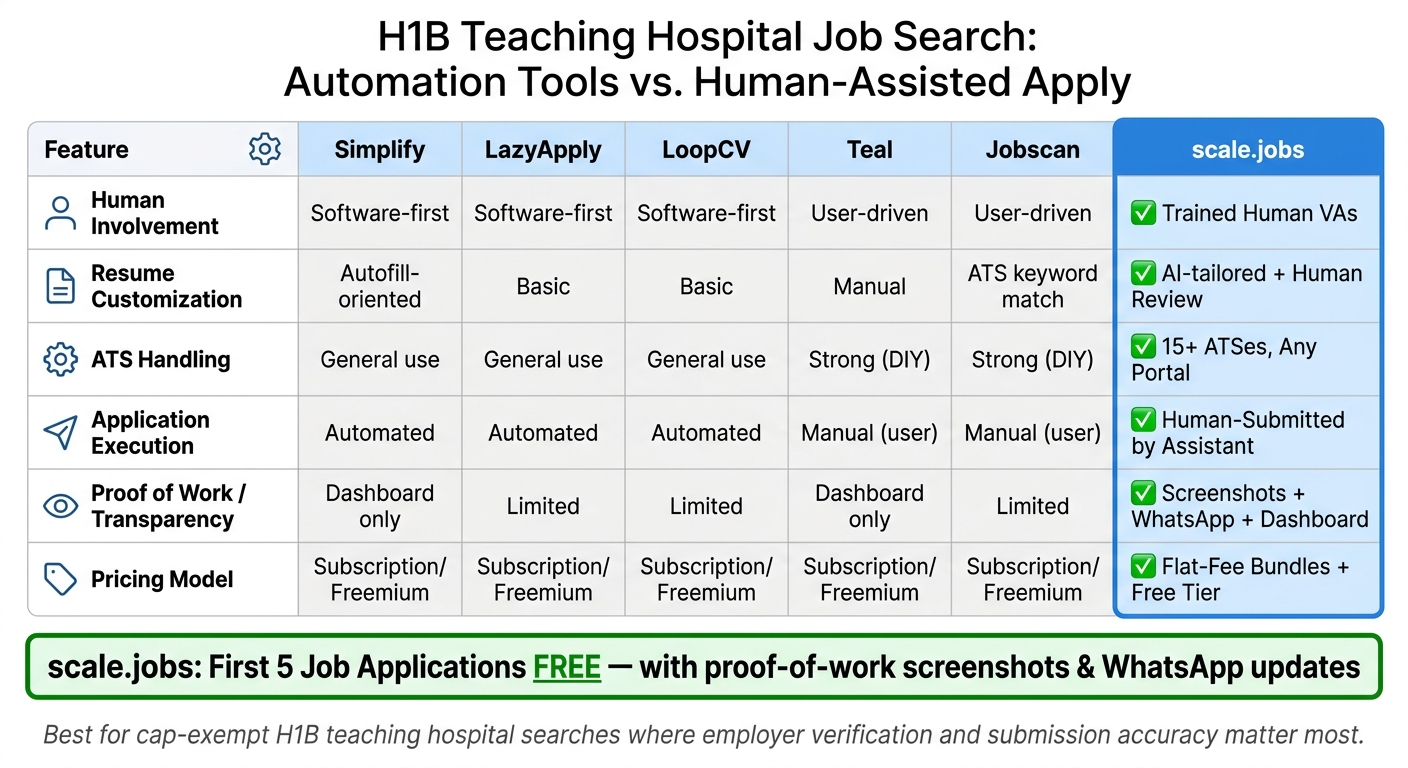
H1B Job Search Tools Compared: Automation vs. Human-Assisted for Cap-Exempt Teaching Hospitals
If your target list includes cap-exempt teaching hospitals, the hard part is not just finding openings. It’s making sure the employer is the right fit for H1B sponsorship and that each application goes through cleanly.
That’s where the gap shows up.
A lot of tools help you find roles or speed up form filling. But a teaching hospital H1B search has a different bar. You need verified employer targeting, clean submission, and a way to confirm the work was actually done. If you're trying to Apply for jobs in a visa-sensitive search, volume alone won’t save you.
Find, Prep, Apply, Track: The Workflow Built for High-Volume Visa-Sensitive Searches
The workflow lines up closely with what a teaching hospital H1B search needs.
Find scans 50,000+ career pages and 15+ ATSes. That gives you reach across hospital systems, university-linked employers, and direct career portals that many people miss when using a basic job search platform.
Prep generates ATS-ready documents in 2–3 seconds. That helps when you need to move fast without sending the same generic resume everywhere. It also fits well if you're already using an ai resume builder or an ai cover letter builder and want the final output shaped for submission.
Apply is handled by trained human assistants. That matters more than it may seem. In a cap-exempt search, a missed field, a bad upload, or a wrong employer choice can waste a strong opening.
Track gives you time-stamped proof plus WhatsApp updates. So instead of hoping an application was sent, you can actually see when it happened.
Pricing is split between subscription software and flat-fee human-assisted bundles, with unused credits refunded.
That’s the bar most automation tools miss. They help with speed. They don’t do as much when accuracy and proof matter just as much as volume.
Simplify, LazyApply, LoopCV, Teal, and Jobscan vs. scale.jobs: Which Tool Fits a Teaching Hospital H1B Search
These tools can work well for broad job hunts. They start to struggle when sponsor verification and submission proof become part of the job.
Simplify is good at autofill and tracking, but visa-sensitive employer review stays on you.
LazyApply supports high-volume submission, but it stays automation-first and does not add a human verification layer.
LoopCV can run automated campaigns well, but submission oversight still falls on the user.
Teal is useful for organizing a search and working on resumes, but it does not submit applications.
Jobscan helps match resumes to job descriptions for ATS use, but it stops at prep.
The difference is easiest to see when you compare execution, not just feature lists. That’s also why people looking at the best job boards or a job application service often end up asking a different question: who is checking the details before the application goes out?
| Feature | Simplify | LazyApply | LoopCV | Teal | Jobscan | scale.jobs |
|---|---|---|---|---|---|---|
| Human involvement | Software-first | Software-first | Software-first | User-driven | User-driven | Trained human VAs |
| Resume customization depth | Autofill-oriented | Basic | Basic | Manual | ATS keyword match | AI-tailored + human review |
| ATS handling | General use | General use | General use | Strong for DIY | Strong for DIY | 15+ ATSes, any portal |
| Application execution | Automated submission | Automated submission | Automated submission | Manual (user) | Manual (user) | Human-submitted by assistant |
| Transparency / proof of work | Dashboard-level | Limited | Limited | Dashboard only | Limited | Screenshots + WhatsApp + dashboard |
| Pricing model | Subscription or freemium | Subscription or freemium | Subscription or freemium | Subscription or freemium | Subscription or freemium | Flat-fee bundles + free tier |
Use this only if your search depends on sponsorship accuracy, not just application volume.
Switch to scale.jobs if:
- Your search targets cap-exempt teaching hospitals and needs verified employer targeting before submission
- You want human-checked submission with proof-of-work screenshots, not just a software dashboard
- You need ATS-ready documents paired with actual application execution
- You’d rather use a flat-fee bundle than a recurring subscription
For job seekers who want a more hands-on setup, this sits closer to a virtual assistant for job seekers than a pure browser tool. It’s also a better fit for people searching across full time jobs and niche visa-sensitive roles at the same time.
scale.jobs Now Offers the First 5 Job Applications Free
scale.jobs now offers the first 5 job applications free, with proof-of-work screenshots and WhatsApp updates.
Next, the decision comes down to whether you need speed alone or speed plus human verification.
Decision Summary: When to Use Automation and When to Switch to Human-Powered Apply
Once you've identified cap-exempt teaching hospitals, the next call is simple: how do you apply at scale without making costly mistakes? In an H1B search tied to teaching hospitals, the answer usually comes down to three things: target accuracy, application volume, and submission quality.
Use automation tools for broad, non-visa searches
Tools like Simplify, Teal, Jobscan, LazyApply, and LoopCV can help in the right setup. Jobscan is useful for ATS keyword checks before you send out a resume. Teal is good for tracking and organizing applications by hand. These tools work best for prep and workflow support, not for deciding cap-exempt eligibility.
Who should use automation tools: people running broad searches, cleaning up resumes early, or sending non-visa-sensitive applications where manual review isn't needed.
If your search stays broad and each employer doesn't need visa review, those tools can do the job.
That's the line. Broad-search tools help with prep, but visa-sensitive execution needs a different system. If you're still getting your materials ready, an ai resume builder or ai cover letter builder can help speed up the first draft before you move into hand-checked applications.
Use scale.jobs when sponsorship accuracy and speed matter
Automation starts to break down when the employer, portal, or visa path needs a closer look. If employer eligibility is unclear, human review matters. That workflow matters because it keeps target verification, document prep, submission, and tracking in one place.
Who should choose scale.jobs: people focused on cap-exempt targets, time-sensitive OPT/STEM OPT searches, high-volume submissions, and cases where proof of work matters.
Why scale.jobs wins on each differentiator:
- Human assistants: Trained human VAs submit every application by hand, catching employer eligibility issues before submission.
- ATS-optimized docs: Resumes and cover letters are tailored for each role, not autofilled from one template.
- Flat-fee bundles: One-time payment with unused credits refunded - no recurring subscription.
- Dedicated WhatsApp support: Direct updates on submission status without another dashboard to check.
- Proof-of-work screenshots: Time-stamped confirmation of every submission, so you know what was sent and when.
This is where a Virtual Assistant for Job Applications can make a clear difference. Instead of relying on browser automation to blast forms across the internet, you get hand-submitted applications with tracking built in. For job seekers trying to Apply for jobs fast without losing control, that setup is often the safer move.
For each blocker already named - targeting, volume, accuracy - scale.jobs deals with it through verified employer selection, human-executed submissions, and documented proof of work.
If you want to test the workflow, start with the free 5 applications and evaluate target accuracy, submission quality, and tracking. You can also compare it against a job application service or a job search virtual assistant if you're weighing different ways to handle volume.
If your search is moving from targeting into execution, the next section shows how scale.jobs handles the full workflow.