
Top #10 soft skill now worth more than code in 2026

Leela Yanamaddi
June 7, 2026

In 2026, soft skills have overtaken coding as the key to career growth. With AI and automation handling routine technical tasks, employers now prioritize human-centric abilities like leadership, communication, and problem-solving. These skills determine who gets promoted, who thrives in hybrid work environments, and who secures higher-paying roles.
Key takeaways:
- Emotional intelligence (EQ) is linked to 58% of job performance and higher earnings.
- Adaptability and learning agility are critical as 44% of today’s skills could become outdated by 2027.
- Leadership without a title and critical thinking are now essential for influencing decisions and solving complex problems.
- Professionals who excel at AI-driven job applications and negotiation are better positioned for success in an evolving job market.
To stand out, focus on showcasing these skills in your resume and job applications. Platforms like Scale.jobs provide tailored, human-driven support to craft resumes that highlight these critical abilities, giving you an edge in competitive markets.
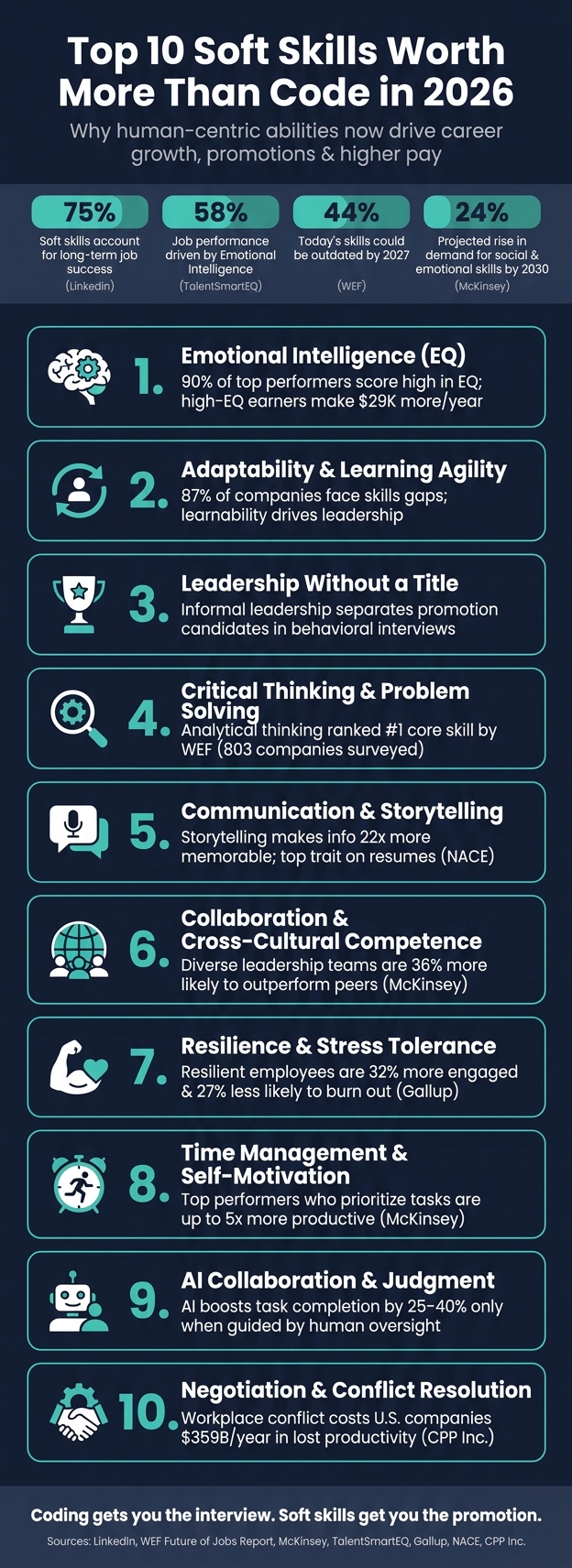
Top 10 Soft Skills Worth More Than Code in 2026
Top Soft Skills for 2026 (To Find your Dream Job)
sbb-itb-564272e
Why Soft Skills Pay More Than Coding in 2026
According to LinkedIn, soft skills account for 75% of long-term job success, while hard skills contribute just 25%. The World Economic Forum highlights analytical thinking, creative thinking, and resilience as the top three skills workers will need through 2027 - placing them ahead of any specific programming language or technical tool. Meanwhile, McKinsey forecasts a 24% increase in demand for social and emotional skills in the U.S. by 2030, as the need for basic cognitive and physical tasks declines. These trends underline why soft skills are becoming just as critical, if not more so, than technical coding expertise.
As AI tools and low-code platforms handle more routine technical tasks, the standalone value of coding diminishes. Employers now prioritize professionals who can frame complex problems, align diverse stakeholders, and make sound decisions - capabilities that machines can't replicate. For example, a developer who can also lead cross-functional meetings, resolve client issues, or translate technical constraints into actionable business strategies is far more valuable than one who focuses solely on writing clean code. This evolving demand is reshaping not only technical roles but also overall career trajectories.
The rise of hybrid and remote work further amplifies the importance of soft skills. Clear written communication, effective time management, and the ability to collaborate across time zones are now essential for maintaining productivity. A Microsoft Work Trend Index revealed that 82% of leaders believe employees need new skills to thrive in a hybrid work environment, with behavioral skills topping the list over technical abilities.
The financial rewards for strong soft skills are undeniable. Roles like product managers, technical account managers, and sales engineers - which rely heavily on communication, negotiation, and stakeholder management - often match or even surpass the total compensation of mid-to-senior software engineers. According to Gallup, organizations with strong leadership and people-management capabilities are up to 2.4x more likely to achieve superior financial performance. This directly ties soft skills to revenue growth, employee retention, and career advancement opportunities.
For professionals aiming to excel, it's essential to develop both soft skills and technical expertise. Equally important is showcasing these skills effectively in your job applications. Using resume writing hacks to highlight leadership, collaboration, and communication can make a significant impact, especially when tailored with ATS optimization tips and human reviewers. Leveraging a professional resume writing service ensures your materials reflect the full spectrum of your abilities. Up next, we’ll explore the top soft skills driving career success in 2026.
1. Emotional Intelligence (EQ)
Emotional intelligence (EQ) can be a game-changer in your career. Research by TalentSmartEQ, based on over 1 million people, reveals that EQ drives 58% of job performance across all roles, with 90% of top performers scoring high in EQ. The financial impact is equally striking: individuals with high EQ earn an average of $29,000 more annually than those with lower EQ. Each additional EQ point adds approximately $1,300 to yearly earnings.
A CareerBuilder survey of more than 2,600 HR professionals found that 71% prioritize EQ over IQ when assessing candidates. Furthermore, 75% of employers are more likely to promote employees with strong EQ over those with superior technical skills but weaker interpersonal abilities. In interviews, EQ often becomes the deciding factor between two equally qualified candidates. How a person handles conflict, accepts feedback, or navigates team challenges speaks volumes about their emotional intelligence, which directly translates to workplace success - even in technical roles.
For technical professionals, EQ amplifies the impact of their skills. Google's Project Oxygen study discovered that their best managers excelled in coaching, empathy, and communication - not just technical expertise. For example, a senior engineer who can empathize with a stakeholder’s concerns, explain complex trade-offs clearly, and de-escalate tense situations is far more valuable than one who cannot. That’s why roles blending technical expertise with interpersonal skills - like product management, engineering leadership, and technical account management - often come with higher salaries in the U.S.
The rise of remote and hybrid work environments has made EQ even more crucial. Without in-person cues, high-EQ professionals excel by using clear communication, consistent follow-ups, and proactive engagement to build trust in distributed teams. They notice subtle shifts, like a change in tone on Slack or a team member’s silence during a Zoom call, and address potential issues before they escalate. Gallup research underscores this, showing that managers influence at least 70% of team engagement, with emotionally intelligent behaviors - such as empathy, recognition, and personalized support - playing a key role. These skills not only enhance team dynamics but also strengthen job application narratives. This is particularly effective when building a tech resume that gets interviews.
EQ also shines in the finer details of job applications. Whether tailoring your experience to match a company’s challenges, framing a career transition as a strategic decision, or positioning technical expertise as a solution to business problems, these elements require human insight. This is where working with professional resume writers can make a noticeable difference. Unlike automated tools, services like scale.jobs combine human expertise with ATS-optimized strategies to craft applications that resonate on a deeper level, giving candidates an edge in competitive markets.
2. Adaptability and Learning Agility
In today's fast-changing job market, staying adaptable is critical. The World Economic Forum's Future of Jobs Report predicts that by 2027, 44% of the skills we rely on today could become outdated. This is why adaptability is increasingly viewed by hiring managers as a key indicator of future potential rather than just current abilities. The ability to learn and adjust quickly has become essential for navigating career changes and thriving in evolving industries.
According to McKinsey, 87% of companies are already experiencing or anticipating skills gaps. To address this, they prioritize learnability - the ability to acquire and apply new skills swiftly - when hiring and promoting employees. While technical expertise might help you land an interview, it's your learning agility that often propels you toward leadership roles. Research from Korn Ferry consistently highlights that individuals who adapt quickly to new challenges are more likely to be identified as future leaders. Combining this adaptability with strong emotional intelligence creates a well-rounded candidate that employers find highly attractive.
Take AT&T as an example. Between 2019 and 2022, the company invested over $1 billion in reskilling tens of thousands of employees, transitioning them from traditional telecom roles to positions in software, cloud computing, and data analytics. Employees who embraced continuous learning were far more likely to secure higher-value roles, proving that a commitment to continuous learning is key to career growth in an ever-changing job landscape.
Tip: Keep track of the new skills you acquire and the strategies you develop during challenging times. These learning experiences can set you apart when applying for jobs or seeking promotions. If you're working with professional resume writers, make sure your ability to adapt and learn is a central theme in your application. Highlighting how you’ve navigated transitions and delivered results in dynamic environments can make your career story stand out.
3. Leadership and Influence Without a Title
You don’t need an official title to demonstrate leadership. In 2026, informal leadership - the ability to guide decisions, align teams, and achieve results without formal authority - has become a key trait hiring managers look for when assessing candidates for larger roles. This quality often distinguishes top candidates, much like Scale.jobs stands out in its focus on showcasing human-driven leadership skills compared to competitors like findmyprofession.
In technical hiring, candidates with equal technical expertise are often assessed differently based on their ability to lead beyond their job descriptions. For example, someone with a history of spearheading cross-functional projects, mentoring junior colleagues, or resolving conflicts independently will often stand out. Companies like Google, Amazon, and Microsoft increasingly rely on behavioral interviews to identify these experiences - where clear, specific examples of leadership can outweigh minor gaps in technical knowledge.
The rise of remote and hybrid work environments has made informal leadership even more apparent. Those who excel at keeping distributed teams on track - by openly communicating decisions, identifying obstacles early, and resolving asynchronous misunderstandings - quickly become indispensable. Managers often see these individuals as critical to a team’s success, and their names are frequently mentioned in promotion discussions.
What makes informal leadership so powerful is how it amplifies technical skills. Take an engineer who not only writes code but also explains AI constraints to legal teams or aligns product strategy with design goals - they evolve from being a “solid coder” to a trusted problem solver. This broader impact provides managers with tangible reasons to advocate for higher raises and quicker promotions, demonstrating how technical contributions can translate into career growth.
If you’re preparing to ask for a promotion or apply for a new role, it’s essential to document these informal leadership moments. Use a “brag document” to track initiatives you’ve led, processes you’ve improved, and measurable results you’ve achieved (e.g., “reduced deployment rollbacks by 30% in three months”). Highlighting these contributions not only strengthens your career story but also enhances your résumé. Consider working with Scale.jobs resume writers to turn these leadership examples into a résumé that truly reflects your impact.
4. Critical Thinking and Complex Problem Solving
Coding tells a computer how to execute a solution, but critical thinking ensures that the solution itself is the right one. This distinction is becoming a key differentiator in the 2026 job market.
The World Economic Forum's 2023 Future of Jobs report, which surveyed 803 companies, ranked analytical thinking as the most important core skill for workers, followed closely by creative thinking. Similarly, complex problem solving and critical thinking were among the top 10 skills projected to grow the fastest through 2027. A McKinsey Global Institute analysis reinforces this trend, predicting that U.S. demand for higher cognitive skills could increase by about 19% by 2030 compared to 2016 levels. With automation handling more basic tasks, including routine coding, the ability to think critically and solve complex problems is becoming indispensable.
Employers are increasingly looking for people who can step into chaotic situations - where data might conflict, goals are unclear, and stakeholders have competing interests - and identify the real problem before any code is written. For example, consider a product manager who observes high sign-up rates but low conversions to paid plans. Instead of rushing to add new features, they might conduct user interviews to uncover a mismatch between pricing and messaging. The solution? A strategic repositioning - no coding required. This level of insight is difficult to automate and highly valued by employers, often leading to promotions and greater responsibilities.
Career growth often hinges on this ability. In the U.S., performance reviews for senior roles frequently assess skills like "decision quality", "systems thinking," and "handling ambiguity." Engineers who can reframe challenges and propose data-driven experiments often transition into higher-paying roles with benefits like bonuses and equity. If you're aiming for such a leap, using a professional resume writing service can help articulate your problem-solving achievements in a way that resonates with hiring committees.
To develop this skill on the job, start by slowing down before offering a solution. Write a concise three-sentence problem statement, list your assumptions, and ask yourself, "What evidence would disprove this?" Then, quantify the potential impact - such as estimating that a 2% reduction in churn could add $180,000 in annual recurring revenue. Managers quickly notice this thoughtful approach, and it demonstrates the kind of judgment that can accelerate your career far more effectively than mastering the latest programming framework.
5. Communication and Storytelling
While critical thinking helps pinpoint solutions, effective communication ensures those solutions are understood, endorsed, and acted upon. It's the bridge that connects your technical insights to meaningful business outcomes.
In 2026, the difference between technical professionals who excel and those who stagnate often boils down to one key question: Can you make your work resonate with people outside your field? Critical thinking might lead you to the right answer, but communication ensures that answer gets the attention and resources it deserves.
A NACE Job Outlook survey highlights that verbal and written communication skills are among the top traits employers prioritize on resumes, often ranking higher than GPA or specific technical expertise. Recruiters frequently note that unclear explanations, disorganized responses, or overly lengthy answers during interviews are common reasons technically skilled candidates are passed over. Meanwhile, LinkedIn's 2024 research underscores communication as a lasting "power skill" that will remain crucial across industries through 2030.
The real art lies in translating technical achievements into language that speaks to business priorities. For example, compare these two statements to an executive: "We improved model accuracy by 4%" versus "Our updated model is expected to cut small-business loan defaults by 15%, saving approximately $3 million annually." The second approach not only grabs attention but also secures buy-in. Research shows that storytelling - framed with context, problem, action, and result - can make information up to 22 times more memorable.
This ability to communicate effectively impacts hiring outcomes as well. On a resume, a bullet point like, "Created dashboards for sales leadership, reducing response times to underperforming campaigns by 25%" tells a compelling story in just one line. In interviews, using the STAR framework (Situation, Task, Action, Result) to structure your answers demonstrates both clarity and self-awareness. Tailoring the level of technical detail to match your audience - whether HR or technical hiring panels - further reinforces your adaptability. Platforms like Scale.jobs can help refine your resume into outcome-focused narratives that stand out, offering human-assisted, ATS-friendly documents that go beyond automated templates from competitors like findmyprofession.
Before any presentation or update, ask yourself: What problem did we solve? Why does it matter? What’s the next step? Writing these answers down forces clarity and ensures your message is focused. This habit not only enhances your communication but also accelerates your inclusion in strategic discussions - often more effectively than earning additional certifications. Clear, impactful storytelling sets the foundation for the broader career strategies covered in the next section.
6. Collaboration and Cross-Cultural Competence
Critical thinking might guide sound decisions, but it’s effective collaboration that turns those decisions into action, especially in global settings. Clear communication ensures your ideas are heard, but collaboration ensures they’re implemented - often across teams spread between the U.S., India, and Europe. In 2026, this isn’t a rare occurrence; it’s the norm.
According to SHRM, over 60% of U.S. companies now operate with employees across multiple countries or cultures. This makes cross-cultural collaboration an essential skill - not just for leaders, but for individual contributors, project managers, and engineers. A survey by NACE underscores this, showing that teamwork and collaboration are rated "very important" or "absolutely essential" by over 80% of U.S. employers, surpassing factors like GPA and even some technical qualifications.
The professional benefits are tangible. Research from McKinsey, analyzing more than 1,000 large companies, shows that organizations in the top quartile for ethnic and cultural diversity in leadership are 36% more likely to outperform their peers in profitability. Leaders who excel at aligning stakeholders across regions are often tapped for high-profile global projects, paving the way for promotions and roles like regional director or global account manager. For example, a U.S.-based software engineer who takes the initiative to coordinate with an offshore development team across time zones might establish asynchronous workflows - daily updates, shared documentation, and rotating meeting times - while respecting local norms around feedback. By fostering trust and reducing defect rates, they position themselves as indispensable. When leadership seeks someone to lead a distributed product team, that engineer stands out, not for their coding skills but for their ability to coordinate effectively, earning a promotion and a higher salary.
In hybrid work environments, successful collaboration often comes down to specific practices. These include rotating meeting times to avoid burdening one region, summarizing decisions in shared tools like Notion or Asana, and asking targeted questions such as, "How does your team prefer to give feedback?" Deloitte’s research highlights the benefits: inclusive teams are 87% more likely to make better decisions and work twice as fast with fewer meetings compared to non-inclusive teams. On the flip side, weak cross-cultural skills can lead to inefficiencies. Studies of virtual teams suggest that 20–30% of project time is often wasted on miscommunication and clarifications when norms aren’t clearly established.
When showcasing collaboration on your résumé, avoid vague statements like "worked with diverse teams." Instead, focus on specifics. For example: "Led a cross-functional team across the U.S., Brazil, and India to deliver a product launch three weeks ahead of schedule, coordinating across four time zones using Slack and Asana." This kind of detail demonstrates cultural awareness, remote collaboration expertise, and accountability. Tools like Scale.jobs can help refine these points into outcome-driven résumé highlights with real-life examples. If you're aiming for global or hybrid roles, pairing detailed, results-oriented accomplishments with professionally crafted résumé services can help position you as a strong candidate for leadership opportunities.
7. Resilience and Stress Tolerance
Resilience is what keeps professionals effective when things don’t go as planned, especially in global teams. Layoffs, reorganizations, and market shifts are inevitable, and hiring managers are looking for more than just strong performance in ideal conditions - they want individuals who can maintain their effectiveness when everything feels uncertain.
Over 60% of U.S. employers prioritize resilience, stress tolerance, and flexibility as key hiring criteria. Gallup’s research sheds light on why: employees with higher resilience scores demonstrate 32% greater engagement and are 27% less likely to experience burnout compared to peers facing similar challenges. For hiring managers looking to reduce costly turnover, this difference can’t be ignored.
The shift to remote and hybrid work has made resilience even more crucial. Without the natural flow of an office environment - like casual check-ins or nonverbal cues - stress can go unnoticed until it escalates. Resilient remote workers create their own systems to stay grounded: setting clear work hours, establishing communication norms, and practicing end-of-day rituals to mentally disconnect. According to studies, employees with higher psychological resilience were 1.6 times more likely to maintain or improve productivity under the same conditions as less resilient peers. This ability to adapt and thrive becomes especially evident during behavioral evaluations in hiring processes.
In interviews, candidates are often asked questions like, "Tell me about a time a project failed. What did you do next?" The best responses follow a clear structure: explaining the situation, identifying what they controlled, describing the changes they made, and highlighting the outcomes. For example, saying, "We missed the launch deadline, so I restructured our sprint planning and added weekly risk reviews - next quarter, we shipped two weeks early," demonstrates emotional stability and a capacity for learning. This is far more compelling than simply stating that you “pushed through.” Employers are looking for evidence of growth, not just endurance.
Resilience sets apart those who remain steady from those who plateau. Everyone faces setbacks - whether it’s a missed promotion, a failed project, or unexpected team changes. The key difference is how you respond: do you see these moments as barriers or as opportunities to learn? By documenting challenges, identifying what you could control, and applying those lessons moving forward, you show a commitment to improvement. And when it’s time to present your experiences on paper, services like a top-rated resume writing services can help frame those moments as strengths that resonate with hiring managers.
One important point to clarify: resilience doesn’t mean tolerating overwork. Sustainable performance requires recovery - getting enough sleep, setting firm boundaries, and taking time to reflect. Resilient professionals know how to protect their energy and avoid burnout, which benefits both their long-term careers and the teams they support. Employers are increasingly aware of the high cost of burnout, making this distinction critical for how you position yourself during the job search.
8. Time Management and Self-Motivation
In 2026, while resilience remains essential for bouncing back, the real drivers of consistent progress are effective time management and self-motivation. These habits are especially critical in remote and hybrid work environments, where traditional oversight is minimal, and outcomes often hinge on your ability to manage yourself. Unlike findmyprofession, which leans on automated resume templates, scale.jobs offers personalized support with human assistants, ATS-optimized documents, and dedicated WhatsApp communication to highlight your self-directed accomplishments.
A 2023 SHRM survey revealed that over 70% of U.S. employers consider self-motivation and time management "very important" when assessing candidates for remote roles and promotions. McKinsey research further underscores this, noting that top-performing knowledge workers who excel at prioritizing their tasks are up to 5 times more productive than their peers. This structured approach not only enhances day-to-day performance but also strengthens the narrative of your achievements on your resume. Tools like scale.jobs can transform these self-managed accomplishments into standout career milestones.
For technical professionals - developers, data analysts, engineers - time management and self-motivation are even more critical. When you're solely responsible for delivering a feature or analysis, your ability to maintain focus, prioritize tasks by their business impact, and identify risks early can determine whether your team meets its deadlines or falls behind. For instance, a software engineer who provides daily asynchronous updates, plans sprints realistically, and completes a complex refactor on schedule isn’t just hitting targets - they’re building trust. This trust, reflected in qualities like "exceptional ownership and independent execution," can be a decisive factor in earning promotions, such as a Staff Engineer title.
Hiring managers look for behaviors that are clear and measurable: consistently meeting deadlines, sharing updates proactively, and taking initiative, such as automating a process or creating documentation. Résumé phrases like "owned end-to-end delivery in a fully remote team" or "self-directed learning of X tool leading to Y outcome" signal leadership potential. To ensure these experiences resonate with hiring managers, scale.jobs can help you implement the best job search strategy for tech professionals by crafting your achievements into a compelling narrative. Their approach offers distinct advantages over automated tools, including:
- Human-driven resume refinement
- Tailored application strategies
- Transparent, one-time payment model
Building these skills doesn’t have to be overwhelming. Start by auditing your time over two weeks to identify where productivity leaks occur. Implement deep-work time blocks inspired by Cal Newport, use a Kanban board to track tasks visually, and send concise weekly updates to your manager. By the third month, take ownership of a self-initiated project with clear milestones. These steps not only enhance your day-to-day effectiveness but also provide tangible examples of self-direction that stand out during performance reviews. Combined with scale.jobs' proven strategies for showcasing achievements, these habits can position you for long-term career growth.
9. AI Collaboration and Judgment
By 2026, simply knowing how to use AI tools isn't enough - it’s about understanding when to trust AI, when to step in, and how to incorporate its output into meaningful decisions. This nuanced approach is what truly distinguishes top candidates in the job market. Employers are increasingly valuing individuals who can bridge the gap between operating AI tools and exercising sound judgment around their use. Unlike automation-heavy services such as findmyprofession, this skill can elevate your résumé and make you stand out.
According to the World Economic Forum's Future of Jobs report, AI and big data rank among the top three fastest-growing skills. Consulting firms have also noted that generative AI can accelerate task completion by 25–40%, but only when refined by human oversight. Relying solely on automation can lead to mistakes, bias, or even damage to a brand's reputation. The professionals who thrive are those who treat AI as a tool for drafting ideas, not making decisions.
This dynamic plays out in various real-world scenarios. For instance, a marketing manager might use AI to generate several headline options but then choose the one that aligns with U.S. audience preferences and legal requirements. Similarly, an HR professional may let AI screen résumés for keywords but personally review candidates from nontraditional backgrounds to minimize bias. A product manager might use AI to align project capabilities with stakeholder needs, ensuring the project stays on course. In each case, sound judgment and strategic thinking go beyond the technical operation of AI - and these are precisely the traits hiring managers are seeking.
On your résumé, showcasing this ability can make a big difference. For example, you could highlight achievements such as "redesigned support workflow with AI-suggested responses plus human review, improving resolution time by 25% without increasing complaint rates" or "developed team guidelines for AI content use, reducing compliance review cycles by 30%". If you’re unsure how to frame these accomplishments effectively, scale.jobs' resume writing services combine the expertise of human writers with ATS-optimized formatting to craft a clear and compelling narrative of your AI-enhanced skills.
Developing strong AI judgment is a key soft skill reshaping career success in 2026. Building this capability requires intentional practice. Consider adopting a structured 90-day plan: identify tasks that could benefit from AI, test its use in low-risk scenarios, and evaluate outputs for accuracy, brand consistency, and bias. Document your findings and share them with your team. This habit of thoughtful and transparent AI use is exactly what hiring managers mean when they say they want someone who can "work with AI responsibly."
- Why scale.jobs improves AI collaboration: Unlike automated résumé tools that produce generic content, scale.jobs pairs human expertise with ATS-optimized design to ensure your AI-related accomplishments are presented with the precision and depth that make you stand out as a candidate ready for today’s AI-driven workplace.
10. Negotiation and Conflict Resolution
In the 2026 job market, negotiation and conflict resolution skills are no longer optional - they’re essential for career growth. While technical expertise like coding helps you land interviews, it’s your ability to navigate workplace dynamics that determines promotions, salary increases, and leadership opportunities. A report by CPP Inc. highlights that U.S. companies lose approximately $359 billion annually in paid hours due to workplace conflicts. This stark figure underscores why hiring managers now view conflict resolution as a key indicator of leadership potential. Unlike findmyprofession, scale.jobs combines human expertise with ATS-optimized tools to help professionals showcase these career-defining skills effectively.
Why Negotiation Skills Matter for Career Growth
Strategic negotiation can lead to offers that are 5–15% higher than those of peers, with the financial benefits compounding over time. Additionally, professionals who negotiate project scope, timelines, and resources often climb the career ladder faster. They don’t just perform tasks - they shape their roles. Here’s how scale.jobs stands out in turning these skills into tangible career advantages:
- Human-driven résumé coaching that translates negotiation achievements into compelling language for hiring managers.
- ATS-optimized résumé formatting to ensure interpersonal accomplishments bypass automated filters.
- Transparent proof-of-work tracking, so you’re always informed about the progress of your applications.
- Dedicated WhatsApp support for real-time advice on positioning and application strategies.
- One-time payment model, eliminating ongoing subscription fees or hidden costs.
| Criteria | findmyprofession | scale.jobs |
|---|---|---|
| Human involvement | Limited; process-driven | Dedicated human assistants throughout |
| Resume customization depth | Template-based refinement | Deep, role-specific customization |
| ATS handling | Basic keyword optimization | Full ATS-optimized formatting |
| Application execution method | Assisted but largely automated | Human-executed, hands-on support |
| Transparency and proof of work | Limited visibility | Clear proof-of-work documentation |
| Pricing model | Subscription or tiered packages | One-time payment, no recurring fees |
Conflict Resolution in Remote and Hybrid Workplaces
In remote or hybrid settings, small miscommunications - whether through Slack, email, or other platforms - can quickly escalate. Managers who summarize agreements, move sensitive discussions to video calls, and clarify intent can significantly reduce workplace friction. These habits not only prevent HR escalations but also enhance your reputation as a leader. Tools like scale.jobs help you spotlight these skills on your résumé, giving you an edge over competitors like findmyprofession.
For practical application, two effective frameworks stand out:
- Interest-Based Problem Solving: This approach shifts discussions from rigid demands ("we need eight weeks") to underlying concerns ("we can’t compromise quality or risk burnout"), enabling creative solutions.
- The CALM Method: This framework - Clarify the issue, Address emotions, Look for solutions, Make a plan - provides a structured way to resolve conflicts before they derail projects. It works equally well in-person with a whiteboard or remotely using shared documents.
These strategies not only strengthen your leadership profile but also make your résumé more ATS-friendly. For example, highlight accomplishments like: "Renegotiated project scope with three stakeholders, preserving key features while reducing delivery time by two weeks" or "Resolved a cross-team conflict that had delayed a product launch, ensuring an on-time release." If you’re unsure how to position such achievements, scale.jobs' resume writing services offer expert help in crafting ATS-friendly, impactful résumés tailored for U.S. hiring managers.
Who Should Use findmyprofession
- Professionals seeking guided career coaching with human consultants.
- Job seekers targeting executive or senior-level roles.
- Candidates comfortable with subscription-based pricing models.
- Those prioritizing interview coaching alongside résumé support.
Who Should Choose scale.jobs
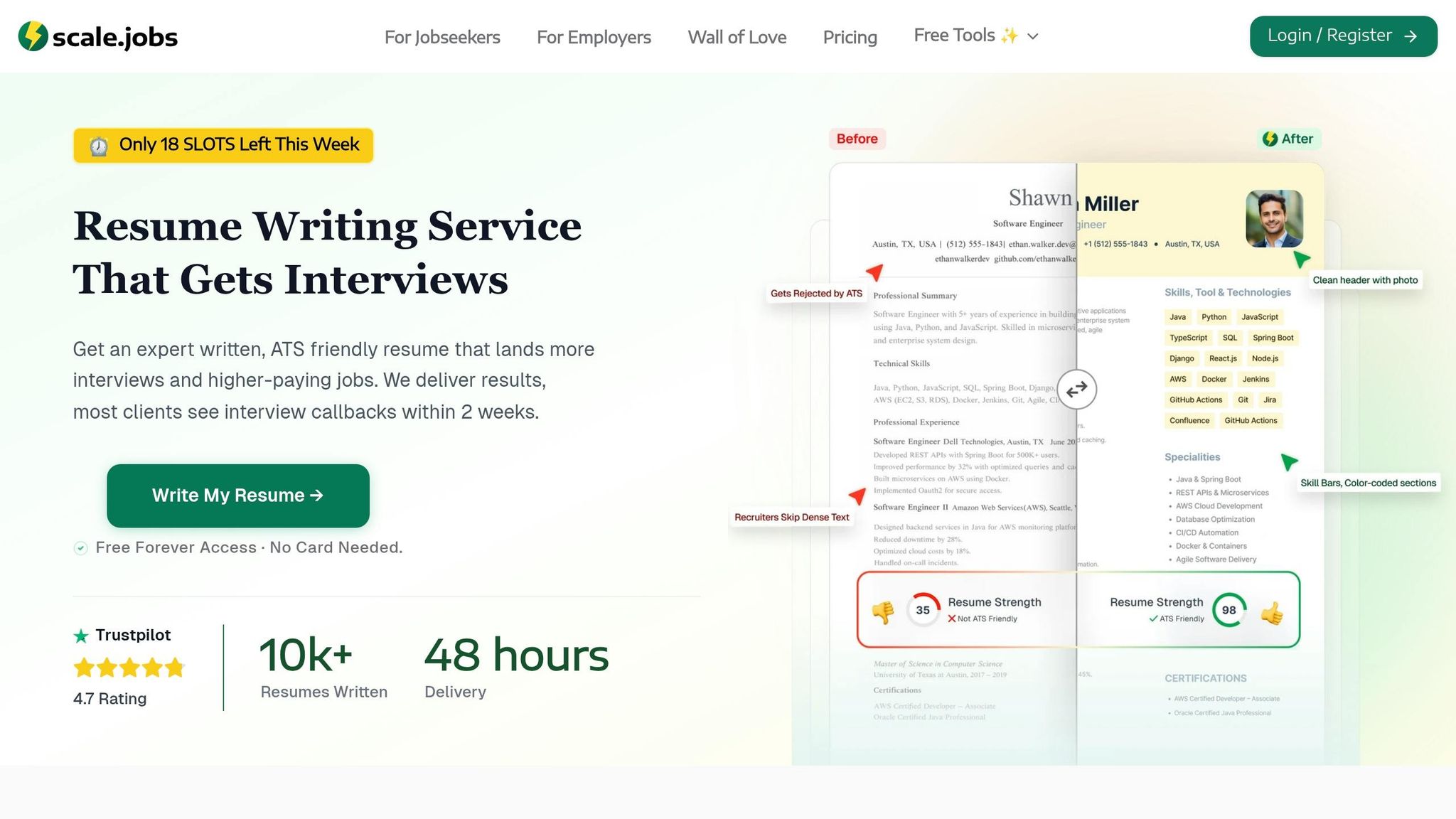
- Job seekers looking for hands-on application execution by human assistants.
- Professionals needing deeply customized, ATS-optimized documents for competitive roles.
- Candidates who value transparency and detailed proof-of-work at every stage of their job search.
- Those preferring a one-time payment over recurring subscription fees.
- Anyone seeking responsive, real-time support via WhatsApp throughout their job search.
Switch to scale.jobs if…
- You want human oversight in crafting negotiation-focused messaging and ensuring your résumé reflects these strengths accurately.
- You prefer detailed, outcome-oriented application support rather than automated templates.
- You value transparency, with clear documentation of how your résumé and applications are prepared and submitted.
- You’re targeting roles where ATS optimization is critical, and generic formatting risks disqualification.
- You want a predictable, one-time investment without the uncertainty of ongoing subscription fees.
How to Build These Soft Skills
Developing soft skills is an ongoing process involving learning, practice, feedback, and showcasing your progress. To make the most of this journey, combine foundational reading, structured courses, and mentorship. This approach ensures you not only understand these skills but also apply them effectively.
Books to Strengthen Key Skills
For building emotional intelligence (EQ) and resilience, Daniel Goleman's Emotional Intelligence is a must-read, offering insights into self-awareness and regulation. Pair it with Option B by Sheryl Sandberg and Adam Grant, which explores strategies for stress management and recovery. If you're focusing on leadership and influence, The Coaching Habit by Michael Bungay Stanier is a practical guide to leading without formal authority, a skill often tested in behavioral interview scenarios like "Describe a time you led without a title." These books are widely available and typically cost between $15 and $30.
For critical thinking and communication, Daniel Kahneman’s Thinking, Fast and Slow provides a framework for tackling complex problems, while Made to Stick by Chip and Dan Heath offers strategies for impactful storytelling - valuable for presentations and job applications alike.
Courses and Learning Opportunities
Platforms like Coursera, LinkedIn Learning, and edX offer workplace-relevant soft skill courses, many of which include certificates.
- For early-career professionals, start with a short course on communication and storytelling (4–6 hours) and follow it with a critical thinking course that includes case studies.
- For mid-career professionals aiming for leadership roles, courses on managing without authority or handling conflict in remote teams can be more beneficial.
Prioritize courses that include peer feedback and graded assignments, as these are often more respected by hiring managers than self-paced video lessons. Once you’ve gained foundational knowledge, mentorship can help you apply what you’ve learned in practical settings.
Mentorship for Rapid Growth
Mentorship is one of the quickest ways to refine soft skills. Identify a senior colleague known for specific strengths - such as resolving conflicts calmly or excelling in collaborative projects - and request monthly 30-minute conversations. Use these sessions to focus on one behavior at a time, then practice and review the results. This process turns abstract qualities into actionable skills, which can also serve as communicating skills in interviews with concrete examples.
Showcasing Your Skills with scale.jobs
The value of soft skill development lies in how effectively you can demonstrate it to potential employers. scale.jobs helps bridge this gap by crafting application materials that highlight your achievements in an employer-focused way. Instead of generic descriptors like "excellent communicator", they frame your experience with measurable outcomes, such as "Coordinated a cross-functional team of 6 to deliver a product feature 3 weeks early, boosting NPS by 8 points."
Their resume writing services include ATS-optimized formatting, a 1-on-1 Zoom session, and real-time WhatsApp support, ensuring your resume aligns with the specific needs of your target employers. These tools not only help you refine your skills but also position you to stand out in competitive job markets, giving you an edge over similar services like findmyprofession.
Conclusion
While coding skills might open the door to an interview, it’s the combination of technical expertise and soft skills that propels professionals to higher-level roles and better compensation packages. As highlighted earlier, these soft skills are what turn technical proficiency into leadership potential. According to McKinsey, the demand for social and emotional skills is expected to rise by 24% by 2030, while the need for basic cognitive and manual tasks continues to decline.
The 10 skills discussed in this article - ranging from emotional intelligence to negotiation and AI collaboration - are the ones that can secure promotions, safeguard your position during company changes, and give you an edge in salary discussions. For instance, a data analyst who can present compelling narratives to executives will consistently outshine one who merely processes data.
Here’s your next step: choose 2–3 skills aligned with your target role, commit to practicing them daily for 30 days, and translate those efforts into measurable resume achievements. Swap vague skill descriptions for specific accomplishments, such as "Facilitated weekly cross-functional meetings for a 10-person team, reducing project delays by 25%." This level of detail is what hiring managers and applicant tracking systems value most. By following this approach, you’ll strengthen your professional profile and stand out in a competitive job market.
If you’re in the midst of a job search, scale.jobs can help you frame your soft skill achievements as measurable business contributions. Their team of human assistants manages the application process, allowing you to focus on networking and interviews - where these skills shine the brightest.
Decision Summary
Choose scale.jobs if:
- You need human-driven, ATS-friendly application support with clear proof of results.
- You want tailored resume narratives that highlight measurable soft skill accomplishments.
- You prefer a one-time payment model and dedicated WhatsApp support.
- You’re applying for competitive roles where generic resumes might not make the cut.
Choose findmyprofession if:
- You’re looking for executive-level career coaching with personalized consultant support.
- You value interview coaching alongside resume writing services.
- You’re comfortable with a subscription-based pricing model.
Professionals who intentionally develop and showcase these skills with precision will remain not only employable but also promotable as workplace demands and technical requirements continue to evolve.
FAQs
Which soft skill should I focus on first for my role?
Developing emotional intelligence is a crucial step in improving your job search strategy. While AI tools are great at identifying keywords, they can't match the human ability to assess soft skills or understand the subtle cues in job postings. For example, there's a difference between a "fast-paced startup" environment and a role that emphasizes being "collaborative." Understanding these nuances allows you to customize your application in a way that aligns with what the employer is truly seeking. Emotional intelligence also makes it easier to work with human assistants, who can help translate your experiences into language that appeals directly to hiring managers.
How do I prove soft skills on my resume with results?
To effectively showcase soft skills on your resume, steer clear of vague statements. Instead, focus on concrete, results-oriented examples that demonstrate your abilities:
- Showcase accomplishments: Replace generic claims like "strong leadership skills" with specific examples, such as leading a team project that boosted efficiency or achieved a key milestone.
- Tailor your language: Adapt soft skills to fit the role and the company's values, ensuring they align with the job description.
- Quantify your contributions: Whenever possible, include numbers or measurable outcomes to highlight the impact of your skills.
For a polished, ATS-friendly resume that emphasizes your strengths, consider using services like those offered by Scale.jobs. Their human-reviewed resumes ensure your skills stand out to potential employers.
How can I use AI at work without becoming overly dependent on it?
To get the best results, combine the strengths of AI with human expertise. Use AI tools for tasks like finding job matches, collecting company details, and breaking down job descriptions. For more crucial steps - like tailoring applications and submitting them - opt for human-guided services such as Scale.jobs. This ensures your applications are customized, optimized for ATS, and avoid being flagged by automated systems.