
I Switched From Auto-Apply to Human Help: Here's Why

Sarah Mitchell
July 13, 2026

My short answer: I switched because auto-apply tools sent more applications, but not better ones. What helped me more was human review, role-by-role resume edits, clear ATS handling, and proof of what was submitted.
If you want to Apply for jobs at scale, here’s the simple takeaway:
- Auto-apply tools help with volume
- Human help helps with fit and accuracy
- Weak execution can kill response rates, even after 100+ applications
- A flat fee can be easier to budget than another monthly tool
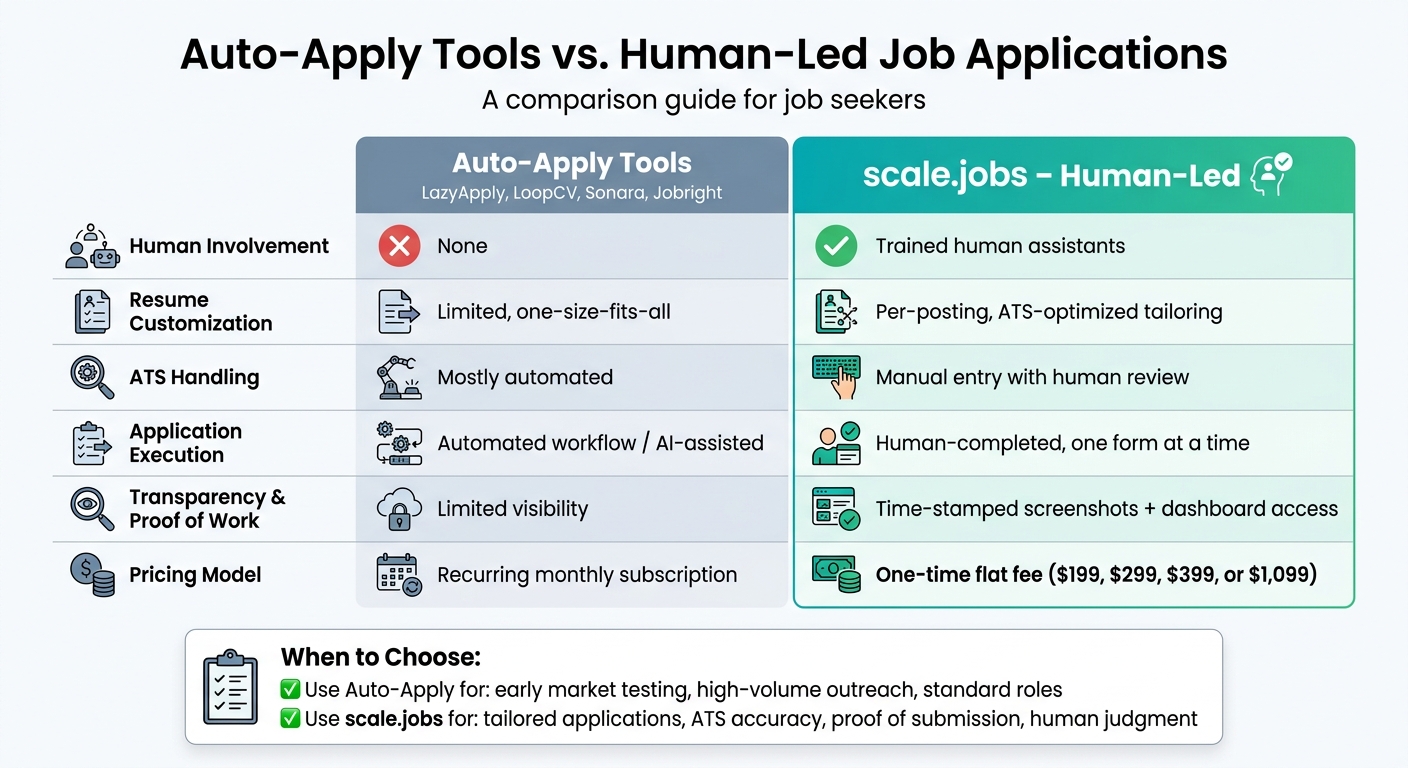
Auto-Apply Tools vs Human-Led Job Applications: Full Feature Comparison
Companies Don't Trust Job Applications Anymore - Here's Why.
sbb-itb-564272e
Quick comparison
| Tool type | Best for | Main gap |
|---|---|---|
| LazyApply, LoopCV, Sonara, Jobright | Early outreach and bulk sending using job application automation tools | Less control over tailoring and form quality |
| scale.jobs | Handled applications with human review | Less about bulk automation, more about done-for-you support |
If you are getting low response rates, the issue may not be how many jobs you apply to. It may be what gets sent, how well it matches the role, and whether the form was filled out the right way.
What changed my mind
I started out wanting speed. After a while, I cared more about four things:
- Resume-to-role match
- ATS-friendly formatting
- Clear records of each submission
- Better handling of custom questions
That is why I moved away from pure automation and toward a human-led job application service.
LazyApply vs Scale.jobs
LazyApply made sense when I wanted to test broad outreach. But once I looked at response quality, the weak spots stood out.
Here’s where I saw the split:
- LazyApply focused on sending many applications
- scale.jobs focused on checking each one before it went out
- scale.jobs gave me screenshots and updates
- scale.jobs tailored resumes and cover letters to each posting
If you are still in the test phase, a tool-first job search platform can be enough. If you are past that stage, execution starts to matter more.
Is LazyApply worth it?
Yes, if your resume already fits the jobs well (using a resume optimization checklist) and you want broad outreach fast.
No, if you need:
- role-by-role edits
- help with open-ended questions
- close handling of work authorization fields
- proof of each submission
That was the breaking point for me. I did not need more volume. I needed fewer mistakes.
Why human help worked better for me
The biggest difference was judgment.
A human assistant could:
- Read the job post
- Spot whether the role was a fit
- Edit my resume for that role
- Fill out odd portal fields by hand
- Answer custom questions with more care
- Send proof after submission as part of a multi-platform application management strategy
That workflow felt closer to what I would have done myself, just without spending hours every day on forms.
It also paired well with tools like an ai resume builder or ai cover letter builder. Those tools can help draft materials, but someone still needs to carry those edits through the full application.
When auto-apply still makes sense
I would still use auto-apply in a few cases:
- I am testing the market
- I am applying to many similar roles
- My resume already lines up with most postings
- I only need prefill, not custom edits
This is common when searching across the best job boards for large batches of similar openings. This is easier to manage with a job application tracker.
When I would switch to Scale.jobs
I would switch if any of these sound familiar:
- You sent 50 to 200 applications and got little back
- You are applying to mixed role types, not one narrow title
- You need human-assisted job applications
- You want records of what was submitted
- You are busy and want a job search virtual assistant, not another dashboard
This setup can also help if you are balancing a current job while applying to full time jobs, or if you want a more hands-on Virtual Assistant for Job Applications.
My simple decision rule
I now use this rule:
- Use auto-apply for market testing and bulk outreach
- Use human help when fit, form quality, and ATS details affect results
That shift saved me time because I stopped chasing raw application count and started looking at interview odds instead.
FAQ
Why did I leave auto-apply tools?
Because volume alone was not fixing low response rates. I needed better job matching, better form handling, and clearer records.
Is Scale.jobs better than LazyApply?
For my use case, yes. I wanted human review and submission proof, not just automation.
Who should use auto-apply tools?
People in early-stage search, or people applying to many near-identical roles with a resume that already fits.
Who should use a human-led service?
People who want tailored applications, ATS-focused resume optimization, and help from a virtual assistant for job seekers instead of another self-serve tool.
Final take
I did not switch because automation is bad. I switched because it stopped being enough.
Once I saw that weak tailoring, missed fields, and generic answers were hurting my search, human help vs. automation made more sense than sending even more applications. If you are stuck after high-volume outreach, moving from automation to a job search coach or done-for-you support may be the next step that changes the result.
Where auto-apply tools like LazyApply, LoopCV, Sonara, and Jobright fell short
If speed is the main goal, these tools can help. But when you want control, accuracy, and a clear view of what’s being sent, the gaps show up fast.
LazyApply and LoopCV: fast volume, limited control
LazyApply and LoopCV are built to push out applications at scale. That sounds good on paper. The problem is what happens after the process starts running on its own.
When the workflow stays automated, it gets harder to see what was submitted, whether the answers fit the job, and how closely the resume matched the posting. That’s usually where role mismatch starts. You may be sending a lot of applications, but not always the right ones.
Why scale.jobs wins:
- Human assistants complete each application by hand
- Resume and cover letter are tailored for each posting
- Every finished application includes time-stamped proof-of-work screenshots
- Real-time WhatsApp updates keep you posted without making you log in and check over and over
- You can review the workflow while it happens
Discovery is one part of the process. Clean execution is the other. That’s the difference between sending more applications and sending better ones. If you're trying to Apply for jobs without losing track of quality, that difference matters a lot.
Sonara and Jobright: better discovery, but execution still matters
Sonara and Jobright are more useful on the discovery side. They can help surface openings and make the search feel easier. That can save time, especially when you're scanning a big market for full time jobs or even Part time jobs near me.
But finding jobs is only half the battle.
Without human review, open-ended application questions can come out weak, generic, or off-target. Role fit can also slip. A tool may spot a keyword match, but that doesn’t mean the application tells a strong story for that role.
Why scale.jobs wins:
- Human assistants handle open-ended application questions directly
- ATS-optimized documents are built for each posting, not made once and reused
- Flat-fee pricing avoids recurring subscription costs
- scale.jobs also offers resume writing services
That setup makes more sense for people who want more than a basic job application service. It’s also a better fit if you want a hands-on virtual assistant for job seekers instead of another tool that stops at job discovery.
Comparison table: auto-apply tools vs human-powered apply
| Feature | LazyApply | LoopCV | Sonara | Jobright | scale.jobs |
|---|---|---|---|---|---|
| Human involvement | None | None | None | None | Trained human assistants |
| Resume customization depth | Limited | Limited | Limited | Limited | Per-posting, ATS-optimized tailoring |
| ATS handling | Mostly automated | Mostly automated | Mostly automated | Mostly automated | Manual entry with human review |
| Application execution method | Automated workflow | Automated workflow | AI-assisted workflow | AI-assisted workflow | Human-completed, one form at a time |
| Transparency and proof of work | Limited visibility | Limited visibility | Limited visibility | Limited visibility | Time-stamped screenshots and dashboard access |
| Pricing model | Recurring subscription pricing | Recurring subscription pricing | Recurring subscription pricing | Recurring subscription pricing | One-time flat fee or campaign bundle |
For job seekers comparing a tool-led job search platform with a human-led workflow, this is where the split becomes clear. One side focuses on volume. The other focuses on getting each application done right.
Why I switched to scale.jobs
I switched for one reason: automation kept falling apart on steps that needed human judgment. The breaking point came when I watched it miss near-fit roles, stumble on odd portal fields, and botch open-ended application questions. After trying tools like LazyApply, LoopCV, Sonara, and Jobright, I realized the problem wasn’t volume. It was judgment.
If you want to Apply for jobs at scale, that difference matters more than most people think. Sending more applications sounds good on paper. But if the wrong roles get picked - or the form gets filled out badly - the extra volume doesn’t help much.
Human assistants handled what automation kept getting wrong
What stood out with scale.jobs was simple: trained human assistants actually read the posting, pick the right fit, and fill out forms by hand when the situation calls for it.
That mattered most in places where automation kept tripping up:
- Conditional fields that change based on earlier answers
- Role-specific open-ended questions
- Near-fit roles where the pitch needs some care
That last one was a big deal for me. Some jobs aren’t a perfect keyword match, but they’re still a good fit if someone frames your background the right way. Bots tend to miss that. A human assistant can spot it and handle the application in a way that makes sense.
If you’ve used a job application service before, you probably know the pain point. The hard part usually isn’t clicking “submit.” It’s making small judgment calls over and over again without messing them up.
ATS optimization and proof of work gave me a clear record
scale.jobs also gave me something I didn’t get from most other tools: a paper trail. I got time-stamped screenshots of each submission, WhatsApp updates, and a tailored resume and cover letter for every role.
That made the process feel much more grounded. Instead of wondering whether an application was sent - or sent correctly - I had proof. For a job search platform, that kind of visibility goes a long way.
It also helped that the materials were tailored for each role. That’s a big step up from blasting the same resume everywhere. If you’re already using an ai resume builder or an ai cover letter builder, you know tailoring matters. The issue is making sure it actually gets carried through during the application itself.
One-time pricing changed the cost comparison
Cost mattered too. One-time pricing worked better for me than adding yet another monthly bill.
scale.jobs offers flat-fee plans of $199, $299, $399, or $1,099, depending on the level of support.
That changed the math in a pretty direct way. A monthly tool can seem cheap at first, but after a few months of job hunting, the total starts creeping up. With a flat fee, I knew what I was paying upfront and what I was getting in return.
For anyone weighing tools against a job search virtual assistant setup, this is worth looking at closely. The price isn’t just about software access. It’s about whether the service can handle the messy parts of job applications without dropping the ball.
scale.jobs vs competitors: who should use each option
The choice comes down to this: broad automation for basic applications or human handling when details matter.
If you're trying to Apply for jobs at scale, that split matters more than most people think. Some tools help you send a lot of applications fast. Others help you avoid sloppy submissions, mismatched resumes, and missed fields.
Who should use LazyApply, LoopCV, Sonara, Jobright, or Simplify
Use these tools when your goal is fast, broad outreach and your resume already lines up well with the roles you're targeting.
They make the most sense for early testing. Say you want to check whether your background gets traction across a large batch of similar roles. In that case, volume can help. This is often where people start when scanning the best job boards or trying to reach a lot of openings in a short stretch.
These tools are a fit when:
- You want high-volume outreach for standard applications
- Your resume already matches the job well
- You don't need much tailoring beyond prefill and bulk submission
- You're still in the early stage of market testing
If your applications need more than prefill and bulk submission, the next option is usually a better fit.
Who should choose scale.jobs
This is where the comparison shifts from speed to execution quality.
scale.jobs makes more sense when human review, ATS-focused documents, and hand-checked submissions matter. If you're looking for a job application service instead of pure automation, this is the point where the gap becomes clear.
A few practical cases stand out:
- Laid-off professionals who need to move fast but still want tailored documents for each role
- Employed job switchers who only have a short window each day to search and apply
- Candidates handling work authorization details who want those fields entered with care and consistency
- Applicants who want role-specific tailoring instead of one generic application package
- Anyone who wants transparency through real-time WhatsApp updates and time-stamped proof-of-work screenshots
This can also work well for people who'd rather have a virtual assistant for job seekers than another tool to manage on their own.
The one-time campaign pricing changes the budget question too. Instead of adding another recurring subscription, you can pick a flat-fee package based on how many applications you want handled. For people weighing monthly software costs against done-for-you help, that's a pretty different setup.
Decision Summary: when to stay with auto-apply and when to switch to scale.jobs
| Situation | Stay with auto-apply | Switch to scale.jobs |
|---|---|---|
| Early-stage market testing | ✓ | |
| High-volume outreach for standard applications | ✓ | |
| Need role-specific tailoring or human review | ✓ | |
| Work authorization or custom fields need careful handling | ✓ | |
| Low response after volume-first outreach | ✓ | |
| Want proof of work and submission visibility | ✓ | |
| Prefer a one-time payment over a recurring subscription | ✓ | |
| Limited time because you are currently employed | ✓ |
Switch to scale.jobs if…
- Your applications need ATS-focused resumes or tailored cover letters, not one generic version
- You want human help across most application portals instead of relying on automation alone
- You need human review for work authorization or custom fields
- You are comparing a flat-fee campaign against a monthly subscription
If you're already using tools but not getting interviews, the issue may not be volume. It may be execution. In that case, support like a job search virtual assistant, help from a job search coach, or stronger documents built with an ai resume builder can make more sense than sending even more applications.
scale.jobs Free Trial: your first 5 job applications at no cost
If the comparison above still has you on the fence, the free trial is the simplest way to see the difference for yourself. scale.jobs gives you your first 5 applications free, with no card required. A human assistant handles those first 5 applications, including tailored documents and submission proof for each one.
LazyApply, LoopCV, Jobright, and Sonara lean on automation first. None offers the same first-5-applications-free model with human support that scale.jobs does.
This matters because the trial is about control, not just free access. You pick the roles. You review the custom changes. You get a submission log that shows the company, job title, date, and edits made.
Want a hands-on way to Apply for jobs without handing everything over to a bot? That’s what this trial is built for.
Paid plans start at $199.
So what are you testing here? Three things:
- Control over which roles get submitted
- Customization in your resume and application materials
- Transparency through clear submission proof
If you’ve been looking at a job application service or comparing tools in the best job boards space, this trial gives you a low-risk way to judge the process before spending money.
It’s also useful if you want human help but aren’t ready to commit to a full job search virtual assistant setup. You can see how the workflow feels first, then decide if a Virtual Assistant for Job Applications is a fit for your search.
That makes the trial a direct test of control, customization, and transparency before you pay.