
Top 5 ATS Resume Scanners Compared (Accuracy Test)

Sarah Mitchell
May 1, 2026

ATS (Applicant Tracking System) resume scanners are essential tools for job seekers aiming to pass automated resume filters used by over 99% of Fortune 500 companies. However, these tools vary significantly in accuracy, keyword detection, and ease of use. This article compares five popular ATS scanners - Jobscan, Resume Worded, SkillSyncer, Rezi, and Teal - to help you choose the best option for optimizing your resume and improving your interview chances.
Key Findings:
- Jobscan offers detailed keyword analysis but relies on manual edits, which can be time-consuming.
- Resume Worded provides educational feedback but lacks ATS simulation accuracy.
- SkillSyncer is affordable but requires users to manually implement suggestions.
- Rezi ensures ATS-safe formatting but offers limited design flexibility.
- Teal excels in job tracking but struggles with formatting compatibility for ATS systems.
- Scale.jobs stands out by combining human expertise with ATS optimization and full-service application submission, saving time and effort.
Quick Comparison:
| Tool | Parsing Accuracy | Keyword Detection | Manual Effort | Pricing | Best For |
|---|---|---|---|---|---|
| Jobscan | 90.7% | Strong | High | $49.95/month | DIY optimization |
| Resume Worded | 7/10 | Moderate | High | $19–$49/month | Educational feedback |
| SkillSyncer | 71% | Moderate | Moderate | $14.95–$40/month | Budget-friendly optimization |
| Rezi | 82% | Limited | Moderate | $29/month or $149 | ATS-safe formatting |
| Teal | 5/10 | Basic | High | $29/month or $348 | Job tracking |
| Scale.jobs | Human-verified | Advanced | None | One-time payment | Full-service optimization |
If you're overwhelmed by manual edits or struggling with ATS resume mistakes, Scale.jobs offers a seamless solution by combining ATS-friendly resume rewriting with tailored job application services. Whether you're applying for full-time jobs, exploring the best job boards, or looking for a virtual assistant for job seekers, this guide will help you make an informed choice.
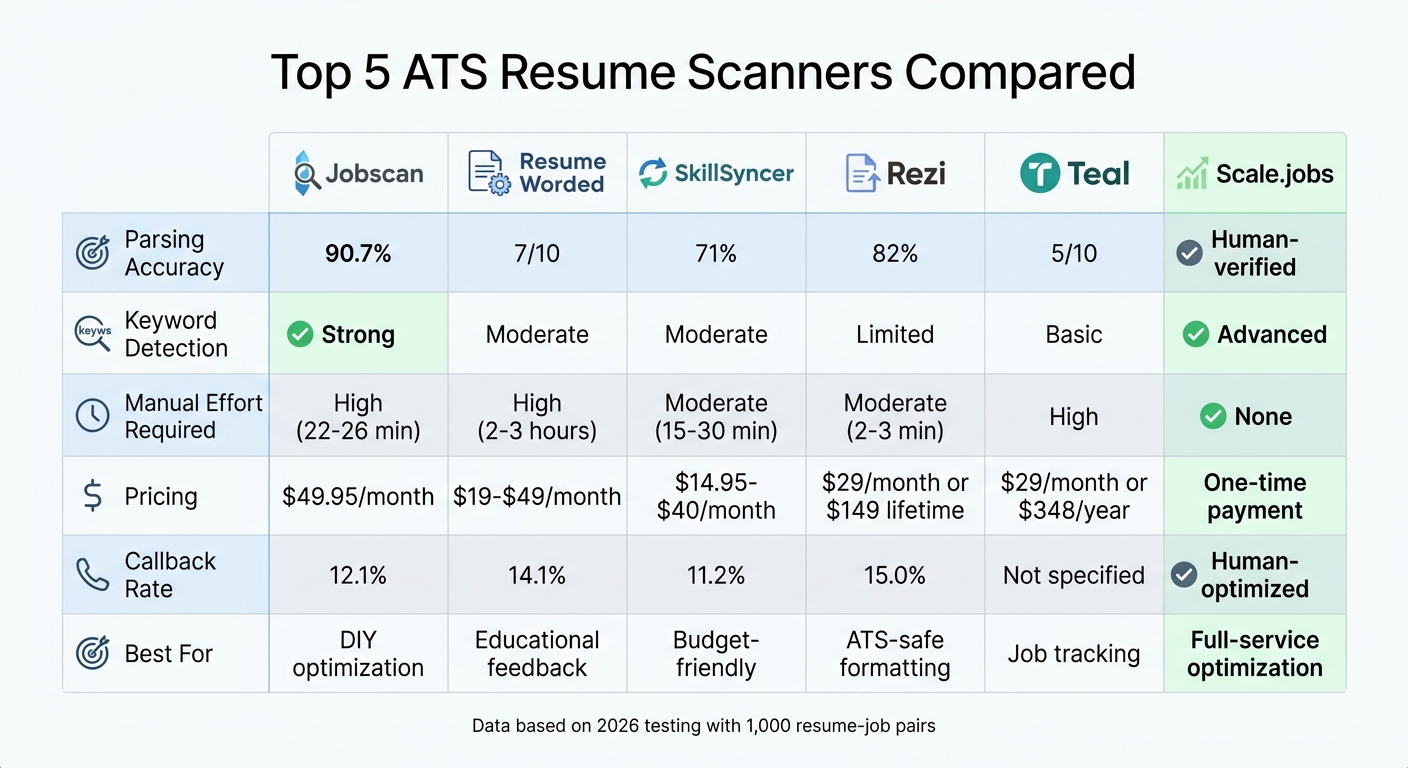
ATS Resume Scanner Comparison: Accuracy, Features & Pricing
Jobscan vs Teal (Which Free Resume Builder is Best For You?)
sbb-itb-564272e
1. Jobscan
Jobscan has been a go-to tool for optimizing resumes for applicant tracking systems (ATS) since 2014. With over a million users, it simulates parsing behavior across 100+ ATS platforms, including popular systems like Workday, Taleo, Greenhouse, Lever, and iCIMS. This makes it one of the most expansive tools for ATS simulation.
Parsing Accuracy
Jobscan boasts an average parser pass rate of 90.7%, though the performance varies across platforms: 88% on Workday, 91% on Greenhouse, and 93% on Lever. However, it uses rule-based simulations rather than actual parser libraries, which can sometimes lead to discrepancies between its "match rate" and how real ATS systems interpret resumes. As the Resume Optimizer Pro Editorial Team explains:
Jobscan's 'match rate' is measuring one thing; actual parser pass-through is measuring something different. A resume can hit 85 percent on Jobscan and still lose 20 percent of its content to a Workday parser if the formatting is structured wrong.
One key limitation is its "additive" optimization approach - it suggests adding keywords but doesn’t address underlying formatting issues. If your resume uses complex layouts like two-column designs or tables, you'll need to manually reformat it before rescanning, which can stretch the optimization process to 22–26 minutes per resume.
Keyword Identification
Jobscan is effective at pinpointing exact-match keyword gaps, sorting them into categories like hard skills, soft skills, and job title alignment. In testing, adding 10 targeted keywords boosted a resume's score by 18 points (from 58% to 76%). Across 1,000 resume-job pairs, the tool achieved an average ATS accuracy score of 68%, performing better in healthcare roles (70%) compared to tech roles (65%).
That said, Jobscan relies on traditional keyword-matching rather than advanced semantic analysis. It can identify specific terms like "GA4" or "Salesforce", but it may miss synonymous phrases or related concepts that newer AI-driven tools can detect. For deeper customization or to avoid the repetitive cycle of suggest-implement-rescan, professional resume writing services may be a better option, offering human expertise combined with ATS knowledge.
Formatting Compatibility
Jobscan uses a checklist-style evaluation to assess elements like contact information, section headers, and date formats. However, it doesn’t specify which ATS platforms might reject certain formatting choices. Since it doesn’t rewrite resumes for you, you’ll need to make all formatting changes yourself, which requires both ATS knowledge and attention to detail.
ATS Pass Rate
Users who achieve a match score of 80% or higher are 50% more likely to get interview callbacks. In a 60-day study, Jobscan users reported a 12.1% callback rate, with an average wait time of 9.3 days for their first response. While its detailed skill categorization and platform simulation are strengths, its reliance on traditional keyword matching can feel outdated compared to scale.jobs, which combines semantic analysis with human-assisted resume optimization.
Jobscan offers a free plan with 5 scans per month, while paid plans range from $24.95/month (annual) to $49.95/month (monthly). It’s a solid choice for those who want control over the optimization process, but its manual workflow and subscription costs may not suit everyone.
Who Should Use Jobscan
- DIY job seekers who like to control every detail, from keywords to formatting
- Budget-conscious individuals who don’t mind spending time manually applying suggestions
- Applicants targeting multiple ATS platforms with detailed simulation needs
- Users comfortable with iterative workflows, including multiple rescans
Who Should Choose Scale.jobs
- Job seekers who prioritize human expertise - scale.jobs pairs you with a dedicated assistant who understands ATS nuances across industries
- Applicants who need automated rewriting - scale.jobs doesn’t just flag issues; it rewrites resumes with ATS-friendly formatting built in
- Users avoiding subscriptions - scale.jobs offers one-time payment options for complete application support
- Candidates seeking transparency - scale.jobs provides WhatsApp support and proof of work, so you know exactly what’s been customized
- Professionals needing full-service support - scale.jobs handles everything from resume optimization to cover letter creation and application submissions
Switch to Scale.jobs If…
- You’re spending 20+ minutes per resume manually implementing Jobscan’s recommendations
- You need human judgment to adapt your resume for different roles, not just keyword matching
- You prefer one-time payments over subscription models that can cost $299.40–$599.40 annually
- You want proof of work and direct communication with your assistant via WhatsApp
- You’re applying to multiple roles and need tailored resumes, not generic optimization
Coming up next, we’ll explore how Resume Worded compares to scale.jobs for ATS optimization with a human touch.
2. Resume Worded
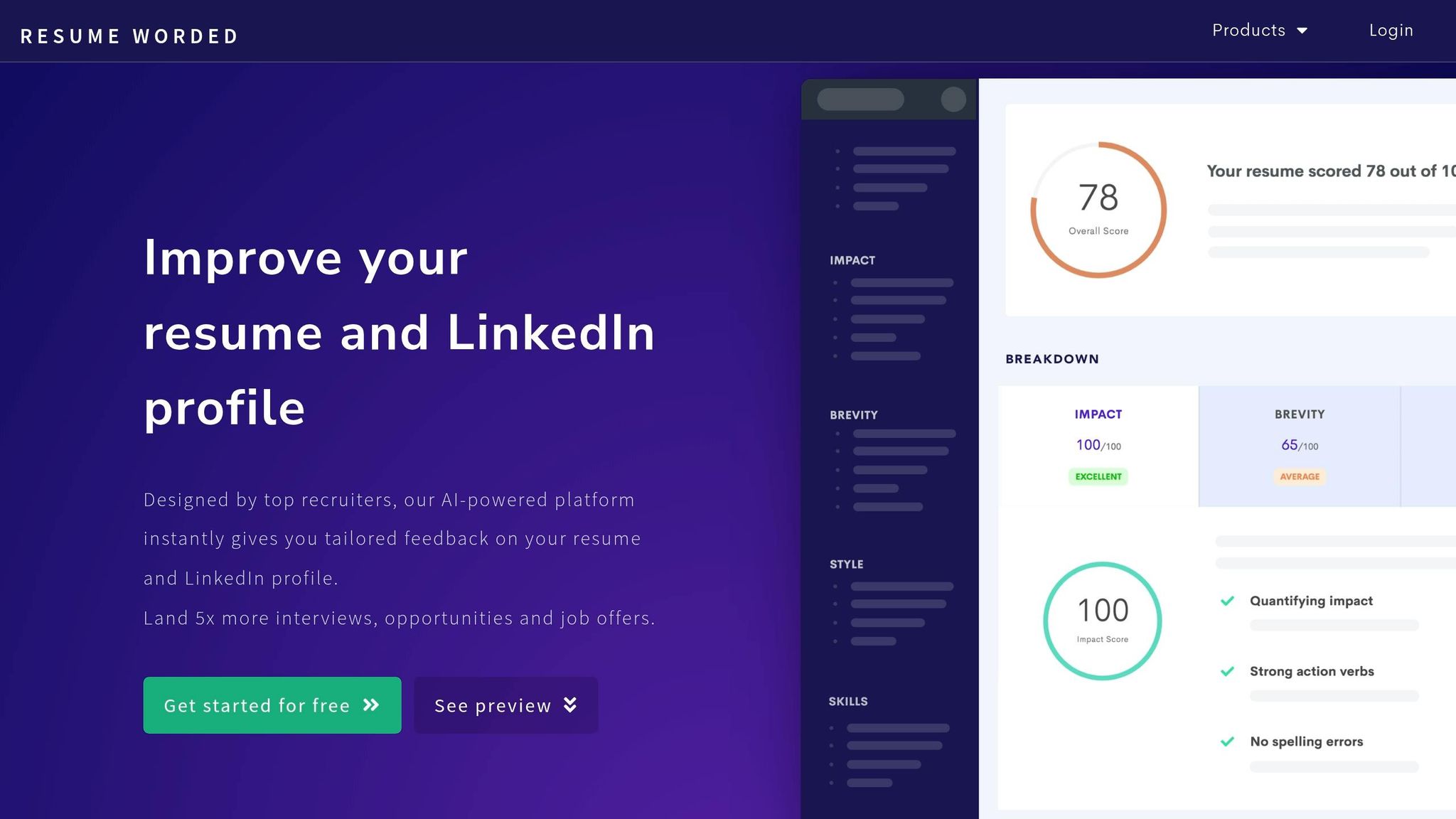
Resume Worded takes a different approach compared to Jobscan, focusing on educational feedback rather than simulating ATS platforms. Instead of testing your resume against systems like Workday or Greenhouse, it evaluates your resume section by section, scoring areas like your summary, experience, skills, and education independently. This detailed analysis helps identify specific weaknesses in your resume.
Parsing Accuracy
Resume Worded doesn't replicate actual ATS parsing engines. Instead, it uses letter grades and section scores rather than percentage-based accuracy metrics, achieving a 7/10 accuracy in simulating ATS performance. While this method helps explain why certain changes are necessary, it doesn’t guarantee your resume will pass through real ATS systems like Taleo or Workday.
The tool stands out for its bullet-level analysis, flagging vague language, weak action verbs, and a lack of quantifiable achievements. However, it sometimes misinterprets context. For instance, it might flag "managed client relationships" as a gap if the job description says "account management", despite the two phrases having the same meaning.
Keyword Identification
Resume Worded's "Targeted Resume" mode allows you to upload a job description and check for keyword alignment. Tests revealed that adding 10 targeted keywords boosted a resume's score by 14 points (from 64 to 78), showing medium sensitivity to keyword changes. However, its keyword gap detection scored only 6/10, falling behind Jobscan (9/10) and Resume Optimizer Pro (10/10).
The tool often gives general advice like "add more keywords" rather than identifying specific terms, such as "GA4" or "Salesforce." It relies on basic keyword matching rather than advanced semantic analysis, which can overlook related terms or industry-specific jargon. For deeper customization, consider using a professional resume writing service vs AI builders that provides human expertise for more nuanced keyword optimization.
Now that keyword alignment has been discussed, let’s look at how these changes affect actual ATS performance.
Why Scale.jobs Stands Out
- Human-driven rewriting: Instead of just diagnosing issues, scale.jobs rewrites your resume with ATS-friendly formatting built in.
- One-time payment: Avoid recurring subscription costs of $228–$588 per year.
- Personalized support: Dedicated WhatsApp communication ensures transparency and proof of work.
- End-to-end service: Scale.jobs doesn’t stop at optimization - it handles application submissions too.
- Industry expertise: Human assistants provide contextual understanding that automated tools often miss.
ATS Pass Rate
A 60-day study showed that users who optimized their resumes with Resume Worded achieved a 14.1% callback rate, compared to just 6.1% for those who didn’t use any optimization tool. The average time to the first callback was 11.7 days. While promising, these results require significant time investment, as users must manually implement every suggestion.
One of Resume Worded’s standout features is its LinkedIn profile grader, which evaluates headlines, summaries, and skill endorsements. Few resume-focused tools offer this functionality. However, its $19–$49/month subscription can be a drawback for active job seekers applying to numerous roles. The free tier provides only 1 basic scan, limiting your ability to test the tool before committing.
Comparison Table: Resume Worded vs. Scale.jobs
| Feature | Resume Worded | Scale.jobs |
|---|---|---|
| Human involvement | None - automated feedback only | Dedicated human assistant per account |
| Resume customization depth | General suggestions you apply yourself | Tailored rewriting for each job application |
| ATS handling | Educational scoring (7/10 accuracy) | Human-verified ATS optimization |
| Application execution | You apply manually | Full-service application submission |
| Transparency | Automated scores and suggestions | WhatsApp support with proof of customization |
| Pricing | $19–$49/month subscription | One-time payment options |
Who Should Use Resume Worded
- Job seekers wanting to learn ATS-friendly writing principles and understand the reasoning behind changes.
- LinkedIn-focused professionals who need detailed feedback for profile optimization.
- Candidates applying to a few roles where educational insights are more valuable than speed.
Who Should Choose Scale.jobs
- Active job seekers who need resumes rewritten quickly - scale.jobs handles the heavy lifting.
- Applicants targeting multiple roles - scale.jobs creates tailored resumes for each position.
- Users valuing human input - scale.jobs assigns a dedicated assistant to address industry-specific ATS requirements.
- Those seeking transparency - scale.jobs offers WhatsApp support and proof of work for every application.
- Budget-conscious applicants - scale.jobs provides one-time payment options, avoiding costly subscriptions.
Switch to Scale.jobs If…
- You’re spending 2–3 hours per resume implementing Resume Worded’s suggestions.
- You need automated rewriting with ATS-friendly formatting rather than diagnostic feedback.
- You’re applying to 10+ roles and can’t afford hours of manual customization.
- You want human oversight to address context issues that automated tools miss.
- You prefer one-time payments over monthly subscriptions that add up over time.
Decision Summary
Choose Resume Worded if you’re applying to a small number of roles, want to understand ATS principles, and have the time to manually implement changes. Choose scale.jobs if you’re actively applying to multiple positions, need human-powered resume rewriting with built-in ATS optimization, and prefer transparent, one-time payment options.
While Resume Worded offers detailed educational feedback, scale.jobs simplifies the process with automated, human-driven revisions. Next, we’ll explore how SkillSyncer compares in ATS optimization and its place alongside scale.jobs.
3. SkillSyncer
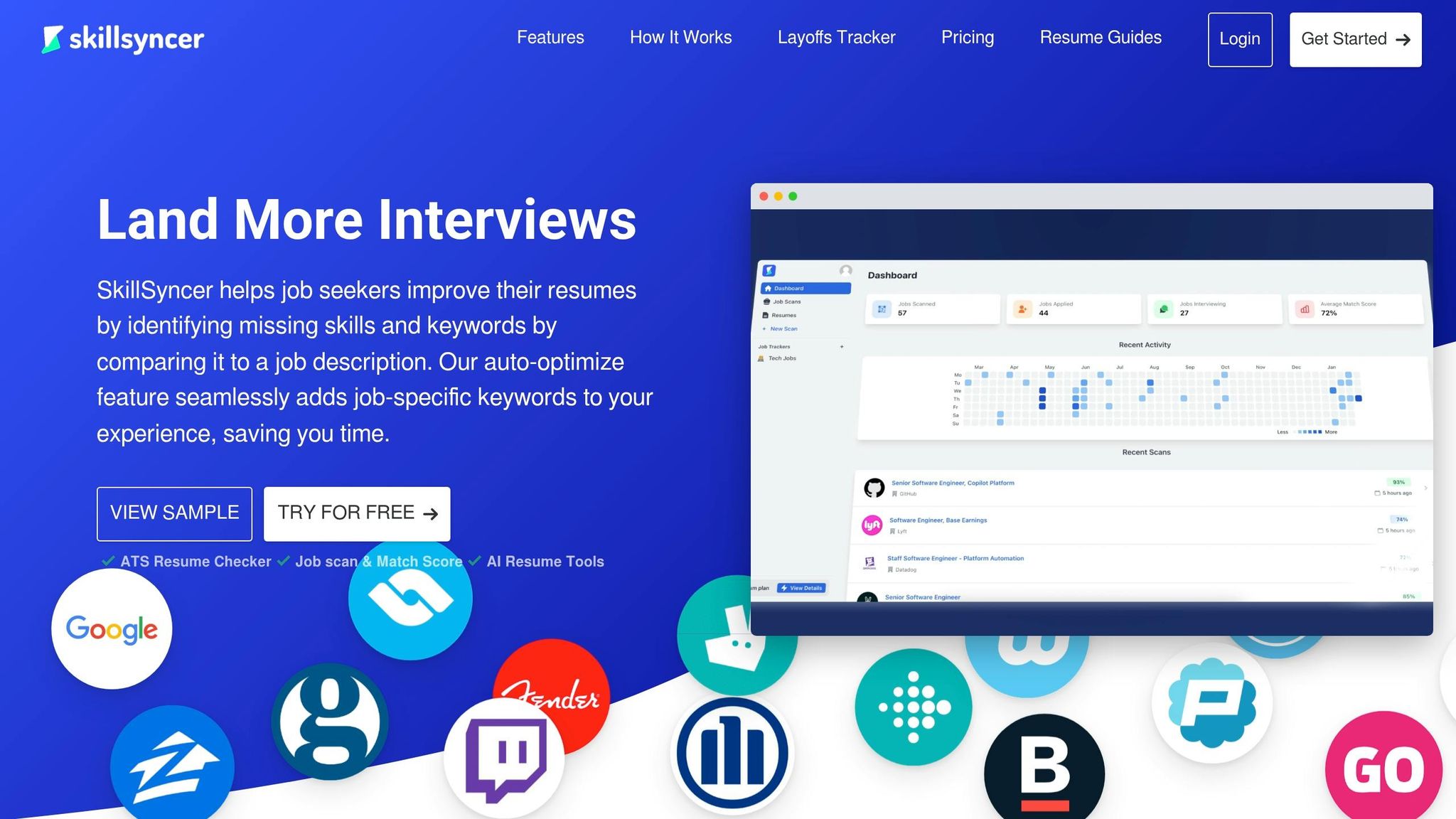
SkillSyncer, like Jobscan and Resume Worded, is evaluated based on its ability to parse resumes accurately, detect keywords, and provide ease of use. These are areas where Scale.jobs also performs well. SkillSyncer is a more affordable option compared to pricier legacy tools and newer AI-driven platforms. At $14.95/month or $40/month for full features, it costs considerably less than Jobscan's $49.95/month subscription. However, this lower price reflects some compromises in technology and automation capabilities.
Parsing Accuracy
In tests conducted with 1,000 resume-job description pairs, SkillSyncer achieved an average ATS score of 71%. While this score surpasses Jobscan's, it falls short of AI-powered tools like Rezi. The platform relies on basic keyword matching rather than semantic analysis, meaning it may fail to link synonymous terms. For instance, it might not identify that "React" and "React.js" refer to the same skill or that "managed client relationships" corresponds to "account management."
SkillSyncer evaluates resumes based on degree requirements, job title alignment, and formatting, but its parsing checks lack the sophistication of specialized tools. Industry-specific tests showed 72% accuracy for Marketing/Sales roles and 69% for Healthcare/Medical roles, indicating moderate consistency across job sectors.
Keyword Identification
SkillSyncer offers a keyword gap report, identifying missing skills or terms from job descriptions. The "Skills Visualization" feature categorizes keyword presence, but the tool does not automate resume rewriting. Instead, users must manually integrate suggested changes.
On average, users spend 15–30 minutes per application applying SkillSyncer's recommendations. For those juggling multiple applications and seeking quicker solutions, a job application service might be a better fit, handling both keyword optimization and ATS formatting without requiring manual edits.
ATS Pass Rate
A 60-day study revealed an 11.2% callback rate, with the first callback typically occurring within 10.5 days. While SkillSyncer scans take 1–2 minutes - faster than Jobscan but slower than instant AI tools - the callback rate remains below competitors like Ajusta (17.6%) and Rezi (15.0%).
SkillSyncer does offer a free tier with five scans per month, allowing users to try it before subscribing. Additionally, students and military personnel with .edu or .mil email addresses can access one year of free service. However, the platform lacks the depth and personalized approach of Scale.jobs.
Why Scale.jobs Stands Out
- Personalized Human Support: Scale.jobs assigns a dedicated assistant to rewrite your resume for each job application, rather than just highlighting issues.
- No Manual Work: Unlike SkillSyncer, which requires 15–30 minutes of editing per application, Scale.jobs handles all changes for you.
- Contextual Understanding: Human assistants identify nuanced connections between terms that keyword-matching tools often miss.
- Comprehensive Service: Scale.jobs not only optimizes your resume but also submits applications on your behalf.
- Proof of Work: WhatsApp support ensures transparency by providing updates and evidence of customization.
Comparison Table: SkillSyncer vs. Scale.jobs
| Feature | SkillSyncer | Scale.jobs |
|---|---|---|
| Human involvement | None - keyword matching only | Dedicated human assistant |
| Resume customization | Manual implementation required | Full rewriting tailored to jobs |
| ATS optimization | 71% average accuracy score | Human-verified optimization |
| Application submission | Manual by user | Full-service submission |
| Transparency | Automated keyword reports | WhatsApp support with updates |
| Pricing | $14.95–$40/month subscription | One-time payment options |
Who Should Use SkillSyncer
- Budget-conscious job seekers who can dedicate 15–30 minutes per application for manual edits.
- Students and military personnel eligible for free one-year access with a .edu or .mil email address.
- Candidates needing basic ATS checks without advanced semantic capabilities or automated optimization.
Who Should Choose Scale.jobs
- Active job seekers applying to multiple roles who want resumes rewritten quickly and efficiently.
- Professionals valuing human expertise to identify contextual nuances missed by keyword-matching software.
- Applicants targeting 10+ roles who lack the time to manually edit resumes for each application.
- Users seeking transparency through WhatsApp updates and proof of every customization.
- Individuals preferring one-time payments over monthly subscriptions costing $179.40–$480 annually.
Switch to Scale.jobs If…
- You're spending 15–30 minutes per application manually editing resumes based on SkillSyncer's suggestions.
- You need semantic understanding to link related terms and industry-specific jargon.
- You're applying to multiple roles and require faster turnaround times.
- You value human oversight for nuanced, contextual resume adjustments.
- You prefer one-time payment options over recurring subscriptions.
Decision Summary
Choose SkillSyncer if you're on a tight budget, applying to a limited number of roles, and have the time to manually optimize your resume. Choose Scale.jobs if you're actively applying to many positions, need human-powered resume rewriting with built-in ATS optimization, and prefer a transparent, one-time payment model.
While SkillSyncer offers a cost-effective way to analyze keywords, Scale.jobs removes the burden of manual edits through its human-driven customization. Up next, we'll explore how Rezi compares in ATS optimization and where it stands alongside Scale.jobs.
4. Rezi
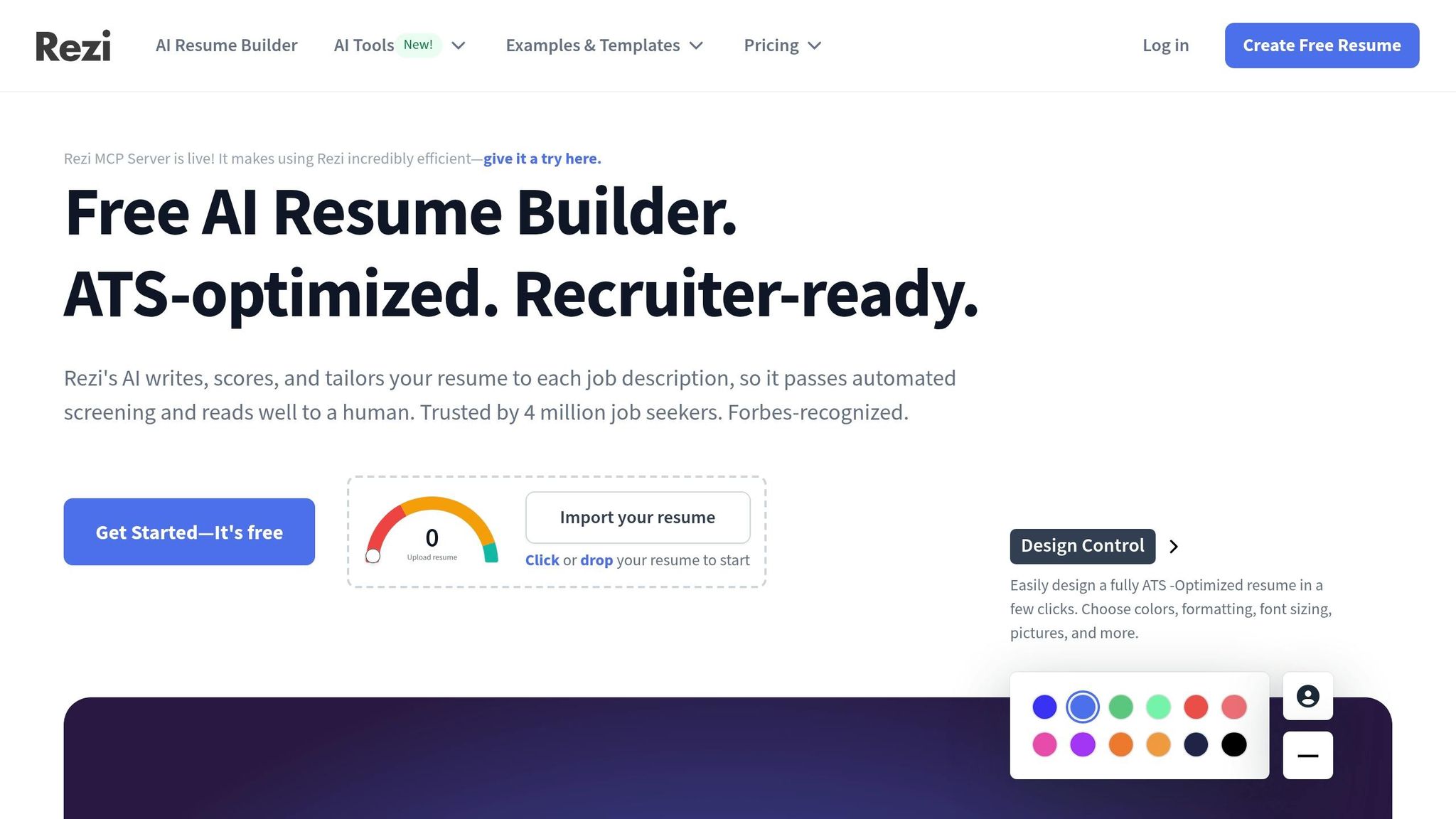
Rezi is an AI-driven resume builder designed with an ATS scanner to ensure compatibility with applicant tracking systems. At $29 per month or a one-time payment of $149 for lifetime access, it offers an all-in-one solution for job seekers creating resumes from scratch or overhauling their existing documents. Rezi's primary goal is to produce resumes that comply with ATS software requirements, focusing on strict formatting for better parsing.
Parsing Accuracy
In tests involving 1,000 resume and job description pairs, Rezi achieved an average ATS score of 82%. For Technology/Engineering roles, it scored 84%, while Finance/Banking roles saw an 81% accuracy rate. These results highlight its consistency across various industries. The platform enforces a single-column layout to enhance parsing accuracy, as explained by Rory Miller, CPRW at Enhancv:
"Rezi isn't trying to help you express yourself. It's trying to make sure your application survives the hiring software."
This approach ensures that resumes are compatible with major ATS platforms like Workday, Greenhouse, Lever, iCIMS, and Taleo.
Keyword Identification
Rezi uses AI to flag missing skills and assigns a "Rezi Score" (0–100) based on factors like active verbs, quantification, and formatting. However, users must manually rebuild content to address flagged issues. While it takes 2–3 minutes per optimization - faster than manual editing but slower than instant AI tools - it effectively identifies non-standard elements like headers, footers, and inconsistent labels that could lead to ATS rejection.
For job seekers applying to multiple roles, a job application service offering both resume optimization and application submission might save significant time compared to Rezi's manual adjustments.
ATS Pass Rate
A 60-day study revealed that Rezi users had a 15.0% callback rate, with an average of 6.8 days to receive their first callback. While this is an improvement over unoptimized resumes, it falls short of results achieved through human-powered services. Rezi's plain templates prioritize ATS parsing but lack visual appeal and nuanced adjustments that human review can provide. With 75% of resumes rejected by ATS software before reaching recruiters, automated tools like Rezi may overlook critical refinements. Next, we'll explore how Teal compares and why Scale.jobs remains a top choice.
Why Scale.jobs Stands Out
- Human Expertise: A dedicated assistant rewrites resumes for each application, eliminating the need for manual edits.
- Contextual Adjustments: Scale.jobs refines content beyond templates, addressing industry-specific nuances that AI tools may miss.
- Full-Service Solution: It optimizes resumes and submits applications on behalf of users.
- Transparent Updates: Real-time WhatsApp support keeps users informed with proof of every customization.
- Flexible Pricing: Offers one-time payment options, avoiding recurring fees.
Comparison Table: Rezi vs. Scale.jobs
| Feature | Rezi | Scale.jobs |
|---|---|---|
| Human involvement | None - AI builder only | Dedicated human assistant |
| Customization depth | Manual adjustments | Full rewriting for each job |
| ATS optimization | 82% average accuracy | Human-verified optimization |
| Application execution | Manual by user | Full-service submission |
| Transparency | Automated Rezi Score | WhatsApp updates |
| Pricing | $29/month or $149 lifetime | One-time payment options |
Who Should Use Rezi
- First-time resume builders needing professional templates and structured guidance.
- Technical professionals (e.g., engineers, analysts) and federal job applicants prioritizing strict ATS compliance.
- Budget-conscious job seekers willing to invest time in using the builder for each application.
- Those applying to a small number of roles (1–5) who can dedicate a few minutes to manual optimization.
Who Should Choose Scale.jobs
- Active job seekers applying to 10+ positions who need quick, hands-off resume rewriting.
- Professionals valuing human expertise for nuanced, context-specific adjustments.
- Applicants seeking a full-service experience that includes both optimization and application submission.
- Users preferring transparency, with regular updates and proof of customization.
- Individuals avoiding subscriptions, opting for one-time payment plans.
Switch to Scale.jobs If…
- You're spending too much time manually optimizing resumes with Rezi.
- You need a deeper understanding of industry-specific terms and context that AI tools might miss.
- You're applying to a high volume of roles and need a faster, more efficient process.
- You value human oversight for precise, tailored adjustments.
- You prefer a one-time payment over recurring monthly fees.
Decision Summary
Rezi is a strong choice for creating ATS-friendly resumes from scratch, especially for users comfortable with manual optimization and strict formatting. However, for those applying to many roles or seeking a more personalized and comprehensive service, Scale.jobs offers a clear advantage. Its human-driven approach ensures nuanced resume adjustments, full-service application handling, and transparent communication - all without the hassle of recurring subscriptions. Next, we'll dive into how Teal performs in ATS optimization and its standing compared to Scale.jobs.
5. Teal
Teal presents itself as a comprehensive job search organizer, emphasizing job tracking and pipeline management over resume optimization. With over 3.2 million members as of 2026, it provides tools for organizing applications and creating resumes. The free tier offers unlimited resumes and job tracking, while the premium Teal+ plan costs $29 per month (or $348 annually), adding advanced features like AI-powered bullet rewriting and deeper analysis.
Parsing Accuracy
Teal's templates, while visually appealing, often struggle with ATS parsing. In tests conducted in April 2026 against systems like Workday and Greenhouse, its "Modern" template frequently caused parsing errors. Key data, such as employment dates and skills, were often misinterpreted or omitted when rendered as images or badges instead of plain text. Marcus Chen, a Recruitment Systems Architect, highlights the issue:
"An ATS doesn't reject resumes because they're bad - it rejects them because it can't understand them. The difference between a $200 designer template and a plain Word doc isn't aesthetic; it's whether a machine can extract your job title from line 47."
Teal's two-column layouts often confuse ATS systems, leading to errors in reading order or missing information. To improve ATS compatibility, users should switch to simple, single-column templates and remove decorative elements like icons or skill badges. For persistent ATS rejections, a resume writing service with human-verified optimization may be more effective than relying on Teal's templates.
Keyword Identification
Teal's AI focuses more on refining grammar and vocabulary than on advanced keyword optimization. While it identifies general gaps like "budget management", it often overlooks specific technical terms such as "GA4", grouping them under broader categories like "analytics tools." In a 2026 comparison, Teal scored 7/10 for keyword gap detection, tying with Resume Worded and achieving a match score of 55% for a mid-level marketing resume. Unlike dedicated tools, it does not offer an automatic rewrite feature, requiring users to manually apply its suggestions. This can be time-consuming, especially for those applying to multiple roles.
Formatting Compatibility
Teal's "Resume Checker" performs over 15 AI-driven checks for formatting issues, structural weaknesses, and keyword gaps. It advises users to stick with standard headings like "Work Experience" and "Skills" while avoiding complex elements such as tables and graphics that can confuse ATS systems. However, in testing, it failed to flag two-column layouts as a potential risk - a significant oversight given their frequent parsing issues.
Teal scored 5/10 for formatting analysis and 6/10 for ATS simulation accuracy. While users can import existing resumes or LinkedIn profiles and customize fonts, margins, and alignment, these features do not guarantee ATS success. Teal's internal scoring system considers a resume "good" if it achieves an 80% or higher score, but this metric does not directly correlate with actual ATS pass rates.
ATS Pass Rate
Teal's standout feature is its Chrome extension (rated 4.9/5 on the Chrome Web Store) and its job tracking capabilities rather than its ATS optimization. While the platform claims users can secure jobs 58% faster and receive six times more interviews, these are marketing claims rather than independently verified statistics. Teal is most effective for those who value organization and application tracking over detailed technical optimization.
For job seekers facing frequent ATS rejections, Teal's limitations become evident. Its AI suggestions are often generic, and its visually complex templates can hinder parsing in systems like Workday and iCIMS. Though Teal is more affordable than Jobscan ($49.95/month), it lacks the precise keyword identification and ATS simulation features of higher-end tools. Platforms like scale.jobs, which provide human-driven customization, offer a more reliable solution for those needing accurate ATS optimization.
Why Scale.jobs Stands Out
- human-driven resume rewriting ensures compatibility with ATS systems, avoiding parsing errors caused by decorative templates.
- One-time payment model eliminates recurring fees, offering a cost-effective alternative to Teal's $348 annual subscription.
- Dedicated WhatsApp support provides real-time updates and proof of work, unlike Teal's self-service approach.
- Specific keyword optimization targets technical terms (e.g., "GA4") that Teal's broader categorizations may overlook.
- Comprehensive application handling removes the need for manual implementation of suggestions.
Comparison Table: Teal vs. Scale.jobs
| Feature | Teal | Scale.jobs |
|---|---|---|
| Human involvement | None - AI suggestions only | Dedicated human assistant |
| Resume customization depth | Manual implementation | Full rewriting for each job |
| ATS handling | Template-based, some issues | Human-verified optimization |
| Application execution method | Manual by user | Full-service submission |
| Transparency and proof of work | Self-service AI feedback | WhatsApp updates with proof |
| Pricing model | $29/month or $348/year | One-time payment options |
Who Should Use Teal
- Job seekers focused on organization and tracking rather than advanced ATS optimization.
- Budget-conscious users who want free job tracking and basic resume tools.
- Applicants managing a limited number of applications who value pipeline visibility.
- Individuals comfortable with manual adjustments to resumes and templates.
Who Should Choose Scale.jobs
- Active job seekers needing tailored resumes and human oversight for each role.
- Those applying to multiple positions who prefer transparency and one-time payment options.
- Professionals facing ATS rejections due to formatting or parsing issues.
- Job seekers wanting proof of customization and real-time updates through WhatsApp.
- Applicants seeking full-service support from resume optimization to application submission.
Switch to Scale.jobs If…
- You're spending hours manually applying Teal's AI suggestions across multiple applications.
- Your resumes are repeatedly rejected by ATS due to complex templates or formatting issues.
- You need precise keyword targeting that Teal's generalized AI might miss.
- You prefer a one-time payment over recurring subscription costs.
- You value human expertise for context-specific adjustments and ATS compatibility.
Decision Summary
Choose Teal if you're applying to a small number of roles, need free job tracking, and are willing to manually optimize resumes. Choose scale.jobs if you're actively applying to multiple positions, need human-powered resume rewriting with verified ATS optimization, and prefer transparent, one-time payment options. Below, we compare the strengths and weaknesses of all five tools to help you make an informed decision.
Strengths and Weaknesses
Here’s a breakdown of how each tool performs, highlighting their key features and limitations, and why scale.jobs emerges as a standout choice.
Jobscan is highly regarded for its detailed keyword analysis, categorizing skills into hard, soft, and management types while identifying ATS platforms like Workday and Greenhouse. Users with scores above 80% reportedly have a 50% higher chance of getting interview callbacks. However, its $49.95/month subscription and manual process - taking 22 to 26 minutes per resume - make it both time-consuming and costly. Additionally, its reliance on older keyword-matching methods rather than modern semantic tools can feel outdated.
Why scale.jobs is better:
- Human experts address nuances that keyword-only tools might miss.
- One-time payment options eliminate the need for a recurring $599.40 annual fee.
- WhatsApp support ensures real-time updates and proof of work.
- Full-service application submission saves you the 22–26 minutes per resume.
- Semantic understanding connects related terms without rigid keyword dependence.
Who benefits from Jobscan:
- DIY job seekers who prefer handling every detail themselves.
- Those targeting multiple ATS platforms and needing detailed simulations.
- Users comfortable with iterative workflows and multiple scans.
Who should choose scale.jobs:
- Active job seekers applying to 10+ roles who value human-powered resume rewriting.
- Professionals seeking transparency with WhatsApp updates and proof of customization.
- Applicants who prefer avoiding subscriptions and opting for one-time payments.
- Users looking for end-to-end support, from resume optimization to submission.
Resume Worded provides line-by-line feedback and boasts an extensive synonym database with over 250,000 phrases, making it useful for identifying semantic equivalents. Its 4.8/5 Trustpilot rating reflects user satisfaction. At $19/month (billed annually), it’s more affordable than Jobscan, but the manual implementation of its suggestions can stretch the revision process to 2–3 hours per resume. Its free tier is also quite limited, offering only one score check, and it lacks ATS simulation capabilities.
Why scale.jobs is better:
- Human-driven resume rewriting eliminates the need for 2–3 hours of manual work.
- Full-service support covers optimization and application submissions.
- Industry experts provide context that automated tools often overlook.
- One-time payment avoids the $228 annual subscription cost.
- WhatsApp updates ensure transparency and proof of customization.
Who benefits from Resume Worded:
- Job seekers aiming to learn ATS-friendly writing techniques.
- LinkedIn-focused professionals seeking profile optimization feedback.
- Candidates applying to a few roles who prioritize educational insights.
Who should choose scale.jobs:
- Job seekers needing quick, hands-off resume rewriting.
- Those applying to multiple roles requiring tailored resumes.
- Professionals who value human insights for industry-specific ATS requirements.
- Users who prefer real-time updates and proof of work via WhatsApp.
SkillSyncer is the budget-friendly option at $14.95/month, with free access for students and military personnel. Its keyword gap reports and "Auto-Optimize" feature help achieve an average ATS pass rate of 71%. However, its analysis lacks the depth of Jobscan, and users must spend 15–30 minutes per application manually implementing suggestions.
Why scale.jobs is better:
- No manual work - human assistants handle all edits.
- Contextual expertise identifies nuanced connections that keyword-only tools miss.
- Full-service application submission saves 15–30 minutes per application.
- WhatsApp transparency provides real-time updates and proof of customization.
- One-time payment avoids annual subscription costs of $179.40–$480.
Who benefits from SkillSyncer:
- Budget-conscious job seekers willing to spend 15–30 minutes per application.
- Students and military personnel eligible for free one-year access.
- Candidates needing basic ATS checks without advanced features.
Who should choose scale.jobs:
- Active job seekers applying to multiple roles who need efficient, hands-off rewriting.
- Professionals seeking human expertise for nuanced adjustments.
- Applicants targeting 10+ roles who don’t have time for manual edits.
- Users valuing transparency through WhatsApp updates.
Rezi is known for its strict adherence to ATS-safe formatting, avoiding multi-column layouts and graphic elements. With an average ATS score of 82%, it’s a solid choice for building resumes from scratch. At $29/month, it’s affordable but offers limited design flexibility. Users must manually adjust flagged issues, taking 2–3 minutes per optimization.
Why scale.jobs is better:
- Human assistants rewrite resumes for each application, removing the need for manual edits.
- Contextual adjustments account for industry-specific nuances that AI tools might miss.
- Full-service support optimizes resumes and submits applications.
- WhatsApp updates provide proof of customization and real-time communication.
- Flexible one-time payment options eliminate recurring fees.
Who benefits from Rezi:
- First-time resume builders needing professional templates and structured guidance.
- Technical professionals and federal job applicants prioritizing strict ATS compliance.
- Budget-conscious users willing to invest time in manual adjustments.
Who should choose scale.jobs:
- Job seekers applying to 10+ positions who need fast, hands-off rewriting.
- Professionals valuing human expertise for context-specific adjustments.
- Applicants wanting a full-service experience, from optimization to submission.
- Users who prefer transparency with regular updates via WhatsApp.
Teal offers a strong free tier and a highly-rated Chrome extension (4.9/5) for managing job tracking and pipelines. Priced at $29/month or $348 annually, it’s cost-effective but lacks the depth of specialized tools. Its match analysis scores 5/10 for formatting and 6/10 for ATS simulation accuracy, and its generic suggestions fall short for roles requiring precise, technical keyword optimization.
Why scale.jobs is better:
- Human-driven rewriting ensures ATS compatibility and avoids parsing errors.
- One-time payment eliminates the $348 annual subscription fee.
- WhatsApp updates provide real-time communication and proof of work.
- Tailored keyword optimization targets technical terms that Teal’s broader approach misses.
- Full-service application handling removes the need for manual effort.
Who benefits from Teal:
- Job seekers focused on tracking and organizing applications rather than advanced ATS optimization.
- Budget-conscious users utilizing free job tracking tools.
- Applicants managing a limited number of applications who value pipeline visibility.
Who should choose scale.jobs:
- Active job seekers needing tailored resumes with human oversight.
- Those applying to multiple positions who prefer one-time payments and transparency.
- Professionals facing ATS rejections due to formatting or parsing issues.
- Job seekers valuing proof of customization and real-time updates through WhatsApp.
Comparison Table
| Tool | Human Involvement | Resume Customization Depth | ATS Handling | Application Execution Method | Transparency and Proof of Work | Pricing Model |
|---|---|---|---|---|---|---|
| Jobscan | None - automated | Manual implementation | 90.7% parser pass rate; simulates 100+ ATS platforms | Manual by user | Automated reports | $49.95/month subscription |
| Resume Worded | None - automated | General suggestions | 7/10 accuracy; educational scoring | Manual by user | Automated scores and suggestions | $19/month (annual) subscription |
| SkillSyncer | None - automated | Manual implementation | 71% average accuracy score | Manual by user | Automated keyword reports | $14.95–$40/month subscription |
| Rezi | None - AI builder | Manual adjustments | 82% average accuracy; strict formatting enforcement | Manual by user | Automated Rezi Score | $29/month subscription |
| Teal | None - AI suggestions | Manual implementation | 5/10 formatting analysis; 6/10 ATS simulation | Manual by user | Self-service AI feedback | $29/month or $348/year subscription |
| Scale.jobs | Dedicated human assistant | Full rewriting tailored to each job application | Human-verified ATS optimization | Full-service application submission | WhatsApp support with proof of customization | One-time payment options |
Why Switch to Scale.jobs?
- You’re spending 20+ minutes per resume and need a faster, hands-off solution.
- You value human expertise for context-specific adjustments.
- You prefer real-time updates and proof of work via WhatsApp.
- You want a cost-effective, one-time payment option instead of recurring fees.
Conclusion
Choosing the right ATS scanner depends on your workflow and how much time you're willing to invest. Jobscan is ideal for those who want platform-specific simulations and can dedicate 20–30 minutes per resume for manual edits. If you're focused on refining writing quality and optimizing LinkedIn profiles, Resume Worded provides detailed feedback, though it requires manual implementation. SkillSyncer offers a cost-effective option at $40/month for keyword gap reports but still demands manual adjustments for each application. For building ATS-compliant resumes from scratch, Rezi delivers an 82% average score, while Teal excels in job tracking, though it lacks the in-depth keyword analytics provided by other tools.
For job seekers applying to multiple roles who need speed and efficiency, scale.jobs stands out by eliminating manual work. With human assistants rewriting resumes for every application, handling submissions, and sending WhatsApp updates with proof of customization, it simplifies the entire process. Unlike traditional scanners that only highlight issues, scale.jobs resolves them, addressing a major hurdle: the fact that 75% of resumes are rejected by ATS before reaching a recruiter.
Why Scale.jobs Stands Out
- Human-powered rewriting removes the need for time-consuming manual edits required by tools like Jobscan, Resume Worded, SkillSyncer, Rezi, and Teal.
- Complete application submission takes care of the process after optimization, saving even more time.
- One-time payment options eliminate recurring subscription costs, which can range from $179.40 to $599.40 annually.
- Real-time WhatsApp updates provide transparency and proof of customization, offering peace of mind.
- Industry-specific expertise accounts for nuances that automated keyword-matching tools often miss.
When to Switch to Scale.jobs
- You prefer human-powered resume rewriting over diagnostic feedback.
- Manual edits are slowing down your application process, and you're applying to 10 or more roles.
- Transparent, real-time updates via WhatsApp are important to you.
- You dislike recurring subscriptions and prefer a one-time payment model.
- Despite high scores from automated tools, your resume still gets rejected by ATS.
No matter which tool or service you choose, proper resume formatting is essential for passing ATS filters. Aim for a 75–80% match score by using a single-column layout, standard fonts like Arial or Calibri, and integrating keywords naturally. Avoid elements like tables, text boxes, and headers, as they can cause parsing errors in systems like Workday and Greenhouse. Focus on embedding keywords within measurable achievements, such as: "Developed Python scripts reducing processing time by 40%." To ensure ATS compatibility, run the copy-paste test - if your resume text appears garbled in a plain text editor, it may not parse correctly in an ATS.
If you’re spending more than 20 minutes per resume, consider professional resume writing services that combine human expertise with ATS optimization. The difference between using diagnostic tools and opting for full-service support can be significant - users of automated optimization tools report callbacks within an average of 4.2 days, compared to 9.3 days for manual methods.
Decision Summary: The key to an effective resume lies in proper formatting, targeted keywords, and human oversight to pass both ATS filters and recruiter reviews. If you prioritize human expertise, ATS-optimized resumes, and a fast, transparent application process, scale.jobs is a strong contender compared to automated tools like Jobscan, Resume Worded, SkillSyncer, Rezi, and Teal. Whether you opt for a DIY scanner or a hands-off service, focus on tools that ensure parsing accuracy and deliver actionable solutions, not just scores.
FAQs
How were the accuracy scores tested?
The accuracy of different ATS scanners was tested using 50 resumes, focusing on their ability to predict ATS compatibility. Among the tools evaluated, Scale.jobs stood out with an accuracy rate exceeding 94% in keyword parsing. This comparison sheds light on how well each tool performed in analyzing and assessing resumes for ATS success.
What ATS formatting issues cause the most rejections?
When it comes to Applicant Tracking Systems (ATS), certain formatting choices can cause trouble. Issues often arise from using multi-column layouts, tables, text boxes, images, graphics, headers, footers, decorative fonts, or unconventional section headings. These elements are often misread or entirely skipped by ATS software, which could result in your application being rejected without a proper review.
To avoid this, it's best to keep your resume formatting straightforward. Stick to a clean, single-column layout and use standard section headings like Work Experience, Education, and Skills. This ensures your resume is easily processed by ATS and increases your chances of making it through to the next stage.
What match score should I aim for before applying?
To improve your chances of getting past ATS filters, aim for a match score of 94% or higher before submitting your application. According to Scale.jobs, this score indicates a strong alignment between your resume and the job requirements. By prioritizing this benchmark, you can significantly enhance your likelihood of advancing in the hiring process.