
12 Strategies to Avoid Loan Default After Losing Your Job

Sarah Mitchell
June 26, 2026

If I lose my job, I focus on two things right away: keeping housing and transportation paid, and cutting the time it takes to get income back. Missed payments can hurt fast. In many cases, a loan becomes delinquent after the first missed due date, and credit score damage can start within 30 days.
Here’s the short version:
- I make a bare-bones budget within 48 to 72 hours
- I call lenders before I miss payments
- I rank debts by housing first, car second, then everything else
- I use relief tools like student loan IDR, mortgage forbearance, and card hardship plans
- I send severance and unemployment money to the bills with the most risk
- I pick a job search tool based on cash runway and interview odds, not hype
If I’m also weighing job search help, the article’s main comparison is simple: LazyApply vs Scale.jobs. One leans on automation and volume. The other leans on human-applied submissions, ATS-focused documents (to avoid getting rejected by ATS), and a pricing setup that may fit better when cash is tight.
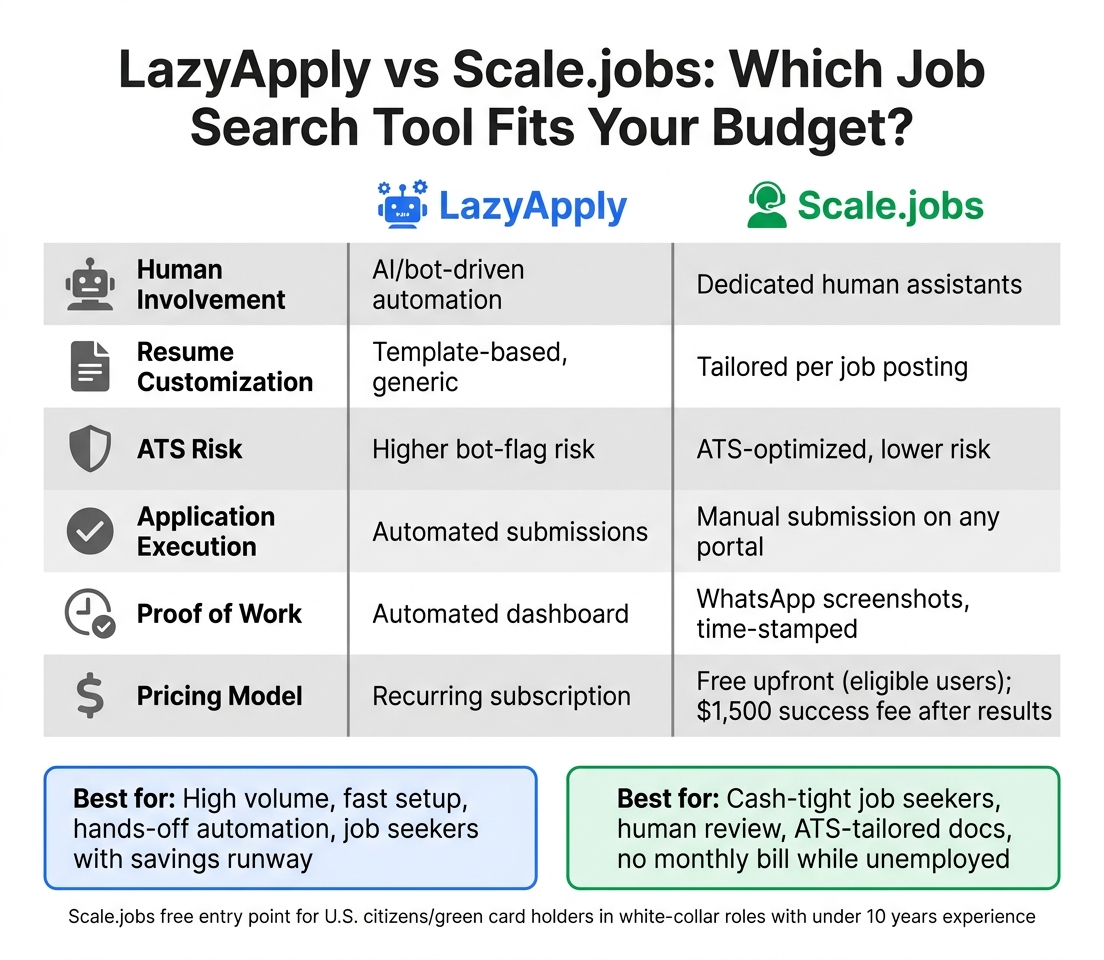
LazyApply vs Scale.jobs: Job Search Tool Comparison After Job Loss
Job Loss: What to Do Financially in Your First 30 Days
sbb-itb-564272e
What I’d do first
- List every bill due this month
- Cut non-core spending today
- Call lenders in order of risk
- Set up hardship relief where I can
- Put all job-search energy into getting interviews fast
Quick comparison
| Topic | Main takeaway |
|---|---|
| Debt triage | Pay housing and transportation first |
| Federal student loans | IDR, deferment, or forbearance can lower payments fast |
| Credit cards | Hardship plans may cut APR or minimums if I call early |
| Personal loans | Ask for deferral or term changes; avoid payday loans |
| Job search tool choice | Match the tool to my budget and how fast I need interviews |
If I want to Apply for jobs while keeping costs under control, I’d also look at a job search platform, a job application service, or a Job search virtual assistant only after I know what my monthly survival number is.
My simple playbook after a layoff
The article points to a clear order of operations. I’d use this checklist:
- Day 1 to Day 3: build a survival budget
- Before each due date: call lenders and ask for hardship help
- This week: set up student loan, mortgage, and card relief if needed
- This week: route severance and benefits to top-priority bills
- Daily: keep job applications moving for full time jobs or, if needed, Part time jobs near me
LazyApply vs Scale.jobs
The comparison between human-assisted and automated job applications matters if I need income back soon and don’t want to waste time.
Quick answer
- LazyApply fits people who want mass applications with low setup friction
- Scale.jobs fits people who want human help, hand-submitted applications, and no recurring monthly fee for eligible users upfront
Quick comparison
| Feature | LazyApply | Scale.jobs |
|---|---|---|
| Setup | Fast | More guided |
| Application style | Automated | Human-submitted |
| Resume handling | More template-driven | Tailored per role |
| Pricing shape | Subscription | One-time or success-fee path |
| Best for | Volume | Control and support |
Is LazyApply worth it?
I’d say it depends on my runway.
LazyApply may be worth it if:
- I have some savings left
- I want to send a lot of applications fast
- I’m okay with less review per application
I’d think twice if:
- I’m close to missing rent or car payments
- My target jobs need tailored resumes
- I want more human help and proof of work
In that case, support like an ai resume builder, ai cover letter builder, or a Virtual Assistant for Job Applications may be a better fit.
FAQ
What should I pay first after losing my job?
I’d pay housing first, then transportation, then other debts based on late-fee risk, collections risk, and service shutoff risk.
Should I call lenders before I miss a payment?
Yes. That usually gives me more options than waiting until I’m already late.
What should I do with severance?
I’d use it for urgent gaps like rent, mortgage, car payment, and past-due risk. Then I’d use unemployment income for monthly basics.
Should I use payday loans to stay current?
No. They can turn one payment problem into a bigger one.
How do I choose a job search tool after a layoff?
I’d match it to my cash position. If I need broad automation, LazyApply may fit. If I want more support, I’d look at a job search coach or a virtual assistant for job seekers.
Bottom line
The article’s core message is simple: act early, protect the bills that keep life working, and get back to earning as fast as possible. Knowing what to do immediately after a layoff can help you recover faster. Debt relief buys time. It does not replace income. So I’d treat lender calls and job search action plan as one plan, not two separate tasks.
What Loan Default Means After a Layoff
Delinquency starts when you miss a payment. Default comes later, and the timing depends on the loan type. The first 30 days matter most because that’s when late fees, credit-score damage, and collection pressure can begin. So the goal here isn’t perfect repayment right away. It’s fast action before things snowball. If you can, act before the first missed payment.
The first fallout usually looks like late fees, credit-score damage, collection calls or notices, and, with housing or a car loan, the risk of eviction or repossession.
Start with housing and transportation. Those two bills usually give you the most breathing room and protect your day-to-day life. Use that order to guide the steps below.
1. Build a bare-bones survival budget within 48–72 hours
When you lose your job, build a bare-bones budget within 48–72 hours so you know what you can still afford. Don’t wait for the “perfect” spreadsheet. A rough plan now is better than a polished one next week.
Start by listing every monthly bill: housing, utilities, transportation, food, insurance, and loan minimums. Then split them into two columns: keep paying and pause now. In most cases, streaming services, gym memberships, meal kits, and software subscriptions can go first. Put housing and transportation at the top of the list. Those two usually protect your day-to-day stability.
The goal here is simple: find your minimum monthly spending. That’s the amount you need to keep housing, transportation, food, utilities, and insurance current while you handle the next steps. Once you know that number, you can make cleaner calls about what gets paid, what gets cut, and what needs a hardship call before you miss a due date.
Speed matters more than precision. Every dollar you redirect toward your mortgage, car payment, or loan minimum is one less dollar coming out of savings or unemployment benefits. If you’re also getting ready to Apply for jobs, this budget gives you a clear runway. And if you plan to use a job search platform or a job application service, you’ll know whether those costs fit your current cash picture.
A simple way to think about it: this is triage, not long-term planning. You’re not building your ideal budget. You’re buying time.
2. Contact every lender early and ask about hardship options
After you cut spending, call every lender before you miss a payment. Timing matters here. Once you’re late, your choices can shrink fast.
If your unemployment is stretching longer than you thought, don’t wait for the next bill to hit. Call each lender before the due date and ask what hardship options they offer. Be direct about your situation and tie your request to your likely job-search timeline.
That part matters more than many people think. If you expect to be out of work for a few weeks, a short deferral may fit. If your search for full time jobs is taking longer, a reduced payment plan or a longer forbearance may make more sense. The goal is simple: ask for a term that matches your expected unemployment window instead of guessing and hoping it works out.
A short script can help:
“I’m currently unemployed, and I’m trying to stay ahead of my payments. I expect my job search to take about [X] weeks/months. What hardship options do you have that could fit that timeline?”
If you’re spending hours trying to apply for jobs while also juggling creditors, write down each lender’s offer, the start and end dates, and any catch-up terms. That way, you can compare options clearly and avoid surprises later.
3. Rank your debts by housing, transportation, and default risk
Not every debt needs the same level of attention. When money is tight, start with the payments that protect your home and your way to get around.
Put your debts in this order: housing first, transportation second, then everything else based on default risk and service disruption.
After those basics, sort the rest by things like late fees, collection risk, and whether one missed payment could trigger acceleration or shut off a service.
Job-search speed matters here too. The faster you get back to work, the lower the odds of falling behind for good. That’s why tools that help you Apply for jobs, a job search platform, or support from a job search coach can be part of the same triage plan.
Use this ranking before you call lenders again. It helps you ask for relief on the debts that matter most first.
4. Use federal student loan relief: IDR, deferment, or forbearance
After you rank your debts, deal with federal student loans next. They often give you faster ways to lower or pause payments than private loans do. The goal is simple: cut the payment before you miss the first bill.
Pick the relief option based on how long you expect to be out of work:
- Use deferment for fast payment relief.
- Use IDR when your income drop will last longer.
Use forbearance only as a short bridge if deferment or IDR doesn’t fit.
This step helps reduce pressure right away, but it doesn’t fix the root problem. A shorter unemployment stretch means fewer months of relief, less interest buildup, and less stress. So while student loan relief stops the near-term cash bleed, a faster job search can shorten how long you need that help.
If you’re trying to Apply for jobs at scale without burning hours every day, that’s where Scale.jobs can help. Unlike automation-first tools like LazyApply, Scale.jobs uses human support and tailored documents instead of one-click mass submissions. For U.S. citizens and green card holders in white-collar roles with under 10 years of experience, it’s free upfront, with a $1,500 success fee only after results. You also get human assistants, ATS-tuned resumes and cover letters, WhatsApp support, and proof-of-work visibility the whole way through.
If you need more hands-on help, a job search virtual assistant or Virtual Assistant for Job Applications can take application work off your plate while you focus on interviews. And if your resume needs work first, an ai resume builder or ai cover letter builder can help you move faster.
If housing debt is the bigger risk, move next to mortgage forbearance and homeowner aid.
5. Apply for mortgage forbearance, modification, or homeowner aid
If housing is your biggest default risk, act fast and move straight to mortgage relief while your job search picks up. Call your loan servicer and ask about forbearance, loan modification, or state homeowner assistance programs before you miss a payment. That timing matters. Once you fall behind, your choices can get tighter.
A shorter job search can also cut down how long you need mortgage relief. That’s the window to keep your search moving with Scale.jobs, a job search platform that uses human assistants to help Apply for jobs, prepare ATS-friendly resumes and cover letters, and provide WhatsApp support. For U.S. citizens and green card holders in white-collar roles with under 10 years of experience, it’s free upfront, with a $1,500 success fee only after results.
If you need more support during the search, tools like a job application service, a Virtual Assistant for Job Applications, or a job search coach can help you stay active while you work through mortgage relief. The goal is simple: get interviews moving so you can exit forbearance sooner or avoid a missed payment in the first place.
If credit-card debt is the next pressure point, move to hardship programs before you miss a payment there too.
6. Sign up for credit-card hardship programs before you miss a payment
If your housing is stable, the next thing to tackle is the debt most likely to trigger a late fee first: credit cards. Call each card issuer before the due date and ask about hardship options.
Many major issuers can temporarily:
- lower your APR
- reduce your minimum payment
- waive late fees
- move your due date to better match your cash flow
These programs usually aren't advertised. But they're often there if you ask before you fall behind.
A simple script makes the call easier:
"I'm currently unemployed and trying to stay current on my account. What hardship options do you have for a temporary APR reduction, lower minimum, or fee waiver?"
Write down every offer you get: the issuer, the terms, the start and end dates, and any catch-up rules. That paper trail matters. It helps you avoid missing a restart date or getting hit with fees later.
While you're on a payment plan, keep working to shorten the unemployment window with an job search plan. If you need help staying organized, a job search virtual assistant or a virtual assistant for job seekers can help you keep momentum without dropping the ball on applications. You can also use an ai resume builder to update your resume fast and get back out there.
Faster reemployment helps, but these hardship calls should come first. The near-term goal is simple: avoid a missed card payment while you rebuild income.
If personal loans are next on your list, move to restructuring those before payday or title loans start to look like an option.
7. Restructure personal loans and stay away from payday or title loans
After credit cards, turn to personal loans and keep working down your debt list in the same order. The goal here is simple: protect your monthly cash so rent, mortgage, car payments, and other core bills don’t fall behind. Reach out to the lender before the due date and ask what relief they can offer.
Ask about these options in this order:
- Payment deferral: Pauses payments for a set time. Interest may still build during the pause.
- Temporary hardship payments: Cuts your payment for a limited period.
- Term extension: Stretches out repayment to lower the monthly bill, but you’ll usually pay more overall. Pick the option that gives you breathing room without setting up a bigger payment issue next month.
- Settlement: A last-resort move for severe delinquency. The lender may take less than the full balance, but credit damage is likely.
For short-term cash flow, deferral and hardship plans usually help the most. Term extensions can lower the monthly hit, but they also increase total cost.
If the lender can’t offer a workable fix, don’t plug the gap with payday or title debt.
Stay away from payday and title loans
Avoid payday and title loans. They can pile on a second high-cost payment when you’re already trying to protect the debt you have now. That’s how one cash crunch turns into two.
Next, send unemployment benefits and severance to the debts you ranked first.
8. Allocate unemployment benefits and severance to high-priority debts
Send severance to housing, transportation, and minimum payments first. Use unemployment benefits for recurring basics like rent, groceries, utilities, and insurance. Assign every dollar before you spend it. That gives you a short runway and helps protect the payments that matter most.
A simple way to split it:
- Use severance for immediate shortfalls and overdue risk
- Use unemployment benefits for monthly basics
- Start with debts that are closest to going past due
- Then move down your ranked list
This approach keeps you from burning through a lump sum too fast. It also makes your cash flow easier to track week by week.
Set aside a small part of severance for your job search strategy. If a faster search gets you back to work sooner, that money can save far more than it costs. For some job seekers, Scale.jobs can fit here. It’s free for U.S. citizens and green card holders in white-collar roles with under 10 years of experience, with a $1,500 success fee only after results.
If you’re comparing options, think in plain terms: software can help you move faster, while people can help you make better calls. An ai resume builder may help you tighten your resume. An ai cover letter builder can speed up custom applications. If you need more hands-on support, a job search virtual assistant or Virtual Assistant for Job Applications may take repetitive work off your plate.
At this point, the question becomes whether automation or human help gets you hired sooner.
9. Get back to work faster with scale.jobs or LazyApply
If you need to protect cash fast, the choice often comes down to scale.jobs or LazyApply. The tradeoff is simple: bulk automation vs. human-reviewed applications.
LazyApply stands out for low-friction, high-volume submissions and simple subscription pricing. scale.jobs takes a different path. It starts free for U.S. citizens and green card holders in white-collar roles with under 10 years of experience. Paid help starts at $199 for 250 applications, or you can choose the $1,500 success-fee option. For people trying to hold onto cash while rent, car payments, and loan minimums are piling up, that free-upfront model can make a big difference.
If you're trying to Apply for jobs without adding another monthly bill, this split matters more than it first seems.
Why scale.jobs wins:
- Human assistants handle each application one by one, using ATS-optimized resumes and cover letters matched to the posting
- Applications are submitted by hand across corporate ATS portals and niche boards, which can lower bot-flag risk
- WhatsApp support and time-stamped screenshots give you proof that each application was submitted
- One-time or success-fee pricing avoids a recurring subscription draining your cash reserves
- Free upfront access lets eligible users test the service before spending money
Where LazyApply has an edge:
- Faster to set up and start sending applications at scale
- Lower upfront cost for job seekers who want broad coverage fast
This is the heart of the decision. If you want volume first, LazyApply is built for that. If you care more about accuracy, hand-submitted applications, and proof of work, scale.jobs has the stronger case.
It also fits better for people who want more than a spray-and-pray tool. A job application service, a Virtual Assistant for Job Applications, or even a job search virtual assistant can help when you're applying across many roles and don't want mistakes slipping through.
Speed matters. But execution quality matters more.
Next: compare them side by side before you choose.
10. LazyApply vs Scale.jobs: A direct comparison
LazyApply is built for volume. Scale.jobs leans on human assistants who submit each application by hand and tailor ATS-ready resumes and cover letters.
That difference matters when money is tight. If rent, car payments, and loan minimums are already eating into your budget, the better option is usually the one that sends cleaner applications without adding another monthly bill. The table below makes that trade-off easier to see.
LazyApply fits people who want a recurring subscription and fast setup. Scale.jobs fits people who want free upfront access and a $1,500 success fee after results, for eligible U.S. citizens and green card holders in white-collar roles with under 10 years of experience. If screening quality matters more than raw volume, Scale.jobs gives you tighter control because a human tailors each application.
| Feature | LazyApply | Scale.jobs |
|---|---|---|
| Human involvement | Automated / AI-driven | Dedicated human assistants |
| Resume customization | Template-based | Tailored per job posting |
| ATS handling | Higher generic rejection risk | Human-optimized for each role |
| Application execution | Bot submissions | Hand-submitted across any portal |
| Proof of work | Automated dashboard | WhatsApp screenshots, time-stamped updates |
| Pricing model | Recurring subscription | One-time fee; free entry point for eligible users |
If you're comparing tools to Apply for jobs at scale, this is the main split: speed versus control. One sends more applications with less effort. The other puts a person between you and the bot pile.
Who should use LazyApply:
- You want fast, broad coverage with minimal setup
- You're comfortable with automated submissions and template-based resumes
- A recurring monthly subscription fits your current cash flow
Who should choose Scale.jobs:
- You want human-reviewed, hand-submitted applications tailored to each role
- You need proof-of-work transparency via WhatsApp updates and time-stamped screenshots
- You prefer one-time or success-fee pricing over a recurring subscription
- You're a U.S. citizen or green card holder in a white-collar role with under 10 years of experience
Switch to Scale.jobs if…
- You need proof that applications were actually submitted, not just queued
- You want one-time pricing instead of a monthly bill while income is on hold
- Your target roles require tailored resumes and cover letters to pass ATS screening
- You want direct human support via WhatsApp during the search
- You qualify for the free entry point and want to limit upfront cash spend
This is also where a human-led job application service can beat pure automation. For jobs with crowded applicant pools, small details in resumes and cover letters often decide whether you get screened out early.
If you're applying to roles that need tighter positioning, a Virtual Assistant for Job Applications or job search virtual assistant setup can help keep quality high without forcing you to handle every portal yourself.
Decision Summary: Choose LazyApply for fast, high-volume automation at a low monthly cost. Choose Scale.jobs if you need human oversight, ATS-tailored documents, and a payment structure that doesn't add to your monthly obligations while you're between jobs.
Use the next section to match the tool to your cash runway.
11. Match your job-search tool to your financial runway
If your next payment is near, pick the tool that keeps cash in your account and helps you get to interviews faster.
Once you've protected housing and worked things out with lenders, the next step is simple: get back to work without stacking on avoidable monthly costs. Your runway should guide the choice. Some tools keep upfront spend low. Others give you more hands-on help so you can move faster.
Cash-flow relief speed
If your next payment is close, LazyApply keeps the upfront cost low with a monthly subscription. That can help in the short term. But heavy template use can hurt ATS fit, which may slow down results. Learning how to build a resume that passes ATS is critical to avoid these delays.
If rent, car, or credit-card payments are already due, be careful about adding another monthly charge unless it clearly helps you get hired faster. Scale.jobs takes a different route. It is free for eligible U.S. citizens and green card holders in white-collar roles with under 10 years of experience, then charges a $1,500 success fee after results. That means no new monthly line item while you're already watching every dollar, and you still get human-reviewed, ATS-friendly applications.
If you're weighing a job application service against a subscription tool, this is where the math starts to matter.
Reemployment acceleration
Human assistants can cut application time and give you more room for outreach, networking, and interview prep. That's often the part people miss. Sending applications is only half the job search. You still need energy for follow-ups and conversations that lead to interviews.
Scale.jobs uses a human-led workflow with WhatsApp updates and proof of submission, so you can see what's happening without chasing down status updates. For job seekers who want a more guided job search platform setup, that kind of visibility can take a lot of pressure off.
Choose LazyApply if you want low upfront cost and broad automation. Choose Scale.jobs if you want human-assisted applications, ATS-tailored documents, and free access with a $1,500 success fee for eligible users. If you're trying to Apply for jobs while keeping spending tight, that tradeoff is worth looking at closely.
Use the table below to make the switch decision in minutes.
| Situation | Better fit | Why |
|---|---|---|
| You need the lowest upfront spend today | LazyApply | Monthly subscription keeps day-one cost lower |
| You need ATS-tailored applications without another monthly bill | Scale.jobs | Free for eligible users, with a $1,500 fee after results |
| You want more time for outreach and interview prep | Scale.jobs | Human assistants handle applications and share proof of submission |
| You want broad automation at scale | LazyApply | Built for high-volume submissions |
| You want more hands-on help during your search | Scale.jobs | Works well for people who want a Virtual Assistant for Job Applications or job search coach style of support |
12. Use these checkpoints to decide your next move
Use these checkpoints only if the Section 11 table still leaves you torn between a recurring subscription and a human-led workflow. They matter most when your current tool is either helping cash flow stay steady - or failing to do that.
Cash-flow relief speed
If a monthly fee is putting pressure on your budget, move to a non-subscription workflow. That change cuts the recurring cost first, which can buy you some breathing room.
Effect on missed-payment risk
If lender hardship is already set up but interviews still aren't coming in, the issue is probably application quality, not application volume. Sending more weak applications won't fix that. In that case, a job application service or a Virtual Assistant for Job Applications may make more sense than staying with the same tool.
Next-payment risk
If missed payments are getting close and your current setup still isn't leading to interviews, switch before the next due date. Waiting another billing cycle can cost money without changing the result.
Time to interviews
Human assistants cut down the time spent on applications, which gives you more room each week for outreach, follow-ups, and interviews. That's often the tradeoff: less time clicking through forms, more time doing the parts of the search that can move things forward. If you need more hands-on help, a job search virtual assistant or virtual assistant for job seekers can help shift time back to the work that matters.
Use the side-by-side table below to make the switch decision faster.
LazyApply vs scale.jobs: Side-by-Side Comparison Table
If you need a fast answer, use the table below to compare the two tools on the features that matter most when job loss has put pressure on your budget. The faster you get interviews, the faster you can protect rent, car payments, and minimum debt payments.
| Feature | LazyApply | scale.jobs |
|---|---|---|
| Human involvement | AI/bot-driven automation | Dedicated human assistants who submit applications manually |
| Resume customization | Template-based, more generic | Tailored resume and cover letter for each job |
| ATS fit and bot-flag risk | Higher risk of automation-flagging | ATS-optimized formatting with lower automation risk |
| Application execution | Automated submissions | Manual submission through any portal |
| Proof of work | Automated dashboard | Real-time WhatsApp updates with time-stamped proof-of-work screenshots |
| Pricing model | Subscription or credit-based | One-time payment; $1,500 success fee for eligible U.S. citizens and green card holders in white-collar roles with under 10 years of experience |
Choose scale.jobs if you want human review, tailored documents, and no recurring subscription. That can matter a lot if you're tired of sending generic applications through a crowded job search platform and hearing nothing back.
Choose LazyApply if you want automated, high-volume submissions and you're fine with a recurring cost. It fits people who want to Apply for jobs at scale and care more about speed than review.
A simple way to think about it: use scale.jobs when application quality matters more than raw volume. Use LazyApply when speed and automation matter more than oversight. If you're also weighing support beyond software, a job search virtual assistant or a Virtual Assistant for Job Applications can help fill the gaps that automation often misses.
Use this table to decide whether you need a lower upfront cost or human-reviewed applications before your next payment is due.
Who Should Use LazyApply and Who Should Use scale.jobs
If the comparison table still hasn’t made the choice clear, this split helps match each tool to your cash runway.
Who should use LazyApply: If you have a few months of savings left and prefer to manage your own search, LazyApply may fit. It’s built for high-volume, automated submissions with very little setup. That can work well if you want to Apply for jobs at scale and don’t mind keeping a close eye on the process yourself.
Who should choose scale.jobs: If your next bill is coming up fast, scale.jobs can ease the cash pressure. Instead of paying another monthly fee while you search, you get human-reviewed applications that may help you move toward interviews sooner. That matters when each week affects your ability to stay current on loans or rent. scale.jobs is free upfront for eligible U.S. citizens and green card holders in white-collar roles with under 10 years of experience, with a $1,500 success fee after results. For people who want more support than a basic job search platform, that setup can make a lot of sense.
This is the simple way to think about it:
- Pick LazyApply if you want a hands-off automation tool and have enough savings to give your search more time.
- Pick scale.jobs if speed, cash flow, and human review matter more right now.
If you’re also weighing extra support, it may help to compare this with a job application service or even a job search coach, depending on how much help you want with the process.
Choose the option that gets you to interviews faster without adding avoidable monthly costs. If you still need a final check, use the next section’s checkpoints before you switch.
Conclusion
If lender relief is already in motion, the next move is simple: get income back as fast as you can. Start with hardship options from your lender. Then put your energy into the tool most likely to land interviews fast.
At that point, the problem stops being debt triage and becomes a speed problem. You need a job-search setup that helps shorten unemployment, not one that just keeps you busy. The tradeoff here is pretty clear: low-cost automation with LazyApply, or human-reviewed applications with scale.jobs. If automation isn't getting interviews fast enough to protect upcoming bills, move to human-led applications.
scale.jobs is free upfront for eligible U.S. citizens and green card holders in white-collar roles with under 10 years of experience, then charges a $1,500 success fee after placement.
Choose LazyApply if you want low-cost automation to apply for jobs. Choose scale.jobs if you want human-reviewed applications through a job application service without a recurring monthly bill.