
Which Canadian Provinces Are Actually Hiring International Grads Right Now?

Sarah Mitchell
April 3, 2026

Canada's job market in 2026 offers strong opportunities for international graduates, particularly in healthcare, skilled trades, and technology. With over 700,000 job openings and an unemployment rate of 6.7%, several provinces stand out for their graduate-focused immigration pathways. Ontario, Manitoba, Saskatchewan, and the Atlantic provinces provide accessible options, while British Columbia has paused some programs.
Key takeaways:
- Ontario: Ideal for tech, finance, and healthcare jobs. Offers fast pathways for Master's and PhD grads.
- Manitoba & Saskatchewan: Lower experience requirements with in-demand pathways for healthcare and trades.
- Atlantic Canada: Graduate-specific programs for healthcare, IT, and childcare roles.
- Alberta: Focus on local work experience and tech-related roles.
Each province has unique eligibility criteria, processing times, and job market demands. Starting early during your Post-Graduation Work Permit (PGWP) period is critical to securing permanent residency. Use tools like a job search virtual assistant to optimize applications and track job opportunities in real-time.
5 Tips for International Graduates to Land Their First Job in Canada
Ontario: Tech, Finance, and Healthcare Jobs
Ontario stands out as a prime destination for international graduates seeking career opportunities in Canada, thanks to its thriving job markets in technology, finance, and healthcare. With major hubs like Toronto and Waterloo, the province offers a wealth of options for skilled workers.
OINP Streams for International Graduates
Ontario's Immigrant Nominee Program (OINP) provides three main pathways for international graduates, all requiring prior Expression of Interest (EOI) registration.
The Employer Job Offer: International Student stream is ideal for those with a job offer in NOC TEER 0, 1, 2, or 3 roles. Employers in the Greater Toronto Area (GTA) must meet specific criteria, including generating at least $1 million in revenue and employing a minimum of five full-time staff. Outside the GTA, the requirements drop to $500,000 in revenue and three employees. Ontario graduates can qualify with a one-year certificate, while graduates from other Canadian provinces need either a two-year diploma or a one-year postgraduate credential.
The Master's Graduate stream and PhD Graduate stream do not require a job offer but have other prerequisites. Applicants must have lived in Ontario for at least one year within the past two years and submit their application within two years of graduating. Additionally, Master's applicants need to demonstrate Canadian Language Benchmark (CLB) 7 proficiency in all language skills.
With these pathways in mind, it's crucial for graduates to focus on industries with active hiring in Ontario to maximize their chances of success.
Industries Hiring in Ontario
Ontario's job market is booming across several key sectors:
- Technology: The province is a hotspot for tech talent, with roles like software developers (NOC 21232), data scientists (NOC 21211), and cybersecurity specialists (NOC 21220) in high demand. The Waterloo tech corridor and Toronto's bustling tech scene are at the center of this growth.
- Finance and Accounting: Opportunities abound for financial analysts and accountants (NOC 11100), especially in Toronto's financial district, where major banks and fintech firms are actively hiring and often sponsor international talent.
- Healthcare: The healthcare sector is another area of growth, with a strong need for registered nurses (NOC 31301), medical laboratory technologists (NOC 32120), and pharmacists (NOC 31120). These roles are critical to addressing Ontario's healthcare demands.
For those navigating the Ontario job market, tools like a job search virtual assistant or professional resume services can make a significant difference in showcasing international qualifications effectively.
To streamline your immigration journey, start your EOI registration as soon as you secure a qualifying job offer or meet the Master's/PhD eligibility requirements. Keep in mind the 21-month processing period and plan accordingly.
British Columbia: Graduates from BC Institutions
British Columbia has shifted its pathways for international graduates, now channeling them into its Skills Immigration streams. These updates focus on critical areas like technology and healthcare, while replacement streams are temporarily paused due to limited federal nomination allocations.
BC PNP Graduate Stream Requirements
Graduates who have completed their studies at eligible BC institutions within the last three years can pursue permanent residency through the Skills Immigration streams. To qualify, applicants need a full-time, permanent job offer from a BC employer in a NOC TEER 0, 1, 2, or 3 occupation.
The International Graduate stream also requires two years of relevant work experience in the same occupation. Language requirements depend on the job's classification: positions under NOC TEER 2 or 3 need a minimum CLB 4, while roles in TEER 0 or 1 typically waive language testing. However, graduates with a Master's or PhD in natural, applied, or health sciences from a BC institution can apply without needing a job offer.
Employers play a crucial role and must meet certain standards. Businesses in the Greater Vancouver Regional District must have at least five full-time employees, while those outside the region need a minimum of three. The application fee is $1,150 CAD, and processing times generally range from 2 to 3 months. After receiving an Invitation to Apply through the Skills Immigration Registration System (SIRS), candidates have 30 days to submit their application.
Job Sectors Hiring in BC
The BC PNP prioritizes job offers in five key sectors: Technology, Healthcare, Childcare, Construction, and Veterinary care. The BC PNP Tech stream is particularly active, offering weekly invitations and expedited processing for 29 eligible tech-related occupations. Applications under this stream are assigned to a processing officer within one business day. Since its launch in May 2017, this program has facilitated nominations for over 6,000 tech professionals.
In-demand technology roles include software engineers (NOC 21232), data scientists (NOC 21211), computer systems developers, and web designers. Healthcare positions cover registered nurses (NOC 31301), physiotherapists, occupational therapists, and medical sonographers. For tech roles, job offers must span at least one year (365 days) with a minimum of 120 days remaining at the time of application.
Graduates can boost their registration scores by accepting job offers from employers located outside Metro Vancouver. The SIRS uses a points-based ranking system, with a maximum score of 200 points. Additionally, candidates linked to the federal Express Entry pool receive an extra 600 CRS points, significantly enhancing their chances for permanent residency. To streamline the application process and ensure compliance with employer requirements, tools like scale.jobs can be invaluable by combining AI-driven insights with expert guidance.
These details set the stage for exploring how BC's program compares to other provincial opportunities in the next sections.
Alberta: In-Province Experience and Targeted NOCs
Alberta's immigration pathways focus on supporting graduates with local experience. Through the Alberta Advantage Immigration Program (AAIP), international graduates can access several routes, with the Alberta Opportunity Stream (AOS) being one of the most straightforward. To qualify, candidates must complete six months of Alberta-based work within 18 months, directly tied to their field of study, and on a valid Post-Graduation Work Permit (PGWP). This emphasis on local work aligns with Alberta's graduate streams and specific requirements.
Alberta Graduate Streams and Requirements
The Alberta Opportunity Stream (AOS) is open to most occupations under NOC TEER categories 0, 1, 2, 3, 4, and 5, but excludes roles such as elementary school teachers, home child care providers, and taxi drivers. Language requirements vary by occupation: CLB 5 for TEER 0–3 and CLB 4 for TEER 4–5, with nurse aides needing CLB 7. The application fee for this stream is $1,500. For the Alberta Express Entry Stream, applicants must meet a minimum CRS score of 300.
The Graduate Entrepreneur Stream targets graduates educated in Alberta. Requirements include two years of full-time education in Alberta, a valid PGWP, a CLB 7 language score, and at least 34% ownership of an Alberta-based business. This stream has a higher application fee of $3,500. Additionally, Alberta's Accelerated Tech Pathway offers expedited Express Entry processing for candidates in 38 tech-related occupations.
Industries Hiring in Alberta
Alberta's key industries shape the job market for graduates. The energy sector, skilled trades, and healthcare are significant employers, offering competitive opportunities. For instance, skilled trades like electricians, plumbers, and welders often see high demand and strong wages in Alberta and neighboring Saskatchewan. Technology roles, including data scientists (NOC 21211), software engineers (NOC 21231), and information system testing technicians (NOC 22222), are also growing rapidly.
Healthcare remains vital, with positions such as registered nurses (NOC 31301), licensed practical nurses (NOC 32101), and general practitioners (NOC 31102) in steady demand. Meanwhile, construction managers (NOC 70010), civil engineers (NOC 21300), and mechanical engineers (NOC 21301) represent essential roles in Alberta's infrastructure and development sectors.
Graduates can streamline their job search by using tools like scale.jobs to create ATS-friendly resumes and efficiently manage job applications. This includes using resume optimization tips to ensure your application passes automated screenings. These resources help ensure compliance with provincial licensing standards and employer expectations, improving the chances of securing roles in Alberta's competitive job market.
Atlantic Provinces: Graduate-Specific Pathways
Atlantic Canada offers unique opportunities for international graduates through its graduate-specific pathways. The region, comprising Nova Scotia, New Brunswick, Prince Edward Island, and Newfoundland & Labrador, provides options like the Atlantic Immigration Program (AIP). To qualify for the AIP, applicants need a job offer from a designated employer, graduation from an approved Atlantic institution, and at least 16 months of residency within the last two years. The program typically processes applications in approximately 33 months, with fees starting at $1,525.
PNP Streams in Atlantic Provinces
Each Atlantic province complements the AIP with its own graduate-focused immigration streams:
- Nova Scotia: The International Graduates in Demand Stream targets specific roles, including paramedics, pharmacy technicians, nurse aides, and early childhood educators, identified by their NOC codes. This stream allows direct applications without requiring an Expression of Interest (EOI).
- New Brunswick: The Graduates Pathway mandates six months of provincial residency and a full-time job offer. Additionally, the Private Career College Graduate Pilot Program, set to close in Fall 2025, is open to graduates from institutions like Eastern College or Oulton College, making it essential to apply promptly.
- Newfoundland & Labrador: The International Graduate Category requires applicants to hold a Post-Graduation Work Permit (PGWP) with at least four months of validity and a job offer in NOC TEER 0, 1, 2, or 3, or a high-demand TEER 4 role. Applicants must also be between the ages of 21 and 59.
- Prince Edward Island: The International Graduates Stream is available to those who graduate from a public institution in PEI and secure a job offer for at least two years or a permanent position. The province currently emphasizes hiring in healthcare, trades, and childcare sectors.
These programs are designed to meet the labor needs of Atlantic Canada, focusing on sectors where employers face talent shortages.
Industries Hiring in Atlantic Canada
Healthcare is a key sector across all four provinces, with urgent demand for roles such as nurse aides, paramedics, and pharmacy technicians. In Nova Scotia, applications for roles in Accommodation and Food Services (NAICS 72) and Food Service Supervisors (NOC 62020) have been paused until April 17, 2024, due to high volumes. Meanwhile, New Brunswick is actively seeking professionals in IT, cybersecurity, business administration, and logistics. Trades like electricians and welders, along with early childhood educators, are also in demand across the region.
Before applying, ensure your employer has a Confirmation of Designation under the AIP to avoid unnecessary delays. For those pursuing regulated professions, obtaining provincial licensing is a critical step. To stand out, consider using an ATS-optimized resume service from platforms like scale.jobs, which can help you showcase your qualifications effectively for these targeted roles in Atlantic Canada.
Manitoba and Saskatchewan: Low-Experience Requirements
Manitoba and Saskatchewan have introduced accessible pathways for international graduates, offering options with lower experience thresholds. These provinces conduct nomination draws specifically for student applicants, making them appealing choices for those just starting their careers post-graduation.
Manitoba International Education Stream
Manitoba's International Education Stream (IES) provides three distinct pathways tailored to different graduate profiles:
- Career Employment Pathway: Requires a full-time job offer (minimum one-year contract) in an in-demand occupation aligned with your training. You must also be employed at the time of assessment.
- Graduate Internship Pathway: Designed for Master's and PhD graduates who have completed Mitacs internships, this pathway does not require a job offer.
- International Student Entrepreneur Pilot: Allows graduates to operate a business for six months instead of pursuing traditional employment. This pathway is limited to 20 nominations annually and is open to applicants aged 21 to 35.
All pathways require a high English proficiency level (CLB 7) and proof of intent to remain in Manitoba. Manitoba conducts bi-monthly IES draws, offering significant nomination opportunities. For the Graduate Internship and Student Entrepreneur pathways, attending an official Manitoba Provincial Nominee Program (MPNP) session is mandatory before submitting your Expression of Interest (EOI). If your job offer isn’t listed as an in-demand occupation, you might still qualify under the Skilled Worker in Manitoba stream.
Saskatchewan Student Pathways and Draw Statistics
Saskatchewan’s Student Sub-category offers a straightforward process. To qualify, you need six months (780 hours) of paid work in the province related to your field of study, along with a permanent, full-time job offer from an approved employer. Unlike Manitoba, Saskatchewan does not require an EOI submission - you can apply directly once your employer secures a Job Approval Letter from the Saskatchewan Immigrant Nominee Program (SINP).
The province reserves 750 nomination spaces annually for graduates with approved job offers in priority sectors such as healthcare, agriculture, and skilled trades. To ensure fair distribution, certain sectors have capped nominations, and applications for these are accepted during specific bi-monthly windows in January, March, May, July, September, and November. Your job must fall under NOC TEER 0, 1, 2, or 3, or be a designated trade. Language requirements are more relaxed compared to Manitoba; a CLB 4 is sufficient for jobs in designated trades at TEER 4 or 5. The application fee is $500 as of April 1, 2026.
Saskatchewan also offers faster credential processing for international graduates in sectors like healthcare and skilled trades (e.g., electricians, plumbers, welders) compared to provinces like Ontario. Tools like scale.jobs can assist in building ATS-friendly resumes to improve job application outcomes in these fields.
Both Manitoba and Saskatchewan prioritize streamlined processes and lower experience requirements, making them attractive for international graduates seeking accessible pathways to permanent residency.
Provincial Nominee Program Comparison for International Grads
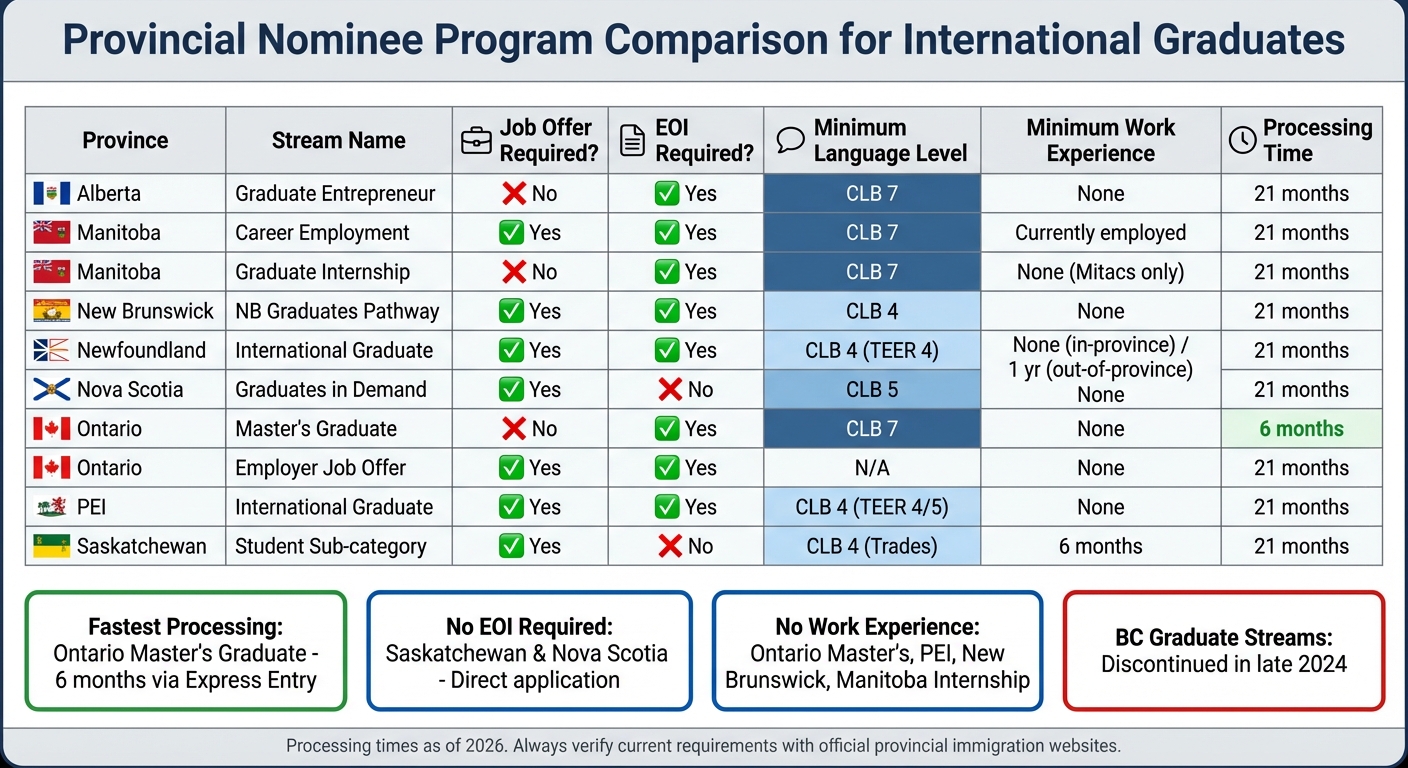
Canadian Provincial Nominee Programs for International Graduates Comparison 2026
PNP Criteria Comparison Table
Here's a breakdown of the Provincial Nominee Program (PNP) streams tailored for international graduates. The table highlights critical criteria across provinces, helping you identify options that align with your qualifications and goals.
| Province | Stream | Job Offer Required? | EOI Required? | Min. Language | Min. Work Experience | Processing Model |
|---|---|---|---|---|---|---|
| Alberta | Graduate Entrepreneur | No | Yes | CLB 7 | None | 21 months (base PNP) |
| Manitoba | Career Employment | Yes | Yes | CLB 7 | Currently employed | 21 months (base PNP) |
| Manitoba | Graduate Internship | No | Yes | CLB 7 | None (Mitacs only) | 21 months (base PNP) |
| New Brunswick | NB Graduates Pathway | Yes | Yes | CLB 4 | None | 21 months (base PNP) |
| Newfoundland | International Graduate | Yes | Yes | CLB 4 (TEER 4) | None (in-province) / 1 yr (out-of-province) | 21 months (base PNP) |
| Nova Scotia | Graduates in Demand | Yes | No | CLB 5 | None | 21 months (base PNP) |
| Ontario | Master's Graduate | No | Yes | CLB 7 | None | 6 months (Express Entry) |
| Ontario | Employer Job Offer | Yes | Yes | N/A | None | 21 months (base PNP) |
| PEI | International Graduate | Yes | Yes | CLB 4 (TEER 4/5) | None | 21 months (base PNP) |
| Saskatchewan | Student Sub-category | Yes | No | CLB 4 (Trades) | 6 months | 21 months (base PNP) |
Most streams adhere to the standard 21-month processing time under the base PNP model, with Ontario's Master's Graduate stream standing out for its faster 6-month processing through Express Entry.
Key Differences and Considerations
- Faster Processing: Ontario's Master's Graduate stream is ideal if you meet the advanced degree and CLB 7 language requirements, as it processes in just six months.
- Simpler Application Routes: Saskatchewan and Nova Scotia allow direct applications without requiring an Expression of Interest (EOI), which can save significant time.
- No Work Experience Needed: Streams like Ontario's Master's Graduate, PEI's International Graduate, New Brunswick's NB Graduates Pathway, and Manitoba's Graduate Internship are designed for applicants on a Post-Graduation Work Permit (PGWP) with little or no work experience.
- Specific Occupations: Nova Scotia's Graduates in Demand stream is limited to four National Occupational Classifications (NOCs): Paramedics, Pharmacy Technicians, Nurse Aides, and Early Childhood Educators.
- Changes in British Columbia: Graduate-specific streams in British Columbia were discontinued in late 2024, and replacement pathways remain uncertain due to reduced federal nomination allocations.
Tips for Optimizing Your Application
For those unsure about meeting the criteria, platforms like scale.jobs can assist with creating ATS-friendly resumes, AI-generated cover letters, and personalized support to improve your chances. If you're pursuing a regulated profession, such as nursing, plan ahead by starting your NNAS credential assessment 6–12 months before applying, as provincial licensing is often a prerequisite.
Choosing the Right Province
Your decision will likely hinge on whether speed or accessibility matters more. For instance:
- Ontario: Offers quicker processing but demands higher language proficiency (CLB 7) and advanced degrees.
- Saskatchewan: Requires only CLB 4 for trades but mandates six months of local work experience.
If you graduated from a Canadian institution outside your target province, confirm whether your credentials will be accepted. While Ontario is flexible with out-of-province graduates, many Atlantic provinces prioritize those who graduated within their borders.
Conclusion: Selecting the Right Province for Your Career
Choosing the ideal province for your career hinges on three main factors: your credentials, your timeline, and your industry focus. For example, Ontario's OINP Master's/PhD streams are ideal for advanced degree holders since they don’t require a job offer. On the other hand, if you're a graduate in healthcare, early childhood education, or skilled trades, Nova Scotia and Prince Edward Island offer sector-specific pathways designed to address pressing labor shortages.
For PGWP holders, provinces like Saskatchewan and Manitoba present practical options. Saskatchewan requires just six months of local work, while Manitoba emphasizes in-demand job offers. New Brunswick stands out for its flexibility, accepting job offers across any NOC TEER level, which is particularly helpful for graduates in less traditional skilled roles. Meanwhile, British Columbia has become less predictable after discontinuing its graduate streams in late 2024. It’s best to wait for confirmed replacement programs before relying on BC pathways. Always review the specific eligibility criteria for each province to ensure alignment with your qualifications and goals.
It's also crucial to verify that your degree meets the in-residence criteria of your chosen province. Most Provincial Nominee Programs require applicants to demonstrate a genuine intent to reside in the nominating province permanently. Applying to multiple provinces simultaneously could raise concerns about misrepresentation, so proceed with caution. Additionally, ensure your PGWP covers the 21-month processing period to avoid complications.
Once you’ve identified the right province, streamline your job search with targeted tools. Platforms like scale.jobs can be invaluable, offering ATS-optimized resume builders, AI-driven cover letter assistance, and human-supported application services. With features like free access for the first five applications and a straightforward flat-fee model, scale.jobs eliminates the hassle of recurring subscriptions while giving you a competitive edge in your provincial application process.
If you’re concerned about meeting language benchmarks or aligning your credentials with provincial priorities, expert services can help refine your application. Whether your focus is Ontario’s advanced industries or Atlantic Canada’s healthcare opportunities, tailoring your approach to provincial expectations is the final and most critical step for improving your chances of nomination success.
FAQs
Which provinces are easiest for new grads with little work experience?
Provinces with active immigration pathways tend to be more accessible for recent graduates with limited professional experience. For instance, Atlantic Canada provides opportunities through the Atlantic Immigration Pilot, a program tailored to attract newcomers to the region. Similarly, provinces like Ontario and British Columbia focus on international students and recent graduates, offering expedited immigration routes through their Provincial Nominee Programs (PNPs) and other fast-track initiatives. These pathways are designed to simplify the process for those looking to establish their careers in Canada.
Can I apply without a job offer, and where?
Yes, it’s possible to apply for jobs in Canada even without having a job offer in hand. For example, the International Mobility Program (IMP) allows entry into Canada for LMIA-exempt roles, which don’t require a labor market test, making the process quicker. Additionally, several provinces have immigration programs designed for international graduates, enabling them to apply for permanent residence (PR) without needing a job offer - as long as they meet the required conditions.
How can I avoid PGWP expiry while my PNP is processing?
To ensure your Post-Graduation Work Permit (PGWP) doesn’t expire while your Provincial Nominee Program (PNP) application is under review, you can apply for a bridging open work permit (BOWP) or request an extension to continue your work authorization. It’s crucial to submit your permanent residence application before your PGWP expires. You may also want to consult an immigration professional to explore other ways to maintain your legal status during this period.