
Cap-Exempt H1B Interview Questions to Expect

Sarah Mitchell
July 27, 2026

If your OPT unemployment days are getting low, cap-exempt H-1B interviews are mostly about three things: your dates, your fit, and filing risk. I’d prepare short answers for your EAD end date, OPT/STEM OPT status, unemployment days left, and how your work lines up with the team’s grant, lab, clinic, or department.
Here’s the short version:
- Post-completion OPT: 90 unemployment days
- STEM OPT: 150 total unemployment days
- H-1B cap checklist: 65,000 + 20,000 advanced-degree slots
- Cap-exempt employers can file year-round
- Interviewers want to know:
- Can you do the job?
- Can they file without confusion?
- Do you fit the unit’s work and funding?
If I were getting ready now, I’d do four things first:
- Write a 30–60 second visa timeline
- Memorize my exact dates
- Match my background to the team’s immediate work
- Avoid legal guesses and point filing questions to counsel
That’s the core of it. The rest is just getting your answers short, factual, and easy to check.
Unlocking H-1B Cap Exempt Visas: Must-Know FAQs | H-1B Visa USA | Direct U.S. Immigration
sbb-itb-564272e
What I’d expect in a cap-exempt H-1B interview
These interviews are usually more focused than standard screens for full time jobs. I’d expect questions like:
- What is your current status?
- When does your EAD expire?
- Are you on OPT or STEM OPT?
- How many unemployment days do you have left?
- Do you need sponsorship now or later?
- How does your work fit this lab, unit, or program?
- Have you worked on grant-backed or deadline-based projects?
- Can you start by a certain date?
- What happens next for sponsorship?
The point is simple: the employer is checking whether your case is easy to follow. Having a job search system for OPT and H-1B candidates can help you stay organized during this process.
My playbook for answering without causing doubt
I’d keep every visa answer short and factual.
Use this format:
- Current status
- EAD end date
- Unemployment days left
- Next step if selected
Example:
“I’m on STEM OPT. My EAD is valid through August 15, 2026. I have 28 unemployment days left. If the role is cap-exempt, your immigration counsel can confirm filing steps, and I’m ready to move on my side.”
That answer works because it is short, clear, and stays away from legal claims.
What to bring to the interview
For research, hospital, or university roles, I’d bring:
- A role-specific resume
- Publication list, if needed
- Short project summaries
- Notes tying my work to the team’s current needs
If you’re still tailoring documents, an ai resume builder can help cut prep time. If you also need help with written materials, an ai cover letter builder may help keep each application aligned with the posting.
Why many OPT candidates still miss these interviews
From what this article shows, the issue often isn’t interview skill. It’s application volume and timing.
Many candidates need 300 to 800 targeted applications. And cap-exempt roles often sit outside the best job boards, especially across university, hospital, and research portals.
So if I were under time pressure, I’d focus on:
- H1B sponsoring companies
- cap-exempt institutions
- direct employer career pages
- effective job application tracking
That’s where a job search platform or a job application service can help if the main problem is keeping submissions moving.
Quick comparison: Jobscan vs Teal vs Scale.jobs
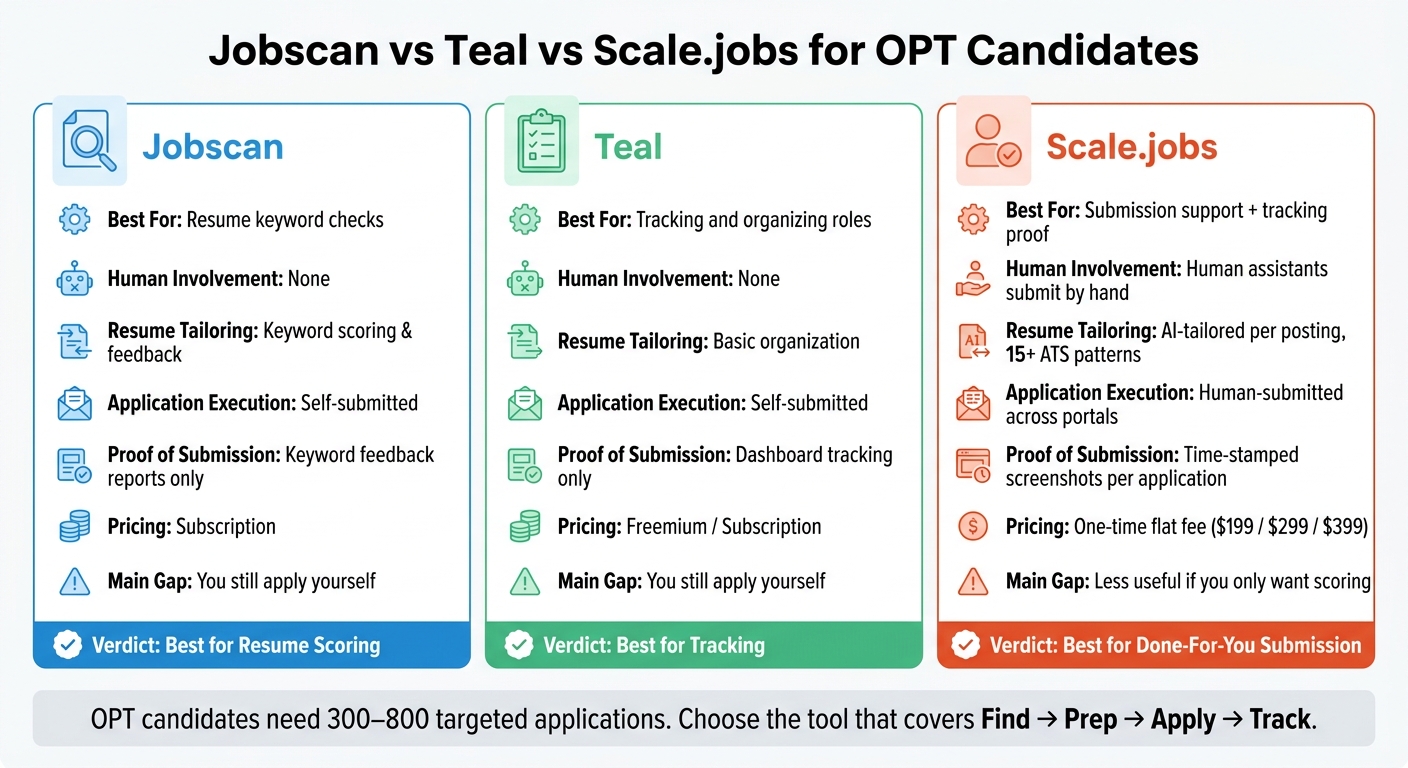
Jobscan vs Teal vs Scale.jobs: OPT Job Search Tool Comparison
If you’re comparing tools, the key question is not just tracking or resume scoring. It’s who does the submission work.
| Tool | Best for | Main gap |
|---|---|---|
| Jobscan | Resume keyword checks | You still apply yourself |
| Teal | Tracking and organizing roles | You still apply yourself |
| Scale.jobs | Submission support and tracking proof | Less useful if you only want scoring |
Jobscan vs Scale.jobs
I’d pick Jobscan if I only wanted resume-match feedback before I Apply for jobs.
I’d look at Scale.jobs if I needed:
- help with portal-heavy applications
- proof of submission
- human support on manual applications
Is Jobscan Worth It?
Yes, if your main issue is resume matching.
No, if your main issue is getting many applications submitted fast.
Teal vs Scale.jobs
I’d pick Teal if I wanted a tracker and planned to do every application myself.
I’d look at Scale.jobs if I wanted:
- submission help
- ATS-ready tailoring
- portal handling across hospitals and universities
Is Teal Worth It?
Yes, if you want a clean tracker.
No, if you want done-for-you submission help.
FAQ
What do cap-exempt H-1B interviewers care about most?
Usually three things:
- job fit
- filing readiness
- mission or department fit
Should I explain H-1B filing steps in detail?
No. I’d explain my own dates and status, then direct legal or filing-process questions to the employer’s immigration counsel.
What is the safest way to talk about my OPT timeline?
Use exact facts only:
- status
- EAD end date
- unemployment days left
- start-date limits
Do not guess.
Where should I look for cap-exempt jobs?
Start with universities, nonprofit research groups, hospitals, and government research employers. A focused job search virtual assistant can also help if you’re sorting through many portals and role types at once.
My bottom line
If I had to sum up the article in one sentence, it would be this: cap-exempt H-1B interviews are less about giving long answers and more about making your timeline easy to verify.
So I’d keep it simple:
- know my dates
- match my work to the role
- avoid legal guesses
- keep applications moving while the OPT clock is still running
That approach gives you the best shot at turning interviews into offers before your remaining days get too tight.
What cap-exempt interviewers are actually testing
Once you focus on cap-exempt roles, the interview changes. It’s no longer just about general fit. It’s about filing readiness.
Most cap-exempt interviews are checking three things:
- job fit
- filing readiness
- mission fit
That shift matters. Your OPT clock doesn’t stop, so employers want to know if filing can happen without delays and whether your visa timeline creates extra friction.
If you're trying to Apply for jobs in this space, it helps to treat these interviews less like broad career chats and more like timeline-and-fit reviews.
Status, dates, and work authorization questions
Expect direct questions about your EAD end date, whether you’re on standard OPT or STEM OPT, and whether you need sponsorship now or later.
This is one area where vague answers can hurt you fast. If the employer has to guess, they may assume the process will be harder than it is.
A clear answer works better:
"My EAD is valid through [date], and I am currently on STEM OPT"
That gives the employer what they need right away. Short. Exact. Easy to work with.
If you’ve been using a job search platform or a job search coach, this is one of the first parts worth practicing. Small wording changes can make your timeline sound much easier to assess.
Research, teaching, clinical, and mission-fit questions
Cap-exempt employers often hire for roles tied to grants, departments, or program goals. So the interview may lean hard into your match with a specific project, lab, teaching need, or clinical unit.
That means they’re not only asking, “Can this person do the job?”
They’re also asking, “Does this person fit this work, this team, and this funding setup?”
You may get questions about grant deliverables, department needs, research focus, or how your past work lines up with the role’s immediate goals. In practice, this can feel more targeted than interviews for many full time jobs.
Risk, funding, and long-term planning questions
Employers also want clear answers on funding stability and start-date timing.
If grant funding is tied to the role, don’t dance around it. Acknowledge that funding matters, then explain how you’d handle timing changes using exact dates and facts only.
That’s the key here: facts, not guesses.
If your timeline is tight, say so plainly. If your work authorization runs through a certain date, give that date. If filing needs to happen by a certain point, make that easy to follow.
This is where a job application service or Virtual Assistant for Job Applications can help you tighten your wording before the interview, especially if you’re sending out a high volume of applications and repeating the same timeline details again and again.
Next, turn those facts into short, precise answers that keep the conversation focused.
How to answer cap-exempt H-1B interview questions without raising red flags
Cap-exempt interviews often come down to one thing: can the employer verify your visa timeline fast? If your status, dates, and next step are easy to check, hiring teams move with less friction.
That matters even more when you're trying to Apply for jobs in a narrow window. A vague answer can make a recruiter pause. A clear answer helps them keep going.
Build a one-minute visa explanation with exact dates and next steps
Write a short script before the interview. Keep it under one minute. Your goal is simple: explain your current status, your EAD end date, and your remaining unemployment days in plain English.
You don't need a speech. You need a tight, accurate timeline.
A simple format works well:
- Your current immigration status
- The date your EAD ends
- How many unemployment days you have left
- The next filing step the employer would likely take if they move ahead
Then connect that timeline to the employer's hiring process. That shows you understand how cap-exempt H-1B sponsorship fits your current situation without making the conversation feel heavy.
Example: “I’m currently on OPT, my EAD expires on August 15, 2026, and I have 28 unemployment days left. If the role is cap-exempt, your immigration counsel would usually confirm the filing steps, but from my side, my timeline is clear and I’m ready to move fast.”
That kind of answer does two things at once. It gives facts, and it shows you're organized.
If every unemployment day counts, unclear answers can cost interviews. The same level of precision should show up in your follow-up emails, your document set, and even the way you track roles on a job search platform. If you're juggling many applications, a job application service or job search virtual assistant can help keep those dates from slipping through the cracks.
Bring materials that match how cap-exempt employers hire
Once your timeline is clear, your materials should make your fit just as easy to check.
For academia or research-heavy roles, bring documents that match how those teams review candidates. In most cases, that means a resume tailored to the role, a publication list, and short project summaries tied to grant deliverables or department goals.
Think of it this way: the hiring team is trying to answer, Can this person do the work, and can we verify that fast? Your materials should help them say yes.
A strong interview packet may include:
- A role-specific resume
- A publication list
- Brief project summaries linked to lab, grant, or department needs
- Files formatted to match the employer's application system
This is where prep outside the interview helps. Tools like an ai resume builder can speed up tailoring, especially if you're applying across both full time jobs and research roles with slightly different requirements.
Answer immigration questions accurately without turning the interview into a legal discussion
When immigration questions come up, accuracy matters more than detail. Do not guess about your status, filing steps, or institution-specific procedures.
If an interviewer asks about filing mechanics, the cleanest answer is often the best one: your status timeline is clear, and the employer's immigration counsel should confirm legal or filing details.
That keeps the discussion factual without turning the interview into a legal consult.
Example: “I can explain my current status and dates clearly, but for filing mechanics or institution-specific steps, your immigration counsel would be the right source to confirm details.”
That answer shows restraint, which is often a good sign in visa-related conversations. You're not dodging the question. You're staying in your lane.
The same discipline should shape your full search process, from where you look to how you track sponsor-ready openings. If you're sorting through cap-exempt roles across universities, hospitals, and nonprofits, working with a virtual assistant for job seekers can help you stay organized and keep each application aligned with the employer's process.
Why candidates miss these interviews anyway, and where scale.jobs fits in
Most OPT candidates miss cap-exempt interviews for one simple reason: the application pipeline moves too slowly.
These searches often need 300 to 800 targeted applications, and many openings never show up on the best job boards like LinkedIn or Indeed. So the problem usually isn't motivation or interview skill. It's the system itself. If your job search platform slows down applications, it cuts into your shot at getting interviews.
Checklist: what a serious OPT candidate should require from any job search tool
Cap-exempt hiring tends to be slower, heavier on portals, and spread across many employer sites instead of one central board. So before you pick a tool, check whether it can handle that setup.
Use this checklist to tell the difference between something that looks useful and something that actually cuts unemployment days.
| Requirement | Why it matters for OPT candidates | Does scale.jobs cover it? |
|---|---|---|
| Monitors university and hospital career pages | Cap-exempt roles rarely appear on standard job boards | Yes - 50,000+ career pages indexed |
| Human assistants for complex portals | Manual handling is often needed on university and hospital application portals | Yes - trained human VAs submit by hand |
| ATS-friendly resume tailoring | Recruiters spend 2–3 seconds on an initial scan; ATS compatibility matters | Yes - AI tailoring per posting, 15+ ATS patterns |
| Submission proof and tracking | You need to verify every application was actually submitted | Yes - timestamps and screenshots per application |
| One-time or flat-fee pricing | Recurring subscriptions add up fast on a student budget | Yes - one-time bundles at $199, $299, $399 |
| WhatsApp support for fast updates | Immigration timelines don't wait for email response windows | Yes - real-time WhatsApp communication |
| Single dashboard for all applications | Keeps submissions organized against the unemployment clock | Yes - centralized tracking dashboard |
If you're comparing options, this is the baseline. A tool should help you find jobs, prep materials, apply at scale, and track every submission. If it misses one of those, the gap usually lands back on you.
Find, Prep, Apply, Track: how scale.jobs cuts wasted unemployment days
The main issue is not interview prep. It's getting enough qualified interviews before the OPT clock runs out.
Once a tool clears the basics, the next question is simple: does it move each part of the search faster? More clean submissions usually mean more interviews. That's where the visa questions, employer fit, and role details start to get sorted out.
scale.jobs lines up with the four points where OPT candidates usually lose time:
- Find: indexes 50,000+ career pages, bringing in cap-exempt openings from universities, hospitals, and research institutions
- Prep: builds ATS-friendly resumes and cover letters for each posting, including 15+ ATS patterns used by more than 75% of Fortune 500 employers
- Apply: uses human assistants to complete applications by hand across portal-specific workflows, which matters if you need a Virtual Assistant for Job Applications
- Track: shows timestamps and screenshots for each submission, so you can confirm status without chasing recruiters by email
For candidates who want extra document support, the AI Assistant Pro tier includes unlimited tailored resumes and cover letters on a monthly plan. That makes it useful if you're also looking for an ai resume builder or an ai cover letter builder inside the same workflow.
On the application side, pricing is simple: $199 for 250 applications, $299 for 500, and $399 for 1,000.
Time and cost math for students balancing applications, classes, and interviews
Human application help can save 20+ hours per week. For a student balancing classes, interview prep, and follow-ups, that's not a small gain. That's time you can put into networking, mock interviews, and replying to employers you most want to hear from.
If you're spending your best hours filling out portals, you're probably doing low-value work at the worst possible time.
For resume help, scale.jobs' resume writing services combine writing and submission support in one flow. That can make more sense than stitching together a separate job application service and document tool on your own.
Next, compare that setup against the tools many OPT candidates still use to Apply for jobs across scattered portals and listings.
Switching tools: Jobscan vs scale.jobs and Teal vs scale.jobs for cap-exempt applications
If you're already comparing tools, the next question isn't tracking or resume feedback. It's who actually submits the application.
If you already use Jobscan and Teal, the gap isn't resume scoring or tracking. It's execution. Jobscan helps with keyword matching. Teal helps you stay organized. Neither one submits applications, tailors each posting, or shows proof that the application was finished.
For OPT candidates sending 300–800 targeted applications before the 90-day or 150-day clock runs out, manual submission is often the choke point. That’s where scale.jobs steps in. It handles the final submission step with human assistants, ATS-ready documents, and proof that each application was sent.
If your main pain point is volume, this is less about finding the best job boards and more about getting applications out the door without burning hours on university and hospital portals.
Jobscan vs scale.jobs and Teal vs scale.jobs for cap-exempt applications
Jobscan and Teal are solid starting points, but they stop short of done-for-you execution.
Jobscan is helpful when you want keyword feedback before you apply. Teal is helpful when you want a cleaner place to track roles, notes, and follow-ups. But both hit the same wall: they stop before the most time-heavy step. That matters even more for university, hospital, and research portals, where each posting can have a different upload flow, extra fields, or awkward formatting rules.
| Feature | Jobscan | Teal | scale.jobs |
|---|---|---|---|
| Human involvement | None | None | Human assistants submit by hand |
| Resume tailoring | Keyword scoring and feedback | Basic organization and tracking | AI-tailored per posting with ATS-ready documents |
| ATS-ready formatting and portal compatibility | Resume analysis and keyword alignment | Tracking-focused | ATS-ready resumes built and submitted per application |
| Application execution method | Self-submitted | Self-submitted | Human-submitted across portals |
| Transparency and proof of work | Keyword feedback reports | Dashboard tracking | Time-stamped screenshots per submission |
| Pricing model | Subscription | Freemium/subscription | One-time flat-fee bundles |
The right pick comes down to what you need most: feedback, organization, or full submission support.
Why scale.jobs wins over Jobscan
- Jobscan gives keyword feedback before you apply; scale.jobs tailors the resume for each posting and submits it.
- Human submission cuts down on portal mistakes in university and hospital systems.
- scale.jobs gives time-stamped screenshots for every application; Jobscan stops at the prep stage.
- scale.jobs combines prep and submission in one workflow.
This is the big split in Jobscan vs Scale.jobs: one helps you prepare, the other helps you finish.
Why scale.jobs wins over Teal
- Teal tracks where you applied; scale.jobs completes the applications and confirms each one was sent.
- scale.jobs handles portal-specific flows across university and hospital systems; Teal does not.
- scale.jobs gives time-stamped screenshots per submission; Teal gives dashboard tracking only.
- scale.jobs replaces a manual process; Teal organizes one.
That’s the core difference in Teal vs Scale.jobs. Teal is a tracker. scale.jobs is a job application service.
Who should use Jobscan: Candidates who still need resume keyword feedback before they apply for jobs.
Who should use Teal: Candidates who want a simple tracker while submitting applications themselves.
Who should choose scale.jobs: Candidates who need human execution, ATS-ready documents, and proof of submission without patching together separate tools.
If you're already using an ai resume builder or an ai cover letter builder, scale.jobs fills the part those tools leave behind: actual submission.
Use the checklist below if you need one tool that covers both preparation and execution.
Switch to scale.jobs if...
- You already use Jobscan or Teal, but still submit applications yourself.
- You need human help for portal-based applications.
- You want ATS-ready resumes tailored for each role.
- You need proof of submission for every application.
- You want a one-time payment instead of another subscription.
Is Jobscan Worth It? Yes, if your main issue is resume keyword matching. No, if your main issue is getting a high number of applications submitted fast.
Is Teal Worth It? Yes, if you want a clean tracker. No, if you want a job search platform that does the work for you.
Decision Summary: Choose Jobscan for resume scoring, Teal for tracking and organization, and scale.jobs for hands-off submission with human oversight and proof of work.