
How ATS Score Checkers Work (And How to Beat Them)

Sarah Mitchell
May 7, 2026

Did you know? 75% of resumes are filtered out by Applicant Tracking Systems (ATS) before recruiters even see them. With nearly all Fortune 500 companies relying on ATS, your resume’s ability to pass these systems is critical. ATS score checkers, such as Scale.jobs and Jobscan.co, simulate this process to help you optimize your resume for better results.
Here’s the key takeaway: Resumes scoring below 70% on ATS match rates are often auto-rejected. Tools like Scale.jobs not only identify keyword gaps and formatting errors but also offer human-assisted services to improve your chances of landing interviews. If you’re applying to dozens of jobs or struggling to get callbacks despite high ATS scores, understanding these systems and using the right tools can make all the difference.
Quick Overview: How ATS Tools Work
- Keyword Matching: ATS matches your resume’s keywords with the job description.
- Formatting: Graphics, tables, or non-standard fonts can confuse ATS and lower scores.
- Scoring: Resumes are ranked on a 0-100 scale; scores above 80% are ideal for passing filters.
Key Comparison: Scale.jobs vs Jobscan.co
| Feature | Jobscan.co | Scale.jobs |
|---|---|---|
| Cost | Paid tiers ($49.95–$89.95) | Free scans; flat fees for services |
| Resume Optimization | Automated suggestions | AI + human customization |
| Submission Support | Manual | Virtual assistants handle submissions |
| Updates | Self-tracking | Real-time WhatsApp updates |
| Best For | DIY users | High-volume applicants or tailored support |
Scale.jobs goes beyond automated tools by offering manual application services, real-time updates, and proof-of-work screenshots, making it ideal for job seekers managing high volumes or targeting competitive roles.
Actionable Insights
- Optimize with Keywords: Match your resume keywords to the job description, using exact phrases like "Agile methodology."
- Stick to ATS-Friendly Formatting: Use single-column layouts, standard fonts (Arial/Times New Roman), and save as .docx files.
- Leverage Tools: Use free ATS checkers like Scale.jobs to test multiple resume versions and identify areas for improvement.
If your current approach isn’t working, consider switching to a service like Scale.jobs for tailored support. Whether you’re applying for full-time jobs, part-time jobs near you, or navigating niche portals, these tools can simplify your job search and improve your outcomes.
How to Beat the ATS (Most People Are Doing This Wrong)
sbb-itb-564272e
How ATS Score Checkers Work
ATS score checkers simulate the way corporate hiring systems filter resumes. They analyze your resume the same way platforms like Taleo, iCIMS, and Workday do - by organizing its data, comparing it against job description keywords, and assigning a score to determine whether it moves forward. This is especially important since 99% of Fortune 500 companies rely on ATS, and about 75% of resumes are filtered out before a human even sees them.
Keyword Matching and Parsing
When you submit a resume, the ATS converts it into machine-readable text. Using natural language processing (NLP), the system identifies key sections like "Professional Experience", "Skills", and "Education" to extract relevant terms. It then compares these terms to keywords from the job description, looking for both exact matches and related phrases.
Keyword density plays a big role in how your resume is scored. Striking the right balance is key - too few keywords can make you seem underqualified, while overloading your resume can result in penalties for keyword stuffing. A 2023 Jobscan survey revealed that resumes with less than an 80% keyword match often perform poorly.
Formatting is just as critical. If your resume isn’t properly formatted, the ATS might misread or miss important keywords altogether.
Formatting and Structure Requirements
The way your resume is formatted can significantly affect how well it’s parsed by ATS systems. Resumes with heavy graphics can experience parsing errors as high as 43%, compared to just 5% for plain-text formats. ATS software often struggles with elements like images, tables, headers, footers, columns, and non-standard fonts (especially those smaller than 10 points). For instance, a two-column resume or one with embedded tables might scramble key details, such as misplacing your contact information or omitting skills, which can reduce your score by 30–50%.
To avoid these pitfalls, an ATS-friendly resume should follow a simple, single-column layout. Use standard fonts like Arial or Times New Roman in sizes 11–12, and bold section headings for clarity. Stick to a chronological structure and save your file as a plain PDF or DOCX. Additionally, use U.S. date formatting (MM/YYYY) and spell out acronyms the first time you use them, like "Applicant Tracking System (ATS)", to improve parsing accuracy.
Scoring and Ranking Algorithms
ATS platforms calculate scores by weighing several factors. Keyword matching contributes about 40–60% of the score, while formatting accounts for 20–30%. Section organization adds another 15–25%, and skills alignment makes up about 10%. Machine learning models then normalize these scores on a 0–100 scale, with resumes scoring above 80% typically advancing to recruiters. Resumes scoring below 60% are often automatically rejected.
Understanding how ATS algorithms work is essential for tailoring your resume to stand out. Different ATS checkers have varying levels of accuracy. For example, Jobscan focuses on single-job keyword matching and simulates over 20 ATS platforms, achieving around 85% accuracy. On the other hand, Scale.jobs uses advanced NLP across more than 100 enterprise systems, including Workday and Oracle, to deliver approximately 95% accuracy with real-time updates and context-aware parsing. For job seekers targeting major U.S. employers with complex ATS systems, these differences in precision can directly influence your chances of landing an interview.
Jobscan.co vs Scale.jobs: Which ATS Checker Should You Use?
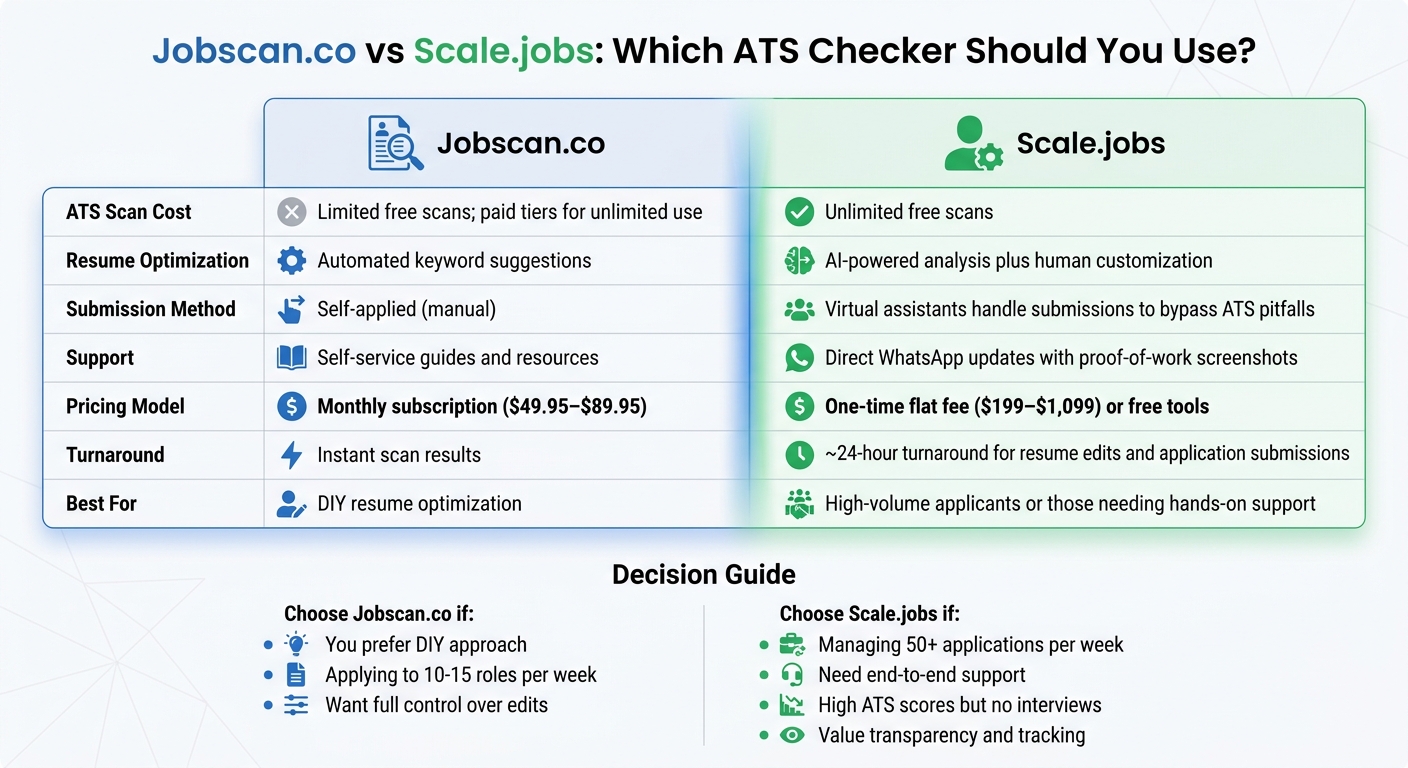
Jobscan vs Scale.jobs ATS Checker Comparison Chart
Jobscan.co has become a go-to tool for job seekers looking to optimize their resumes for applicant tracking systems (ATS). It provides keyword-matching reports that mimic how systems like Workday or Taleo analyze resumes, offering a percentage match score and suggestions for improvement. On the other hand, Scale.jobs takes a more hands-on approach, combining a free ATS checker with human-assisted services, including resume optimization and application submission. Below, we’ll break down the key differences to help you decide which option aligns best with your job search strategy.
The main distinction lies in how much support you need. Jobscan gives you the tools to analyze and improve your resume independently, while Scale.jobs offers end-to-end assistance, including resume customization and application submissions handled by trained virtual assistants. If you’re juggling a high volume of applications or struggling to turn ATS scores into interview opportunities, Scale.jobs might be the better fit. Let’s dive into the details.
| Feature | Jobscan.co | Scale.jobs |
|---|---|---|
| ATS Scan Cost | Limited free scans; paid tiers for unlimited use | Unlimited free scans |
| Resume Optimization | Automated keyword suggestions | AI-powered analysis plus human customization |
| Submission Method | Self-applied (manual) | Virtual assistants handle submissions to bypass ATS pitfalls |
| Support | Self-service guides and resources | Direct WhatsApp updates with proof-of-work screenshots |
| Pricing Model | Monthly subscription ($49.95–$89.95) | One-time flat fee ($199–$1,099) or free tools |
| Turnaround | Instant scan results | ~24-hour turnaround for resume edits and application submissions |
| Best For | DIY resume optimization | High-volume applicants or those needing hands-on support |
Why Scale.jobs Stands Out
- Unlimited ATS Scans: Unlike Jobscan, which limits free scans and requires a subscription for extended use, Scale.jobs offers unlimited scans at no cost. This allows you to test multiple resume versions without worrying about hitting a paywall.
- Human-Driven Resume Edits: Instead of just suggesting keywords, Scale.jobs integrates them into your resume with precision. This ensures your resume meets ATS thresholds while maintaining readability for hiring managers.
- Transparent Pricing: Jobscan’s monthly subscription can become costly over time, especially for long-term job seekers. Scale.jobs simplifies this with a one-time fee structure, making it easier to budget for your job search.
- Real-Time Updates: One of Scale.jobs’ standout features is its real-time WhatsApp updates. You’ll receive proof-of-work screenshots showing when and how your applications were submitted, which is particularly useful for tracking progress or meeting documentation requirements.
- Broad ATS Compatibility: Whether it’s a corporate ATS or niche job board, Scale.jobs handles applications across various platforms, saving you from the hassle of manual uploads or navigating tricky employer portals.
When Jobscan.co Makes Sense
Jobscan is a solid choice if you’re comfortable taking a DIY approach to resume optimization. It’s best suited for job seekers who:
- Want to understand how ATS systems work and apply that knowledge themselves.
- Prefer full control over resume edits and application submissions.
- Are applying to a moderate number of roles, such as 10–15 per week.
When to Opt for Scale.jobs
If you’re managing a high volume of applications - say, 50+ per week - Scale.jobs can save you significant time and effort. It’s ideal for job seekers who:
- Need end-to-end support, from resume customization to application submissions.
- Find that high ATS scores alone aren’t leading to interviews.
- Value transparency and real-time updates, especially when tracking applications is essential.
For those looking to streamline their job search while focusing on networking or interview prep, Scale.jobs provides the hands-on assistance that Jobscan lacks. Learn more about their services, including Virtual Assistant for Job Applications, to see how they can simplify your process.
Final Thoughts
Choosing between Jobscan.co and Scale.jobs ultimately depends on your job search needs. If you prefer a self-guided approach with detailed resume insights, Jobscan may be the right fit. However, for high-volume applicants or those seeking professional support with added transparency, Scale.jobs offers a more comprehensive solution. The choice is yours, but for those prioritizing efficiency and results, Scale.jobs delivers a level of service that goes beyond simple ATS scans.
How to Beat ATS Systems: Optimization Strategies
Getting past an ATS (Applicant Tracking System) requires more than just a polished resume. It’s about strategically tailoring your content, using clean formatting, and leveraging the right tools. Did you know that around 75% of resumes never make it to a human recruiter because they fail ATS screening? However, resumes optimized for ATS can boost your chances of success by 67%. With just a few key adjustments, you can fine-tune your resume to stand out.
Tailoring Resumes with Keywords
Keywords are the lifeblood of ATS optimization. Use the exact phrasing from the job description. For example, if the job listing says "Project Management", avoid rephrasing it as "Managing Projects." Focus on hard skills like SQL, Salesforce, or A/B Testing, and list them in a dedicated skills section where ATS parsers typically look. Long-tail keywords, such as "B2B SaaS customer acquisition", show specific expertise better than broad terms like "marketing."
Pay attention to the order of requirements in the job posting - those listed first or repeated are often the most important. Incorporate these keywords into your professional summary and work experience sections. Also, include both the full term and its abbreviation (e.g., "Search Engine Optimization (SEO)") to ensure the ATS recognizes the skill, no matter how it’s configured. If your previous job title doesn’t match the one in the posting but the roles are identical, consider modifying your title to align with the job listing (e.g., changing "Community Manager" to "Market Manager"). This small tweak can prevent your resume from being filtered out.
"Think of an ATS as a digital bouncer at an exclusive club - except this bouncer can't see your face or hear your charm. All it knows is whether you're speaking its language." - HireFlow
Once your keywords are in place, it’s time to ensure your resume’s structure supports their visibility.
ATS-Friendly Formatting Tips
Resume formatting plays a crucial role in how ATS systems read your resume. Stick to standard fonts like Arial, Calibri, or Times New Roman in sizes 10–12. Avoid using graphics, multi-column layouts, tables, or text boxes, as they can confuse the ATS. Instead, opt for a simple, single-column layout with left-aligned text. Use universal section headings like "Summary", "Work Experience", "Education", and "Skills" to help the system categorize your information properly.
For file format, .docx is your safest bet, as many older ATS systems struggle to process PDFs. Avoid using Canva or graphic design templates, as their formatting can interfere with ATS parsing. Keep 1-inch margins and use white space effectively to enhance readability. Once your resume makes it past the ATS, a recruiter will spend an average of just 7 seconds scanning it, so clarity is key.
Using Tools and Templates
After refining your resume’s content and format, take advantage of tools designed to test its ATS compatibility. Free ATS checkers like Scale.jobs’ scanner allow you to analyze multiple versions of your resume without hitting paywalls. These tools provide a detailed score (0–100) and highlight issues like problematic formatting or missing keywords.
To streamline the customization process, create a master resume - a comprehensive document that includes all your experience and skills. This makes it easier to tailor specific applications without starting from scratch, saving you time while ensuring consistency across your job applications.
Switch to scale.jobs If...
While optimizing your resume can help with ATS (Applicant Tracking System) scores, switching to scale.jobs offers hands-on support where automated tools often fall short.
You Need Human Review and Application Support
Free ATS checkers can point out what needs fixing - like missing keywords, formatting issues, or low match scores - but they won't handle the entire application process for you. When you're applying to 50+ positions, customizing resumes, navigating complex application portals, and tracking submissions can be overwhelming. Scale.jobs steps in with human assistants who tailor your resumes, manually complete forms to avoid bot detection, and ensure applications are submitted within 24 hours. This personalized approach is particularly useful when you're targeting competitive roles that demand custom cover letters or when you need to address career transitions or employment gaps with strategic framing - things automated tools just can't handle effectively.
Free ATS Checkers Haven't Improved Your Results
Achieving an 80% match on free ATS checkers but still landing fewer than one interview per 20 applications can be frustrating. The issue often lies beyond ATS compatibility - it's about human-proofing your application to appeal to hiring managers. Free tools tend to overemphasize keywords to pass ATS filters, but this can make your resume less engaging for human readers. Studies show resumes optimized only for ATS often have 30-40% lower callback rates compared to those designed for both systems and readability. Scale.jobs solves this problem by blending human insights with ATS requirements, ensuring your resume not only passes initial screenings but also resonates with hiring managers. This approach has been shown to increase interview requests by 2-3x. If your interview rate is below 5%, professional resume writing services can help identify deeper issues that automated tools might overlook.
You Want Proof of Work and Real-Time Updates
Using self-service tools often leaves you in the dark about submission status, formatting consistency, or which resume version was used. Scale.jobs eliminates this uncertainty by providing timestamped screenshots of every application, updates via WhatsApp as applications are submitted, and a centralized dashboard to track progress. The dashboard shows the status of each application (submitted, viewed, rejected, or interview scheduled) and helps you analyze patterns - like identifying industries where your applications aren't gaining traction. This transparency is invaluable when juggling multiple applications, allowing you to tweak strategies, avoid duplicate submissions, and follow up with recruiters confidently. Unlike free ATS tools, scale.jobs ensures accountability and provides a clear audit trail for your job search.
Decision Summary
When deciding between free ATS checkers and a platform like Scale.jobs, it’s essential to evaluate your specific needs and goals. Here’s a quick guide to help you make the right choice:
Stick with free ATS checkers if you’re looking for a quick, no-cost way to identify basic issues in your resume. In under two minutes, tools like Resume Worded or Jobscan.co can highlight formatting mistakes, missing sections, or weak action verbs. These are best suited for candidates whose resumes already score 70+ and who apply to 10-20 jobs per week. If you have the time and energy to customize applications daily and are targeting fewer than 50 positions, free tools can offer adequate support. However, if these tools aren’t leading to interviews, it may be time to explore a more advanced option.
Consider Scale.jobs if your high ATS scores aren’t converting into interviews (less than a 5% success rate). This platform is particularly helpful for:
- Competitive or senior-level positions that demand tailored cover letters and strategic framing of experience
- Career changers who need to highlight transferable skills effectively
- High-volume applicants targeting 100+ jobs, where time efficiency is critical
- Visa-dependent candidates who need to maximize interview opportunities
Scale.jobs offers human-assisted services, such as resume tailoring within 24 hours, manual application form completion to bypass bot detection, and timestamped proof of every submission via WhatsApp. These features are especially beneficial for mid-career professionals, individuals impacted by layoffs, or anyone needing to focus their time on networking rather than administrative tasks.
If you’re unsure whether your resume requires more than just ATS optimization, professional resume writing services can help identify deeper issues, such as weak storytelling or poorly framed experience. The key distinction lies in focus: free ATS checkers are designed to help you pass automated filters, while Scale.jobs aims to help you land interviews. For those with interview rates below 5%, human-assisted services often achieve 2-3x better results by balancing ATS compliance with human readability.
FAQs
What ATS score should I aim for before applying?
To boost your chances of passing initial applicant tracking system (ATS) screenings, aim for a score of at least 80%. If you're targeting a standout ranking, strive for a score above 85%. Achieving higher scores increases the likelihood that your resume matches the job's requirements and grabs the attention of recruiters.
Should I upload my resume as a PDF or .docx to avoid parsing issues?
When submitting your resume, it’s usually a good idea to upload it as a .docx file. This format is more consistently read by ATS (Applicant Tracking System) software and autofill tools. Although PDFs are great for preserving formatting, they can occasionally create issues with keyword extraction. To improve compatibility, stick to a straightforward .docx layout - avoid intricate graphics or unusual formatting that might confuse the system.
If I’m scoring high but not getting interviews, what should I change next?
A strong ATS (Applicant Tracking System) score indicates your resume meets the system's technical requirements, but it doesn’t necessarily mean it will captivate a recruiter. To make your resume stand out, emphasize specific achievements that set you apart and address any gaps or overlooked soft skills. Additionally, ensure your LinkedIn profile and overall professional branding are consistent with the details in your resume. For a more tailored approach, platforms like Scale.jobs can help with personalized reviews and manual job application submissions, increasing your visibility and boosting your chances of securing interviews.