
5 Reasons your job applications keep getting ghosted

Sarah Mitchell
May 16, 2026

If you're sending out job applications and hearing nothing back, you're not alone. Many job seekers face this frustrating experience, often due to avoidable mistakes. Here's what could be going wrong and how to fix it:
- Your Resume Fails ATS Filters: Most companies use Applicant Tracking Systems (ATS) to screen resumes. Poor formatting or missing keywords can lead to automatic rejection.
- Generic Resumes: Submitting the same resume for every job makes your application blend in with hundreds of others.
- Applying Too Late: Popular job postings often draw hundreds of applications quickly. Submitting late reduces your chances of being noticed.
- Unclear Presentation of Your Background: Even if you're qualified, failing to align your experience with the job's requirements can hurt your chances.
- No Follow-Up: Without a timely follow-up, your application might be forgotten amidst a sea of submissions.
Quick Fixes:
- Use an ATS-friendly resume with clear formatting and relevant keywords.
- Tailor your resume for each job to reflect specific qualifications and achievements.
- Apply within the first 48–72 hours of a posting going live.
- Reframe your experience to match the job description, especially if you're transitioning careers.
- Send a professional follow-up email 1–2 weeks after applying to stay on the recruiter’s radar.
For a more personalized approach, you can explore tools like Scale.jobs, which offer tailored resume writing, job application services, and follow-up tracking to improve your chances of landing interviews. Whether you're applying for part-time jobs near you or aiming for competitive full-time roles, these strategies can help you stand out.
Do This and NEVER Get Ghosted in Your Job Search
sbb-itb-564272e
1. Your Resume Fails ATS Filters Before a Human Sees It
In today’s job market, many large U.S. companies rely on Applicant Tracking Systems (ATS) to manage the overwhelming number of applications they receive. These systems are designed to scan, analyze, and rank resumes before a recruiter even looks at them. According to a Jobscan survey, over 98% of Fortune 500 companies use ATS software, making it a critical hurdle for job seekers. If your resume doesn’t meet the system’s criteria, it may never reach human eyes.
The main issues that trip up ATS are keyword mismatches and poor formatting. For instance, if a job description calls for "customer success" and your resume says "client support", the system might rank you lower. Similarly, specific tools, certifications, or job titles must align with the job posting. On the formatting side, ATS can struggle with complex layouts like tables, columns, or graphics, often scrambling or missing key information. A CareerBuilder survey revealed that 75% of recruiters use ATS for initial screening, so if your resume isn’t ATS-friendly, it’s essentially invisible.
To improve your chances, stick to a clean, single-column layout with standard section headings such as "Work Experience", "Skills", and "Education." Use a .docx file unless the job posting specifies otherwise, and incorporate keywords from the job description directly into your resume. Don’t just list them in a "Skills" section - integrate them into your achievements, like this example: "Built automated SQL reports that reduced monthly close time by 15%."
Before submitting, test your resume’s formatting by copying and pasting it into a plain .txt file. If the content looks jumbled, your formatting may confuse the ATS, and adjustments are needed.
For expert assistance in creating a resume that’s optimized for both ATS and recruiters, consider using Resume Writing Services from scale.jobs.
2. You Are Sending the Same Resume to Every Job
Recruiters often sift through dozens - or even hundreds - of applications for a single position. A generic resume is easy to spot, and when they do, it typically lands at the bottom of the pile. Unlike LazyApply's mass submission strategy, Scale.jobs focuses on tailoring your resume to each job, ensuring your application reflects genuine interest rather than a one-size-fits-all approach. Overlooking this step can hurt your first impression and reduce your chances of passing through ATS filters.
Customizing your resume title to match the job posting title can increase your chances of landing an interview by up to 3.5 times. This small adjustment can have a big impact. ATS software often looks for exact keyword matches, so even slight differences like "Adobe Creative Suite" versus "Adobe Creative Cloud" can make or break your chances of being noticed.
"If your resume does not contain the exact words or phrases the recruiter searches for, you do not show up, even if you possess the required skills." - Fastapply Team
To stand out, make sure your resume mirrors the language of the job description. You don’t need to overhaul your resume entirely for every application. Instead, spend about 15 minutes tailoring it by aligning your skills and experiences with the specific requirements listed in the job posting. Replace generic statements with measurable achievements that directly address the employer’s needs. Think of the job description as a checklist, and ensure your resume ticks each box.
While tools like LazyApply prioritize speed with bulk submissions, Scale.jobs takes a more focused approach by creating tailored, ATS-friendly resumes. This strategy ensures your application stands out and gets noticed. If customizing every resume feels overwhelming, Scale.jobs' resume writing and tailoring services offer a practical solution. Their service combines human expertise with AI tools to craft personalized resumes and cover letters for each job posting, saving you time while maximizing your chances of success.
3. You Are Applying Too Late to Overloaded Job Postings
Timing is everything when it comes to job applications - being early can make all the difference.
In 2024, employers, on average, received 180 applications for every hire, with popular roles drawing even larger numbers. Entry-level positions often attract 400–600 applicants, while remote tech roles can exceed 1,000 submissions within just a week. For highly sought-after positions like software engineering, it's not uncommon to see over 2,000 resumes before the hiring team even begins screening.
This massive influx of applications means recruiters often focus on the first 20–30 qualified candidates they come across. Submitting your application a week after a job is posted? By then, interview slots may already be filled, and your resume could end up overlooked.
To increase your chances, aim to apply within the first 48–72 hours of a job posting going live. This window is when recruiters are actively reviewing applications, and your submission is more likely to be seen before automated filters or overwhelmed hiring teams take over.
| Submission Window | Impact on Visibility |
|---|---|
| First 48–72 hours | High visibility; likely to be among the first reviewed |
| After 1 week | Lower visibility; recruiters may have already shortlisted candidates |
| Post-deadline / late | Minimal visibility; reviewed only if initial candidates don’t work out |
To stay ahead, make it a habit to check LinkedIn and other best job boards daily. Focus on newly posted jobs for the best chance of being noticed. Unlike tools like LazyApply, which prioritize volume, Scale.jobs provides a more targeted approach. With human-assisted submissions, Scale.jobs ensures your ATS-optimized application reaches employers within 24 hours, giving you an edge in timing and presentation. Their job application service also includes tailored resume writing, so your documents are ready to compete.
One thing to watch out for: about 18–22% of job postings on major platforms are "ghost jobs." These are positions that remain online for weeks without updates, often signaling that the role is no longer actively being filled. Avoid wasting your time on postings older than three weeks unless there’s clear evidence of recent activity.
Next, let’s dive into how effectively presenting your background can further enhance your chances of success.
4. Your Background Is Not Clearly Framed for the Role
When your background doesn’t immediately align with a job’s requirements, your application risks being overlooked. Even if you’re perfectly qualified, recruiters often skim resumes quickly. If your experience doesn’t clearly connect to the role, it’s not that you’re underqualified - it’s that your resume isn’t bridging the gap effectively.
This challenge is especially common for career changers and candidates with nontraditional paths. Think about a teacher transitioning to corporate training, a restaurant manager aiming for customer success, or a military logistics specialist targeting supply chain roles. Their experience is often relevant, but the way it’s described might still sound tied to their previous roles. For example, a bullet point like "coordinated logistics for unit deployments" might not resonate with civilian recruiters. Instead, rephrasing it as "managed end-to-end logistics for 200+ personnel, ensuring on-time readiness" speaks directly to the skills a hiring manager might value. Unlike generic tools like LazyApply, platforms like Scale.jobs help refine your experience into industry-specific language, making your resume stand out.
The key isn’t exaggeration - it’s clear, accurate translation of your experience. Start by analyzing the job description to pinpoint the skills, tools, and outcomes the employer prioritizes. Then, rewrite your resume bullets to reflect those needs. For instance, a retail manager’s generic line like "supervised staff and assisted customers" could become "led a 15-person team, optimizing staffing and training to boost monthly sales by 12% while maintaining a 4.7/5 customer satisfaction rating." It’s the same job, but the message to recruiters is entirely different.
| Problem | Better Framing Approach |
|---|---|
| Job title doesn’t match the target role | Include a target-role summary and highlight relevant skills |
| Experience seems unrelated | Translate duties into transferable skills and competencies |
| Resume follows strict chronology | Reorder for relevance; add a skills or projects section |
| No direct industry experience | Highlight certifications, projects, volunteer work, or portfolio pieces |
| Missing key role-specific language | Use the employer’s exact phrasing from the job description |
Structuring your resume strategically also amplifies its effectiveness. Add a targeted headline and professional summary right below your name. For example: "Operations Coordinator Transitioning into Project Management | PMP Candidate | Cross-functional Team Leadership." This immediately signals your focus to recruiters. If your background isn’t a direct match, sections like "Relevant Projects" or "Certifications" can bridge the gap faster than a job title ever could.
For those making significant career shifts, services like Scale.jobs' human-assisted resume writing can make all the difference. This personalized approach ensures your resume gets noticed by recruiters instead of being filtered out by automated systems. By reframing your experience and structuring your resume thoughtfully, you can greatly improve your chances of advancing to the next stage of the hiring process.
5. You Are Not Following Up After Applying
Submitting your application is just the first step. Without a follow-up, even the most qualified candidates risk being overlooked in the sea of applications recruiters deal with daily. A well-timed, thoughtful follow-up can bring your name back to the forefront, reminding the hiring manager of your interest and qualifications.
For most applications, wait 1–2 weeks before reaching out. If the job posting includes a closing date, plan to follow up 3–5 business days after it closes. Timing matters - send your follow-up email to the hiring manager between 9:00 AM and 11:00 AM on a Tuesday, Wednesday, or Thursday. This avoids the chaos of Monday mornings and the slowdown that often hits on Fridays.
When crafting your follow-up, steer clear of generic messages. Use a subject line like "Following Up: Marketing Coordinator Application – [Your Name]" to make your email clear and professional. In the body, mention a recent accomplishment or certification, or highlight a specific company initiative you admire. This adds a personal touch and reinforces your enthusiasm for the role.
"Ideally a company should reach out and say, 'We haven't forgotten about you, we just need to sort some things out.' Unfortunately, that's not a standard part of the process." - Mark A. Herschberg, CTO and Author
Limit yourself to two follow-up attempts. If you don’t hear back after the first, wait another 4–14 days before sending the second. Beyond that, it’s best to move on - persistent follow-ups can sometimes work against you. Additionally, consider sending a brief, personalized LinkedIn message to the recruiter or hiring manager. Keep it polite and professional to stay on their radar without coming across as pushy.
However, always respect the job posting's instructions. If it explicitly states "no further contact", skip the follow-up entirely. Ignoring such details can signal poor judgment, which is not the impression you want to leave.
If managing follow-up timing feels overwhelming, tools like Scale.jobs offer tailored support. Their job search assistants can help track submission dates, manage follow-ups, and ensure you never miss an opportunity to stay visible.
A strong follow-up strategy can make all the difference in setting your application apart, especially when paired with services like Scale.jobs, which go beyond job search automation tools like LazyApply to provide a more personalized job search experience.
Comparison Table
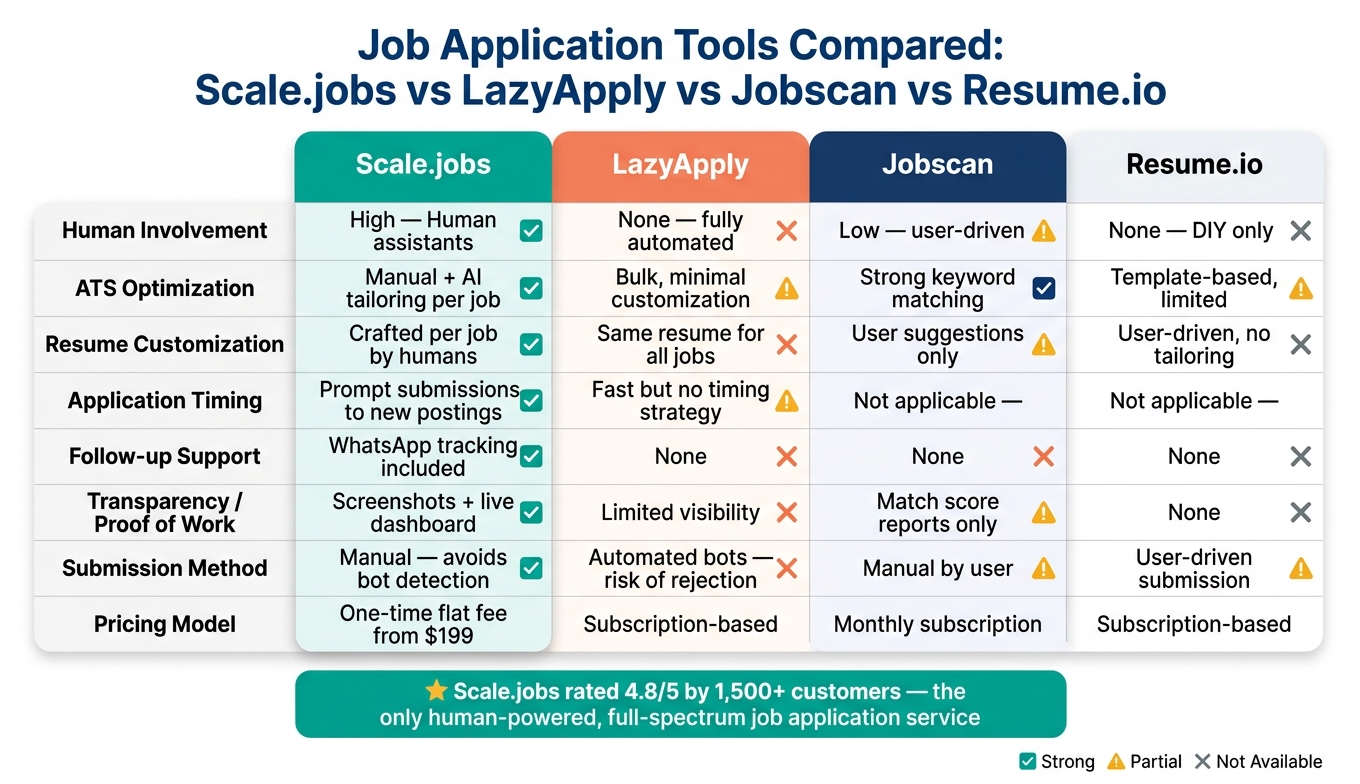
Job Application Tools Compared: Scale.jobs vs LazyApply vs Jobscan vs Resume.io
When weighing tools like LazyApply, Jobscan, and Resume.io against a human-powered option like Scale.jobs, it's important to understand how each approach impacts your job search. While some platforms focus solely on resume optimization or mass applications, others - like Scale.jobs - combine human expertise with tailored strategies to address key challenges, such as application ghosting.
Here’s a side-by-side comparison of the main features that influence your application success:
| Factor | Scale.jobs | LazyApply | Jobscan | Resume.io |
|---|---|---|---|---|
| Human Involvement | High - trained virtual assistants handle each application manually | None - fully automated bots | Low - user-driven, self-service | None - DIY resume builder only |
| ATS Optimization | Manual tailoring with AI tools for each job posting | Automated bulk actions, minimal customization | Strong keyword matching and scoring | Template-based, limited depth |
| Resume Customization | Crafted per job by human assistants | Minimal - same resume sent for all applications | User-driven suggestions only | User-driven, no job-specific tailoring |
| Application Timing | Assistants apply promptly to new postings | Fast but indiscriminate - no timing strategy | Not applicable (optimization-only tool) | Not applicable (resume builder only) |
| Follow-up Support | Included - WhatsApp tracking and follow-up management | None | None | None |
| Proof of Work / Transparency | Time-stamped screenshots, live WhatsApp updates, application dashboard | Limited visibility | Match score reports only | None |
| Submission Method | Manual by humans - avoids bot detection | Automated bots - risk of platform rejection | Manual by user | User-driven submission |
| Pricing Model | One-time flat fee (starting at $199) | Subscription-based | Monthly subscription | Subscription-based |
The standout difference lies in human involvement. LazyApply prioritizes volume over precision, firing out applications without considering timing or job fit. Jobscan specializes in identifying ATS keyword gaps but doesn’t offer end-to-end application support. Resume.io is a quick, user-friendly option for creating polished resumes but lacks job-specific tailoring.
Scale.jobs, with a 4.8/5 rating from over 1,500 satisfied customers, offers a comprehensive solution tailored to tackle all aspects of the job application process. Their human-led model ensures ATS-optimized resumes, personalized applications, timely submissions, and proactive follow-up tracking - all designed to minimize ghosting and maximize results. If you're in need of a professionally written resume as part of your strategy, their resume writing and career toolkit services integrate seamlessly with their application support, offering much more than just a polished document.
"The best part of Scale.jobs is the people who apply on your behalf and communicate with you along the way." - Teja Aditya Surabhi, Product Strategy & Growth
For those who prefer to self-manage their job search, Jobscan is an effective tool for improving keyword alignment and boosting ATS compatibility. However, it falls short when full-spectrum support - such as crafting tailored applications, ensuring timely submissions, and managing follow-ups - is required. The following sections will help you determine which tool is the best fit for your specific job search needs.
Conclusion
Tackling these five common mistakes can turn ghosted job applications into real opportunities. If you're being ghosted after applying, it doesn't mean you're unqualified - it could be that your application strategy needs a rethink. Issues like common ATS resume mistakes, generic submissions, late applications, poorly presented backgrounds, and lack of follow-ups are all fixable with the right approach.
Most large companies use ATS (Applicant Tracking Systems) to filter resumes, which makes proper formatting essential. Beyond that, tailoring your resume to the job description is key. According to a TopResume survey, 54% of recruiters say that customizing a resume for the specific position is the most important factor in landing an interview. Adjusting your summary, highlighting relevant skills, and tweaking key bullet points to match the job description can make a big difference.
Timing also plays a critical role. Glassdoor reports that an average job opening in the U.S. gets around 250 applications, and LinkedIn notes that many positions are filled within the first 24–48 hours. Setting up job alerts and prioritizing close-match postings can give you a much-needed edge. If you don’t hear back within 7–10 business days, sending a polite, professional follow-up email can help keep your application on the radar without being overbearing.
For those who want a more efficient and expert-guided approach, Scale.jobs' resume writing and career services can simplify the process. They handle everything from creating ATS-friendly resumes to submitting tailored applications, while providing real-time updates so you’re never left wondering about the status of your submissions.
Switch to Scale.jobs if…
- Your resume keeps getting rejected by ATS filters despite having strong qualifications.
- You need customized applications for each job rather than relying on a generic resume.
- You’re missing out on early applications because you don’t have time to monitor job postings daily.
- You want clear, transparent updates - like time-stamped screenshots and WhatsApp tracking - so you know exactly when and where your applications are submitted.
- You’ve tried bulk-submission tools like LazyApply but aren’t getting the responses you hoped for.
Decision Summary
- Who should use LazyApply: Job seekers focused on sending a high volume of applications quickly, who are comfortable managing their own resume quality and follow-ups, and who don’t mind trading precision for reach.
- Who should choose Scale.jobs: Job seekers looking for personalized, hands-on support throughout the application process - from crafting tailored resumes to timely submissions and follow-up tracking - without having to manage every detail themselves.
While LazyApply may work for those prioritizing quantity, Scale.jobs is better suited for those who value a tailored approach and higher response rates over sheer application numbers.
FAQs
How can I tell if a job post is a “ghost job” before I apply?
To identify a potential "ghost job", keep an eye out for job postings with vague descriptions, unrealistic expectations, or minimal details about responsibilities and qualifications. Warning signs include listings that appear outdated, postings that are repeatedly recycled without updates, or inconsistent information about the company. Take time to research the company’s hiring history and online presence - if the role seems overly generic or unnecessarily complex, it could be a placeholder job or even a scam.
What’s the fastest way to tailor my resume without rewriting it from scratch?
The fastest way to customize your resume is by using ATS-friendly templates and incorporating keywords and accomplishments directly from the job description. Instead of creating a new resume from scratch, focus on aligning your existing one with the specific role. Tools like Scale.jobs offer manual, ATS-optimized resume updates through trained professionals, helping you maintain relevance and compatibility while saving valuable time.
How do I follow up without sounding pushy - or hurting my chances?
When following up after submitting a job application, it’s important to strike the right tone - professional yet approachable. Aim to send a short, polite email about one to two weeks after applying. Use this opportunity to reaffirm your excitement about the position and express your ongoing interest.
Keep your message respectful and avoid sounding impatient or pushy. A concise, well-worded follow-up not only shows your enthusiasm but also indicates you understand and respect the employer’s timeline. This thoughtful approach can leave a positive impression and potentially boost your chances of getting a response.