
10 Recommended Tips For Landing a Job That's Currently Hiring?

Sarah Mitchell
May 20, 2026

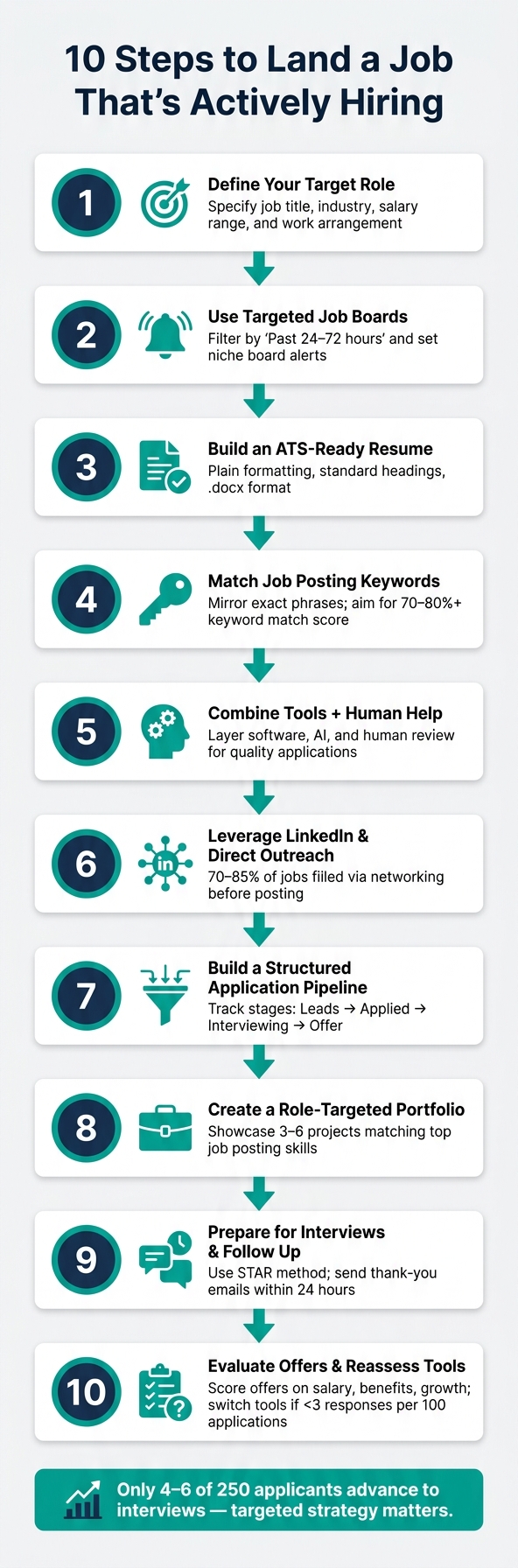
If you're struggling to land interviews despite sending out numerous applications, the problem may not be your qualifications but your approach. Today's job market is challenging, with many postings being outdated or inactive. Instead of focusing on quantity, target roles actively hiring and customize each application. Here's a quick overview of how to improve your job search:
- Define Your Ideal Role: Be specific about job title, industry, and work arrangement to narrow your focus.
- Use Targeted Job Boards: Prioritize niche boards and set alerts for recent postings.
- Craft ATS-Friendly Resumes: Align your resume with job descriptions using exact keywords.
- Leverage LinkedIn & Networking: Many roles are filled through referrals - optimize your profile and engage directly with hiring managers.
- Track Applications: Organize your efforts with a structured pipeline to manage follow-ups effectively.
- Tailor Portfolios: Showcase projects that match the role’s requirements.
- Prepare for Interviews: Use STAR techniques and send thoughtful thank-you emails.
- Evaluate Offers Carefully: Look beyond salary to assess overall benefits and growth opportunities.
- Combine Tools and Human Help: Platforms like Scale.jobs offer human-assisted, ATS-compliant applications for better results.
- Adjust Strategy: If response rates are low, reassess your tools and tactics.
Focus on quality over quantity, track your progress, and refine your approach regularly. Platforms like Scale.jobs can simplify the process by combining automation with human expertise, ensuring your applications are tailored and effective.
10-Step Job Search Strategy to Land a Job That's Actively Hiring
20 Years of Job Search Advice in 26 Minutes (I've hired 1,000+ people)
This video provides a high-level overview, but you can also follow a complete job search plan to organize your daily activities.
sbb-itb-564272e
1. Define Your Target Role and Priorities
Before diving into the job hunt, take time to define your ideal role. A vague goal like "a marketing job" leads to scattered and unfocused results. Instead, aim for clarity by specifying details like the job title, industry, work arrangement (remote, hybrid, or on-site), and salary range. This approach acts as a filter, helping you weed out irrelevant options and focus on roles that truly align with your goals.
On average, corporate job postings in the U.S. attract around 250 resumes, with only 4–6 candidates advancing to interviews. Recruiters often look for candidates who meet their "must-have" criteria. When your profile closely matches these requirements, your chances of standing out increase significantly.
Limit your non-negotiables to 3–5 key factors. These might include minimum salary, work location, commute distance, work authorization, or scheduling needs. Everything else - like specific perks, preferred tech stacks, or company size - can be considered "nice-to-haves." Career experts often emphasize that being overly rigid in your criteria can lead to frustration, especially if you're targeting roles with limited openings. By focusing on a few critical priorities, you can maintain flexibility while staying true to your core needs.
A useful starting point is to draft a concise "target role statement." This should outline your preferred job titles (e.g., "Project Manager" or "Program Coordinator"), industry, seniority level, and work arrangement. Once written, cross-check this statement against recent job postings. Use filters on platforms like LinkedIn or Indeed to see roles posted in the last 7 days. If fewer than 10 relevant jobs appear in your area weekly, consider expanding your search to include related roles.
Once you've nailed down your criteria, platforms like scale.jobs can help streamline your search. By allowing you to input specific parameters - such as titles, skills, salary range, and location preferences - scale.jobs ensures applications are tailored to your exact requirements. Unlike tools like LazyApply, which rely solely on automated processes, or comparing AIApply vs Scale Jobs for precision, scale.jobs combines the precision of human oversight with ATS-optimized documents. Their services, including resume writing services and AI tools, help translate your experience into a resume that aligns perfectly with your target role. This focused approach saves time and ensures you're applying to positions that truly match your goals.
2. Use Targeted Job Boards and Set Alerts for Roles Hiring Now
Not all job boards are equally effective when it comes to finding positions that are actively hiring. Broad platforms like Indeed, LinkedIn Jobs, and ZipRecruiter reach a large audience but often include outdated listings. A 2023 Pew Research Center survey revealed that 45% of recent U.S. job seekers applied to roles that turned out to no longer exist - primarily due to stale postings on these major platforms.
To avoid this frustration, always filter your searches by "Date posted: Past 24–72 hours." Applying early is key, as competitive roles often fill quickly after being posted. Alongside general boards, consider adding niche platforms to your search strategy. For instance, Dice caters to tech professionals, We Work Remotely focuses on remote opportunities, and Hired is tailored for software and data specialists. These specialized boards often feature employers with clear timelines and detailed requirements, saving you time and effort.
Once you’ve chosen your job boards, set up targeted alerts that go beyond generic keywords. Instead of simply searching for "Project Manager", refine your criteria to something like "IT Project Manager" AND (Agile OR Scrum), specifying your preferred location - such as "Remote (United States)" - and a salary minimum (e.g., $80,000+/year). High-priority alerts should be set for daily or immediate notifications, while weekly digests can be reserved for less urgent opportunities.
Dedicate 10–15 minutes each morning to reviewing these alerts, and use a focused 30-minute block to apply to your top 3–5 roles. At the end of each week, evaluate your results and adjust your approach by replacing boards or refining alerts that aren’t yielding callbacks.
For an even more streamlined process, consider using an integrated solution like scale.jobs. This platform not only offers a curated job board with over 2 million live postings refreshed monthly but also provides human assistants to handle applications on your behalf. Unlike fully automated tools like LazyApply or Sonara, scale.jobs employs trained virtual assistants who manually submit applications, reducing the risk of being flagged by applicant tracking systems (ATS). Key benefits include:
- Human oversight for personalized applications
- ATS-optimized resume adjustments
- Manual application submissions to avoid bot detection
- Transparent proof-of-work for peace of mind
- One-time payment with dedicated WhatsApp support
Additionally, if you want to enhance your professional profile before applying, their resume writing and career toolkit services ensure your materials are polished and ready to impress potential employers. This combination of tools and human support can significantly improve your chances of landing the right role.
3. Build an ATS-ready master resume with role-specific versions
Once you've identified roles with active hiring, your resume needs to align closely with each job posting. To complement your targeted job alerts, craft a resume that reflects the specific requirements of each position.
Your master resume acts as a comprehensive repository for all your career accomplishments, formatted in plain, machine-readable text. It should include every job role, achievement, tool, certification, and measurable outcome from your career. When applying for a specific position, draw from this "content bank" to create a streamlined, targeted version tailored to that job.
ATS-friendly formatting is crucial. Stick to a single-column layout with standard headings like Summary, Experience, Skills, Education, and Certifications. Use fonts such as Arial or Calibri (10–12pt), and avoid text boxes, icons, columns, or tables, as these can confuse ATS systems. To test compatibility, paste your resume into Notepad - if the text appears jumbled, ATS software will likely struggle to process it. Save your resume as a .docx file unless a PDF is specifically requested.
To tailor your resume, duplicate your master file, place the job description next to it, and identify recurring keywords - especially those tied to the job title, skills, and core responsibilities. Update your bullet points to reflect these terms. For instance, if a job description highlights "cross-functional stakeholder management" and you have relevant experience, use that exact phrasing. Quantify your achievements wherever possible - statements like "Reduced onboarding time by 30% within six months" perform better in ATS scans than generic descriptions.
Be consistent with file naming (e.g., Resume_JaneDoe_DataAnalyst_CompanyX.docx) to avoid sending outdated versions. Keep a log of which version was sent to each employer for easy tracking and follow-ups.
For added efficiency, consider using services like scale.jobs, which offer tools such as ATS-optimized templates, human-assisted resume customization, and clear proof-of-work. Unlike automated tools like LazyApply that use a one-size-fits-all approach, scale.jobs excels in:
- Human oversight to ensure precise role-specific adjustments
- Detailed tailoring for each job application
- Proof-of-work transparency so you know exactly what was submitted
After fine-tuning your resume for ATS and customizing it for each role, maintain a detailed log of all versions. This will help you stay organized and streamline follow-ups during your job search.
4. Match Every Application to the Job Posting's Exact Keywords
Once you’ve created an ATS-friendly resume, the next step is ensuring it aligns perfectly with the employer’s keywords. Applicant Tracking Systems (ATS) don’t just skim for general themes - they evaluate resumes based on specific words and phrases from the job description. According to Jobscan, over 98% of Fortune 500 companies use ATS software to screen resumes before they reach a recruiter. Missing critical keywords can mean being filtered out, even if you’re well-qualified for the role.
To boost your chances, incorporate recurring keywords from the job description - especially those related to skills, responsibilities, and industry-specific terms. Focus on these four keyword categories:
- Hard skills: Examples include software or tools like "Salesforce."
- Role responsibilities: Phrases like "manage recruitment" or "develop sales strategies."
- Industry terms: Words specific to the field, such as "FinTech" or "SaaS."
- Metrics: Quantifiable achievements like "increased ARR by $250K."
When reviewing a job description, pay close attention to words or phrases that appear multiple times. Repetition often indicates what the employer values most. Prioritize mandatory keywords first, then incorporate preferred ones.
For example, instead of a vague bullet point like "Handled newsletters and promotions," rewrite it to reflect the job posting’s language and showcase measurable results: "Managed email campaigns for 50,000+ subscribers, boosting conversion rates by 18% through A/B testing." This approach not only mirrors the job description but also highlights your impact with U.S.-style metrics.
To fine-tune your resume, you can use tools like Jobscan ($49.95/month), Teal (ranging from ~$9–$29/month), or Resume Worded (~$29/month). These platforms analyze keyword gaps and provide match scores, helping you identify missing terms. Aim for a match score of 70–80% or higher. While these tools pinpoint gaps, you’ll need to manually update your resume.
If you’re looking for a more personalized solution, Scale.jobs offers human assistants to seamlessly integrate keywords. Unlike automated tools vs. human-led optimization, Scale.jobs ensures that keywords are woven naturally into your resume, avoiding the common pitfall of keyword stuffing - which might help with ATS but could alienate recruiters. Their service pairs human expertise with ATS optimization, creating resumes that are both tailored and impactful. For those starting from scratch, Scale.jobs’ resume writing service combines professional writing with keyword strategies tailored to your specific roles.
Here’s a quick comparison of keyword optimization tools:
| Feature | Jobscan / Teal / Resume Worded | Scale.jobs Human Assistant |
|---|---|---|
| Keyword gap analysis | Yes – automated scoring | Yes – human-reviewed |
| Resume rewriting | No – user edits manually | Yes – done for you |
| ATS formatting check | Yes | Yes |
| Proof of work | Dashboard only | WhatsApp screenshots + timestamps |
| Pricing model | Monthly subscription | Flat-fee, one-time bundle |
5. Combine Software, AI, and Human Help Instead of Relying on Bots Alone
Building on tailored resumes and keyword optimization, your job application strategy should go beyond just automation. By integrating software, AI, and human expertise, you can create a more effective and polished approach. While ATS-optimized resumes are essential, combining these elements ensures your applications truly stand out.
Relying solely on bots to send out hundreds of generic applications might seem like a time-saver, but it often backfires. For instance, platforms like LazyApply focus solely on automated submissions, which can lead to irrelevant applications filled with wrong keywords or missed requirements. U.S. recruiters, who are quick to spot such errors, often dismiss these applications outright. As reported by Lever, a recruiting software firm, only 1 in 152 applicants from general job boards gets hired, compared to 1 in 16 for referred candidates. Simply put, quantity without quality doesn’t work. Unlike LazyApply or Simplify.jobs, Scale.jobs prioritizes a layered approach that focuses on quality, relevance, and precision.
The key is to adopt a layered approach where each tool plays a specific role. Software helps track applications and organize your job search pipeline, AI creates tailored resumes and cover letters using job-specific keywords, and human reviewers step in to verify details, ensuring accuracy and relevance. Bots, on the other hand, often send out generic applications that recruiters dismiss outright. Advanced ATS platforms like Workday and Taleo can even flag automated submissions as spam, meaning your application may never reach a recruiter. By incorporating human oversight, you can avoid these pitfalls and ensure that every submission is properly crafted and delivered.
Scale.jobs is a perfect example of this layered model in action. Its software centralizes job leads from over 2 million monthly postings and tracks every application. The AI component generates customized resumes and cover letters tailored to each job description. Finally, trained human virtual assistants manually submit each application, bypassing bot-detection systems, and provide time-stamped WhatsApp screenshots as proof of submission. For candidates looking to refine their foundational documents beforehand, Scale.jobs' resume writing and career toolkit pairs professional writers with keyword strategies to ensure your materials are solid before you start applying.
| Layer | What It Does | Scale.jobs Feature |
|---|---|---|
| Software | Tracks jobs, organizes your search pipeline | Job board, application tracker, dashboard |
| AI | Creates tailored resumes and cover letters | Single-click AI resume & cover letter per role |
| Human | Verifies accuracy and submits applications | Trained VAs + WhatsApp proof-of-work |
This integrated approach delivers 10–15 verified, role-specific applications each week, far more effective than sending out 300 generic submissions that are often ignored. By focusing on quality over quantity, this strategy not only enhances your application process but also sets you up for success in the next stages, such as direct outreach and networking.
6. Use LinkedIn and Direct Outreach to Find Roles That Aren't Posted Publicly

Many job seekers focus entirely on public job boards, but here's the thing: up to 70–85% of jobs are filled through networking and referrals before they're even posted. Career data from Zippia and Jobscan also shows that referred candidates are 4x more likely to get hired than those applying directly through job boards. This highlights the importance of networking as a way to uncover hidden opportunities.
Start by optimizing your LinkedIn profile. A strong, keyword-rich headline helps recruiters find you. Instead of something generic like "Open to Work", try a specific and results-driven statement: "Senior Marketing Manager | Demand Gen & Paid Social | Drove 120% Pipeline Growth in B2B SaaS." Add 3–5 measurable impact points under each job role and aim for 3–8 recommendations from past managers or colleagues. This combination makes your profile stand out to recruiters searching for unadvertised roles. If you need extra help revamping your LinkedIn profile, Scale.jobs' professional resume and career document services offer expert assistance to align your profile with your career goals.
When it comes to direct outreach, keep your messages short and personalized. For example, reaching out to a former colleague might look like this: "Hi Alex, I’m exploring Product Manager roles in B2B fintech and noticed your team at Stripe has been growing. Would you have 15 minutes to share insights about product hiring at Stripe?" For cold outreach to a hiring manager, reference something specific about their work, clearly state your focus, and ask a simple question about the team. Keep it under 150 words and avoid directly asking for a job in your first message.
Consistency is key, and this is where many fall short. Scale.jobs offers networking tools to help you stay organized by tracking employer contacts and responses. Their human assistants can even handle outreach for you, crafting personalized messages that bypass automated filters. This blend of human strategy and technology ensures your efforts are more effective.
Spend 15–20 minutes daily engaging with posts from target companies to boost your visibility. Follow 20–50 company pages and interact with hiring managers' content to stay on their radar. Over 4–6 weeks, this steady engagement can lead to conversations - and even job offers - that never make it to public job boards.
Once your LinkedIn profile is polished and your outreach strategy is consistent, you're ready to move on to organizing your job applications in the next step.
7. Build a Structured Pipeline to Track Outreach and Applications
Once your LinkedIn outreach is running smoothly, the next hurdle is keeping track of your applications. According to a 2021 Jobvite survey, 56% of job seekers struggle with tracking applications and communications. With multiple roles and networking conversations in play, it’s easy to let opportunities slip through the cracks.
Think of your job search as a sales pipeline. Break down every opportunity into clear stages: Leads → Research → Application Drafting → Applied → Interviewing → Offer/Negotiation → Closed. Each stage should have a specific action tied to it, ensuring no opportunity gets stuck in limbo. Track essential details like the company name, job title, application date (MM/DD/YYYY), source, contact info, follow-up date, and expected compensation in USD. For example, if you’ve applied to 30 roles but only 2 have moved to the "Interviewing" stage, it might be time to revisit your resume and adjust your keyword strategy.
The tool you choose depends on how many applications you’re managing. For fewer than 10 applications per week, a Google Sheets tracker with calendar reminders can do the job. If you’re handling 20 or more applications weekly, a visual tool like Trello (free plan) or Notion (free personal plan) can help you stay organized. For added convenience, job-search tools like Teal let you save postings directly through browser extensions, though their more advanced features are behind a paywall.
Consistency is key. Dedicate 30–60 minutes each week to reviewing your pipeline. Decide which leads should move to the drafting stage, follow up on applications older than 10 days, and close out any stale entries. After each interview, log important details and schedule a follow-up within 24–48 hours. This kind of routine keeps you in control and ahead of the curve.
If you’re applying to a high volume of roles - 250 or more in a single campaign - manual tracking might not be practical. For such cases, platforms like Scale.jobs can simplify the process. Scale.jobs' human assistant service automates tracking, provides real-time updates through WhatsApp, and even includes time-stamped proof-of-work screenshots for every application. For candidates navigating visa timelines like H-1B or F-1 OPT, this level of documentation isn’t just helpful - it can be a legal requirement.
8. Build a Portfolio That Directly Matches What Open Roles Require
When it comes to landing a job, a generic portfolio often falls short. Hiring managers are far more likely to respond to a portfolio that aligns directly with the skills and requirements of the role they're looking to fill. A 2022 TopCV survey found that 61% of hiring managers believe a strong portfolio can "significantly strengthen" a candidate's application, especially for career changers or those breaking into a new industry.
To create a targeted portfolio, start by analyzing 5–10 job postings for your desired role. For instance, if you're aiming for a "Data Analyst" position, look for recurring skills across the listings. If SQL, Excel dashboards, and A/B testing appear in most postings, ensure those skills are prominently showcased in your portfolio. One junior data analyst in Chicago saw impressive results using this approach: after swapping out a generic portfolio for one with four projects tailored to the top five skills in job postings, their callback rate jumped from around 5% to 25% over the next 20 applications.
When presenting each project, follow a clear structure to make it easy for recruiters to review: context → problem → actions → results → tools used. Use U.S. formatting for consistency, such as dollar amounts with commas (e.g., "$14,000"), MM/DD/YYYY dates, and plain American English. Focus on measurable outcomes rather than design aesthetics. For example, a UX designer applying to a healthcare startup replaced generic e-commerce projects with a HIPAA-compliant patient portal redesign. The hiring manager noted that this tailored portfolio was the reason they advanced to the final interview stage.
To streamline the process, maintain a master portfolio organized by skill, industry, and role type. For each application, select 3–6 projects that align with the job's key requirements. Tools like Scale.jobs' portfolio website generator can help create a polished and cohesive presentation across all application materials. This approach saves time and ensures every portfolio submission is highly relevant, reinforcing your qualifications across touchpoints like your ATS-friendly resume and LinkedIn profile.
Finally, remember that 72% of employers hiring developers review GitHub profiles or public code samples as part of the evaluation process. If you lack professional examples, consider working on practice projects using public datasets or contributing to open-source initiatives. Hiring managers prioritize the relevance and clarity of your work over whether it was done for a client or as a personal project.
9. Prepare for Interviews and Follow Up While the Role Is Still in Process
After organizing your application process, shift your attention to preparing for interviews and following up effectively.
When you receive an interview invitation, act quickly - time is crucial as roles can close fast. Confirm the interview details within 24–48 hours in writing, including the date, time, format, and the name of your interviewer. Next, carefully review the job description and prepare at least one specific STAR (Situation, Task, Action, Result) story for each major responsibility listed. This structured approach ensures you're ready to provide clear and relevant examples during the interview.
To anticipate the kinds of questions you might face, leverage tools designed for interview practice. For instance, Google's Interview Warmup, Big Interview, and Pramp allow you to practice role-specific questions and even record your answers for review. Additionally, Scale.jobs offers a free Interview Questions Predictor that analyzes job postings to suggest likely questions - a great resource if you're juggling multiple interviews. Aim to keep your responses concise, ideally between 1–2 minutes, and practice eliminating filler words to deliver clear, polished answers.
Tailor your preparation based on the person interviewing you. For example:
- Recruiters are interested in your overall career story and salary expectations.
- Hiring managers want to hear about your achievements and how you can deliver results.
- Peers are likely to focus on your collaboration skills and how you handle conflicts or teamwork.
According to a 2020 TopResume survey, 68% of hiring managers consider thank-you emails influential in their decision-making process. However, a 2017 Accountemps survey found that only 24% of candidates actually send them.
Send personalized thank-you emails within 24 hours of your interview. Mention specific points from your discussion, restate how you can add value, and address any areas where your responses may not have been as strong. If you spoke with multiple interviewers, send individual, tailored emails to each. If you don’t hear back by the date they provided, send a polite follow-up email after 3–5 business days - just one follow-up, not multiple.
Keep track of your interviews in a spreadsheet. Include details like the company name, role, interviewer names, interview dates, follow-up status, and next steps. This is especially helpful if you’re managing multiple interviews at once, as the average interview process in the U.S. spans about 23.8 days. Staying organized prevents missed follow-ups and helps you maintain momentum.
For candidates seeking more hands-on assistance, Scale.jobs offers resume and job search services that combine human guidance with structured tools. This allows you to focus on preparing for interviews while leaving the logistical details to experts.
With a solid plan in place, you're well-equipped to handle this critical phase of your job search.
10. Evaluate Job Offers and Know When to Switch Your Job Search Tools
Once you’ve organized your application process, the next step is to carefully evaluate job offers and ensure your current job search tools are meeting your needs. When offers start coming in, it’s important to look beyond just the salary. According to the U.S. Bureau of Labor Statistics, benefits make up about 30.5% of total employer compensation costs for private industry workers. For instance, a $78,000 salary with comprehensive health benefits and a 5% 401(k) match could outweigh an $85,000 salary with limited perks.
To make an informed decision, consider creating a scoring system. Use a spreadsheet to list your priorities - such as salary, remote work policies, health insurance, retirement contributions, vacation time, career advancement opportunities, and compatibility with your potential manager. Assign each factor a weight from 1 to 5 based on its importance, then score each job offer from 1 to 10 for each criterion. Multiply the scores by their weights, add them up, and compare the totals. This method helps remove emotional bias, especially when you’re managing multiple offers or tight deadlines. Be alert for warning signs like unclear compensation details, pressure to decide quickly, or inconsistencies between verbal promises and written agreements.
This evaluation process also provides an opportunity to reflect on whether your job search tools are delivering results. If you’ve sent out over 100 applications in a span of four to six weeks but received fewer than three responses, it might be time to reassess your tools. A 2023 FlexJobs survey found that 56% of job seekers encountered scams or misleading postings on major job boards, highlighting the importance of choosing a reliable job search platform.
Automated platforms like LazyApply and Sonara.ai can handle large-scale submissions, but they often fall short when it comes to navigating modern applicant tracking systems (ATS). Many ATS filters flag bot-generated applications, meaning your resume might never reach a recruiter. This is where scale.jobs stands out. Instead of automation, scale.jobs uses trained human virtual assistants to manually submit applications, bypassing ATS filters and providing time-stamped proof of submission via WhatsApp. Their pricing model is also straightforward - a one-time flat fee starting at $199 for 250 applications, with pro-rata refunds if you secure a job before using all your credits. Additionally, they offer resume writing services tailored to specific job descriptions, making them an excellent choice for those re-entering the workforce or switching industries.
Here’s a comparison of automated platforms and scale.jobs to help you decide which tool aligns with your needs:
| Feature | Automated Platforms (e.g., LazyApply, Sonara.ai) | scale.jobs |
|---|---|---|
| Application Method | Bot/automation | Human virtual assistants (manual) |
| ATS Handling | High risk of being flagged | Manual submissions that bypass filters |
| Resume Customization | Generic keyword templates | Tailored to each job description |
| Proof of Work | Basic dashboard metrics | Time-stamped WhatsApp screenshots |
| Pricing Model | Recurring monthly subscriptions | One-time flat fee with pro-rata refunds |
| Support | Automated or email | Live WhatsApp support with real assistants |
Who Might Benefit from LazyApply or Sonara.ai
- Job seekers aiming to apply to a large number of roles quickly, especially in industries with minimal ATS filtering.
- Candidates who are on a tight budget and prefer a low-cost monthly subscription for exploratory job searches.
- Those applying for roles where speed matters more than tailored applications.
Why scale.jobs Could Be a Better Fit
- Professionals targeting competitive roles where ATS compliance and application quality are crucial.
- Job seekers who need verifiable proof of application submissions, particularly for visa-related timelines like H-1B or F-1 OPT.
- Individuals re-entering the workforce or transitioning to a new industry who require tailored resume support and personalized application help.
Consider switching to scale.jobs if:
- You’ve submitted over 100 applications in a few weeks but received fewer than three responses.
- Your target companies use advanced ATS systems, making bot-generated applications ineffective.
- You need help navigating complex application portals, especially those requiring detailed visa sponsorship information.
- You’re spending 20+ hours per week on applications, time that could be better used for networking or preparing for interviews.
Bottom Line: Automated platforms like LazyApply and Sonara.ai can be a good starting point for broad, quick applications in less competitive fields. However, if your response rate is low despite high application volume, or you require tailored, high-quality submissions with documented proof, scale.jobs offers a more hands-on, reliable approach that addresses the shortcomings of automated tools.
Conclusion
Securing a job in today’s competitive market takes more than just sending out bulk applications. Platforms like LazyApply and Simplify.jobs may offer automation, but they often fall short when it comes to delivering tailored, effective results. Success comes from focusing on roles that align with your skills, crafting personalized resumes and cover letters for each opportunity, and maintaining consistent follow-ups while positions are still open.
While technology can streamline certain aspects of the job search - like sending alerts, creating ATS-friendly resumes and cover letters, and optimizing keywords - it’s not the whole solution. Ultimately, hiring decisions are made by people. This means that human judgment, direct outreach, and relationship-building remain crucial throughout the process.
The most successful job seekers approach their search with a strategic mindset. They set clear goals, track every application, analyze response rates, and refine their methods over time. If a particular approach doesn’t yield results after 4–6 weeks, they pivot - focusing on quality over quantity.
This is where scale.jobs stands out. Unlike competitors such as LazyApply and Simplify.jobs, which rely solely on automation, scale.jobs combines advanced tools with hands-on human expertise to maximize your chances of success. From professionally crafted, ATS-optimized resumes to virtual assistants who manually submit applications, scale.jobs ensures every step of the process is handled with precision and care. Their free toolkit, which includes features like an ATS checker, job tracker, and salary predictor, simplifies the groundwork, while their Human Assistant packages - starting at $199 for 250 applications - take the heavy lifting off your shoulders.
Here’s what makes scale.jobs different:
- Human virtual assistants who manually submit applications, bypassing ATS filters and ensuring accuracy.
- Custom-tailored resumes and cover letters designed to match specific job descriptions and increase your chances of being noticed.
- Transparent, one-time pricing with no recurring fees and the option for pro-rata refunds if you land a job early.
- Dedicated WhatsApp support with real-time updates and time-stamped proof of every submission.
If you’re tired of low response rates and generic, automated applications, scale.jobs offers a personalized, human-powered alternative that helps your applications stand out. With their combination of technology and expert support, you’ll have the tools and guidance needed to turn applications into opportunities.
FAQs
How can I tell if a job posting is still active?
When exploring job opportunities, it's crucial to check the posting date and the company's career page for updates. If a job has been listed for an extended period, there’s a chance it may no longer be accepting applications. To verify, ensure the "Apply" button is functional and confirm the role is still visible on the company’s website. For added clarity, you can reach out directly to a recruiter or hiring manager to confirm whether the position is still available.
What’s the fastest way to tailor my resume for ATS?
The fastest way to get your resume ATS-ready is by pulling 5–10 key terms straight from the job description. These could include certifications, specific tools, or relevant industry jargon. Weave these keywords naturally into your work experience and skills sections.
For formatting, stick to a clean, single-column layout and use standard fonts like Arial or Calibri. Avoid using tables, images, or any design elements that could confuse the system. When saving your file, choose either .docx or PDF formats for compatibility.
If you’re looking for expert help, Scale.jobs offers tailored, human-assisted resume services that align with ATS-2.0 standards. Unlike automated systems, they ensure your resume avoids mechanical keyword stuffing while still meeting the requirements.
When should I change my job-search strategy or tools?
If you’re experiencing frequent rejections from Applicant Tracking Systems (ATS) or getting very few callbacks, it might be time to rethink your job-search approach or the tools you’re using. One common issue is sending out generic resumes and cover letters that aren’t customized for each role. This can significantly hurt your chances, especially in competitive industries, during career transitions, or when applying for positions requiring visa sponsorships.
For better results, consider using Scale.jobs, which offers human-assisted, ATS-friendly applications. This service provides tailored applications along with updates that showcase proof of your work, helping you stand out in a crowded job market. Relying solely on automation may not be enough for these situations, as a personalized touch often makes all the difference.