
LinkedIn Headline Formulas That Get Callbacks in 2026

Sarah Mitchell
June 24, 2026

Most LinkedIn headlines fail for one simple reason: they say what you are, but not why someone should click.
If I want more recruiter replies in 2026, I need a headline that does three things fast:
- names my target role as part of a LinkedIn profile optimization strategy
- uses search terms recruiters type
- shows one proof point with numbers, scale, or a known signal
A plain headline like “Product Manager at Company” gets buried. A sharper one like “Senior PM | B2B SaaS + Payments | Grew ARR from $5M to $20M” gives search match and a reason to open the profile.
LinkedIn Headline Formula that WORKS in 2025 | LinkedIn for Professionals
sbb-itb-564272e
Quick take
Here’s what matters most:
- Put the target title first
- Keep the main keyword inside the first 60 characters
- Add 2–3 role-specific terms
- End with proof: a metric, certification, employer brand, or scope
- Do not lead with “Open to Work,” “seeking opportunities,” or filler words
Quick comparison
| Formula | Best for | What leads | Best proof |
|---|---|---|---|
| Role + Specialization + Outcome | Direct-fit candidates | Job title | Metric |
| Target Title + Keywords + Signal | Search visibility | Exact title | Cert or known company |
| Target Role + Proof + Availability | Active applicants | Target role | Result + availability |
| Specialty + Niche + Result | Narrow searches | Function/domain | Scale |
| Tool Stack + Function + Impact | Engineering/data/ML | Stack + role | Business result |
| Brand Statement + Role + Keywords | Senior talent or pivots | Strength area | Scope or employer brand |
If I’m fixing my profile before I Apply for jobs, this is one of the first edits I would make. To track the impact of these changes, monitor your LinkedIn job search metrics.
What a Callback-Worthy LinkedIn Headline Needs in 2026
Here’s the simple framework: a strong 2026 LinkedIn headline has four parts - role keywords, specialization, outcomes, and credibility signals. If one is missing, your headline can lose either search reach or fit.
Role keywords come first. They’re the base. Recruiters search by job title plus skill terms, so you want the exact title people use in the market. Go with Customer Success Manager, not a clever spin on it.
Specialization helps narrow the match. Words like B2B SaaS, Fintech, or Distributed Systems tell recruiters where you fit. That small detail can make your profile feel much more aligned with the role.
Outcomes give people a reason to click. This is where you show impact with a clear result, like “Grew organic traffic 4x” or “Reduced latency 40%.” Numbers do a lot of heavy lifting here.
Credibility signals add proof fast. Think AWS Certified, PMP, ex-Stripe, or 10+ years in payments. These cues help a recruiter size up your fit in seconds.
One practical rule matters more than most people think: put your target title and main keyword in the first 60 characters. On mobile, headlines get cut off early. That’s why the strongest keyword should come first. Use pipes or dots to make the line easier to scan, and stick with the standard market title.
| Building Block | What It Does | Example |
|---|---|---|
| Role Keywords | Gets you found in search | Senior Product Manager, Backend Engineer |
| Specialization | Matches you to a specific domain | B2B SaaS, Payments, ML Infrastructure |
| Outcomes | Earns the click-through | "Reduced latency 40%", "Grew ARR from $5M to $20M" |
| Credibility Signals | Builds trust instantly | ex-Google, AWS Certified, PMP |
The formulas below mix these blocks in different ways, based on what you need most: search visibility, seniority, or a career pivot.
1. Role + Specialization + Outcome
Formula: [Target Job Title] | [Specialization/Hard Skills] | [Quantified Outcome/Proof Point]
Use this when you already have direct experience and want recruiters to spot the fit fast. It works well for people applying to full time jobs or moving through a busy job search platform.
| Role | Weak Headline | Formula-Driven Headline |
|---|---|---|
| Software Engineer | Software Engineer at Salesforce | Senior Backend Engineer | Python + AWS | Scaled payments infra to 50K TPS |
| Product Manager | Product Manager looking for new opportunities | Senior PM | B2B SaaS + Payments | Shipped 0-to-1 products generating $20M ARR |
| Data Analyst | Data Analyst | SQL + Python | Data Analyst | SQL + Python + Tableau | Built reporting for $40M ARR product |
| AI/ML Engineer | ML Engineer | Deep Learning | ML Engineer | PyTorch + Inference Performance | Reduced inference latency 60% |
Most headlines stop at skills. This version goes one step further and adds proof. That single change can make your profile feel much sharper, especially when recruiters skim dozens of candidates in a row.
If your headline still feels generic, the issue is often one of two things:
- The job title is too vague or too internal
- The proof point doesn’t say much
Use the market title, not the title your company made up. A recruiter searching for candidates won’t search for “Growth Ninja” or “Platform Wizard.” They’ll search for terms tied to the role they need to fill.
A simple way to tighten this up: review 8–10 target job posts before you apply for jobs. Pull out the 2–3 hard skills that show up again and again. Those are usually the terms recruiters filter by first. If you want extra help with this step, a job search coach or virtual assistant for job seekers can speed things up.
Think of your headline like a movie trailer, not the whole film. It doesn’t need to tell your life story. It just needs to make the right person want to click.
If you need more visibility or you’re making a pivot, the next formulas shift that balance between specificity and range. A tool like an ai resume builder can also help you test a few headline versions without starting from scratch each time.
2. Target Title + Keywords + Credibility Signal
Formula: [Exact Target Job Title] | [2–3 Common Search Terms] | [Proof Signal]
This formula puts search visibility first.
If Formula 1 leans on results, this one is built to help recruiters find you in LinkedIn search. LinkedIn tends to reward exact job titles and skill terms, so this setup works well when you want to show up fast and make your fit clear in one line.
Start with the exact title recruiters search for. Not a vague version. Not a clever spin. Use the real role name.
Then add two or three terms tied closely to that role. Think of the words a recruiter would type when trying to fill that job. For your proof signal, add something that builds trust at a glance, like ex-[Company], a certification, or a hard result tied to your work. For example, ex-Stripe or ex-McKinsey can help right away. In sales or growth roles, quota attainment or ARR proof tends to work better.
Outcome-led headlines often get more profile views and recruiter messages than title-only headlines. If you're trying to stand out while you Apply for jobs, this format gives you a clean way to do it.
Use the structure below to plug in your target title, keyword set, and proof signal.
| Role | Weak Headline | Formula-Driven Headline |
|---|---|---|
| Product Marketing Manager | Product Marketing Manager at Company | Product Marketing Manager | B2B SaaS + GTM | ex-Stripe |
| Data Engineer | Data Engineer | Big Data | Data Engineer | Spark + dbt + Snowflake | AWS Certified |
| Account Executive | Account Executive looking for new role | Account Executive | Mid-Market SaaS + Outbound | 140% to Quota |
| UX Designer | UX Designer | Figma | UX Designer | Figma + Design Systems | 50M+ Users |
A simple way to think about it:
- Title shows what role you want
- Keywords help you appear in search
- Proof signal gives people a reason to trust the match
There’s one more detail that matters: put your target title and main keyword in the first 60 characters. On mobile, LinkedIn cuts off a lot of headlines early. If your best terms are buried at the end, they may never get seen.
If you're also using a job search platform or a job application service, keep this same wording consistent across your LinkedIn profile, resume, and applications. That repetition helps recruiters connect the dots fast.
For people using an ai resume builder or ai cover letter builder, this headline format is also a good starting point for your top-line positioning.
3. Job Seeker Status + Target Role + Proof
Formula: [Target Role] | [Core Skills] | [Proof Point] | [Availability Signal]
If you’re actively applying, stick with the same search-friendly structure from the earlier formulas and place availability at the end. That way, your headline still matches what recruiters search for first: role, skills, and proof. Open to Work should support the headline, not lead it.
If your last employer is well known, use ex-[Company] as your trust signal. If it isn’t, lead with a measurable result instead. Think in plain terms: revenue impact, team size, a product launch, or a percentage gain you helped drive.
The right version comes down to your strongest signal. Sometimes that’s a known company name. Sometimes it’s a hard number. And sometimes it’s simply a clean match for the role you want.
| Situation | Weak Headline | Formula-Driven Headline |
|---|---|---|
| Recently laid off (recognizable company) | Seeking new opportunities in Product | Product Manager | B2B SaaS | Shipped 0-to-1 product to $20M ARR | ex-Google | Open to Work |
| Recently laid off (less-known company) | Product Manager looking for next role | Product Manager | B2B SaaS | Shipped 3 zero-to-one products | Open to Work |
| Career pivot | Software Engineer transitioning to PM | Product Manager | B2B SaaS | Built analytics dashboards used by 20K users | Open to Work |
| Open-to-work candidate | Data Analyst seeking new role | Data Analyst | SQL + Python + Tableau | Built reporting for $40M ARR product | Open to Work |
For career pivots, there’s one rule that matters more than most: lead with your target title, not your current one. If you want PM roles, say Product Manager first. Your past background should back up that move, not take over the headline. Save the full pivot story for your About section.
Use the next formulas when you need tighter niche positioning instead of availability signaling.
4. Specialty + Niche Domain + Measurable Result
Formula: [Specialty/Function] | [Niche Domain] | [Measurable Result]
If your earlier headline still feels broad, tighten both the role and the niche.
This matters because general headlines often get skipped. Recruiters don’t usually search for vague labels. They search for narrow function-and-domain combinations. A headline like Software Engineer at Acme Corp leaves out the exact terms that show up in recruiter searches. A headline like Backend Engineer | Payments & Checkout | Scaled API to 100M+ requests/day is much easier to match with what hiring teams type into LinkedIn and ATS filters.
The fix is simple: optimize your LinkedIn profile by narrowing the function and the domain.
“Fintech” is still broad. “Payments & Checkout” or “KYC Flows” is much closer to the wording recruiters use. The same idea works across other fields. “Healthcare” becomes “ICU & Critical Care” or “Remote Patient Monitoring.” “AI Expert” becomes “LLM Infrastructure” or “Vertical AI.”
When you add proof, use scale signals instead of sensitive numbers where needed. Phrases like served 50M+ requests/day, shipped to 2M+ users, or managed $40M+ in ad spend give context fast. Then make the result fit the niche. Reduced checkout API latency by 40% or lifted RPM patient activation by 38% tells a recruiter not just that you performed well, but where you performed well.
That’s the whole point of this formula: better search matches than a plain job title can give you.
Use these replacements to sharpen the niche without making the headline hard to find:
| Industry | Avoid | Use Instead |
|---|---|---|
| Fintech | Financial Services | Payments & Checkout, KYC Flows, Consumer Fintech |
| Healthcare | Healthcare Admin | ICU & Critical Care, Clinical Informatics, RPM |
| AI/ML | AI Expert | LLM Infrastructure, ML Platform, Vertical AI |
| Cybersecurity | Security Professional | AppSec, Threat Modeling, Compliance Automation |
| SaaS | Marketing Manager | B2B SaaS post-PMF, Demand Gen (Series B–D), Lifecycle & Retention |
Here’s a practical way to do it:
- Pull 8–10 target job descriptions
- Highlight the role terms that repeat
- Highlight the niche terms that repeat
- Build your headline from those repeated phrases
- Add one result that shows scale or business impact
If you’re using a job search platform or a job application service, this step gets easier because you can compare patterns across openings instead of guessing. The same goes for working with a job search coach or a Virtual Assistant for Job Applications who can spot repeated keywords fast.
Good headlines don’t try to say everything. They try to match the right search.
5. Tool Stack + Function + Business Impact
Formula: [Tool Stack] | [Role] | [Business Impact]
Use this when recruiters start with tools. It works best for engineering, data, and ML roles, where search often depends on exact tool names and exact job titles. If your stack is the clearest signal of fit, put it front and center.
Broad labels like "Data Professional" or "Cloud Expert" don’t do much here. They’re too vague. Recruiters usually search for specific terms, so your headline should match that behavior.
Put the role and your top tools first. For example, ML Engineer | PyTorch, MLflow, Kubernetes | Reduced inference latency 60% in production works because it does three things in one line:
- names the function
- shows the core stack
- ends with a result that proves business impact
That last part matters. Tools get you found. Results give the tools weight.
A simple way to build this headline: review target job posts, spot the 2 to 3 tools that show up again and again, then use those same terms in your LinkedIn Skills section too. That keeps your profile language aligned and helps with search consistency. If you're also trying to apply for jobs at scale, this kind of alignment can save a lot of wasted effort.
Here’s a quick reference:
| Role | High-Value Tools to Name |
|---|---|
| Backend Engineer | Go, Python, Kubernetes, Kafka, AWS |
| ML / AI Engineer | PyTorch, MLflow, Kubernetes, LLMs |
| Data Analyst | SQL, Tableau, Snowflake, dbt, Python |
The point is not to dump every tool you’ve touched into one line. The point is to show a stack that signals clear fit for the role.
A headline like Python | AWS | Kafka | Kubernetes | dbt | Snowflake doesn’t read like a person. It reads like a pile of keywords. There’s no function, no focus, and no proof. Add the role and a short business result, and now it starts to work.
scaled infra to 50K TPS
reduced inference latency by 60%
Even short outcome phrases like these can make the difference between a searchable headline and one that feels flat. That same idea shows up across strong profiles, resumes, and even tools like an ai resume builder or ai cover letter builder: keywords help you show up, but outcomes help you stand out.
If your tools aren’t the main reason someone would hire you, don’t force this format. In that case, your niche, domain focus, or measurable wins may be the stronger lead signal. That’s often the case for people working with a job search coach, a job application service, or a job search virtual assistant who are trying to position the profile around fit, not just stack.
Next, turn these formulas into role-by-role before-and-after rewrites.
6. Brand Statement + Target Role + Search Keywords
Use this formula:
[Transferable Strength] | [Target Role] | [Target Keywords]
This is one of the few cases where you should not lead with a job title. It works best when a title-first headline boxes you into an old role or makes your background look smaller than it is.
Use this setup when Role + Specialization + Outcome still doesn't tell the full story. It also helps if your current title undersells your level or hides a pivot you're making.
Skip vague, motivational filler. It doesn't help with LinkedIn search, and it doesn't help recruiters figure out where you fit. Start with the clearest identity term instead.
For senior people, scope matters as much as skill. A known employer like ex-Notion or ex-Asana can add instant context. A hard scale marker like Scaled design from 4 to 18 does the same thing. That's the kind of signal that makes someone stop and look twice.
Your LinkedIn headline is one of the strongest fields for search match and first impressions. Put your strongest signal first. In many cases, leaders who use strategic, results-focused headlines get more recruiter attention than people who stick with a plain Job Title at Company format.
Then close with the exact terms recruiters search for when hiring for your target role. If you're trying to Apply for jobs in a new lane, this part matters more than most people think. It's also one of the simplest ways to make your profile work better across a job search platform or with a recruiter search.
Here’s how this formula shifts by career stage.
| Candidate Type | Example Headline |
|---|---|
| Senior Professional | Design Director · ex-Notion, ex-Asana · Scaled design org from 4 to 18 |
| Career Pivot | Ops & Process Optimization · Supply Chain · Military Logistics | Lean Six Sigma Green Belt |
| Senior Product Lead | Senior Product Manager · B2B SaaS + Payments · Led 3 teams to $20M ARR |
| Finance to UX Pivot | Finance Manager → UX Researcher · Financial Services + User Psychology |
A good gut check: if someone reads your headline in three seconds, can they tell what you do now, what you want next, and why you'd be a fit?
If you're in a pivot, the answer should be yes. If you're aiming for senior roles, the answer should be yes there too. That's why many people working with a job search coach or a virtual assistant for job seekers spend extra time on this one line. It does a lot of heavy lifting.
Review your headline every 3 to 6 months so your positioning stays current. That matters even more if you're targeting full time jobs, shifting focus, or using a job application service to speed up outreach.
Before-and-After Headline Rewrites by Role
Here’s how this plays out across four common roles. The same headline formula stays intact, but the details shift based on role, focus area, and seniority.
| Role | Before | After |
|---|---|---|
| Software Engineer | Senior Software Engineer at Acme Corp | Senior Software Engineer | Go + Kubernetes + AWS | Built infra for a fintech serving 5M users |
| Product Manager | Product Manager exploring new opportunities | Senior PM | Growth & Activation | Increased 30-day retention by 34% | B2B SaaS |
| Data Analyst | Data Analyst at Startup XYZ | Data Analyst | Python, SQL, Machine Learning | MS Data Science, NYU 2026 | Open to ML Roles |
| AI/ML Candidate | Machine Learning Engineer | ML Engineer | PyTorch, MLflow, Kubernetes | Reduced inference latency by 60% in production | AI Infra |
Software Engineer: The first version gives the company name, but it leaves out the stack. The rewrite fixes that with Go, Kubernetes, and AWS. It also ends with scale: 5M users. That gives recruiters more to work with, fast.
Product Manager: “Exploring new opportunities” sounds vague. It doesn’t show where the candidate fits. The rewrite adds a specialty, a retention win, and a B2B SaaS label. That makes the profile easier to match when recruiters search for growth-focused PM talent, especially on a job search platform.
Data Analyst: The weak version is only a title plus employer. The rewrite gets much more specific. It lists the tools, adds the degree, and ends with a clear “open to” signal that fits an early-career search. If you’re trying to Apply for jobs, that kind of clarity helps.
AI/ML Candidate: “Machine Learning Engineer” by itself is too light in a field where recruiters screen for tailored keywords and exact frameworks. The rewrite names PyTorch, MLflow, and Kubernetes, then backs it up with a measured result: a 60% drop in inference latency in production. That’s the kind of detail a job search coach would tell you to lead with.
Use these examples to shape the formula around your role, pivot, or stage of search. If you’re also fixing your resume with resume optimization tips, tools like an ai resume builder and ai cover letter builder can help keep your message lined up across every application.
Which Formula Fits Your Job Search Situation
Your headline should match the stage of your search. That sounds simple, but this is where a lot of people get stuck.
A person sending out applications every day needs a different headline than someone making a career switch. The same goes for someone coming off a layoff, running a senior-level search, or dealing with visa limits. In each case, the main thing should shift: sometimes it's the title, sometimes it's proof, and sometimes it's search terms.
That’s also why tool choice matters. A generic job search platform can help you track listings, but if you need tighter positioning and custom edits, a job application service or Virtual Assistant for Job Applications may fit better.
If you're actively applying right now, lead with the title you want, not the one you have today. Recruiters search by target role. Put your target title and top two hard skills in the first 60 characters. Use Open to Work to show availability, not as headline text.
If you're pivoting careers, use the pivot formula: [Target Role] | Transferable Skills | [Previous Background]. Skip "Aspiring [Role]." If you're going for the role, say the role.
If you were recently laid off, keep the headline tied to role identity, specialty, and a credibility marker. "Senior PM | Consumer Fintech | ex-Stripe" lands better than wording that hints at doubt.
Senior specialists should lead with niche scope and scale, not a long list of skills. Start with specialty and a clear scale signal: "Staff Engineer | Platform Architecture | Scaled Checkout from 10K to 10M Orders." That tells people what level you work at and how big the work was.
Visa-dependent candidates should leave sponsorship details out of the headline. Use LinkedIn's Work Authorization field instead. If you're targeting cap-exempt employers, end with "Open to Cap-Exempt H1B Roles."
Use this guide when your search situation is easier to define than your title. It gives you a clean way to pick the right pattern before you apply for jobs at scale or work with a job search coach.
| Situation | Formula to Use | What to Avoid |
|---|---|---|
| Active Applicant | Target Title | Hard Skill 1 + Skill 2 | Quantified Result | "Seeking new opportunities" in text |
| Career Pivot | Target Role | Transferable Skills | Previous Background | "Aspiring [Role]" |
| Recently Laid Off | Role Identity | Specialty | ex-[Company] or Credibility Marker | "Laid off", "exploring options" |
| Senior Specialist | Senior Title | Niche Scope | Scale or Revenue Signal | Generic title with no specialty or scale |
| Visa-Dependent | Role | High-Demand Skill Stack | Outcome | "H1B sponsorship required" in headline |
Use the same filter before you compare tools that edit, tailor, or submit applications for you. For example, if you're applying to a high volume of full time jobs or balancing that with Part time jobs near me, consistency matters more than clever wording. That's where a virtual assistant for job seekers can help keep your positioning tight across every application.
Formula Comparison Table: Visibility, Specificity, and Best Use Case
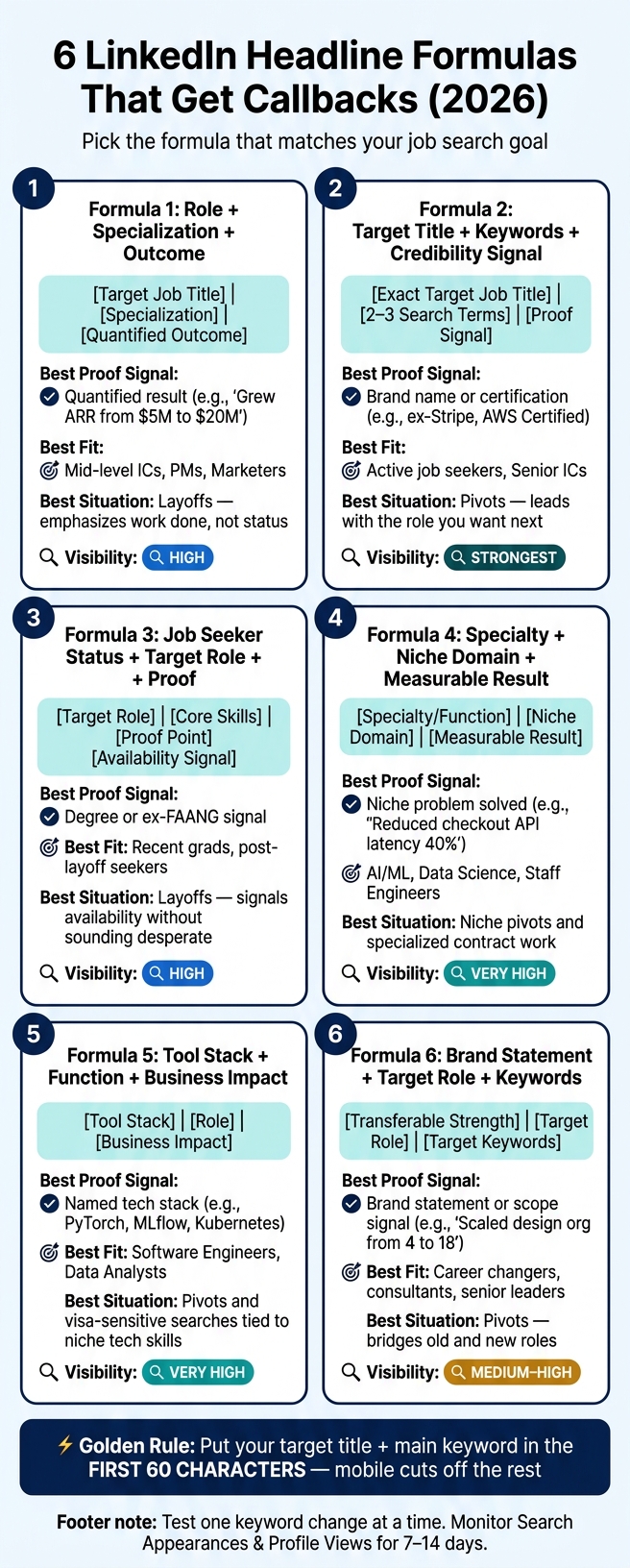
LinkedIn Headline Formulas That Get Callbacks: 6-Formula Comparison Guide
Once you’ve written the headline, use this table to pick the formula that matches your goal.
If you want more search visibility, go with Formula 2. If you need a tighter niche fit, Formula 4 or Formula 5 usually works better.
This is the practical trade-off: some headlines cast a wider net, while others help you show up for a smaller, more targeted set of searches. If you're trying to apply for jobs across a broad range of openings, visibility often matters more. If you're aiming at a narrow lane, specificity tends to win.
| Formula | Recruiter Visibility | Specificity Level | Best Proof Signal | Best Fit | Best Situation |
|---|---|---|---|---|---|
| 1. Role + Specialization + Outcome | High | High | Quantified result | Mid-level ICs, PMs, Marketers | Layoffs - emphasizes work done, not status |
| 2. Target Title + Keywords + Credibility Signal | Strongest | Medium–High | Brand or certification | Active job seekers, Senior ICs | Pivots - leads with the role you want next |
| 3. Job Seeker Status + Target Role + Proof | High | Medium | Degree or ex-FAANG | Recent grads, post-layoff seekers | Layoffs - signals availability without sounding desperate |
| 4. Specialty + Niche Domain + Result | Very high for niche searches | Very High | Niche problem solved | AI/ML, Data Science, Staff Eng | Niche pivots and specialized contract work |
| 5. Tool Stack + Function + Business Impact | Very high for stack-based searches | High | Named tech stack | Software Engineers, Data Analysts | Pivots and visa-sensitive searches tied to niche tech skills |
| 6. Brand Statement + Target Role + Keywords | Medium–High | Medium | Brand statement | Career changers, consultants | Pivots - bridges old and new roles |
Choose the formula that gets the right recruiter to stop scrolling.
If you’re using a job search platform or working with a job search coach, this table can help you tighten your personal brand on LinkedIn faster without guessing.
Next: check the mistakes that reduce visibility and suppress replies.
LinkedIn Headline Mistakes That Cut Your Callbacks
The formulas above fall apart when your headline is vague, bloated, or out of sync with recruiter search. In most cases, the problem ties back to one of four parts: role, specialization, outcome, or credibility.
One of the biggest misses is leaving LinkedIn’s default "Job Title at Company" headline in place. It uses space on info recruiters can already see in your Experience section, and it skips the search terms they use to find people. The same goes for vague or internal titles like "Customer Success Wizard" or "Associate Level II." If a recruiter searches for product manager and fintech, an internal label may keep your profile from showing up. Start with the market-facing job title, not the company’s in-house version.
Another common mistake is using a mission statement instead of a searchable headline. A line like "Passionate professional helping brands tell their story through authentic connection" may sound polished, but it gives recruiters nothing to search for. Your headline has two jobs: show up in results and earn the click. Put your target title and top hard skills near the front, especially in the first 60 characters. That’s the part people often see first.
Buzzword overload hurts too. Terms like "ninja", "guru", or "results-driven" don’t help you rank, and they can make your profile feel thin. Keyword stuffing does the opposite kind of damage. A headline like "Project Manager | Project Management | Managing Projects" looks forced and hard to read. When readability drops, clicks often drop with it. A better move is to swap empty labels for specific tools like "Salesforce", "Python", or "Agile", or add one clear result like "130% to quota."
If you’re trying to apply for jobs with more focus, this is one of the first profile fixes worth making. It also pairs well with a stronger resume built using an ai resume builder and a tighter outreach plan from a job search coach.
Use these quick fixes to catch the headline problems that show up most often.
| Mistake | Quick Fix |
|---|---|
| Default title ("Software Engineer at Acme") | "Backend Engineer | Python + AWS" |
| Fluffy ("Passionate Sales Ninja") | "Account Executive | 130% to Quota" |
| Availability-only ("Available for new roles") | "UX Designer | Figma + Design Systems | Open to Work" |
| Vague title ("Marketing Professional") | "Demand Generation Manager | B2B SaaS" |
| Mission statement ("Helping brands find their voice") | "Marketing Manager | Demand Generation & ABM Strategy | B2B SaaS" |
If your search has stalled, clean up these headline issues before you change anything else. Then rewrite your headline with the formula that fits your target role, and make sure it lines up with the rest of your job application service workflow or support from a virtual assistant for job seekers.
Conclusion
A callback-worthy headline does three jobs fast: it names the role, uses the right search terms, and adds one proof point. Put the most important words first. Lead with your target job title and top keywords, and keep them inside the first 60 characters, since that's usually what shows on mobile.
The formulas in this article are not one-size-fits-all. A software engineer and a product manager may both need keyword-heavy headlines, but the right setup changes based on your goal. Are you signaling open availability? Showing transferable skills? Proving impact with numbers? That part changes the formula.
Test slowly and keep it clean. Change one variable, then watch Search Appearances and Profile Views for 7–14 days. If search appearances stay flat, swap one keyword and test again. That's the whole game: help recruiters spot fit fast enough to click.
Pick the formula that fits your search goal, then test one keyword change at a time. If you want human help with tailoring and ATS-friendly resumes, use scale.jobs. If you just want self-serve edits, a lighter tool may be enough.
FAQs
How often should I update my LinkedIn headline?
Update your LinkedIn headline when your career direction changes, the role you want changes, or you have a new metric worth showing off.
Don’t write it once and forget about it for years. Your headline carries a lot of weight in LinkedIn search, so it should match the job you want now, not just the title on your current badge.
If you’re switching industries, change it. If you’re moving from an individual contributor role into management, change it. If you just shipped a strong result like “Cut onboarding time by 35%” or “Grew pipeline by $1.2M,” work that in too.
Think of your headline as a live snapshot of where you’re headed. When your target changes, your headline should change with it.
Should my headline match my resume title exactly?
Yes - your LinkedIn headline and resume title should line up because both help recruiters find you in search.
That said, your headline shouldn’t be a word-for-word copy. Keep the main job title the same, then add key skills, industry focus, and proof points that help you stand out. Think of it as a search-friendly pitch, not just a job label.
What if I do not have strong metrics to use?
If you don’t have hard numbers, use clear proof points instead. Recruiters still want signs that you can do the job, so give them concrete evidence.
That can mean well-known company experience, shipped projects, rare qualifications, or hands-on operating work. Put the spotlight on the problems you solve and what you build, manage, or improve. That keeps your headline credible, specific, and easy to remember - even without a percentage or dollar figure.