
Slack vs Discord vs Geneva: best communities for remote job leads

Sarah Mitchell
May 18, 2026

In 2026, Slack, Discord, and Geneva have become key platforms for finding remote job leads not typically available on traditional job boards. Each offers unique strengths: Slack is structured and professional, Discord is casual and community-driven, and Geneva focuses on curated, niche groups. However, all require active participation and manual effort to turn leads into applications.
For those needing a more efficient approach, Scale.jobs simplifies the process by managing job applications on your behalf - offering ATS-optimized resumes, real-time updates, and proof of submission. This article compares these platforms to help you decide which fits your job search strategy.
Quick Comparison:
| Platform | Best For | Key Features | Limitations |
|---|---|---|---|
| Slack | Professional networking | Structured channels, searchable leads | No built-in application tools |
| Discord | Real-time community building | Voice/text channels, live events | Overwhelming content, unmoderated |
| Geneva | Niche communities | Curated groups, low-noise interface | Limited job lead volume |
| Scale.jobs | Application execution | Human-powered, ATS-optimized resumes | Paid service |
Each platform serves a specific role in the remote job search process. Use Slack, Discord, or Geneva to find leads, then rely on Scale.jobs to handle applications efficiently.
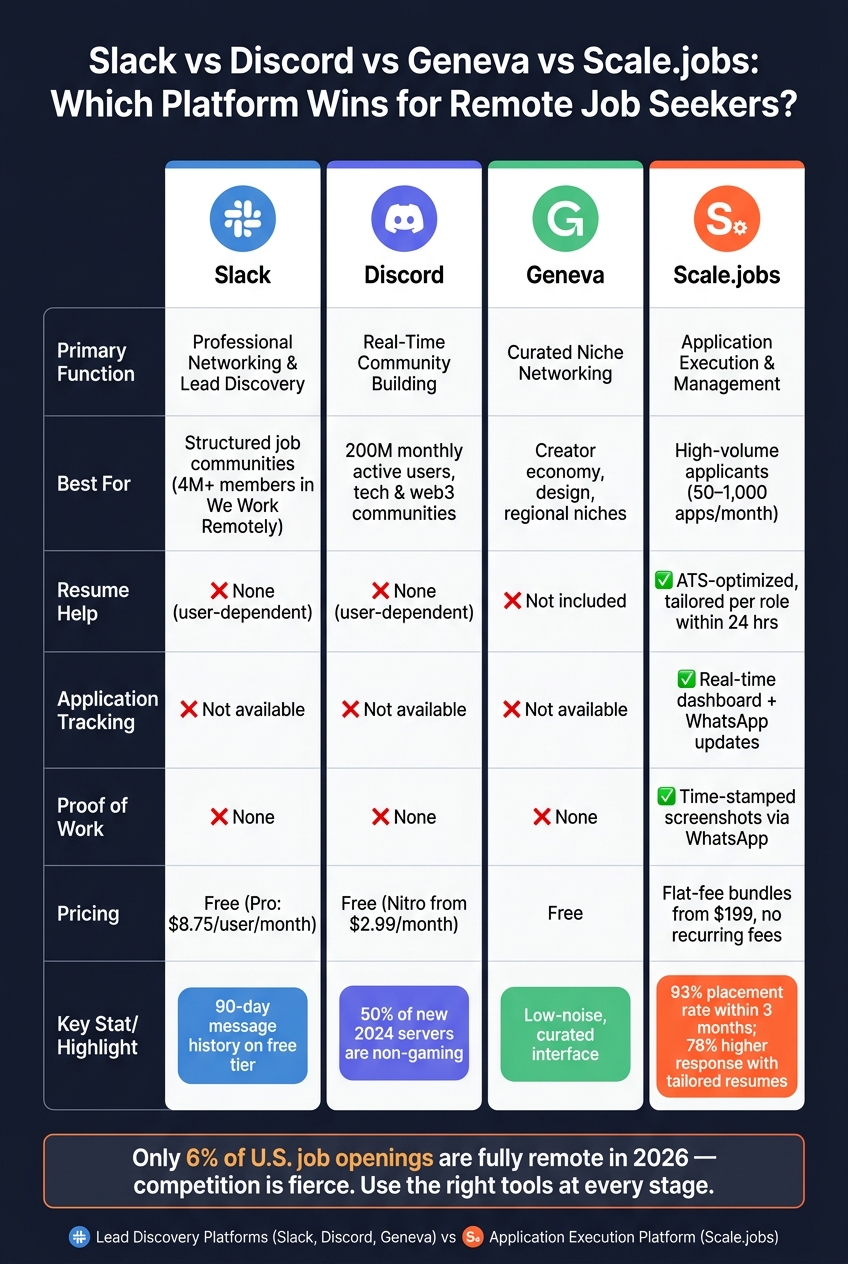
Slack vs Discord vs Geneva vs Scale.jobs: Remote Job Search Platform Comparison
How Slack, Discord, Geneva, and Scale.jobs Fit Into a Remote Job Search
How Slack, Discord, and Geneva Are Used for Job Hunting
Each platform brings something different to the table when it comes to remote job hunting.
Slack stands out as the most structured option. It organizes job leads through threaded conversations within communities like We Work Remotely (boasting over 4 million members), Remotive, Remote Women, and Nomad List. Its robust search features allow users to filter for specific job titles or company mentions, even months after they were posted. This makes it an excellent tool for tracking leads over time. As data scientist Gianluca Malato puts it:
"Slack is just the right communication tool when it comes to remote work. It allows remote co-workers to easily communicate with each other whenever they want."
Discord, on the other hand, is designed for real-time interaction. With around 200 million active users every month, it fosters a sense of community through live text streams, always-on voice channels, and a casual networking vibe. While it’s great for spontaneous referrals and quick voice chats, the lack of moderation can make job leads harder to find as they quickly get buried in the chatter.
Geneva offers a quieter, more curated experience, perfect for niche professional groups. While its job-lead network isn’t as extensive as Slack’s, its low-clutter design makes it easier to focus on meaningful connections. Both Discord and Geneva are excellent for networking, but Geneva’s minimalist approach can feel less overwhelming compared to Discord’s bustling channels.
These platforms are great for uncovering opportunities, but turning those leads into actual job applications requires a different approach.
Where Scale.jobs Fits in the Remote Job Search Process
While Slack, Discord, and Geneva excel at helping you discover job leads, Scale.jobs focuses on converting those leads into successful applications. With only 6% of all U.S. job openings being fully remote as of early 2026, competition for these roles is fierce. The gap between finding a job and securing an interview has never been wider.
Scale.jobs bridges this gap by offering a managed application service. Instead of leaving you to handle the tedious application process, Scale.jobs steps in with human assistants who take care of it for you. Here’s what makes it different:
- Real human assistants handle every application manually.
- Resumes are tailored and optimized for applicant tracking systems (ATS) to ensure they meet the specific requirements of each role.
- Updates are sent in real-time via WhatsApp, complete with time-stamped proof of work.
- Flat-fee pricing eliminates recurring costs, making it a straightforward option for job seekers.
Unlike automated tools, every application is submitted by hand, ensuring a personal touch. For those needing extra support, Scale.jobs also offers resume writing services, combining expert-crafted resumes with direct application assistance.
In essence, platforms like Slack, Discord, and Geneva help you find opportunities, while Scale.jobs ensures you can act on them effectively - saving you the 20+ hours typically spent on manual applications.
| Platform | Primary Role in Job Search | Key Strength |
|---|---|---|
| Slack | Lead discovery & professional networking | Searchable history, structured communities |
| Discord | Relationship building & real-time networking | Voice channels, community culture |
| Geneva | Niche community engagement | Curated, low-noise interface |
| Scale.jobs | Application execution & resume optimization | Human assistants, ATS-optimized submissions |
sbb-itb-564272e
Tech Recruiting Academy - Sourcing Through Discord and Slack
Slack for Remote Job Leads: What It Does Well and Where It Falls Short
When deciding between Slack and scale.jobs, it's essential to weigh the difference between a discovery-driven platform and a service focused on managing and executing job applications.
What Slack Gets Right for Job Seekers
Slack shines in its ability to organize information. Unlike the chaos of a typical social feed, Slack communities divide conversations into channels based on topics, industries, and roles. For example, in communities like Remotive, you’ll find channels dedicated to engineering, design, and marketing jobs. Similarly, Remote Women offers channels for job postings, mentorship, and salary negotiation, all within a single workspace. This setup simplifies your search and keeps things focused.
Another key benefit is direct access to recruiters. Many Slack groups extend established job boards, where hiring managers and recruiters post openings directly. Communities like We Work Remotely, one of the largest remote-focused Slack groups, let you see new listings early. Additionally, AMA (Ask Me Anything) sessions with industry professionals provide invaluable insights into breaking into specific companies or roles.
However, while Slack is excellent for finding leads, it doesn’t assist with the application process itself.
Where Slack Falls Short Compared to scale.jobs
Slack's main drawback is the disconnect between finding job leads and executing applications. Once you spot a promising opportunity, you’re left to handle everything on your own - researching the role, tailoring your resume, navigating the company’s ATS portal, writing a cover letter, and submitting the application. There’s no built-in tracking system, no consolidated application history, and no tools to manage follow-ups. Juggling multiple Slack workspaces only adds to the challenge, often causing leads to slip through the cracks or deadlines to be missed.
Low callback rates further highlight Slack’s limitations. This is where scale.jobs steps in with a more cohesive approach:
- Human-powered applications: Trained assistants handle applications manually, adding a personal touch.
- Centralized tracking: A dashboard consolidates all application progress, unlike Slack’s scattered approach.
- ATS-optimized resumes: Resumes are customized for each role to meet applicant tracking system (ATS) requirements.
- Proof of submission: WhatsApp updates include time-stamped screenshots for every application.
- Transparent pricing: One-time flat fees replace recurring subscriptions, offering predictable costs.
scale.jobs fills the gaps left by Slack. After identifying a lead, scale.jobs' team takes over, tailoring your resume, submitting applications through any portal, and providing proof of submission via WhatsApp. For those starting from scratch, scale.jobs also offers expert resume writing services paired with application support. With a verified 93% placement rate within three months, scale.jobs delivers results that a Slack-based job search cannot match.
Slack vs scale.jobs: Who Should Use Which?
Who should use Slack
Slack is ideal for those who value early networking opportunities and engaging with industry-specific communities.
Who should choose scale.jobs
scale.jobs is the better choice for job seekers who want a streamlined, professionally managed application process.
| Criteria | Slack | scale.jobs |
|---|---|---|
| Primary function | Lead discovery & networking | Application execution & management |
| Human involvement | None (self-directed) | Trained human VAs handle every application |
| Resume customization | User-dependent | ATS-optimized, tailored per role |
| Application tracking | Manual, no built-in tools | Dashboard with real-time WhatsApp updates |
| Proof of work | None | Time-stamped screenshots per application |
| Pricing model | Free to join most communities | Flat-fee bundles, no recurring subscriptions |
The table above highlights the strengths of each platform, helping you decide which aligns with your job search strategy. As you explore Slack’s capabilities, don’t miss the upcoming sections on Discord and Geneva for more options to refine your approach.
Discord for Remote Job Leads: What It Does Well and Where It Falls Short
Discord has evolved significantly from its gaming-focused beginnings. With over 200 million monthly active users and nearly half of its new servers in 2024 catering to non-gaming interests, it has become a noteworthy platform for professional networking - particularly in tech, web3, and remote work sectors. Let’s explore what makes Discord a valuable tool for job seekers and where it struggles compared to platforms like scale.jobs.
What Discord Gets Right for Job Seekers
Discord’s biggest strength lies in its ability to connect people in real time through niche communities. For example, servers like Nomad List bring together remote workers from across the globe, while web3 developer groups often share job opportunities - ranging from contract gigs to full-time positions - that may not be listed on traditional job boards. Its voice and text channels allow for instant communication, making it easier to engage with hiring managers or team leaders directly.
Features like Stages and Scheduled Events also stand out. These tools let community organizers host live networking events, AMAs (Ask Me Anything sessions), and even hiring meetups. Such dynamic interactions can lead to referrals and job opportunities faster than static listings on a typical job board.
While these strengths are compelling, Discord has notable limitations that platforms like scale.jobs address more effectively.
Where Discord Falls Short Compared to scale.jobs
A major drawback of Discord is the overwhelming amount of irrelevant content that can obscure valuable job leads. Without proper moderation or curation, important opportunities may get lost in the noise. The quality of moderation varies significantly from server to server, adding to the inconsistency.
Another challenge is the lack of built-in tools to track your job search progress. Discord doesn’t offer features to monitor which roles you’ve applied for, which applications are still pending, or which positions have been filled. Once you identify a job opportunity, the entire process - researching, applying, and following up - is entirely your responsibility. This manual approach can be exhausting, especially when juggling multiple applications in a competitive market.
Here’s where scale.jobs steps in. Unlike Discord, scale.jobs provides a streamlined process for handling job applications. Trained human assistants manage every step, from crafting ATS-friendly resumes and cover letters to submitting applications. They even send time-stamped proof of submission via WhatsApp, ensuring transparency and saving you hours of effort.
Discord vs scale.jobs: Who Should Use Which?
Both Discord and scale.jobs have their unique advantages, but they cater to different needs. Discord excels at networking and discovering job leads, making it ideal for those in tech, web3, or remote work who thrive on real-time interactions. On the other hand, scale.jobs simplifies the application process, ensuring your materials are tailored and submitted efficiently without requiring constant manual effort.
Here’s a quick comparison to highlight the differences:
| Criteria | Discord | scale.jobs |
|---|---|---|
| Primary function | Real-time networking & lead discovery | Structured application execution |
| Human involvement | Self-directed | Trained human VAs manage every application |
| Resume customization | User-dependent | ATS-optimized and tailored per role within 24 hours |
| Application tracking | Manual, with no built-in tools | Dashboard with real-time WhatsApp updates |
| Proof of work | Not provided | Time-stamped submission screenshots |
| Pricing model | Free (with Nitro starting at $2.99/month) | Flat-fee bundles starting at $199 with no recurring fees |
If you enjoy tapping into niche communities and engaging in direct conversations, Discord is a great option. However, if you’re looking for a reliable and organized way to turn those leads into interview opportunities, scale.jobs offers a more efficient and stress-free solution.
Geneva for Remote Job Leads: What It Does Well and Where It Falls Short
Geneva is a community platform structured around "Homes", which are organized spaces containing individual "Rooms" for chat, audio, video, or broadcast. This unique setup sets it apart from platforms like Slack and Discord, making it a go-to option for professionals in the creator economy, lifestyle-focused groups, and niche professional networks.
While Geneva shines in fostering niche networking, it lacks the tools for efficiently converting leads into interviews. For that, platforms like scale.jobs take the lead.
What Geneva Gets Right for Job Seekers
Geneva’s standout feature is curation. Its communities are smaller, more focused, and better moderated than many alternatives. Professional "Homes" often include job-focused "Rooms", where members share leads and referrals that you won’t typically find on major job boards. For those in fields like design, the creator economy, or specific regional hubs, this peer-to-peer sharing can uncover opportunities that might otherwise stay hidden.
The platform also supports live events, enabling activities like rapid networking and portfolio reviews. Compared to the cold outreach of platforms like LinkedIn, these events can help job seekers connect faster and more meaningfully.
However, Geneva's strengths in curated networking are offset by its manual approach to applications, something scale.jobs automates with precision.
Where Geneva Falls Short Compared to scale.jobs
Geneva’s tight-knit structure inherently limits its reach. The volume of job leads is intentionally narrow, and the platform lacks built-in tools for managing applications. There’s no applicant tracking system (ATS), no resume optimization, and no automated application process. This means that once you find a lead, you’re left to handle everything - from research to submission - on your own.
This is where scale.jobs steps in. Its trained human assistants manage the entire application process, from creating ATS-optimized resumes and cover letters tailored to specific roles to submitting applications within 24 hours. Users even receive time-stamped proof of submissions via WhatsApp, ensuring transparency and eliminating guesswork. If you’re also looking to refine your core documents, their resume writing services integrate seamlessly with their application management system.
Why scale.jobs Stands Out
- Human-powered applications: Dedicated assistants take care of every application, saving you from the manual effort Geneva requires.
- ATS-optimized resumes and cover letters: Each document is tailored to the role and optimized for applicant tracking systems, delivered within 24 hours.
- Flat-fee pricing: With bundles starting at $199 and no recurring fees, it’s a cost-effective alternative to the time investment Geneva demands.
- Real-time tracking and proof of work: Submissions are documented with time-stamped screenshots via WhatsApp, ensuring complete transparency.
- Centralized application management: A dashboard consolidates all your application progress - a feature Geneva doesn’t offer.
Geneva vs scale.jobs: Who Should Use Which?
Geneva is ideal if you’re deeply involved in a specific niche, such as the creator economy or a regional professional network, and value relationship-building over sheer application volume. It’s a slower, more organic approach that works when the community is active and aligned with your goals.
On the other hand, scale.jobs caters to those ready to move from networking to action. If you’ve built your connections and now need to convert leads into interviews efficiently, it’s the logical next step. These platforms aren’t necessarily competing - they serve different stages of the job search process. Geneva helps you find the leads, while scale.jobs ensures those leads turn into applications.
| Criteria | Geneva | scale.jobs |
|---|---|---|
| Primary function | Curated niche networking | High-volume application execution |
| Human involvement | Self-directed | Trained human assistants handle applications |
| Resume customization | Not included | ATS-optimized, tailored per role within 24 hours |
| Application tracking | Not available | Real-time dashboard with WhatsApp updates |
| Proof of work | Not provided | Time-stamped submission screenshots |
| Pricing model | Free | Flat-fee bundles starting at $199, no recurring fees |
If your focus has shifted from building connections to securing interviews, scale.jobs offers the tools Geneva lacks, making it the perfect follow-up to a well-established network.
Slack vs Discord vs Geneva vs scale.jobs: Side-by-Side Comparison
Key Strengths of Each Platform at a Glance
When comparing Slack, Discord, and Geneva, it's clear that each platform caters to specific aspects of the job search process. However, scale.jobs distinguishes itself by managing the entire application process, offering unparalleled support for job seekers. Here's a breakdown of how these platforms serve different needs and where scale.jobs takes the lead.
Slack is ideal for structured networking. Its threaded conversations and professional communities like We Work Remotely and Remotive make it a great tool for finding remote job leads. That said, the free tier's 90-day message history limit can make it challenging to revisit older opportunities.
Discord focuses on real-time interaction. With always-on audio channels and free core features, it's a more casual and social platform. However, it lacks the professional focus and organizational tools that Slack offers. As Justin Pot from Zapier aptly noted:
"Slack is for work, Discord is for play... but these apps aren't entirely interchangeable. They have different strengths and weaknesses, which reflect their designers' priorities."
Geneva is tailored for smaller, curated communities, often centered around creators, designers, or regional professional groups. While it surfaces unique leads not commonly found on major job boards, its intentionally limited volume may not meet the needs of job seekers looking for a broader range of opportunities.
While these platforms excel at lead discovery, they don't provide the hands-on support needed for applications. This is where scale.jobs steps in. It offers a comprehensive application service that includes tailored documents, direct submissions, and real-time updates. Here's what sets scale.jobs apart:
- Human assistants manage the entire application process, from preparing documents to submitting applications on any portal.
- ATS-optimized documents tailored for specific roles are delivered within 24 hours.
- Flat-fee pricing eliminates recurring costs.
- WhatsApp support provides time-stamped proof of every submission.
- A centralized dashboard tracks all progress in one place.
For those looking to enhance their applications with professional-grade resumes, scale.jobs also integrates resume writing services directly into its workflow. The comparison table below highlights how each platform measures up.
Full Comparison Table: Slack, Discord, Geneva, and scale.jobs
| Criteria | Slack | Discord | Geneva | scale.jobs |
|---|---|---|---|---|
| Primary function | Professional networking & structured chat | Community building & audio/video | Curated niche networking | Application execution & management |
| Human involvement | High - user-driven networking | High - social and community-led | High - relationship-based | Trained human assistants handle applications |
| Resume customization | Manual, peer feedback only | Manual, no built-in tools | Not included | ATS-optimized, tailored per role within 24 hours |
| ATS handling | None | None | None | Specialized - zero bot-flags |
| Application execution | Manual, user-led | Manual, user-led | Manual, user-led | Managed by human VAs across any portal |
| Proof of work | Not provided | Not provided | Not provided | Time-stamped screenshots via WhatsApp |
| Application tracking | Not available | Not available | Not available | Real-time dashboard |
| Pricing model | Free (90-day history limit); Pro at $8.75/user/month | Free core; optional Nitro upgrades | Free | Flat-fee bundles from $199, no recurring fees |
Slack, Discord, and Geneva are excellent for building connections and finding leads - the top of the funnel in the job search process. On the other hand, scale.jobs specializes in the bottom of the funnel by handling applications with precision, documentation, and support. Together, these platforms can cover the entire job search journey seamlessly.
Which Platform Should You Use? Decision Summary and Recommendations
After analyzing Slack, Discord, and Geneva, it’s clear that each platform serves distinct purposes in the job search process. However, knowing when to use each and when to rely on scale.jobs for application execution can make all the difference.
Your choice should align with your current job search needs. Slack is ideal for those seeking structured, professional communities with searchable archives. Many Slack groups provide vetted job leads and peer advice. Discord is better suited for those who prefer real-time conversations and informal coworking spaces. Meanwhile, Geneva can be a great fit for niche fields like design, content creation, or regional tech, where smaller, curated groups often highlight opportunities not listed on mainstream job boards.
Who Should Use Slack, Discord, or Geneva
While these platforms are excellent for networking and discovering leads, they all stop short when it comes to executing applications. Once you've identified a role, tasks like tailoring resumes and managing follow-ups often become time-consuming hurdles. This is where scale.jobs steps in to provide a seamless solution.
Who Should Choose scale.jobs
scale.jobs goes beyond networking by serving as an execution-focused platform. It offers trained human assistants who manage job submissions across any portal, deliver ATS-optimized resumes within 24 hours, and provide time-stamped proof of every application via WhatsApp. Additionally, its integrated resume writing and career toolkit ensures professional-grade application materials. While platforms like Slack, Discord, and Geneva are great for generating leads, scale.jobs excels at transforming those leads into actionable, proof-backed applications.
Switch to scale.jobs If...
You might want to consider switching to scale.jobs if any of the following apply:
- High Application Volume: Applying to over 50 roles per month can be overwhelming. scale.jobs offers bundles for up to 1,000 applications starting at $399. Notably, 70% of users receive refunds because they secure jobs before utilizing all their credits.
- Lack of Callbacks: If you're networking actively but not receiving responses, ATS filters may be rejecting your resume. Tailored resumes have been shown to increase response rates by 78%.
- Targeting Large Employers: Applying to organizations with high ATS usage often requires optimized applications to pass initial screenings.
- Limited Time: Balancing a job search with full-time work can be exhausting, especially when manual applications consume over 20 hours weekly.
- Need for Documentation: Whether for visa compliance, severance requirements, or personal record-keeping, scale.jobs provides time-stamped screenshots of every submission via WhatsApp.
Decision Summary
Use Slack for structured networking, Discord for informal, real-time interactions, and Geneva for specialized, niche communities. When it’s time to turn those leads into applications, scale.jobs is your go-to for efficient, human-powered execution. With ATS-optimized documents, one-time payment options, WhatsApp support, and complete proof-of-work transparency, scale.jobs bridges the gap between networking and landing your next role.
FAQs
Which platform finds the most remote job leads for my role?
As of 2026, Discord communities have become a standout resource for remote job leads, with 80% of opportunities being shared within private, real-time groups. These communities often lead to quicker hiring timelines, typically ranging from 1 to 3 weeks, and boast higher success rates thanks to referral-based connections. While platforms like Scale.jobs offer comprehensive support for job seekers, Discord’s specialized groups shine in providing direct networking opportunities and uncovering less visible roles, making them a valuable option for those actively searching for work.
How can I avoid losing job posts across multiple communities?
To ensure your job posts don't get buried, it's helpful to use platforms that centralize your job search efforts. While networking communities like Slack, Discord, and Geneva are excellent for making connections, they can sometimes make it harder to keep track of opportunities. Pair these platforms with tools designed to streamline your search - such as those that provide ATS-optimized resumes or application tracking features. This combination keeps everything organized and manageable. Prioritize active, industry-specific groups that offer referral opportunities, and maintain a clear record of your progress to stay on top of leads and avoid missing out on potential roles. For added support, consider using a job search virtual assistant or a job application service to simplify the process.
When should I outsource applications instead of applying myself?
When you're dealing with a large number of job applications, tight deadlines, or the need for quick results, outsourcing can be a smart move. For example, if you're applying to over 100 jobs in a month or navigating urgent visa requirements, outsourcing can save you significant time and effort while potentially improving your chances through ATS-optimized resumes. On the other hand, if you're applying to fewer than 10 roles each month and have plenty of time, handling the process yourself might be more manageable.