
H1B Cap-Exempt Jobs for AI & ML Researchers

Sarah Mitchell
July 16, 2026

If I’m on F-1 OPT, I should not build my AI/ML job search around the H-1B lottery alone. The safer path is often to target cap-exempt employers that can file year-round, especially when I only get 90 days of unemployment on OPT and 150 days total on OPT + STEM OPT.
Here’s the short version:
- Cap-subject H-1B depends on a yearly lottery and an October 1 start date.
- Cap-exempt H-1B can often be filed any time of year.
- For AI and ML researchers, cap-exempt roles are often found at:
- universities
- university-linked hospitals
- nonprofit research institutes
- government research labs
- The hard part is not just finding roles. It is verifying the employer and getting applications through messy research portals without wasting OPT time.
- That is why many candidates use a mix of a job search platform, an ai resume builder, and a job application service.
H-1B Cap-Exempt Jobs: Indian Beneficiaries' Path Beyond Lottery
sbb-itb-564272e
Quick comparison
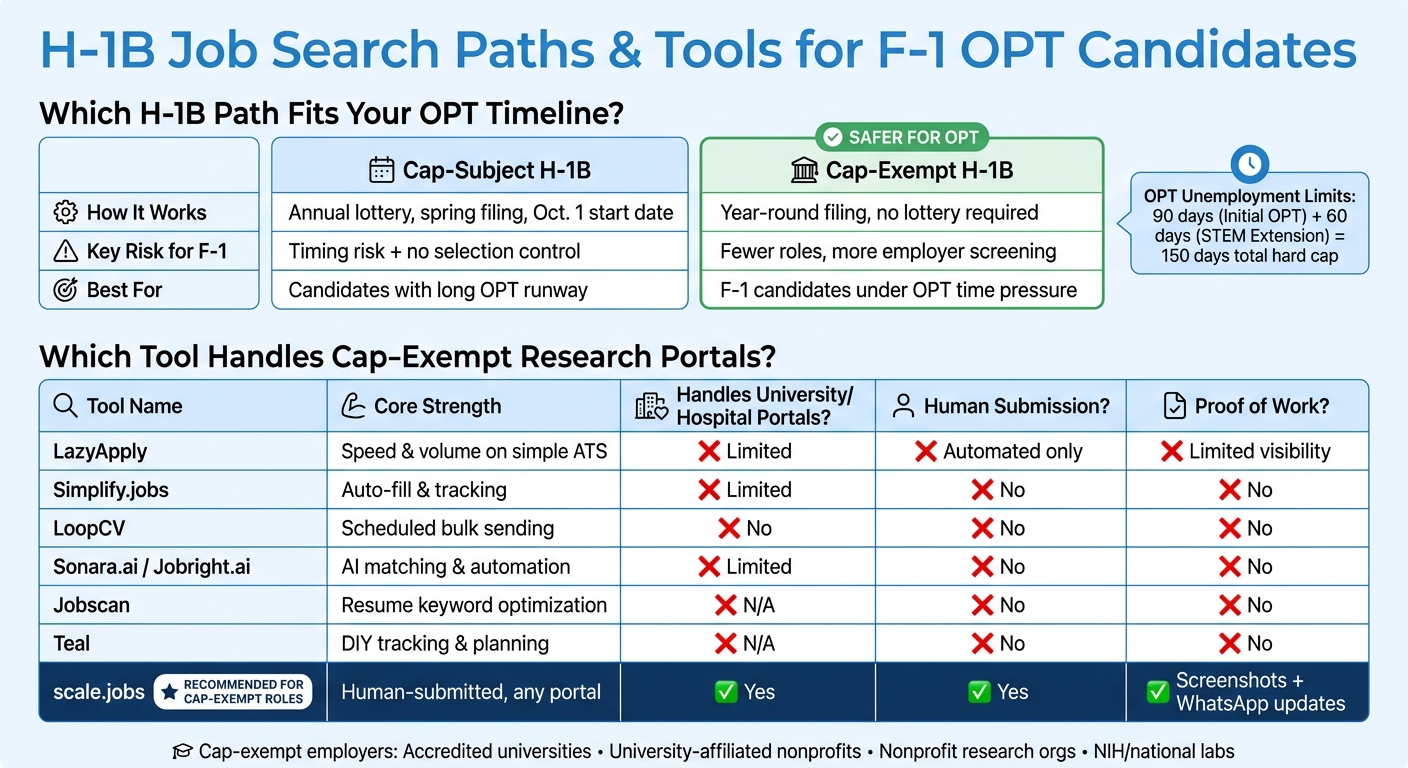
Cap-Exempt vs Cap-Subject H-1B: Job Search Tools Compared for F-1 OPT Candidates
| Path | How it works | Main issue for F-1 candidates |
|---|---|---|
| Cap-subject H-1B | Annual lottery, spring filing, Oct. 1 start | Timing risk and no selection control |
| Cap-exempt H-1B | Year-round filing through eligible employers | Fewer roles and more employer screening |
| DIY search | I find, tailor, submit, and track everything myself | Time drain across 300–800 applications |
| Auto-apply tools | Browser tools send high-volume applications | Many fail on university and hospital portals |
| Human-led help | People handle submissions and tracking | Costs more than software-only tools |
If I’m under OPT pressure, the playbook is simple: find cap-exempt targets early, verify them fast, and submit a high volume of clean applications without delay.
My simple playbook
1) Start with employer type, not job title
A “Research Scientist” title at a private company is not the same as a research role at a university lab. I first check whether the employer is:
- an accredited university
- a nonprofit tied to a university
- a nonprofit research group with research as a main function
- a government research lab or linked institute
If not, I do not assume the role is cap-exempt.
2) Work backward from my OPT clock
I treat job search timing like a deadline, not a side task.
- Initial OPT: 90 unemployment days
- STEM OPT total: 150 unemployment days across the full period
That means each week of delay matters. So I batch my search, track submissions, and Apply for jobs early instead of waiting for “perfect” roles.
3) Use tools based on portal type
For standard ATS portals, simple tools may be enough to beat ATS rejections.
For university and hospital systems, I usually need more than auto-fill. This is where a Virtual Assistant for Job Applications or job search virtual assistant setup makes more sense, since those applications often require:
- research statements
- publication links
- custom uploads
- manual profile creation
- repeat follow-up steps
Is LazyApply worth it for cap-exempt AI/ML roles?
Sometimes, but only for simple portals.
If I’m applying to standard software roles on clean ATS systems, LazyApply can help with volume. But if my target list includes university labs, hospitals, and nonprofit research portals, it can fall short.
I would ask:
- Does it handle portal changes well?
- Can it tailor a research resume to each posting?
- Can I confirm what was fully submitted?
If the answer is no, then I need more than automation.
LazyApply vs Scale.jobs
This comparison is useful if my issue is execution, not just job discovery.
LazyApply fits candidates who want software-led volume.
Scale.jobs fits candidates who want people to handle submissions across mixed portals.
The main difference is simple:
-
- LazyApply = automation-first
- Scale.jobs = human-submitted workflow
That matters when I’m dealing with cap-exempt roles hidden across school and hospital sites instead of the best job boards.
Simplify.jobs, LoopCV, Sonara.ai, Jobright.ai, Jobscan, and Teal vs Scale.jobs
These tools each help with one part of the process:
- Simplify.jobs: auto-fill and tracking
- LoopCV: bulk sending
- Sonara.ai / Jobright.ai: matching and automation
- Jobscan: resume keyword checks
- Teal: planning and tracking
That said, none of these fully replaces a daily job search system for cap-exempt research workflows.
If I need help with:
- identifying companies that truly sponsor H1B
- tailoring research resumes
- handling school and hospital portals
- keeping proof of submission
then a virtual assistant for job seekers or job search coach can fill the gaps better than a single browser extension.
My cap-exempt application checklist
Before I pay for any tool or service, I check whether it can do these six things:
- find university, hospital, and research nonprofit roles
- support hard institutional portals
- tailor my resume for each role
- tailor cover letters when needed
- keep proof of each submission
- give me clear pricing
If a tool only helps me organize links, it is not enough. If it only edits resumes, it is not enough. For high-stakes visa searches, I need the full chain.
A workflow I would use right now
Find
I collect roles from university sites, hospital systems, nonprofit labs, and niche research boards. I do not rely only on public boards for full time jobs.
Prep
I tailor my materials to the posting. For research roles, this often means:
- resume edits
- publication order changes
- project emphasis
- cover letter edits
This is where an ai cover letter builder can save time.
Apply
I submit based on portal type:
- easy ATS = self-submit or simple tool
- hard institutional portal = human help or manual review
Track
I log:
- date submitted
- employer type
- cap-exempt check result
- portal used
- current status
This helps me keep control of my OPT timeline.
FAQ-style answers
What counts as a cap-exempt H-1B employer?
Usually universities, some university-linked nonprofits, nonprofit research groups, and some government research organizations.
Can any AI research job be cap-exempt?
No. The employer, not just the title, decides that.
Should I wait for the H-1B lottery first?
If I am on OPT, waiting can cost me status time. I would search for cap-exempt roles at the same time.
Are auto-apply tools enough for university research jobs?
Often no. Many school and hospital portals need manual work.
What if I only want nearby backup work?
If I need short-term options while planning my next step, I may also search for Part time jobs near me, but I still need to check visa rules before taking any role.
Bottom line
If I’m an AI or ML researcher on F-1, the safest move is not to rely on the lottery alone. I would build my search around year-round cap-exempt targets, verify employers early, and use the right mix of tools and people to keep applications moving before OPT days run out.
The Visa Rules That Should Shape Your Job Search Strategy
OPT and STEM OPT limits that affect how aggressively you need to apply
STEM-eligible graduates can extend OPT to 36 months total, but the unemployment limit is tight: 150 days across the full period. That breaks down to 90 days during initial OPT and 60 extra days during the STEM extension. There’s no wiggle room here. It’s a hard cap across both phases.
That changes how you should approach your search. Every week spent chasing poorly matched roles eats into your unemployment buffer. In plain terms, waiting too long or applying too narrowly can cost you time you may not get back.
That’s why application volume matters now, not later. If you need a more structured way to Apply for jobs at scale, this is the point where process beats guesswork.
Once you know where you stand on the OPT clock, the next filter is simple: cap-subject or cap-exempt.
Cap-subject vs. cap-exempt H-1B for research roles
Cap-subject H-1B roles sit under the annual 85,000-visa limit. They also depend on one filing window each year: filed in the spring, selected in April, then started on October 1.
For FY2027, USCIS uses a wage-weighted lottery, which gives an edge to higher-paid roles. So if you miss the lottery, the problem isn’t just disappointment. You keep burning OPT time without a filing path.
Cap-exempt employers work very differently. They can file year-round, skip the lottery, and start without a fixed October date. For an F-1 researcher watching the unemployment clock, that difference is huge. Timing matters just as much as role fit.
This is where a focused search can help. Instead of spraying applications everywhere, it often makes more sense to use a job search platform or a job application service that helps you sort targets by visa fit, not just title.
That distinction only helps if you verify the employer before you apply.
How to confirm whether an AI or ML role is truly cap-exempt
Not every AI or ML role at a research organization is cap-exempt. Titles can sound promising and still lead nowhere on immigration timing. Before you spend one of your applications, check the employer first.
Use these checks:
- Confirm the employer is an accredited institution of higher education or has a formal written affiliation with a university.
- Confirm that research is a primary organizational activity.
- Look for a tie to a government research organization such as NIH or a national lab.
| Employer Type | Example | Cap-Exempt? |
|---|---|---|
| Accredited university | Institution of higher education | Yes |
| University-affiliated nonprofit hospital | Formally connected nonprofit hospital | Yes, with formal affiliation |
| Nonprofit research org | Organization primarily engaged in research | Yes, if research is primary |
| NIH-linked or national lab | Federal or national research lab | Yes |
| Non-cap-exempt employer | Industry AI employer | No |
Large academic research consortia often operate inside cap-exempt institutions, but you still need to verify the sponsoring employer. That’s the part many job seekers miss. If the employer fails these checks, it is not a cap-exempt target, no matter how research-heavy the title sounds.
If you want help sorting roles before you spend time applying, a job search coach or virtual assistant for job seekers can help you screen employers much faster.
Why Most Job Tools Fail for Cap-Exempt AI and ML Searches
The real blockers: scattered portals, research resumes, and timing risk
Once employer type is set, the next bottleneck is submission speed. For cap-exempt AI and ML roles, that sounds simple on paper. In practice, it gets messy fast.
These jobs often sit behind university, hospital, and nonprofit research portals. Each one has its own forms, upload rules, account steps, and follow-up flow. One portal wants separate research statements. Another asks for publication links in a custom field. A third rejects a file because the naming format is off. That kind of friction is where most automation breaks.
Research-track applications add another layer. They’re publication-heavy and need to show specific research output: publications, model work, and niche research contributions. A generic auto-apply tool can move fast, but it can’t reliably judge what matters most on a faculty-led lab posting, a grant-funded research scientist role, or a narrow ML research team opening.
That’s the core problem. These roles need judgment. You need to know what to customize, what to spotlight, and what still has to be done by hand. Speed helps, but speed alone won’t rescue a broken portal step or adjust when a new upload rule appears.
For F-1 and OPT candidates, that timing risk hits harder. The issue is not just how fast you can Apply for jobs. It’s whether your system can get through hard portals cleanly without burning OPT days on failed or incomplete submissions.
Is LazyApply worth it for cap-exempt AI and ML roles? Reviews and alternatives
LazyApply can work well if you want a light, fast way to send applications. For straightforward roles with simple portals, that approach makes sense.
But cap-exempt AI and ML searches usually aren’t simple.
This is where automation-first tools and human-submitted services split. LazyApply is built around speed, not judgment. University and hospital portals often need manual follow-up, and that’s where automation tends to stumble. It also doesn’t tailor a research resume for a specific lab or institute, and it doesn’t add the human review that many institutional portals call for.
Here’s the practical difference:
| Factor | LazyApply | scale.jobs |
|---|---|---|
| Human involvement | Fully automated | Trained human assistants handle submissions |
| Resume customization | Static resume with limited customization | ATS-optimized resume and cover letter tailored to each posting |
| ATS handling | Best for simple, mainstream portals | Handles complex institutional portals and niche boards |
| Application execution | Browser-based automation | Human-submitted applications by hand |
| Transparency/proof of work | Limited visibility into what was completed | WhatsApp updates, time-stamped proof-of-work screenshots, dashboard tracking |
| Pricing model | Subscription-based | One-time or flat-fee bundles starting at $199 for 250 applications |
Who should use LazyApply: Candidates applying mostly to straightforward corporate software roles where speed matters more than customization and portal complexity is low.
Who should choose scale.jobs: F-1 and OPT candidates targeting cap-exempt universities, hospitals, and nonprofit research institutes where the application flow changes from portal to portal, the resume needs real customization, and proof of submission matters.
If you’re weighing LazyApply vs Scale.jobs, the simplest way to think about it is this: LazyApply helps with volume, while scale.jobs is built for messy, high-stakes application flows.
You should switch to scale.jobs if:
- Your target roles sit behind institutional portals instead of a single job search platform
- Your resume needs to highlight publications, research depth, or niche technical work
- You want human review before an application is submitted
- You need clear proof that each submission was completed
- You are managing a high-stakes search and want less time spent on manual portal work
For many candidates chasing cap-exempt roles, the better alternative isn’t just another auto-apply extension. It’s a job application service or Virtual Assistant for Job Applications that can handle edge cases without dropping the ball.
Simplify.jobs, LoopCV, Sonara.ai, Jobright.ai, Jobscan, and Teal vs. scale.jobs
The same gap shows up with Simplify.jobs, LoopCV, Sonara.ai, Jobright.ai, Jobscan, and Teal. Each one helps with part of the search.
Simplify.jobs is good at auto-fill and tracking. LoopCV helps with scheduled distribution. Sonara.ai and Jobright.ai lean on AI matching and automation. Jobscan helps with resume keyword alignment. Teal is a clean DIY tracker and organizer.
Those are useful features. But for cap-exempt roles, they don’t run the full workflow from start to finish.
| Tool | Genuine Strength | Where It Falls Short for Cap-Exempt Roles |
|---|---|---|
| Simplify.jobs | Clean auto-fill and job tracking | Limited for niche institutional portals; no human submission |
| LoopCV | Scheduled automation and volume | Not built around research-specific tailoring |
| Sonara.ai | AI-based matching and applying | Limited human oversight for complex applications |
| Jobright.ai | AI-driven search support | Better for standard roles than institutional research portals |
| Jobscan | Strong ATS keyword optimization | Does not execute applications |
| Teal | Organized DIY tracking and resume tools | No application execution or portal handling |
| scale.jobs | Human assistants, ATS-optimized docs, any-portal compatibility, proof of work | More manual than pure automation, but built for high-stakes searches |
If your search depends on research-heavy applications, portal reliability, and clear submission proof, automation-only tools can create the appearance of progress without fixing the real workflow problem.
That’s why Simplify.jobs vs Scale.jobs, LoopCV vs Scale.jobs, or Teal vs Scale.jobs usually comes down to one question: do you need help organizing the search, or do you need someone to get the application submitted properly?
scale.jobs adds human execution, ATS-optimized documents, and live transparency across three practical areas: human submission, tailored research docs, and proof of work. If you’re already using an ai resume builder or ai cover letter builder, that can still help on the document side, but it won’t replace manual portal handling for these roles.
For candidates targeting cap-exempt AI and ML positions, that difference is often the line between a tracked application and a completed one.
A Cap-Exempt Job Search Workflow for AI and ML Researchers
Buyer's checklist: what your job search system must do before you pay
Once portal friction becomes the bottleneck, a tool has to do more than basic autofill. Before you spend money on any job search platform, test it against the list below. If it misses even one item, it can burn precious OPT time on cap-exempt searches.
| Requirement | Why It Matters | Does scale.jobs cover it? |
|---|---|---|
| Cap-exempt employer discovery | Universities, hospitals, and research nonprofits are common cap-exempt employers | 50,000+ career pages monitored |
| University and hospital portal support | Complex institutional portals often break standard automation tools | Human assistants submit any portal |
| ATS-optimized, tailored resume per role | AI and ML research roles need role-specific customization to get past filters | AI-tailored resume and cover letter per posting |
| Human oversight before submission | Reduces failed or incomplete applications on complex forms | Hand review before submission |
| Proof of work | Critical for managing the 90-day OPT unemployment clock | WhatsApp updates + time-stamped screenshots |
| Predictable, flat-fee pricing | Useful when you need to manage a 300–800 application search without recurring subscriptions | Flat-fee bundles from $199 to $1,099 |
scale.jobs combines free tracking, AI tailoring, and human submission.
That’s the baseline. The next step is matching those needs to the way a cap-exempt search actually works.
Find, Prep, Apply, Track: how scale.jobs maps to your visa timeline
The four-stage workflow below lines up with how F-1 and STEM OPT candidates move through a cap-exempt search - and where time usually slips away.
Find. scale.jobs monitors 50,000+ career pages, including university, hospital, and nonprofit research portals. That matters when you’re trying to Apply for jobs beyond the usual public boards.
Prep. Research resumes need role-specific tailoring and ATS-ready formatting. The AI Assistant Pro layer generates a tailored resume and cover letter for each posting in a single click, based on the actual job description. If you’re comparing tools, this is where an ai resume builder and an ai cover letter builder can save hours.
Apply. Human assistants submit by hand across any portal, including institutional systems that block automation. This is the part many software-only products miss. A Virtual Assistant for Job Applications can handle forms that bots often fail to complete.
Track. Every submission is logged with time-stamped proof-of-work screenshots. You can see what was submitted, when, and to which employer. That record helps if you need to show an active search during the 90-day OPT unemployment window.
Time and cost math: when switching from DIY or automation to scale.jobs makes sense
After fit and execution, the choice usually comes down to time lost per application and the price of failed submissions.
DIY search is slow and labor-heavy. Software-only tools move faster, but they often trip over institutional portals and usually don’t confirm whether the submission fully went through. Human-assisted campaigns cover both gaps. Flat-fee bundles range from $199 to $1,099 as one-time campaigns, and at volume, the cost can drop to about $0.03 per application.
Switch to scale.jobs when your target roles sit behind university or hospital portals, your resume needs role-specific edits, and you can’t risk incomplete submissions against a hard visa deadline.
If you’re weighing options, the useful comparison isn’t just automation versus manual work. It’s X vs Scale.jobs based on one simple point: how much human review your search needs. That question tends to matter even more for cap-exempt roles than for standard full time jobs on the best job boards.
Why scale.jobs Is Built for High-Stakes Job Searches
How scale.jobs helps F-1 and OPT candidates under time pressure
scale.jobs is built for F-1 and OPT searches where a missed submission can cost OPT days. It was set up for the kind of search many international candidates face: 300 to 800 applications, a roughly 30% sponsor rate, and a hard 90-day unemployment limit. That’s a very different situation from a standard job hunt, and it’s why this isn’t positioned as just another general job search platform.
Instead, scale.jobs works more like execution support for people who need to Apply for jobs at high volume without losing time to broken portals, repeat form fields, or portal-specific quirks. That matters even more when your list includes schools, hospitals, or nonprofit research labs, where the process often goes far beyond a simple LinkedIn Easy Apply flow.
The platform combines human submission, ATS-ready resume tools, and AI-generated tailored resumes and cover letters. In practice, that means you get help from a Virtual Assistant for Job Applications while still using tools that improve your materials, like an ai resume builder and ai cover letter builder. It also includes proof-of-work tracking across standard ATS portals and institutional portals at universities, hospitals, and nonprofit research labs.
Every submission comes with time-stamped screenshots and WhatsApp updates. That proof matters. When you’re sending hundreds of applications, it’s easy to lose track of what was submitted, where it went, and whether the application was fully completed.
Candidates from teams at Goldman Sachs, Netflix, NVIDIA, Waymo, Stripe, and Airbnb have used the platform to manage searches at this volume.
Pricing is a one-time payment, not a recurring subscription. If you want to test whether this setup matches your search, the fastest option is the free 5-application trial.
scale.jobs free trial: your first 5 job applications at no cost
The free trial gives you your first 5 job applications at no cost. If your target list includes university, hospital, or nonprofit portals, start there. Those are usually the hardest ones to finish, and they’re the best way to see whether a human-led job application service fits your search better than a software-only tool.
A simple way to use the trial:
- Pick 5 roles from your hardest portals
- Share the roles first, not the easy ATS listings
- Review the proof-of-work screenshots after submission
- Check whether the team handled the portal steps the way you’d expect
- Decide after that if a larger bundle makes sense
That test tells you a lot, fast. If the team can handle your messy, fragmented portals, the easier applications usually won’t be the problem.
Tools like LazyApply, Simplify.jobs, LoopCV, Sonara.ai, Jobright.ai, Jobscan, and Teal can still help with narrower parts of the search. Some are useful for tracking, some for resume edits, and some for automation on standard portals. But they’re a different fit when the main bottleneck is application execution across fragmented institutional systems.
Decision Summary
If your search is limited to standard ATS portals, a software-first tool may be enough. That can work well for many full time jobs and high-volume listings that live inside clean, repeatable systems.
If your target roles sit behind university, hospital, or nonprofit research portals, the picture changes. In that case, human submission, tailored research documents, and proof of work can matter more than another browser extension or auto-fill bot. That’s where scale.jobs fits better, especially for F-1 and OPT candidates working against a hard deadline.
If you’re comparing options, think of it this way: software tools help with parts of the process, while scale.jobs is closer to a job search virtual assistant built for application execution under pressure.
Start with the free 5-application trial on your hardest portals.
The FAQ below answers the most common switch questions.