
Reverse Recruiting vs. Career Coaching: What's the Difference?

Sarah Mitchell
July 24, 2026

If you want someone to do the job search work for you, pick reverse recruiting. If you want advice so you can do it yourself, pick career coaching. That is the main difference.
Here’s the short version:
- Reverse recruiting helps with job sourcing, resume edits, applications, and interview scheduling.
- Career coaching helps with direction, resume feedback, networking, interview prep, and pay talks.
- AI auto-apply tools focus on volume, but often with less review and less role-by-role tailoring.
- If you already know your target role, reverse recruiting often fits better.
- If you are still figuring out your story, target roles, or interview approach, coaching usually fits better.
A lot of job seekers spend 10 to 20+ hours a week searching, editing resumes, and sending applications. So the right choice comes down to one thing: what part of the process do you want off your plate?
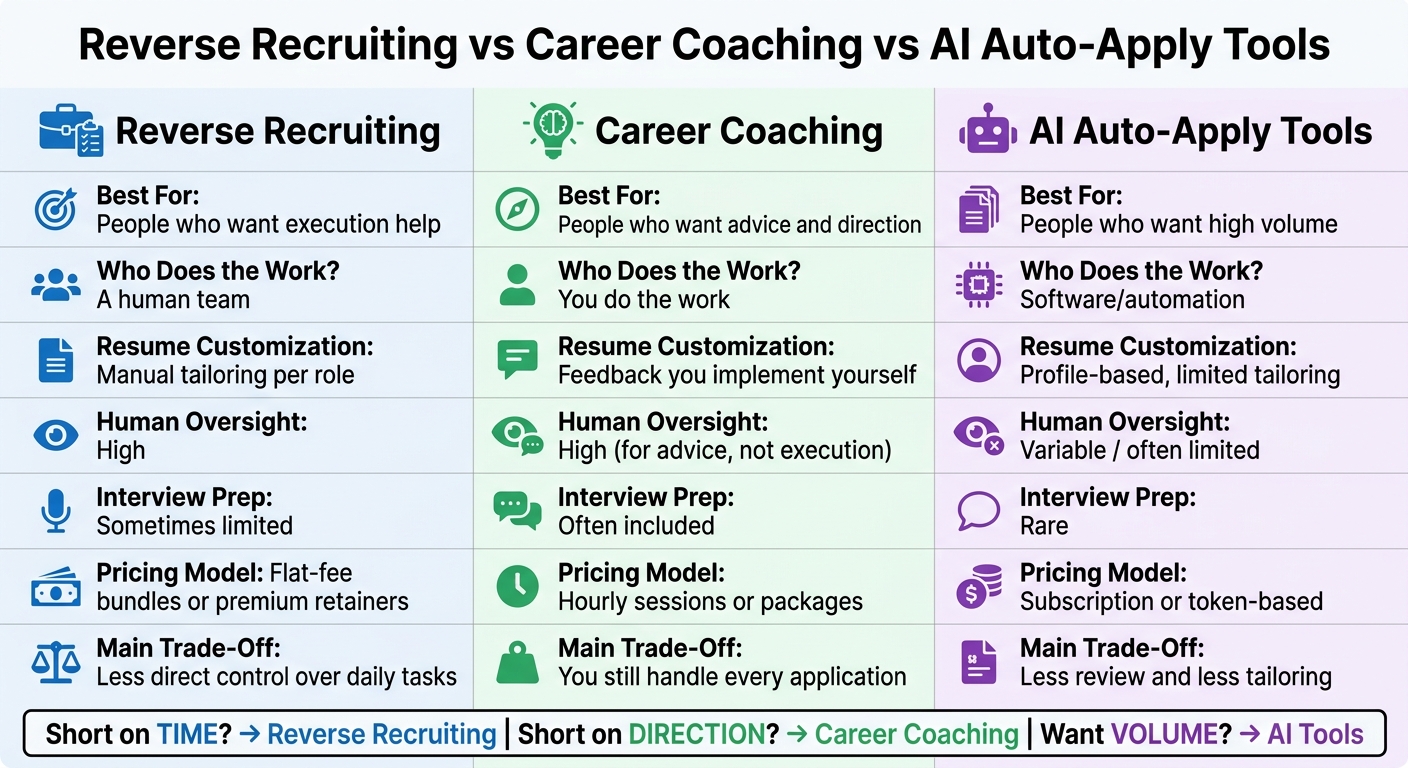
Reverse Recruiting vs Career Coaching vs AI Auto-Apply Tools
Why Job Seekers Are Spending Thousands On Reverse Recruiters
sbb-itb-564272e
Quick comparison
| Option | Best for | Who does the work? | Main trade-off |
|---|---|---|---|
| Reverse recruiting | People who want execution help | A person or team | Less direct control over daily tasks |
| Career coaching vs. virtual assistants | People who want advice and direction | You do the work | You still handle every application |
| AI auto-apply tools | People who want high volume | Software | Less review and less tailoring |
My simple take
I’d use career coaching first if I were changing fields, fixing a weak career story, or getting interviews but failing late in the process. I’d use reverse recruiting if I already knew what roles I wanted and just needed help to Apply for jobs at scale without spending my nights in job portals. If you're short on time, job search automation can be a game-changer.
Below, I break down how to choose, when each option makes sense, and where tools like a job application service, a job search coach, and a job search platform fit.
What I’d ask before choosing
Before I paid for anything, I’d answer these four questions:
- Do I know my target role?
- Am I short on time or short on direction?
- Do I want advice, execution, or both?
- Do I care more about volume or role-by-role quality?
If I needed help with the daily workload, I’d look at reverse recruiting services or a Virtual Assistant for Job Applications. If I needed help with positioning, I’d start with coaching.
Reverse recruiting vs career coaching: what changes day to day?
The day-to-day difference is simple:
- With reverse recruiting, someone helps run the search.
- With career coaching, someone helps you think through the search.
That changes what you get, how much time you save, and how much control you keep.
When reverse recruiting makes more sense
I’d choose reverse recruiting if:
- I already knew the titles I wanted
- I was applying to many full time jobs
- I didn’t have time to search and submit every day
- I wanted help with resume tailoring and scheduling
- I wanted a person, not just a bot
This is where a job search virtual assistant or virtual assistant for job seekers can help. The main value is not advice. It is getting the work done.
When career coaching makes more sense
I’d choose coaching if:
- I was changing industries
- My resume was not getting interviews
- My LinkedIn profile was weak
- I needed help with networking
- I wanted mock interviews or pay guidance
A coach can help fix the plan. But I would still need to source jobs, track them, and submit them myself.
A simple decision playbook
Here’s the fastest way I’d decide.
Pick reverse recruiting if...
- You know your target role
- You want help sending applications
- You want role-by-role resume edits
- You want interview scheduling help
- You are busy and want the admin work off your plate
Pick career coaching if...
- You are still choosing a path
- Your job search feels scattered
- You need resume or LinkedIn feedback
- You need interview prep
- You want help with pay talks
Pick AI auto-apply tools if...
- You want high output
- You are okay with lighter review
- You can monitor quality yourself
- You know automation may miss role-specific details
Quick comparison: reverse recruiting, coaching, and AI tools
| Factor | Reverse recruiting | Career coaching | AI auto-apply tools |
|---|---|---|---|
| Main value | Execution help | Advice and feedback | Automation |
| Applications submitted by | Human team | You | Software |
| Resume edits | Often done per role | Suggested by coach | Auto-filled or rule-based |
| Interview prep | Sometimes limited | Often included | Rare |
| Best for | Busy applicants | Career pivots and weak positioning | Volume-first search |
Is reverse recruiting worth it?
It can be worth it if your problem is time.
If I were losing 15 to 20 hours a week to job searching, the math would be simple. Paying for help could make sense if it gave me back evenings and kept my applications going out on time.
It makes less sense if I still do not know what jobs I want. In that case, I would fix the direction problem first.
Is career coaching worth it?
It can be worth it if your problem is clarity.
For example, if I were applying to 100 roles and getting almost no interviews, I would not assume I needed more volume. I’d first check whether I was targeting the wrong roles, telling a weak story, or using a poor resume.
Coaching helps more when the issue is not effort, but fit and positioning.
Find My Profession vs Scale.jobs
If I were comparing premium reverse recruiting companies with a lower flat-fee option, I’d focus on three things:
- Who submits the applications
- How much tailoring I get
- What proof I see after submission
Find My Profession is more of a premium done-for-you service. Scale.jobs focuses on human-submitted applications with proof of work and flat-fee bundles.
I’d lean toward premium support if I wanted close hand-holding. I’d lean toward Scale.jobs if I wanted lower-cost execution help and clear submission records.
Is Find My Profession worth it?
It may be worth it for senior candidates who want a white-glove search and are fine with higher pricing.
If I only wanted a team to help me send human-reviewed job applications, I would compare flat-fee options more closely.
LazyApply vs Scale.jobs
This comparison comes down to automation vs human review.
LazyApply can help with volume. Scale.jobs puts people in the loop for applications, resume edits, and proof of work.
If I cared most about speed, I might test automation tools. If I cared more about what was actually submitted, I’d lean toward human help.
This same idea applies to LoopCV and similar tools.
Is LazyApply worth it?
It can be worth it if you want broad reach and are okay with less control.
I would be more cautious if I were targeting niche roles, roles with strict ATS fields, or jobs where tailoring your resume matters more. In that case, a job application service or a human-led option may be safer.
A real-world way to choose
Here’s how I’d think about three common cases.
Scenario 1: Busy full-time worker
You work 45 hours a week and can only apply at night.
I’d pick reverse recruiting or a Virtual Assistant for Job Applications. Time is the problem, not effort.
Scenario 2: Career switcher
You want to move from teaching into customer success, but your resume does not tell that story.
I’d pick a job search coach first. Direction is the problem.
Scenario 3: Volume-first applicant
You want to test many openings across national and local roles, including Part time jobs near me.
I’d compare automation tools with human support. If I wanted to move fast, AI tools might help. If I wanted tighter review, I’d look at human help.
My 5-step framework
If I wanted to decide in under 15 minutes, I’d use this:
-
Name the bottleneck
Is it time, direction, interviews, or follow-through? -
Check your target role clarity
If your role list is messy, coaching comes first. -
Check your weekly search hours
If you spend 15+ hours a week applying, execution help may pay off. -
Check quality needs
If each resume needs match resume keywords, human help may fit better than AI resume builders. -
Pick one support model
Don’t stack three tools at once. Start with the one that solves your biggest problem.
FAQ
What is the main difference between reverse recruiting and career coaching?
Reverse recruiting helps do the work for you. Career coaching helps you do the work better yourself.
Should I get coaching before reverse recruiting?
Yes, if you are
What reverse recruiting does vs. what career coaching does
Reverse recruiting handles the hands-on job-search work for you. Career coaching gives you direction and feedback so you can handle the search yourself. That sounds like a small difference, but in practice it changes what each service removes from your plate.
Reverse recruiting deliverables: job sourcing, applications, resume tailoring, and scheduling
A reverse recruiting service takes care of the daily grind of the job hunt. That usually includes finding matching roles, submitting applications for you, tailoring your resume to fit each opening, and setting up interview times when employers reply.
If your main issue is time, this is usually the better fit. Instead of spending hours trying to apply for jobs, you hand off the busywork to a team or a job application service that manages the process for you.
This kind of help makes sense for people who already know what they want but can’t keep up with the volume of work. Maybe you’re working full-time, juggling family stuff, or trying to land one of many full time jobs without turning your evenings into a second shift. In that case, a job search virtual assistant or Virtual Assistant for Job Applications can save a lot of effort.
Career coaching deliverables: goal-setting, resume feedback, networking plans, interview prep, and salary guidance
Career coaching is built around advice, not execution. A coach helps you clarify goals, narrow down target roles, improve your resume and LinkedIn profile through feedback, build a networking plan, prepare for interviews, and think through salary negotiation.
You still do the manual work yourself. That’s the key point. A job search coach can help you make better moves, but they usually won’t send applications, track openings, or manage scheduling for you.
Reverse recruiting is about doing. Coaching is about guiding.
Coaching tends to work best when the problem is strategy, positioning, or follow-through. Maybe your resume isn’t landing interviews. Maybe your story feels messy. Maybe you’re applying a lot but aiming at the wrong roles. In those cases, feedback can matter more than raw output.
If time is the bottleneck, choose reverse recruiting. If positioning is the bottleneck, choose coaching. Put more simply: pick reverse recruiting when execution is the problem, and pick coaching when strategy or accountability is the problem. That split becomes easier to see in a side-by-side comparison.
Side-by-side comparison: reverse recruiting, career coaching, and AI auto-apply tools
If you're thinking about switching, look at one thing first: how much of the job search gets done for you.
That's the part many people miss.
Some services give advice. Some tools send applications at scale. Others take the hands-on work off your plate. The cleanest way to compare them is by checking who runs the search, how much each application is tailored, and what proof you get after the work is done.
Comparison table: human involvement, ATS handling, resume customization, application method, transparency, and pricing
| Feature | Reverse Recruiting | Career Coaching | AI Auto-Apply Tools |
|---|---|---|---|
| Who does the work? | A human handles sourcing, tailoring, and submitting applications | You handle sourcing and applying; the coach advises and reviews | An AI agent or workflow handles submissions, with human review varying by tool |
| Human oversight | High; a person manages the execution | High for advice, not execution | Variable; often limited unless the tool has review steps or guardrails |
| Resume customization depth | Manual tailoring for each role | Feedback and edits you implement yourself | Context-aware auto-tailoring, depending on the tool |
| ATS handling | Human-reviewed, ATS-optimized formatting | Coach can point out ATS fixes, but you apply them | Bulk automation can reduce personalization and create ATS compatibility issues |
| Application method | Human submits through employer portals and job boards | You submit manually | Automated through the tool's agent or integration |
| Transparency and proof of work | Direct communication; some services provide screenshots and dashboards | Session notes and feedback | Varies; advanced tools may provide logs, but others offer limited visibility |
| Pricing model | Flat-fee bundles or premium retainers | Hourly sessions or packages | Subscription or token-based |
Choose based on what you need most:
- Reverse recruiting = execution
- Career coaching = guidance
- AI auto-apply tools = automation
If you want help to apply for jobs without doing all the admin yourself, reverse recruiting usually fits best. If you want advice but still want to stay in charge of the search, coaching makes more sense. If your goal is volume, a job search platform with automation may feel faster, though it can come with trade-offs.
scale.jobs mixes human assistants, ATS-focused resumes, timestamped proof of work, WhatsApp updates, and flat-fee pricing starting at $199 for 250 applications. The first 5 applications are free.
When each option fits: hands-on execution, expert guidance, or a hybrid approach
Use reverse recruiting when you want someone else to carry the application workload from start to finish and you already know the kinds of roles you're targeting. This is often the better path if you're applying to lots of full time jobs and don't want to spend your evenings buried in job portals.
Use career coaching when you need help narrowing your goals, fixing your resume, building a networking plan, getting ready for interviews, or talking through salary decisions. A job search coach can help you sharpen the plan, but you'll still be the one doing the search and sending the applications.
Use AI auto-apply tools when speed matters most and you're okay with lighter review. These tools can help push out applications fast, but fast doesn't always mean tailored. That's where many job seekers start looking for a Virtual Assistant for Job Applications or a more guided service.
A hybrid approach can work well if you want both planning and execution. A common setup is to start with coaching so your target roles, resume, and positioning are tighter, then hand off the application work to a service like job application service. scale.jobs also lets you pair its AI Assistant Pro with Human Assistant support for tailored resumes, cover letters, and portal submissions.
Next, compare Find My Profession, LazyApply, LoopCV, Wonsulting, and Interview Kickstart against scale.jobs.
Find My Profession, LazyApply, and LoopCV vs. scale.jobs: comparisons for switchers
If you already know you want execution instead of coaching, compare these services by one simple thing: how much human work they remove from your plate.
Some tools help you plan. Some help you improve your pitch. Others help you Apply for jobs at scale. If you're switching from advice-first help to done-for-you support, this is the comparison that matters.
Find My Profession vs. scale.jobs: premium reverse recruiting or flat-fee human-submitted applications
Use this comparison if you want managed reverse recruiting and are trying to decide if a premium service makes sense for your budget.
Find My Profession is a premium, human-led reverse recruiting service for job seekers who want close support. scale.jobs takes a different route: human assistants submit applications by hand, with ATS-safe customization, timestamped proof-of-work screenshots, and WhatsApp updates - at $199 for 250 applications on a flat, one-time basis.
If you want white-glove search help, Find My Profession fits that lane. If you want a job application service that focuses on hands-on execution without a retainer, scale.jobs is built for that.
Where scale.jobs differs
- Flat one-time pricing instead of premium retainers
- Human-submitted applications with ATS-safe tailoring
- Timestamped proof of work, dashboard updates, and WhatsApp support
| Feature | Find My Profession | scale.jobs |
|---|---|---|
| Human involvement | High-touch, human-led reverse recruiting | Human assistants submit applications by hand |
| Resume customization | Tailored per role | ATS-safe, tailored per application |
| ATS handling | Human-led support | Human-reviewed, ATS-safe formatting |
| Application execution method | Managed reverse recruiting service | Human submits applications by hand |
| Transparency and proof of work | Direct client communication | Timestamped screenshots + dashboard + WhatsApp updates |
| Pricing model | Premium pricing | Flat-fee bundles starting at $199 |
Who should use Find My Profession: Senior professionals or executives who want a premium, fully managed search.
Who should choose scale.jobs: Job seekers who want human application execution, ATS-safe docs, and clear proof of work. This is often a better fit if you're applying across many full time jobs and want to keep momentum without doing every submission yourself.
That same lens applies to automation-first tools, where the real trade-off is speed versus oversight.
LazyApply and LoopCV vs. scale.jobs: what you give up with automation-first apply tools
This comparison is for job seekers deciding whether to trade control and customization for faster application volume.
LazyApply and LoopCV are built for speed. If your main goal is pushing out a large number of applications fast, automation can help. The trade-off is control: pure automation relies on stored profile data and workflow rules, which usually means less role-specific tailoring and less human oversight on the final submission.
That can work for broad outreach. But if you're aiming at a tighter list of roles, or you care about how each application looks inside an ATS, the difference starts to matter. A job search platform can help you find openings, but submission quality still shapes outcomes.
Where scale.jobs differs
- Human review instead of automation-only submission
- ATS-safe, role-specific customization per application
- Timestamped proof of work instead of limited submission visibility
- One-time flat fee instead of a recurring subscription
| Feature | LazyApply / LoopCV | scale.jobs |
|---|---|---|
| Human involvement | Automation-first | Human assistants submit applications by hand |
| Resume customization | Profile-based, limited tailoring | ATS-safe customization per application |
| ATS handling | Less control over formatting and portal-specific quirks | Human-reviewed, ATS-safe formatting |
| Application execution method | Bot or automated workflow submits applications | Human submits by hand |
| Transparency and proof of work | Limited visibility into submissions | Timestamped screenshots + WhatsApp updates |
| Pricing model | Recurring subscription model | One-time flat fee |
Who should use LazyApply or LoopCV: Job seekers who value speed and can manage follow-up themselves.
Who should choose scale.jobs: People targeting specific roles where customization and oversight matter more than raw volume. That includes applicants who are balancing a broad search across Part time jobs near me or niche roles and don't want to guess what got submitted.
If you're the kind of person who wants help after finding jobs, scale.jobs acts more like a Virtual Assistant for Job Applications than an auto-apply bot. The work is done by people, and you can see what was submitted.
That sets up the next comparison: coaching-first guidance versus execution-first support.
Decision summary: how to choose between reverse recruiting, career coaching, and scale.jobs
Choose based on what you want to hand off: application work, search strategy, or both. The comparisons above break this down by control, customization, visibility, and cost. That gives you a simple way to decide which part of the process you want to keep and which part you want someone else to handle.
If you’re still figuring out your target role or working through a career pivot story, career coaching usually makes more sense before you outsource execution. Services like Wonsulting, Ramped Careers, and Interview Kickstart are built for that stage. They’re often a better fit when you need direction from a job search coach before you start sending applications at scale.
scale.jobs fits when your target roles are already clear and you want human-run applications, ATS-safe documents, WhatsApp support, and proof of work without a retainer. If your main pain point is execution, not strategy, that’s where a job application service or Virtual Assistant for Job Applications can save a lot of time.
The table below turns the earlier feature comparison into a final choice filter.
| Situation | Best fit |
|---|---|
| Still defining target roles | Career coaching (Wonsulting, Interview Kickstart) |
| Want a managed search | Premium reverse recruiting (Find My Profession) |
| Want human-led application execution | scale.jobs |
| Want quick auto-apply volume and can accept less oversight | LazyApply, LoopCV |
Switch to scale.jobs if you want human application help, ATS-safe customization, and proof of work
If you’re leaning toward execution instead of coaching, use this checklist to see whether scale.jobs lines up with what you need from a job search platform.
- You’ve spent 15–20+ hours a week on applications and want that time back.
- You’ve used an auto-apply tool and want clearer visibility into what was submitted.
- You already have a plan and need help executing it.
- You want a flat one-time cost instead of a recurring subscription.
- You need human oversight across portals and niche best job boards.
The free trial covers your first 5 applications at no cost. Paid bundles start at $199 for 250 applications.
If that sounds like your situation, scale.jobs is less about advice and more about getting the work done. It can be a strong fit for people applying to full time jobs and high-volume roles where consistency matters day after day.