
F1 Student Job Search: How to Land Your First US Job

Sarah Mitchell
April 7, 2026

Navigating the U.S. job market as an F1 student is challenging but achievable with the right strategies. Key obstacles include visa restrictions, employer hesitation to sponsor, and cultural differences in resumes and interviews. Here's a streamlined guide to overcoming these challenges:
- Work Authorization Options: Understand CPT, OPT, and STEM OPT timelines, and how to transition to an H-1B visa.
- Resume Best Practices: Use one-page U.S.-style resume hacks, avoid personal details, and optimize for ATS systems.
- Finding Visa-Friendly Employers: Leverage tools like MyVisaJobs and LinkedIn to identify companies with a history of sponsorship.
- Networking: Tap into alumni networks, career fairs, and platforms like Handshake to build connections.
- Job Application Tools: Consider platforms like scale.jobs for tailored applications or Lazyapply for volume-based submissions.
This guide provides actionable steps, tools, and resources to help you secure your first U.S. job while navigating visa complexities.
How to Find a Job as an International Student (OPT/STEM OPT Tips)
F1 Work Authorization Options: CPT, OPT, and H-1B
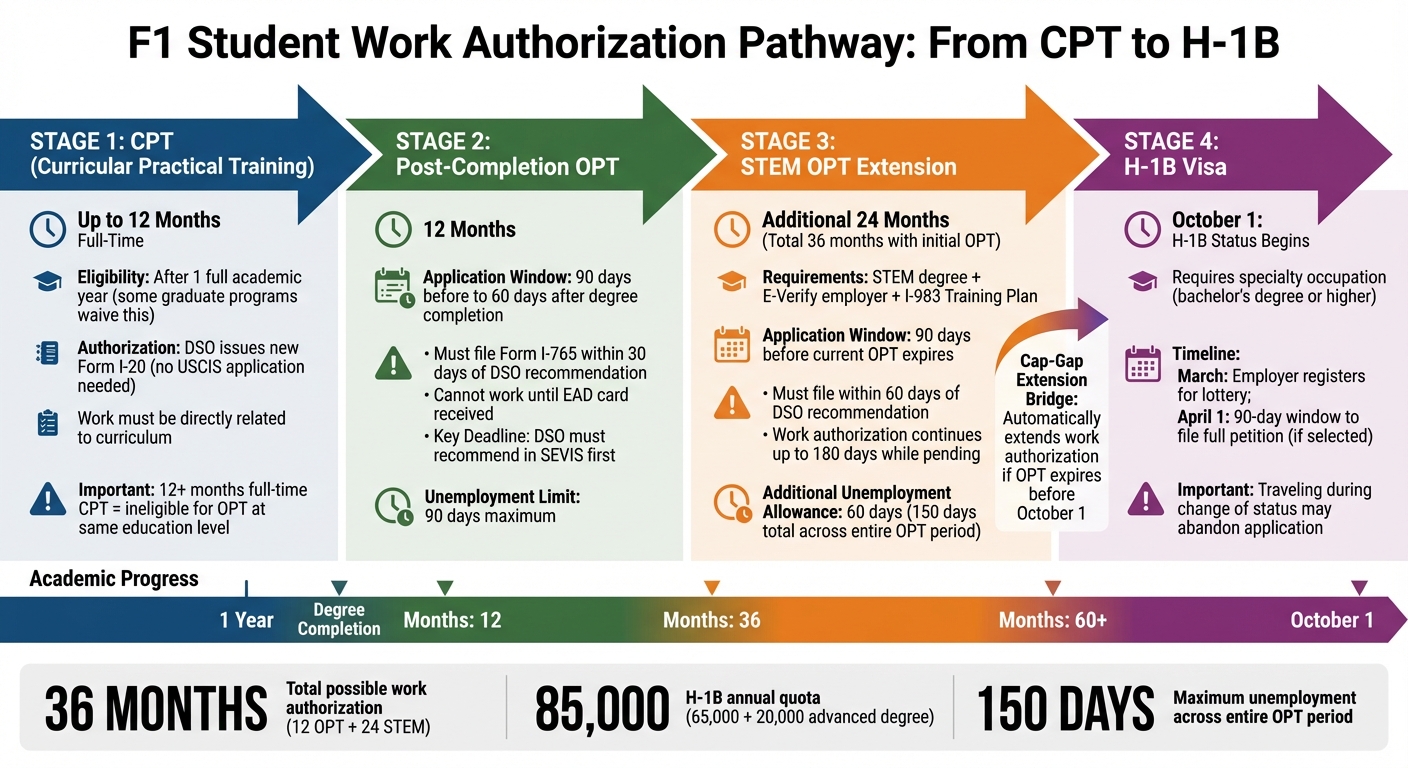
F1 Student Work Authorization Timeline: CPT, OPT, STEM OPT, and H-1B Visa Pathways
Navigating work authorization as an F1 visa holder requires careful attention to deadlines and requirements. Missing these could seriously affect your ability to work in the U.S. Here's a breakdown of the main pathways: CPT, OPT, and H-1B.
Curricular Practical Training (CPT)
CPT allows you to work while studying, but only when the job is tied to your major. Most students qualify after completing one full academic year of study, though some graduate programs may waive this requirement if internships are mandatory from the start.
To get CPT authorization, your Designated School Official (DSO) will issue a new Form I-20, meaning you don’t need to apply through USCIS. However, you must have this updated I-20 before you start working. The work must be directly related to your curriculum, whether it’s an internship, practicum, or cooperative education.
"CPT is integral to your major and the experience must be part of your program of study." - ICE
One important note: if you use 12 months or more of full-time CPT, you won’t be eligible for OPT at the same education level.
Optional Practical Training (OPT)
OPT provides 12 months of work authorization in your field of study and is available at every higher education level. Your DSO must first recommend OPT in SEVIS before you can submit Form I-765 to USCIS. Be sure to file within 30 days of the recommendation; filing earlier or later will result in denial and loss of fees.
You can’t begin working until you receive your physical Employment Authorization Document (EAD) card, even if your I-20 lists an earlier start date. During this initial OPT period, you’re allowed up to 90 days of unemployment. Exceeding this limit can put your visa status at risk.
For those with degrees in STEM fields, a 24-month extension is available. This requires employment with an E-Verify employer and a formal I-983 Training Plan. The STEM OPT extension increases the unemployment allowance by an additional 60 days, giving you a total of 150 days across the entire OPT period. Filing on time for the extension ensures your work authorization continues for up to 180 days while your application is pending.
Here’s a quick guide to OPT application timing:
| Authorization Type | Earliest Application Date | Latest Application Date | DSO Recommendation Deadline |
|---|---|---|---|
| Post-completion OPT | 90 days before degree completion | 60 days after degree completion | Must file within 30 days of recommendation |
| STEM OPT Extension | 90 days before current OPT expires | Before current OPT expires | Must file within 60 days of recommendation |
Once your OPT period ends, transitioning to an H-1B visa becomes a key step for long-term employment.
Moving to H-1B or Other Work Visas
After CPT and OPT, the H-1B visa is typically the next step for those seeking to build a long-term career in the U.S. The H-1B is designed for specialty occupations that require a bachelor’s degree or higher in a specific field. Each year, 65,000 visas are available, with an additional 20,000 reserved for individuals holding advanced degrees from U.S. institutions.
"Specialty occupation means a position that requires specialized knowledge and skills, and at least a bachelor's degree in that specialty." - Berkeley International Office
Employers must register for the H-1B lottery in March. If selected, they have a 90-day window starting April 1 to file the full petition. H-1B status typically begins on October 1. If your OPT expires before this date, a cap-gap extension can automatically extend your work authorization, provided your employer files a timely change of status petition. If the petition is filed during your 60-day grace period after OPT ends, only your legal stay is extended, not your ability to work.
Be cautious about traveling while your H-1B change of status is pending, as it may be considered an abandonment of the application. Additionally, you must notify your DSO of any changes in your name, address, or employer within 10 days to maintain your status.
For a smoother application process, consider using professional services like scale.jobs to ensure your resume and other materials meet the requirements for H-1B sponsorship, emphasizing the specialized skills employers need for a successful petition.
Resume and Cover Letter Best Practices for F1 Students
For F1 students navigating the U.S. job market, creating a polished and compliant resume is crucial. A well-crafted resume not only helps you stand out but also ensures you meet the expectations of both applicant tracking systems (ATS) and hiring managers. Stick to one page if you have less than 10 years of experience. Unlike resumes in many other countries, U.S. employers require you to leave out personal details such as photos, date of birth, marital status, or religious affiliations. Including these can lead to your application being flagged as non-compliant due to anti-discrimination laws.
US Resume Format Requirements
Organize your resume in reverse-chronological order, starting with your most recent experience. Each bullet point should highlight measurable achievements using frameworks like the STAR method (Situation, Task, Action, Result) or the XYZ formula. For instance, instead of saying "Responsible for managing social media", write something like, "Boosted Instagram engagement by 32% in 4 months by implementing a content calendar and posting five times weekly."
Avoid using tables, graphics, or multi-column layouts, as ATS software often struggles to read these formats. Stick to clean, straightforward section headers such as Experience, Education, and Skills, and opt for standard fonts like Arial or Calibri in sizes 10 to 12. Include your LinkedIn profile link and format your phone number as +1 (XXX) XXX-XXXX for consistency.
Next, let’s explore how to navigate visa status disclosure without overshadowing your qualifications.
How to Present Your Visa Status
Avoid labeling your resume with "F1 Visa", as this can create unnecessary barriers before your qualifications are even reviewed. Instead, address your work authorization strategically in your cover letter or application portal. Use phrasing like: "Eligible for 36 months of work authorization via STEM OPT and does not require immediate sponsorship." This approach shifts the focus to your skills and capabilities rather than your visa needs.
"In the U.S... self-promotion is expected as long as it's honest, introspective, and objective. If you don't promote yourself... no one can do it for you." - Don Goldstein, Career Adviser
If an application directly asks about sponsorship, be transparent but specific. For example, saying "I have 12 months of OPT starting May 2026" provides clarity and helps hiring managers make informed decisions. This level of transparency saves time for both parties while ensuring your application remains professional.
Finally, make sure your resume is optimized for ATS to increase your chances of being noticed by hiring managers.
Using ATS Optimization Tools
Before submitting your application, use tools like Jobscan.co to compare your resume against the job description. The free version allows up to five scans per month and identifies missing keywords that ATS might flag. For instance, if a job posting mentions "Python" multiple times but your resume only lists it once, Jobscan will highlight this discrepancy. For more advanced features like LinkedIn optimization, premium plans are available starting at $49.95/month.
Another option is scale.jobs' free ATS checker, designed specifically for international student profiles. This tool not only checks for ATS compatibility but also helps translate non-U.S. experience into terms that resonate with American employers. If you're applying to roles across different industries, consider professional resume writing services that understand both ATS requirements and the nuances of visa sponsorship. These strategies will position you for success as you seek out visa-friendly employers in the next steps of your job search.
Finding Visa-Friendly Employers and Building Connections
Once you understand CPT, OPT, and H-1B, the next step is identifying visa-friendly employers and building connections that can lead to referrals. This process involves targeted research, strategic networking, and attending events where recruiters are actively seeking international talent. Combining these approaches can significantly improve your chances of landing a role with sponsorship opportunities.
Tapping Into University and Alumni Networks
Your university's International Student Services Office and career center should be your first stops. These resources often host workshops on topics like OPT, STEM OPT, and transitioning to H-1B. Many universities also offer access to Interstride, a platform dedicated to helping international students connect with employers experienced in visa sponsorship.
Additionally, platforms like Handshake and LinkedIn are excellent tools for finding roles that accept OPT/CPT candidates. Set keyword alerts to stay updated on openings. On LinkedIn, search for alumni from your university currently working in the U.S. on H-1B visas. Reach out with a personalized message mentioning your shared alma mater, and request a brief 15-minute informational interview. Alumni who have gone through the visa process themselves are often more willing to share advice, provide referrals, and discuss company culture. You can also join LinkedIn groups such as "OPT and CPT Job Seekers" and "H1B Visa & Green Card Guidance" to discover job leads and connect with professionals in similar situations.
"Networking is as much about creating relationships as it is about finding immediate job leads." - Minho Lee, ISOA
Researching H-1B Sponsoring Companies
Before submitting applications, it's crucial to verify whether a company has a history of H-1B sponsorship. The USCIS H-1B Employer Data Hub is a reliable resource that provides information on approval and denial rates for H-1B petitions by company name. For more detailed insights, platforms like MyVisaJobs.com and H1Bdata.info offer searchable databases with sponsorship history categorized by industry and job title. MyVisaJobs, for example, has been a trusted resource for over 533,000 users since 2006 and includes free career profile tools.
"Your best chance of being hired is with U.S. employers that have previously sponsored foreign workers with your skill set." - MyVisaJobs
Focus your efforts on multinational companies that also operate in your home country. These organizations are often more open to hiring international candidates and may offer future transfer opportunities. Kelly O'Sullivan, a Senior Talent Acquisition Associate at AlphaSights, emphasizes:
"Search for jobs at global companies... If you have a global mindset and are looking for challenges and to drive ideas, companies will notice."
Specialized job boards like F1 Hire and OPTnation can also be helpful. F1 Hire tracks H-1B sponsorship history, while OPTnation features over 300,000 F1 OPT and CPT resumes and connects with a network of more than 50,000 recruiters. Another option, USponsorMe, lists over 50,000 U.S.-based jobs across 15,000 visa-friendly companies. On general platforms like LinkedIn and Indeed, use filters like "visa sponsorship" or "will sponsor work visa" to streamline your search.
Once you've compiled a list of potential employers, shift your focus to networking opportunities at career fairs.
Making the Most of Career Fairs and Events
Career fairs are a great way to connect with recruiters and make a strong first impression. Research the attending companies beforehand, focusing on those with a history of H-1B sponsorship. Prepare by practicing a 30-second introduction that highlights your skills and bringing multiple copies of your ATS-optimized resume.
Virtual job fairs, such as those hosted by CareerEco, are particularly helpful for F1 OPT and STEM students. These events allow you to interact with multiple employers from the comfort of your home. Additionally, university career fairs often feature companies specifically looking for international talent, so even if you're not actively applying, attending can be beneficial.
After the event, follow up with recruiters within 24–48 hours. Send a brief LinkedIn message or email referencing your conversation and attach your resume. Ensure your document is formatted correctly to avoid common ATS rejection triggers. Including specific details from your discussion can help jog their memory and keep you top of mind.
"When you're on the job hunt, it's essential that you know which companies are open to hiring international students, otherwise you might waste a lot of time." - Anson Tan, President of the University of San Francisco International Student Association
Interview Preparation and Application Management
Once you've identified visa-friendly employers and started building connections, the next step is preparing for interviews and managing your job applications effectively. This phase is particularly critical for F1 students, who often face challenges such as addressing visa-related questions and demonstrating alignment with workplace expectations while staying true to their background. Unlike fully automated platforms like Lazyapply, scale.jobs incorporates human expertise to refine both interview preparation and application tracking. Here's how you can highlight your international experience, excel in interviews, and streamline your job application process.
Highlighting Your International Background
Your international background can be an advantage in the U.S. job market. Skills such as multilingual communication, cross-cultural adaptability, and global perspectives are highly sought after by employers, especially those with international operations or diverse client bases. During interviews, emphasize how these qualities align with the role you're pursuing.
For example, if you're applying for a software engineering position, you could explain how studying in different educational systems has sharpened your adaptability and problem-solving skills. If you’re fluent in multiple languages, highlight how this can help with tasks like communicating with global clients or translating technical materials. Always tie your unique experiences to the specific needs of the company.
Additionally, ensure all your academic credentials are professionally translated into English. Certified translations help U.S. employers clearly understand your qualifications. The EducationUSA network, available in over 170 countries, is a great resource for guidance on presenting international degrees effectively.
"The advice I would give to students is to be calm. You know what you are applying for, be honest and cooperate... relax, cooperate and hopefully, everything will go as planned." - Khalid Al-Azri, former Global Launch student
Preparing for Behavioral and Cultural Interview Questions
U.S. employers value clear, confident, and conversational communication during interviews. To stand out, practice answering questions naturally rather than relying on memorized scripts. Behavioral questions, such as "Tell me about a time when...", require specific examples. Use the STAR method (Situation, Task, Action, Result) to structure your responses, but keep them conversational and aligned with your resume and visa documentation to avoid inconsistencies.
Mock interviews can be a helpful way to practice. Career advisors or friends can provide feedback to refine your answers and boost your confidence. Be ready to discuss your chosen field of study and how it connects to the role. For instance, if you're a computer science major, explain how your skills could impact industries like healthcare or education.
Lastly, pay attention to first impressions. Professional attire and a well-organized folder with documents like transcripts, certificates, and work authorization paperwork can demonstrate your preparedness.
"First impressions are always important... Choosing the right attire can highlight your professionalism and seriousness." - Shorelight Team
"Be prepared with any paperwork you might need, practice some interview questions with yourself, and relax!" - Therese Fagre, ASU international student
Applying to Multiple Job Types
To maximize your chances, apply to a mix of internships, entry-level roles, and positions at companies with international offices. Employers with global operations are often more familiar with visa sponsorship processes and may offer opportunities for future transfers to offices in your home country.
Keep track of your applications by organizing details such as submission dates, follow-up deadlines, and tailored materials. Some students use spreadsheets, while others prefer specialized tools. If managing multiple applications becomes overwhelming, consider professional services that can help customize resumes and cover letters while ensuring they meet ATS requirements - especially important when visa documentation must be precise.
Balancing quantity with quality is key. Automated platforms like Lazyapply or Simplify.jobs can submit applications quickly but often lack the customization needed for visa-specific requirements. Meanwhile, human-powered services may process fewer applications but provide the accuracy and strategic presentation necessary for roles requiring sponsorship.
scale.jobs vs Lazyapply & Simplify.jobs: Why scale.jobs Stands Out
Here’s how scale.jobs compares to automated platforms like Lazyapply and Simplify.jobs:
- Human Expertise: Unlike Lazyapply’s fully automated submissions, scale.jobs assigns experienced professionals to review and customize each application. This ensures your visa status is presented accurately and strategically.
- Tailored Documents: While Simplify.jobs uses generic templates, scale.jobs creates ATS-optimized resumes that highlight OPT/CPT eligibility and translate international credentials into a U.S.-friendly format.
- Transparent Pricing: Lazyapply charges recurring subscriptions ($99–$249/month) with limited visibility into submitted applications. In contrast, scale.jobs offers a one-time payment and provides clear proof of work, including screenshots and confirmations for every application.
- Real-Time Support: scale.jobs provides dedicated WhatsApp support, allowing you to communicate directly with your assigned assistant for updates and adjustments - something automated platforms cannot offer.
- Error-Free Submissions: Automated tools often mishandle critical fields like visa status or work authorization dates. scale.jobs’ manual approach ensures these details are entered correctly, reducing the risk of ATS rejection.
Choosing the Right Service: If you’re applying to hundreds of generic internship postings, platforms like Lazyapply or Simplify.jobs might save time. However, for roles requiring H-1B sponsorship or precise visa-related documentation, scale.jobs’ human-powered approach is better suited to meet your needs. By addressing the unique challenges faced by F1 students, scale.jobs provides a level of care and attention that automated tools often overlook.
Lazyapply.com vs scale.jobs: Automation vs Human Support
For F1 students deciding between job application platforms, the choice often boils down to speed versus precision. This comparison of Lazyapply.com and scale.jobs will help you determine which platform best suits your needs. Lazyapply.com focuses on automating the process, submitting 150 to 300 applications daily across platforms like LinkedIn, Indeed, and ZipRecruiter. It uses AI to auto-fill forms, making it a time-saver for students targeting high-volume applications, such as on-campus or CPT-authorized roles. Users report applying to over 1,000 jobs weekly, but the downside is a low response rate - typically around 1–5% - as automated submissions can miss crucial visa-specific requirements like OPT eligibility or H-1B sponsorship.
If you’re weighing speed against precision, here’s why scale.jobs stands out for F1 students.
What Lazyapply.com Does Well
Lazyapply.com shines in terms of volume and convenience. It optimizes resumes for Applicant Tracking Systems (ATS) by matching keywords from job descriptions and formatting them to standard U.S. styles, such as one-page layouts focused on measurable achievements. This approach is especially useful for F1 students conducting broad searches for entry-level software roles or internships. For instance, a computer science student shared on Reddit how they secured a CPT internship at a mid-sized company after two weeks of applying to about 100 jobs daily via Lazyapply.com. However, they also noted that follow-up networking was critical due to the platform's low callback rate.
The platform’s dashboard feature tracks submission stats, and its pricing is budget-friendly, ranging from $19/month for basic plans to $99/month for higher application limits. While these bulk submissions save time, they often fail to address key visa-specific requirements.
Why scale.jobs Works Better for F1 Students
While Lazyapply.com prioritizes quantity, scale.jobs focuses on quality and visa-specific accuracy. With trained human assistants handling applications, scale.jobs avoids the pitfalls of automation, such as bot-detection systems used by major employers. This human oversight is critical for F1 students, as automated tools often generate generic responses to detailed questions about H-1B sponsorship, OPT timelines, or start dates - errors that can lead to disqualification.
Here’s how scale.jobs outperforms Lazyapply.com for F1 students:
- Visa-Specific Customization: Human assistants tailor resumes to include essential details like "OPT-eligible through [date]" or "STEM OPT authorized", while also researching H-1B-sponsoring employers. Lazyapply.com, on the other hand, requires students to pre-edit resumes, and its AI-generated cover letters may miss these nuances.
- Higher Response Rates: scale.jobs boasts 15–20% response rates for F1/OPT users, a significant improvement over Lazyapply.com's 1–5%, thanks to personalized applications that address sponsorship concerns and highlight international credentials.
- Proof-of-Work Transparency: Applications submitted through scale.jobs include time-stamped screenshots and real-time WhatsApp updates, ensuring every detail is correctly handled. Lazyapply.com only provides dashboard statistics without employer-specific verification.
- One-Time Pricing: scale.jobs charges a flat fee - $199 for 250 applications, with options for up to 1,000 applications - eliminating recurring subscription costs. Lazyapply.com's monthly fees can accumulate over time.
- Dedicated WhatsApp Support: scale.jobs offers direct communication with assigned assistants for updates and adjustments, a feature automated platforms cannot replicate.
Given the visa-specific complexities F1 students face - such as presenting accurate CPT, OPT, and H-1B eligibility - scale.jobs' human-driven approach ensures precision in areas where it matters most. Career coaches on platforms like Handshake emphasize that personalized applications can outperform automated ones by 4–5 times in response rates. For roles with strict bot-detection filters or when verifiable proof of job-seeking activity is required for your DSO, scale.jobs significantly reduces rejection risks.
To further enhance your job search, consider combining scale.jobs with an AI resume builder to ensure your documents are optimized before submission.
Feature Comparison: Lazyapply.com vs scale.jobs
Here’s a side-by-side breakdown of the key differences between the two platforms:
| Feature | Lazyapply.com | scale.jobs |
|---|---|---|
| Human Involvement | Automated scripts | Trained virtual assistants manually submit each application |
| Resume Customization | Basic AI keyword matching; requires manual editing for visa details | Tailored resumes with visa-specific phrases (e.g., "OPT-eligible through [date]") |
| ATS Handling | High optimization but prone to bot-detection flags | Manual entry avoids detection; human review ensures consistency |
| Execution Method | Automated bulk submissions (150–300/day) | Targeted manual submissions (10–20/day) |
| Proof of Work | Dashboard displays submission stats only | Time-stamped screenshots and real-time WhatsApp updates |
| Pricing Model | Monthly subscription ($19–$99/month) | One-time flat fee ($199–$399 for 250–1,000 applications) |
| Typical Response Rate | 1–5% | 15–20% for F1/OPT users |
| Best For | High-volume, exploratory searches without visa-specific needs | Visa-sensitive applications requiring precise documentation and targeted outreach |
Who Should Use Lazyapply.com
Lazyapply.com is a good fit for F1 students who:
- Are conducting broad, exploratory job searches across hundreds of entry-level or internship positions.
- Have already tailored their resume for visa-specific details and don’t need additional customization.
- Value application volume over response rates.
- Are comfortable with low callback rates (1–5%) and plan to supplement automated applications with manual networking.
Who Should Choose scale.jobs
scale.jobs is better suited for F1 students who:
- Require precise handling of visa-specific details (CPT, OPT, STEM OPT, H-1B sponsorship).
- Are targeting competitive roles that demand sponsorship documentation.
- Need verifiable proof of work for DSO reporting or personal tracking.
- Want higher response rates (15–20%) through personalized, human-reviewed applications.
- Prefer a one-time payment without recurring subscription fees.
- Value direct communication and real-time updates via WhatsApp.
Switch to scale.jobs If…
You should consider switching from Lazyapply.com to scale.jobs if:
- Your automated applications yield low response rates (under 2–3%) and you need a more targeted approach.
- You’re applying to roles requiring H-1B sponsorship, where accurate visa timelines and eligibility details are critical.
- You need proof-of-work documentation for your DSO or personal records, beyond basic dashboard stats.
- You’ve faced bot-detection issues or rejections due to errors in automated form submissions.
- You want to avoid recurring monthly costs and prefer a clear, one-time investment with transparent results.
Decision Summary
Choose Lazyapply.com if your focus is on high-volume exploratory searches for entry-level roles and you prioritize speed over precision. Opt for scale.jobs if you need visa-specific accuracy, higher response rates, verifiable proof of work, and dedicated human support for competitive positions requiring sponsorship. For F1 students navigating visa complexities like CPT, OPT, and H-1B requirements, scale.jobs offers the tailored precision needed to stand out in a competitive job market.
When to Switch to scale.jobs
Unlike Lazyapply.com, which depends entirely on automation, scale.jobs combines technology with human expertise to cater specifically to F1 students. If your response rate has been stuck below 3% for four to six weeks, it’s a clear sign that bulk submissions aren’t aligning with visa-specific employer needs. Research shows that 60% of F1 students who switched to human-supported services like scale.jobs received job offers within 90 days, compared to just 8% for those relying solely on automation. This significant difference highlights the shortcomings of automated tools in addressing the unique challenges faced by F1 visa holders.
Lazyapply.com users have also reported issues with bot detection, which can harm your job search. If you’ve received multiple bot-detection flags or identical rejection emails shortly after applying, it’s time to reconsider your approach. Companies like Amazon and Google use advanced filters to block automated submissions. If flagged three or more times, your profile could be at risk. scale.jobs avoids these pitfalls by using manual application methods, which reduce bot-detection incidents by 40%, as noted by user feedback.
For those on OPT, quality outweighs quantity. With the 90-day OPT clock ticking, every application needs to be strategic. Automated platforms often rely on keyword matching and ATS scoring algorithms, leading to applications sent to companies with no history of H-1B sponsorship. scale.jobs focuses on employers that actively sponsor visas and customizes applications to address sponsorship requirements, achieving significantly better response rates compared to the 1–5% typical of automated tools.
If your Designated School Official (DSO) requests proof of your job search efforts, automated platforms may fall short. While they may provide general statistics, they lack employer-specific documentation. scale.jobs, on the other hand, offers time-stamped screenshots and real-time updates via WhatsApp, ensuring you have a solid paper trail for STEM OPT reporting.
Another reason to switch is if university career services or alumni networks haven’t yielded any leads after two months. For example, a 2025 case study highlighted an Indian F1 computer science student who, after attending three unsuccessful career fairs, secured a CPT internship within 45 days using scale.jobs. For additional support, consider professional resume writing services to enhance your applications with tailored resumes and targeted outreach.
Signs it’s time to switch to scale.jobs:
- Your response rate is under 3% after 4–6 weeks
- You’ve encountered three or more bot-detection flags or identical rejection emails
- University career services or alumni networks haven’t provided leads for two months
- You need verifiable proof-of-work for DSO documentation
- You require precise handling of CPT, OPT, or H-1B sponsorship in your applications
Which Platform to Choose
When it comes to deciding between platforms for your job search, the choice depends on your specific needs and circumstances. Here's a breakdown to help you determine which option suits you best.
Pick Lazyapply.com if you're a U.S. citizen or green card holder focused on entry-level roles where visa status is not a factor. This platform is ideal for those who are comfortable with a high-volume approach, understand the need for manual follow-ups, and don't require detailed proof-of-work documentation.
Opt for scale.jobs if you're an F1 student on CPT or OPT, where compliance with strict deadlines is critical, and each application must be carefully tailored. Here's why scale.jobs stands out for F1 students:
- Human-Assisted Applications: Avoids errors in visa-specific fields and bypasses bot-detection systems that automated tools often trigger.
- Customized Resumes for ATS: Ensures resumes are optimized for each role, including visa-specific phrases like "OPT-eligible through [date]."
- Flat-Fee Pricing: Offers clear, upfront pricing with no recurring charges ($199 for 250 applications, $299 for 500, $399 for 1,000).
- Real-Time WhatsApp Support: Provides updates and direct communication with your assigned assistant.
- Proof-of-Work Documentation: Supplies time-stamped screenshots, essential for DSO-required job search documentation.
With trained virtual assistants handling each application, scale.jobs ensures submissions are manually completed, avoiding the bot-detection issues that automated systems face, particularly with major employers like Amazon and Google.
Feature Comparison: Lazyapply.com vs scale.jobs
| Feature | Lazyapply.com | scale.jobs |
|---|---|---|
| Human Involvement | Automated scripts | Trained virtual assistants handle applications manually |
| Resume Customization | Basic AI keyword matching; manual visa detail edits required | Customized with visa-specific phrases for each role |
| ATS Compatibility | High optimization but prone to bot-detection | Manual entry avoids detection; human review ensures accuracy |
| Application Method | Automated bulk submissions (150–300/day) | Targeted manual submissions (10–20/day) |
| Transparency | Dashboard with submission stats | Time-stamped screenshots and real-time WhatsApp updates |
| Pricing | Monthly subscription ($19–$99/month) | One-time flat fee ($199–$399 for 250–1,000 applications) |
When to Switch to scale.jobs
Consider switching from Lazyapply.com to scale.jobs if:
- Your response rate is below 3% after 4–6 weeks of using automated applications.
- You're managing the 90-day OPT unemployment clock and need every submission to count.
- You require verifiable proof-of-work for SEVIS compliance or DSO documentation.
- You've encountered bot-detection issues or received identical rejection emails from automated submissions.
- You're applying for H-1B sponsorship roles, where accurate visa timelines and eligibility details are critical.
For F1 students, strategic targeting and compliance are key. Combining professional resume writing with human-assisted applications improves your chances of success compared to bulk automation. Since most U.S. jobs are secured through networking and referrals - rather than cold applications - ensuring your materials are precise and reach the right decision-makers is crucial.
Decision Summary
Your visa status and job search timeline play a vital role in choosing the right platform. If you're on OPT and need to maintain SEVIS compliance or demonstrate active job-seeking efforts, human oversight is essential. Automated tools often fall short when addressing sponsorship details or providing the documentation required for DSO reviews. scale.jobs bridges these gaps with manual submissions, real-time updates, and proof-of-work documentation that meets regulatory requirements.
FAQs
When should I start CPT or OPT paperwork to avoid losing work authorization?
Starting your CPT (Curricular Practical Training) or OPT (Optional Practical Training) paperwork early is crucial to ensure you don’t risk losing your work authorization. For those applying for OPT, it’s important to file Form I-765 within 30 days of your Designated School Official (DSO) updating your SEVIS record. This step is essential to maintain your visa status.
If you’re pursuing CPT, keep in mind that exceeding 12 months of full-time CPT usage can make you ineligible for OPT. To avoid any setbacks, begin the process several months in advance to meet USCIS deadlines and reduce the chances of delays or rejections. Proper planning can make a big difference in ensuring a smooth transition into your employment.
How do I answer “Will you need sponsorship?” without hurting my chances?
When discussing your F-1 visa status, it's important to approach the topic with transparency and a positive attitude. Acknowledge your current visa situation while demonstrating your readiness to work with the employer to address any sponsorship needs. For instance, you might say: "I am currently on an F-1 visa and open to sponsorship opportunities. I’m fully prepared to collaborate to meet any visa-related requirements."
If you're eligible for OPT (Optional Practical Training) or STEM OPT, it's a good idea to emphasize your ability to work legally without requiring immediate sponsorship. You could add: "I am eligible for OPT, which allows me to work legally for up to 12 months without sponsorship. Additionally, I am open to discussing future sponsorship options to ensure a long-term collaboration." For STEM graduates, you might mention the extended work authorization: "As a STEM graduate, I am eligible for a 24-month OPT extension, providing up to three years of work authorization without immediate sponsorship."
This approach shows both honesty and a willingness to work towards a solution, which can help ease any concerns the employer might have about hiring international candidates.
How can I quickly find companies that actually sponsor H-1B?
To find companies that sponsor H-1B visas, you can rely on resources such as GMAC, MBA-Exchange, Prodigy Finance, and Yale’s Office of Career Strategy. These platforms regularly update their lists of top sponsors, showcasing prominent names like IBM, Intel, Amazon, and Google. Since these lists are refreshed annually, they provide a reliable way to identify active sponsors for the current H-1B cycle.