
First job salary guide: what class of 2026 should ask

Sarah Mitchell
June 8, 2026

Your first salary sets the stage for your future earnings, so negotiating it is crucial. For the class of 2026, new salary transparency laws across 27+ states and tools like Glassdoor and LinkedIn Salary make it easier to research pay ranges. A $5,000 increase in your starting salary could grow into $600,000 over a lifetime, so knowing how to job search effectively and negotiate matters.
Key Takeaways:
- Research Salary Data: Use platforms like NACE, Glassdoor, and LinkedIn Salary to find accurate pay ranges for your role and location.
- Set Clear Salary Goals: Define your target, acceptable, and walk-away numbers based on data.
- Negotiate with Confidence: 64% of candidates who negotiate get higher pay - aim for 7–10% above the initial offer.
- Look Beyond Base Pay: Evaluate benefits like health insurance, 401(k) matches, and PTO to understand total compensation.
If you need help applying to roles that align with your salary goals, platforms like scale.jobs offer tailored application support, including ATS-optimized resumes and targeted job submissions. Negotiating a strong starting salary starts with applying to the right roles.
How to Find Out What You Should Be Paid
Where to Look Up Salary Data as a New Graduate
When you're starting out, it's essential to gather salary data from multiple sources to get a well-rounded understanding. A great starting point is NACE's (National Association of Colleges and Employers) First Destination Survey. This report provides median starting salaries by major, based on real employer and institutional data. For instance, NACE's 2024 data highlights that computer science and engineering graduates often start with median salaries around $75,000–$80,000. Business majors typically land in the $60,000–$70,000 range, while humanities and social science graduates see medians closer to $45,000–$55,000. Use these figures as a baseline, adjusting for your location.
Next, turn to platforms like Glassdoor and LinkedIn Salary. Use specific search terms, such as "Marketing Coordinator, Austin, TX, 0–1 years experience", to find salary ranges for your role and location. These platforms often provide 25th, 50th, and 75th percentile salary data. If the medians on both platforms align closely, you can trust those numbers to reflect the market. If they differ significantly, it's worth digging deeper into the data scope. To further refine your research, consider using tools like scale.jobs' Salary Predictor, which offers detailed low, median, and high salary estimates based on your role and location. Combining these resources will give you a clear and accurate picture of what to expect.
How Location, Role, and Industry Change Your Number
Once you’ve established a baseline, factor in how location, job role, and industry impact salaries. For instance, an entry-level software engineer in New York City might receive offers ranging from $95,000 to $120,000 at mid-sized tech companies. Meanwhile, a similar role in Dallas typically offers $80,000 to $100,000. While the NYC salary appears higher, cost-of-living calculators reveal that housing in New York can cost 80%–120% more than in Dallas, which might even out the difference in actual spending power.
Industry also plays a key role in salary variations. Take Washington, DC, for example: a project coordinator in consulting might earn $55,000–$70,000, while the same role in government contracting offers $50,000–$65,000. In nonprofits, the range drops to $42,000–$52,000. To get the most accurate idea, always consider the combination of job title, industry, and city rather than relying on job title alone.
How to Set Your Target, Acceptable, and Walk-Away Numbers
After collecting and analyzing salary data, it's time to define your negotiation thresholds. Break your expectations into three key numbers:
- Target salary: This should fall between the 50th and 75th percentiles for your role and location. It's the number you'd ideally like to earn.
- Acceptable salary: This is the local median, or 50th percentile, and represents a figure you'd feel comfortable accepting.
- Walk-away number: Start with the 25th percentile and ensure it covers your essential monthly expenses. Use a U.S. paycheck calculator to confirm this.
Don’t overlook the value of benefits when evaluating an offer. For example, if an employer covers your full health insurance premium, that could save you $6,000–$7,000 annually. Similarly, a 4% 401(k) match on a $65,000 salary adds about $2,600 per year. These perks can significantly impact your overall compensation and should be part of your decision-making process. If you need additional guidance, consider using scale.jobs' resume writing services to help strengthen your job applications and negotiations.
sbb-itb-564272e
Building Job Applications That Match Your Salary Target
Why ATS-Optimized Resumes Matter for Higher-Paying Roles
Once you’ve set your salary goals, the next step is making sure your job applications align with those expectations. For roles offering higher pay, competition is fierce, and many employers rely heavily on Applicant Tracking Systems (ATS) to filter resumes before they even reach a recruiter. Even small mistakes - like missing keywords or formatting issues - can prevent your resume from making it through.
For salary-focused applications, ATS optimization involves more than just neat formatting. Your resume should reflect the exact language used in job descriptions within your desired pay range. For example, if a $78,000 data analyst role lists "SQL", "Tableau", and "A/B testing" as required skills, these terms need to appear in context within your experience - not just in a skills section.
Tools like Jobscan can score your resume against job descriptions and point out missing keywords, which is handy for making quick adjustments. Similarly, Rezi offers ATS-friendly templates that are a good starting point. However, these tools only optimize what you provide - they don’t help you decide which experiences to highlight to justify a higher salary.
How scale.jobs stands out:
- scale.jobs adds human insight to identify which experiences best support your salary goals - something automated tools like Jobscan and Rezi don’t offer.
- It customizes your resume language to reflect job postings in industries where every keyword matters.
- The platform combines ATS optimization with strategic framing, ensuring your resume is tailored for higher-paying opportunities.
Automation vs. Human Review in Job Applications
Automated tools like LazyApply and Simplify can submit large volumes of applications quickly. But with competitive roles in the $70,000–$80,000 range, mass automation often falls short. These tools don’t account for job-specific salary nuances, and employers hiring for higher-paying roles are more likely to notice when a resume doesn’t match their requirements.
For roles with higher salaries, quality beats quantity. A $50,000 job and a $78,000 job with similar titles often have very different expectations. Higher-paying roles typically require demonstrated achievements, measurable results, and specific technical skills. Using the same resume for both can waste your chances at the higher-paying position.
How scale.jobs improves your chances:
- scale.jobs takes a selective approach, tailoring each application to match the role’s specific requirements.
- Unlike LazyApply, it uses expert review to ensure your resume aligns with job descriptions, increasing your chances of landing higher-paying roles.
- It focuses on relevance and precision, rather than relying on generic submissions.
Why scale.jobs Works Better for Salary-Focused Applications
scale.jobs uses a hands-on approach where trained professionals customize your resume and cover letter for each application. This is especially important for salary-focused job searches because the human element ensures that your experiences - whether internships, projects, or freelance work - are presented in a way that signals readiness for higher-paying roles.
By framing your achievements in language that resonates with hiring managers, scale.jobs helps position you as a strong candidate for roles in your target pay range. Plus, the platform provides time-stamped proof-of-work screenshots and a live application dashboard, so you can track which roles have been applied to and with which version of your resume. This transparency is particularly useful when monitoring how your applications in the $70,000–$80,000 range perform compared to others.
Who benefits from automated tools (e.g., LazyApply, Rezi, Jobscan): Candidates applying to a high volume of jobs with less focus on salary targeting, who need quick document optimization or bulk submissions.
Who should choose scale.jobs: Job seekers aiming for specific salary goals, who need tailored resume customization, expert human review, and transparent tracking of applications.
Pricing starts at a flat fee of $199 for 250 applications, with no monthly subscription. If you need help refining your resume before applying, their resume writing services bundle a professionally written resume, a 45-minute strategy session, and application support.
"Applying for jobs every day has been super daunting. But now with scale.jobs, one can apply to hundreds of jobs per day while also focusing on interview preparation." - Sona Tambe
For those pursuing entry-level roles at the higher end of the pay scale, the difference is clear: while tools like Jobscan and Rezi help improve your resume, scale.jobs manages the entire process - targeting, customizing, and submitting applications that align with your salary expectations.
| Feature | LazyApply / Simplify | Jobscan | Rezi | scale.jobs |
|---|---|---|---|---|
| Human involvement | None - fully automated | None - self-serve scoring | None - template generation | Full - trained human oversight |
| Resume customization depth | None - same resume everywhere | Keyword gap analysis only | ATS-friendly formatting | Tailored for each role, including strategic framing |
| ATS handling | Basic form-fill automation | Keyword scoring | ATS-optimized templates | Human-verified ATS alignment with contextual keywords |
| Application execution method | Bulk automated submissions | User applies independently | User applies independently | Fully managed by human assistants |
| Transparency and proof of work | Limited reporting | No tracking | No tracking | Time-stamped screenshots and live dashboard |
| Pricing model | Monthly subscription | Monthly subscription | Monthly subscription | One-time fee starting at $199 for 250 applications |
With your applications tailored to reflect your salary goals, the next step is mastering strategies to negotiate your first job offer with confidence.
How to Negotiate Your First Job Offer
Reading the Full Offer: Base Pay, Bonuses, and Benefits
When you receive a job offer, it's important to look beyond the base salary. In the U.S., employers often spend an additional 30%–40% on benefits, so reviewing the full compensation package is crucial. This includes base pay, bonuses, and benefits like health insurance and retirement plans.
Start by examining the 401(k) match - many employers contribute 3%–6% of your salary, which could add up to $2,800 annually on a $70,000 salary. Check how much of your health insurance premiums are covered, the terms of any signing bonuses (like clawback clauses if you leave early), and the amount of paid time off (PTO). For example, five extra PTO days could be worth about 2% of your salary. If the offer includes equity or restricted stock units (RSUs), ask about the vesting schedule and whether the company is public or private - this is especially important for startups, where liquidity risks can be higher.
To make comparisons easier, create a spreadsheet that includes base salary, bonuses, 401(k) contributions, and insurance savings. This way, you can calculate your total compensation and use the data to prepare for negotiations.
How to Write and Present a Counter Offer
Once you've reviewed the offer, use the details to draft a counteroffer. A strong counteroffer is based on data, not just personal preference. Research salary ranges for similar roles using platforms like Glassdoor, LinkedIn Salary, and government statistics. Position yourself within that range based on your specific qualifications, such as internships, technical skills, or relevant projects.
A typical counteroffer is 5%–15% higher than the initial offer. For example, if your target salary is $75,000, you could counter with $78,000–$80,000 to leave room for negotiation. If the employer is firm on the base salary, consider negotiating for other benefits like a higher signing bonus, additional PTO, a professional development budget, or an earlier performance review. These options can provide tangible value even if the base pay remains unchanged.
After any verbal negotiation, always follow up with an email summarizing the discussion. Once an agreement is reached, request an updated written offer before signing.
Scripts for Common Negotiation Situations
Using the right language can make the negotiation feel collaborative rather than confrontational. Here are some examples for common scenarios:
When countering the initial offer:
"Thank you for the offer - I’m very excited about the opportunity. Based on my research for entry-level data analyst roles in Chicago, I’ve seen salary ranges between $68,000 and $78,000. Considering my internship experience with SQL and Tableau, could we adjust the base salary to around $76,000?"
When the employer says the salary band is fixed:
"I understand, and I appreciate you sharing that. If the base salary is at the top of the band, would it be possible to discuss a signing bonus or a salary review after six months? I’d like to find a structure that works well for both of us."
When you have a competing offer:
"I’m fortunate to have another offer at $74,000, but this role is my top choice. If we could get closer to that number, I’d be ready to accept and move forward."
It’s worth noting that 70% of hiring managers expect candidates to negotiate, according to a Robert Half survey. However, fewer than half of candidates actually do. Negotiating is a normal part of the process, and even a $5,000 increase in your starting salary can lead to significantly higher earnings over time due to percentage-based raises.
If you feel unsure about approaching these conversations, consider seeking guidance. Services like professional resume and application services can help you evaluate your offer, understand market trends, and develop a strong negotiation strategy. Walking into the discussion with clarity and confidence can make all the difference.
How to negotiate your first salary
LazyApply, Jobscan, Teal, and Others vs. scale.jobs
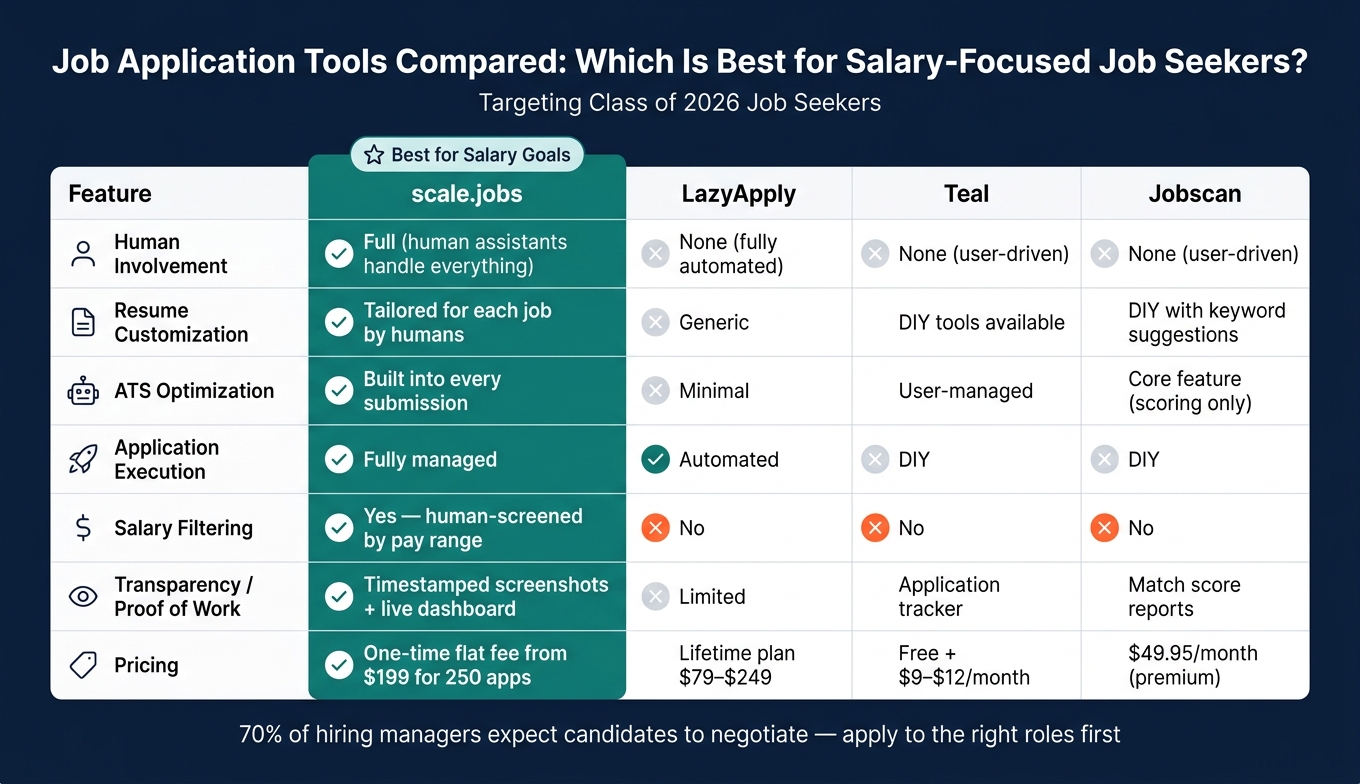
Job Application Tools Compared: Which Is Best for Salary-Focused Job Seekers?
Once you've determined your salary expectations, the tools you use to apply for jobs play a huge role in achieving your financial goals. Picking the right platform can make the difference between landing offers that align with your target or wasting time on mismatched opportunities. Here's a detailed comparison that explains why scale.jobs stands out when it comes to salary-focused applications.
LazyApply vs. scale.jobs: Automation vs. Personalization
LazyApply is all about speed and volume. Using a browser extension, it automates hundreds of job applications across platforms like LinkedIn, Indeed, and ZipRecruiter. This approach is great for recent graduates aiming to cast a wide net.
The downside? Automation doesn't prioritize salary ranges. For instance, if you're aiming for $75,000 in a major city, LazyApply might still submit your application to positions offering significantly less. This mismatch can lead to wasted time on roles that don't meet your financial goals.
On the other hand, scale.jobs emphasizes quality over quantity. Human assistants carefully filter jobs based on your salary and location preferences, customize your resume for every job, and handle the application process. While fewer applications are sent, each one is targeted to align with your salary expectations, saving you time and improving your chances of success.
Who benefits from LazyApply: If you're a graduate looking for high-volume applications and are flexible about salary, this tool is worth considering.
Who benefits from scale.jobs: If you have a clear salary target and want personalized, human-driven applications, scale.jobs is the better choice.
Teal vs. scale.jobs: Organizing vs. Doing the Work
Teal offers a fantastic way to organize your job search. Its CRM-like system helps you track applications through stages like Saved, Applied, Interviewing, and Offer. For those who prefer managing their own job search, this structure can be a big help.
However, Teal stops at tracking. You still need to find job postings, tailor your resume, write cover letters, and submit each application yourself. scale.jobs, by contrast, handles everything for you - from finding roles that match your salary goals to submitting applications. Plus, they provide timestamped proof of submissions and real-time updates, allowing you to focus on preparing for interviews instead of managing applications.
Who benefits from Teal: If you're self-motivated and want a system to organize your job search, Teal is a solid option.
Who benefits from scale.jobs: If you'd rather have someone else manage the entire process while ensuring applications meet your salary expectations, scale.jobs is the better pick.
Jobscan vs. scale.jobs: Resume Insights vs. Full-Service Support
Jobscan is a powerful tool for optimizing resumes. It analyzes how well your resume matches job descriptions, highlighting keyword gaps. According to Jobscan, using their recommendations can triple your chances of landing interviews.
But Jobscan's role ends there. After receiving a match score, you're responsible for revising your resume, finding job postings, and submitting applications. scale.jobs takes it a step further by incorporating ATS-friendly practices into every application they handle. Their team not only optimizes your resume but also manages the entire application process, ensuring roles align with your salary goals.
Who benefits from Jobscan: If you want data-driven insights to improve your resume and prefer handling applications yourself, Jobscan is a good choice.
Who benefits from scale.jobs: If you want both ATS optimization and full-service application management, scale.jobs offers a seamless solution.
The table below highlights the key differences between these platforms:
| Feature | scale.jobs | LazyApply | Teal | Jobscan |
|---|---|---|---|---|
| Human involvement | Full (human assistants handle everything) | None (fully automated) | None (user-driven) | None (user-driven) |
| Resume customization | Tailored for each job by humans | Generic | DIY tools available | DIY with keyword suggestions |
| ATS optimization | Built into every submission | Minimal | User-managed | Core feature (scoring only) |
| Application execution | Fully managed | Automated | DIY | DIY |
| Transparency | Proof of work (screenshots, updates) | Limited | Application tracker | Match score reports |
| Pricing | One-time flat fee | Lifetime plan ($79–$249) | Free + $9–$12/month | $49.95/month (premium) |
When to Choose scale.jobs
Consider switching to scale.jobs if any of these apply to you:
- You have a specific salary target. Their team ensures applications are tailored to roles that meet your pay range.
- You want ATS-optimized applications. Human expertise ensures your resume aligns with job descriptions in a way automated tools can't.
- You need proof of submissions. Timestamped screenshots and dashboard updates provide transparency and help you track which roles perform best.
- You want ongoing support. With WhatsApp updates, you can make changes or ask questions without waiting on a support ticket.
- You prefer a one-time payment. Unlike subscription-based tools, scale.jobs charges a flat fee, saving you money over time.
Summary of Recommendations
| Situation | Best Choice |
|---|---|
| You want to apply to as many jobs as possible with minimal effort | LazyApply |
| You prefer to manage and track your own applications | Teal |
| You want data-driven resume tips but plan to apply yourself | Jobscan |
| You have a salary goal and want full-service application management | scale.jobs |
For job seekers who want a professional to handle every aspect of their applications - from filtering roles by salary to submitting optimized resumes - scale.jobs is an excellent option. Their resume writing and application services combine everything into one flat fee, offering a more comprehensive solution than subscription-based tools like Teal or Jobscan.
Switch to scale.jobs If These Apply to You
The comparison table above highlights the feature differences, but choosing the right tool goes beyond features. It’s about finding a platform that aligns with your job search needs. Here are three scenarios where scale.jobs truly stands out.
You Want Applications Aligned with Your Salary Expectations
Many platforms overlook salary filtering, which can lead to wasted opportunities. For instance, if you're a computer science graduate aiming for a base salary of $85,000–$95,000 in cities like Austin or Chicago, some automation tools might still send your application to roles offering just $68,000. You wouldn’t know until it’s too late. With scale.jobs, human assistants carefully screen job postings to match your desired pay range, ensuring you only target roles that meet your expectations. This is especially helpful if your skills are in demand and you’re aiming for higher-value positions.
You Want Clear, Time-Stamped Records of Every Application
While automation tools may provide a basic count of applications sent, scale.jobs takes it a step further. Each submission includes a detailed, timestamped log with real-time updates via WhatsApp. You’ll know the job title, employer, submission date, and any follow-up actions required. This transparency allows you to track which salary ranges lead to interviews, identify industries that are less responsive, and adjust your resume customization strategy if needed. It’s a level of accountability that goes beyond just numbers or match scores.
You Prefer a One-Time Payment Over Monthly Subscriptions
Using multiple tools for your job search - such as Teal+ for tracking, Jobscan for resume optimization, and an auto-apply tool - can cost $80–$120 monthly, potentially adding up to $480 before you even secure an interview. scale.jobs simplifies this with a flat campaign fee starting at $199 for 250 applications. There are no recurring charges, and you’ll receive a pro-rata refund for unused credits if you land a job early. For those who want additional support, their resume writing and application services bundle everything into one straightforward fee, eliminating the need for multiple tools. This approach not only saves money but also makes the job search process more efficient and stress-free.
Conclusion: Own Your First Job Salary
Your first salary is more than just a paycheck - it’s the foundation for your financial growth. Negotiating even a modest increase, like an additional $5,000 at age 22, can result in over $600,000 in extra lifetime earnings. That’s a huge payoff for one conversation.
Preparation is key. Use at least two reliable sources to research the market range for your role, then define your target salary, acceptable minimum, and walk-away point before stepping into any negotiation. For example, a marketing graduate in Atlanta who counters a $55,000 offer with a well-researched $62,000 isn’t being pushy - they’re demonstrating professionalism. Many U.S. employers, especially in corporate and tech sectors, expect negotiation and often leave room for it in their initial offers.
If the base salary is non-negotiable, consider requesting other benefits like a sign-on bonus, an accelerated performance review, or a budget for professional development. These perks can add significant value to your overall compensation package.
The other piece of the puzzle is applying to roles that align with your worth. As mentioned earlier, tools like scale.jobs help you focus on opportunities that match your financial and career goals. If you’re looking for a more tailored approach, scale.jobs' resume writing and application services can streamline your job search. Starting at $199, these services include professional resume writing, ATS optimization, and targeted applications to help you land roles that pay what you deserve.
FAQs
How do I choose a fair salary when sources differ?
When salary information varies, start by closely examining the job posting for details such as the role, location, and any mentioned salary range. Look at multiple job postings for similar positions to identify a realistic average. If you're uncertain, it's better to stay slightly flexible rather than setting the bar too low. Using Scale.jobs, human assistants can help you align your expected salary with ATS-friendly requirements while also customizing your resume and cover letter to include job-specific keywords.
What should I negotiate if the company won’t move on base salary?
If the base salary is fixed and can't be negotiated, shift your attention to other benefits that can improve your overall compensation or enhance your work-life balance. You might explore options like sign-on bonuses, relocation assistance, additional paid time off, or budgets for professional development. Employers are often more open to offering one-time perks or incentives. Present these requests as thoughtful solutions to close the gap, while also emphasizing your dedication to excelling in the role and contributing to the company's success.
How can I compare two offers with very different benefits or equity?
When comparing job offers with varying benefits or equity, it's essential to calculate a total compensation figure for a clear comparison. Start by combining the base salary and bonuses into their present-day value. Then, estimate the worth of benefits - such as health insurance, retirement plans, and paid time off - by considering your potential out-of-pocket costs. For equity, use a probability-weighted model that evaluates the value per vested share while factoring in vesting schedules and your expected tenure. Be sure to account for any execution risks tied to the equity.
Accuracy and transparency are key when using tools like Scale.jobs or others to evaluate job offers and manage applications effectively.