
H-1B job search in 2026: Why visa holders need human-assisted apps

Sarah Mitchell
June 13, 2026

If I were job hunting on H-1B in 2026, I would not rely on a bot to submit applications for me. With only 60 days after a layoff, one wrong work-authorization answer or one application to a non-sponsoring employer can waste time I may not get back.
Here’s the short version:
- Volume is not the goal. Clean, accurate applications matter more.
- Bots can repeat the same mistake across dozens of applications.
- Human review helps with identifying sponsoring employers, location limits, and form accuracy.
- Proof of submission matters when I need to track what was sent and when. This is a critical part of a daily job search system for visa holders.
- Tools like LazyApply, LoopCV, and Sonara may help some job seekers, but H-1B cases often need more care.
Pro Tips on Getting H1B Sponsorship - My FAVORITE Job Hacks
sbb-itb-564272e
What I would do first
If I were comparing tools, I would check these five things before I use any job application service:
- Does it filter for H1B sponsoring companies?
- Does a person review work-authorization fields?
- Does it catch location or remote-work limits?
- Does it tailor my resume by role?
- Does it give me a record of each submission?
Quick comparison
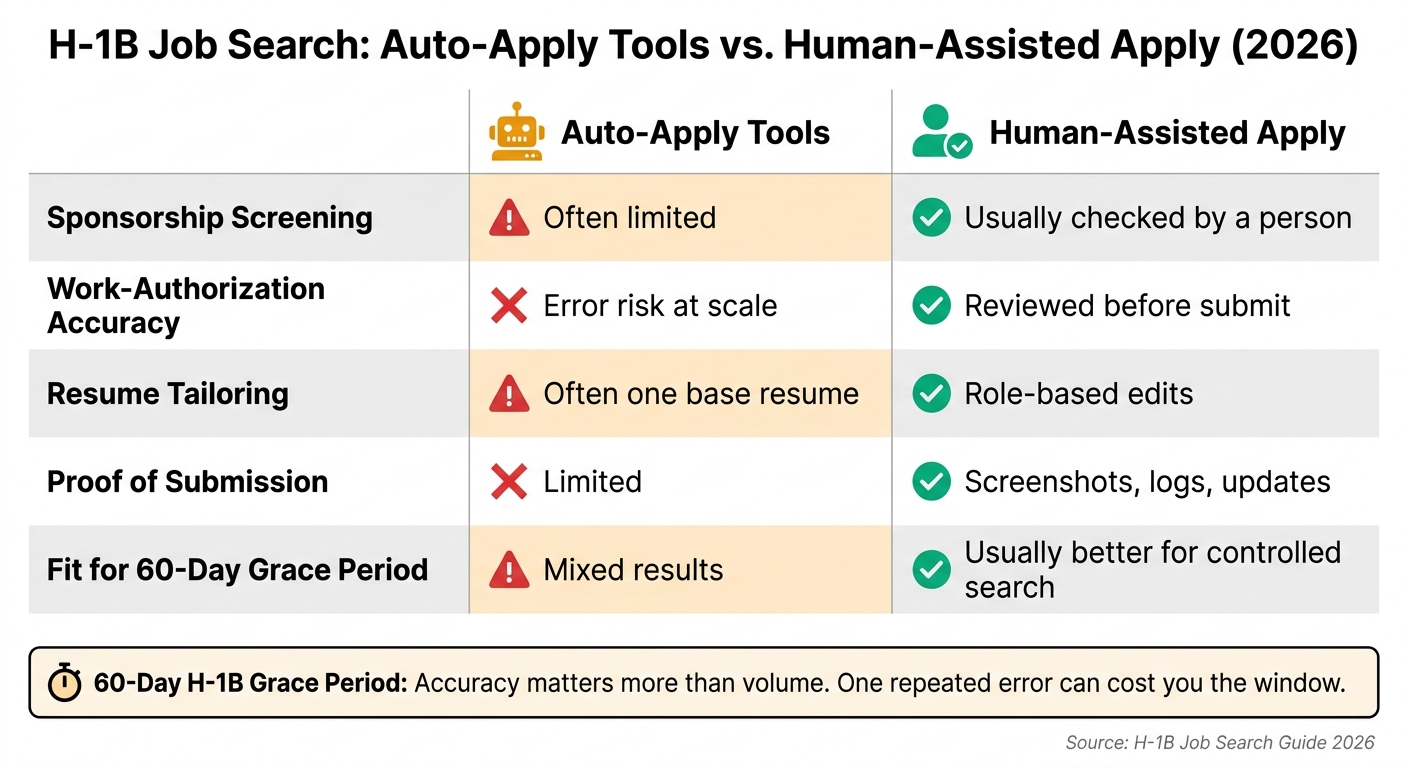
H-1B Job Search: Auto-Apply Tools vs. Human-Assisted Apply (2026)
| What matters for H-1B search | Auto-apply tools | Human-assisted apply |
|---|---|---|
| Sponsorship screening | Often limited | Usually checked by a person |
| Work-authorization accuracy | Error risk at scale | Reviewed before submit |
| Resume tailoring | Often one base resume | Role-based edits |
| Proof of work | Limited | Screenshots, logs, updates |
| Fit for 60-day grace period | Mixed | Usually better for controlled search |
My take
I see the tradeoff as simple: bots help with output, but people help with accuracy. If I need to Apply for jobs while managing transfer timing, employer sponsorship, and location rules, I would lean toward a human-assisted setup over mass automation.
Why auto-apply can fail H-1B candidates
The main problem is not just bad targeting. It is repeated bad targeting.
A bot can:
- apply to employers that do not sponsor,
- mark the wrong work authorization,
- miss state-based remote limits,
- reuse the same resume for very different roles.
That can hurt more than it helps, especially when I am applying for full time jobs tied to visa timing.
A simple workflow I would use
If I wanted a cleaner search process, I would do this:
- Build a base resume with an ai resume builder.
- Draft a base note with an ai cover letter builder.
- Use a human-led Virtual Assistant for Job Applications for submission review.
- Track results in one place and fix patterns fast.
- Use a job search coach only if my interview rate stays low.
Is LazyApply worth it for H-1B candidates?
My short answer: usually no, not as a primary method.
It may work better for job seekers without visa limits who want raw volume. But if my search depends on getting sponsorship, location, and form answers right each time, I would treat LazyApply as high-risk.
LazyApply vs Scale.jobs
This is where the gap is clearest.
LazyApply
- Built for high-volume submissions
- Good for broad outreach
- Less control at the field level
- Uses human review before submission
- Checks sponsorship and work-authorization details against an H1B cap checklist
- Gives logs and proof of work
If I were choosing between the two for an H-1B search, I would pick the one that lowers form-error risk.
Other tools I would compare before deciding
I would group the tools into two buckets.
Auto-apply and search tools
- Simplify.jobs
- LoopCV
- Sonara
- Jobright.ai
- a job search platform
These can help with search flow, but they may not catch visa-related issues inside each application, which is why following an H1B job search checklist is essential.
Resume and prep tools
These help with documents, not submission control. They pair well with a job search virtual assistant if I need help getting applications out cleanly and tracking application status effectively.
FAQ
Should H-1B holders compare auto-apply tools before using them?
I would use them with caution. They can save time, but they can also spread the same error across many applications.
What matters most in an H-1B job search?
I would focus on:
- sponsor fit,
- work-authorization accuracy,
- location rules,
- role-based resume fit,
- submission tracking.
Can resume tools alone solve the problem?
No. Resume tools help me prepare. They do not check every employer form or sponsorship note.
Who may still use automation?
If I had stable work authorization and enough time to review every submission myself, automation might be fine. If not, I would use more oversight.
Final call
If my job search includes sponsorship pressure, I would not judge a tool by how many applications it sends. I would judge it by how many usable applications it sends.
That is the difference between human-assisted vs. automated job applications. For H-1B candidates in 2026, that difference can matter a lot.
Where automation creates avoidable risk in the H-1B job search
Sponsorship filters, location limits, and work-authorization questions that bots often get wrong
These mistakes usually show up in three places: sponsor fit, work-authorization answers, and location rules.
The biggest problem is simple. A bot can send your application to employers that can’t sponsor you. A lot of job posts hide that detail in eligibility notes, fine print, or FAQs. An auto-apply tool may skim the page, see a match on title or skills, and move on. That’s a bad miss.
Work-authorization fields are another trouble spot. Some bots fill those answers in a way that doesn’t match your status. If that answer conflicts with your actual situation, the issue can pop up later when a recruiter reviews the file. At that point, you may get follow-up questions, or the role may be ruled out before you get a fair look. A human check before submission can catch that kind of mismatch.
Location rules create a third weak point. A role may say remote on LinkedIn, but the full posting may limit hiring to certain states or require regular time on-site. Bots often grab the remote label and ignore the rest. For H-1B holders, that’s not a small detail. A different worksite may mean a new LCA filing before the job is even workable.
If you're using a job application service or a job search platform, this is one of the first things to check: does it screen for sponsorship and location limits, or does it just blast applications out?
The same issue shows up again when bots try to cover too many roles with one resume.
Why mass submissions with generic resumes waste limited H-1B time
A 60-day search rewards precision, not sheer volume.
Sending hundreds of applications with one generic resume doesn’t help if the roles aren’t sponsor-ready or the resume doesn’t line up with the job. ATS systems and recruiters both look for direct role fit. When sponsorship is part of the picture, that review gets even tighter. Employers want fewer open questions, not more.
That’s why mass-apply systems often backfire for H-1B candidates. They may help you Apply for jobs at scale, but scale alone isn’t the goal. Fit is. If every application has to pass sponsorship checks, location checks, and resume-fit checks, then low-precision volume burns time you can’t afford to lose.
A broad resume can hurt, too. If it blurs your function or mixes too many directions, it becomes harder to show why you fit one clear role. In a short search window, a tighter resume usually beats a catch-all version.
Tools like an ai resume builder can help speed up edits, but they still need review from someone who understands the role you’re targeting. The same goes for an ai cover letter builder. Speed helps. Blind speed doesn’t.
Why proof of work matters when your job search must be tracked carefully
For visa holders, proof of work isn’t just a nice record to have. It’s part of a controlled search process.
An effective job application tracker helps you track when you started, who you contacted, what roles you applied to, and what you told employers about sponsorship. Without that record, it gets much harder to verify details later. If a bad answer gets repeated across several applications, you may not even spot the pattern right away.
A clear log helps with a few things:
- It shows what was submitted and when
- It helps you review sponsorship answers for errors
- It gives you a clean record of employer contact and application activity
Screenshots and timestamps matter here too. They make it easier to catch inconsistent answers before they spread across more applications. That kind of paper trail is one reason many candidates use a Virtual Assistant for Job Applications or a job search coach instead of relying only on automation.
That’s where human review starts to matter more than speed.
LazyApply vs scale.jobs for H-1B job search in 2026: why human-powered apply is the safer switch
Is LazyApply worth it for H-1B candidates? Strengths, limits, and where scale.jobs wins
LazyApply is fast. And if your goal is to blast applications across LinkedIn, Indeed, and ZipRecruiter, that speed can help.
But H-1B job search is a different game.
For sponsorship-dependent candidates, one wrong answer on a work-authorization field can create a mess. A resume that ignores sponsorship language can also hurt your chances before a recruiter even reads the first line. That’s where the gap starts to show: LazyApply is built for volume, while Scale.jobs puts a human check in the loop before the application goes out.
That difference matters most when you apply for jobs at scale and still need accuracy.
Here’s where scale.jobs works differently in day-to-day use:
- Human assistants review each posting and tailor ATS-friendly, visa-aware resumes for the role. They check sponsorship language, location limits, and eligibility notes that auto tools often miss.
- Work-authorization fields are completed by a person. That lowers the chance of selecting the wrong answer for your visa status.
- Proof-of-work is built in. You get time-stamped records, so every submission is traceable.
- Dedicated WhatsApp support helps with fast calls and clarifications.
If you’re comparing a pure automation tool with a job application service, this is the core tradeoff: speed versus review before submission.
LazyApply vs scale.jobs: side-by-side comparison table
For H-1B searches, the big question isn’t just speed. It’s how much review happens before an application is submitted.
| Feature | LazyApply | scale.jobs |
|---|---|---|
| Human involvement | Fully automated workflow | Trained human assistants handle each application by hand |
| Resume customization depth | Limited; often reuses one resume across many submissions | Per-role tailoring with ATS-friendly, visa-aware edits |
| ATS handling | Focuses on fast submission; limited content optimization | ATS-friendly formatting and keyword alignment per posting |
| Application execution method | Auto-fills standard forms; weaker on multi-step portals | Manual form completion across any portal, including multi-step employer systems |
| Transparency and proof of work | Limited visibility into what was submitted or how answers were entered | Time-stamped screenshots, application logs, and WhatsApp updates |
| Pricing model | Subscription or lifetime-style plans | Flat-fee assisted packages |
This side-by-side view also helps if you’re weighing other tools in the same lane, like a job search platform, an ai resume builder, or an ai cover letter builder. Those tools can help with speed and setup, but they don’t always solve the submission-accuracy problem for H-1B cases.
Who should use LazyApply and who should choose scale.jobs
These workflow differences usually make the choice pretty clear.
LazyApply fits job seekers with no visa or sponsorship constraints who want as much raw volume as possible across standard boards and don’t mind checking results later.
scale.jobs fits H-1B and other sponsorship-dependent candidates who can’t afford form mistakes, need sponsorship-aware targeting, and want a record of every application.
A simple way to think about it:
If your search depends on getting the visa details right every single time, human review is not a nice extra. It’s part of the application itself.
This same logic applies when comparing other auto-apply products, resume tools, or a virtual assistant for job seekers against a human-led process.
Stop using fully automated apply tools until you compare these rivals with scale.jobs
Fully automated apply tools can save time. But for H-1B candidates, speed alone isn't enough. The problem often isn't finding jobs. It's getting each application right.
That gap matters more than people think. A tool can blast out applications all day, but if it repeats the wrong work-authorization answer, skips a sponsorship detail, or sends you to employers that don't sponsor, the damage happens before anyone even opens your resume.
If you're using a job search platform or testing a job application service, this is the part to look at closely: who checks the application before it goes out?
Simplify.jobs, LoopCV, Sonara, and Jobright.ai vs scale.jobs
Simplify.jobs cuts down repetitive data entry with 1-click apply. LoopCV runs fully automated daily applications based on saved criteria. Sonara offers hands-off AI job search. Jobright.ai surfaces relevant postings through real-time curation and ranking.
That sounds efficient. And for some job seekers, it is.
For H-1B candidates, though, the risk shows up inside the application itself. Sponsorship filters, location limits, and work-authorization questions can trip you up fast. These tools are not built to catch every visa-sensitive issue at the field level.
An auto-apply tool may reuse the same work-authorization answer across many submissions. A human checks each field against your actual status. That small difference can decide whether your application moves forward or gets rejected on the spot.
Why scale.jobs wins for H-1B searches:
- Sponsorship and work-authorization review filters out employers that do not sponsor H-1B candidates and catches field-level errors before submission.
- Per-role resume customization goes deeper than a single saved profile, improving ATS fit and recruiter relevance for each specific posting.
- Time-stamped screenshots, application logs, and WhatsApp updates create proof of work you can track and verify throughout your search.
Here's how these tools compare on the points that matter most for visa-constrained candidates:
| Feature | Simplify.jobs / LoopCV / Sonara / Jobright.ai | scale.jobs |
|---|---|---|
| Human involvement | Mostly automated or AI-assisted self-serve | Trained human assistants handle each application |
| Resume customization depth | One profile or limited tailoring per role | Per-role resume and cover letter customization |
| ATS handling | Basic autofill, tracking, and profile-based matching | ATS-optimized documents plus human-checked submissions |
| Application execution method | Auto-apply or streamlined self-serve submissions | Human assistants submit applications by hand |
| Visa-aware handling | Generic job search; limited visa-sensitive handling | Explicit sponsorship filtering and visa-sensitive form completion |
| Transparency and proof of work | Basic dashboards or email summaries | Time-stamped screenshots, application logs, WhatsApp updates |
| Pricing model | Monthly subscriptions | One-time flat-fee campaign packages |
A simple example shows the risk. An H-1B holder using LoopCV's fully automated mode may end up applying to roles that clearly exclude visa sponsorship or require relocation they can't complete in time. At scale.jobs, human screening stops those submissions before they happen.
If your current setup ends with sourcing and one-click apply, that's the next issue to solve. Not just can you apply for jobs faster, but can you submit the right application to the right employer with the right answers?
This is also where a Virtual Assistant for Job Applications or a virtual assistant for job seekers starts to make more sense than another auto-apply subscription.
Jobscan, Teal, Rezi, Resume Worded, and TopResume vs scale.jobs
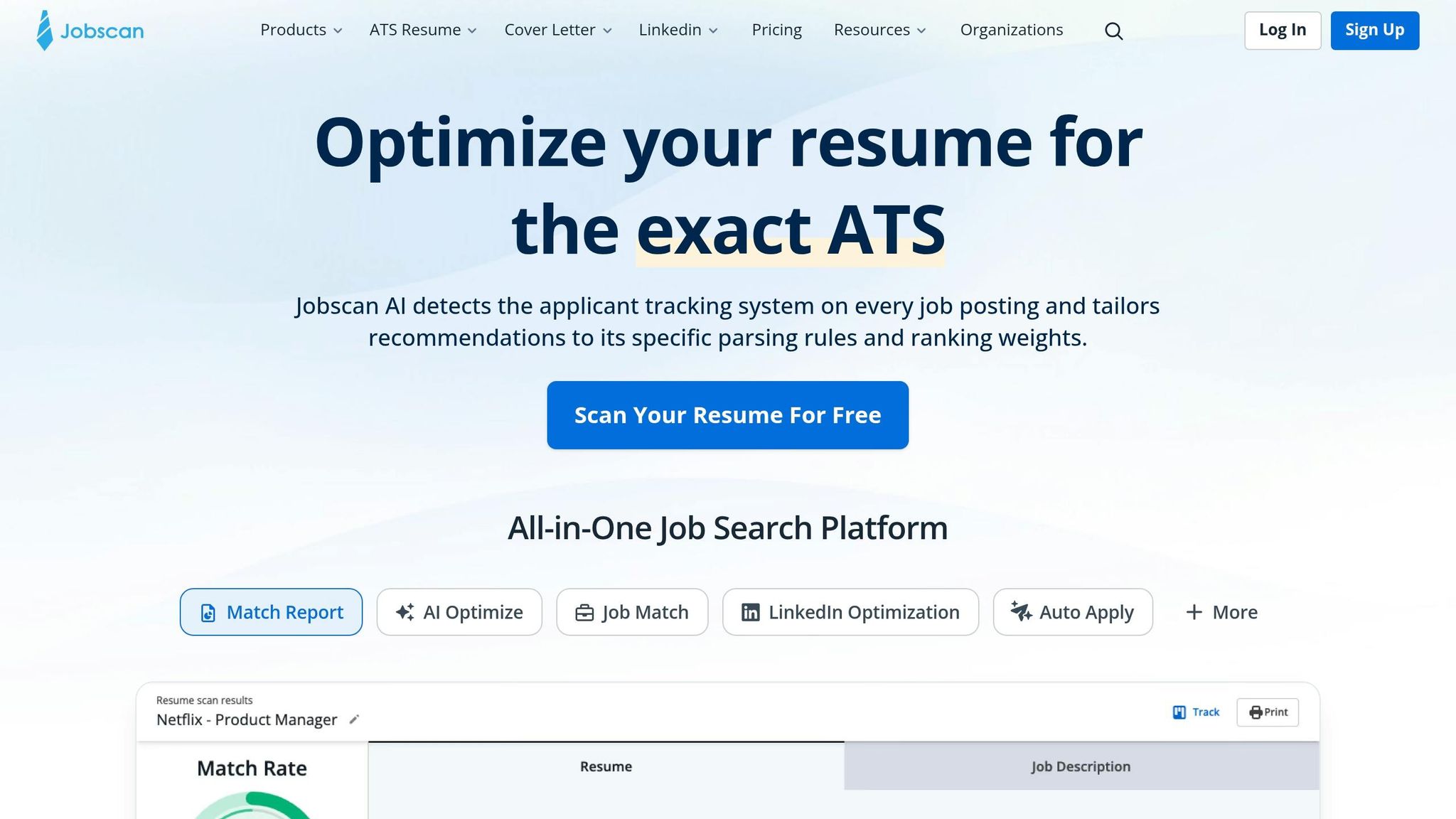
These tools help you improve the resume. They do not execute sponsorship-aware applications.
Jobscan and Resume Worded flag missing keywords against job descriptions. Rezi and Teal give you structured templates and tracking dashboards. TopResume delivers professionally written resumes and cover letters.
They're useful. In many cases, they're part of a smart workflow.
But there's a clear limit: none of them filter out non-sponsoring employers, handle work-authorization questions, or prioritize urgent roles. A polished resume still fails when it gets sent to the wrong company or paired with the wrong answer on the form.
That's why ATS optimization alone doesn't solve the full problem. An ai resume builder or ai cover letter builder can help shape your base materials. What it can't do is review each submission like a person who knows visa-sensitive details matter.
A practical workflow looks like this:
- Use Jobscan or Rezi to optimize your base resume.
- Then hand that document to scale.jobs' human assistants to customize and deploy it across a sponsorship-aware campaign at a one-time flat-fee rate.
That setup works well for job seekers who want document help and careful execution, especially when applying to full time jobs tied to sponsorship timing.
Who should stay with a resume tool only, and who should switch to human-assisted application support
Some people don't need extra hands. Others do, and usually fast.
Stay with resume tools if you have stable work authorization, enough time to manage your own search, and you're already getting a decent interview rate. In that case, a resume product, a tracker, and one of the best job boards may be enough.
Switch to human-assisted application support if you're inside a 60-day grace period after a layoff, your applications involve location limits or transfer timing, or sponsorship constraints are causing automated tools to mishandle submissions.
Think of it this way: a resume tool helps you prepare. A Job search virtual assistant helps you execute. If your search is still document-only, stick with the resume tool. If submission accuracy now decides whether you stay in the game, human-assisted apply support is the better move.
For candidates dealing with visa pressure, this isn't a minor workflow choice. It's often the difference between sending more applications and sending the right ones.
Decision summary: switch to scale.jobs if your H-1B search needs human oversight, not just speed
Decision summary: when to choose automation and when to choose scale.jobs
When sponsorship rules, location limits, and work authorization can make or break an application, the choice usually comes down to volume vs. review.
At this point, the call is pretty straightforward: automation is built for volume. scale.jobs fits better when accuracy matters more, especially if sponsorship and timing are tight.
Use this rule:
- Choose automation-first tools if you’re a U.S. citizen or green card holder, want high application volume, and can manually review every submission.
- Choose scale.jobs if you’re on H-1B or another employer-sponsored status, can’t risk a bot answering work-authorization questions the wrong way, or need a clear, timestamped record of every application sent.
For H-1B candidates, the biggest risks are simple but costly: applying to employers that don’t sponsor, selecting the wrong work-authorization answer, or missing location limits tied to the role. Human review helps close that gap. If you're using a job application service or a Virtual Assistant for Job Applications, this is where the difference shows up in plain terms: less guesswork, more control.
Switch to scale.jobs if these conditions apply to you
These are the clearest signs that a human-assisted setup may fit better than another automated subscription:
- You’re on H-1B or another employer-sponsored status where employer choice and worksite location can affect your timeline.
- You need a fast H-1B transfer or post-layoff search, so every bad-fit application costs time you may not have.
- You want timestamped proof of each submission for tracking and follow-up.
- You’d rather pay a one-time flat fee than keep paying a monthly tool after your search slows down.
- You need WhatsApp support to flag urgent roles, update targeting, and confirm submission status.
This is often the point where a job search virtual assistant or a virtual assistant for job seekers makes more sense than another hands-off job search platform. If your search includes sponsorship risk, speed alone isn’t enough. You need applications that are usable, tracked, and sent to the right employers.
For H-1B candidates in 2026, human review matters when accuracy, targeting, and traceability decide whether an application is usable. Human-assisted apply cuts visa-related submission risk when accuracy matters more than speed.