
This Free ATS Score Checker Found 7 Mistakes in Your Resume Instantly

Sarah Mitchell
April 30, 2026

Up to 75% of resumes fail ATS filters, often due to formatting, missing keywords, or vague descriptions. These systems scan resumes in seconds, prioritizing those with the right structure and relevant terms. If you haven't optimized your resume for ATS, it might never reach a recruiter.
Here’s what you need to know: Free ATS score checkers like Jobscan and ATSGrade analyze your resume for issues such as unreadable formatting, missing keywords, or unclear headers. They highlight errors and suggest fixes to improve your chances. However, tools like scale.jobs go further by combining human expertise with ATS optimization, ensuring your resume gets noticed and submitted correctly.
Key takeaways:
- Avoid tables, graphics, and unconventional formats.
- Match keywords directly from job descriptions.
- Focus on measurable achievements rather than vague responsibilities.
- Use standard file formats (.docx or simple PDFs) and conventional headings.
For high-volume job seekers, scale.jobs offers a hands-on service, tailoring your resume and manually submitting applications to avoid bot detection. It’s a time-saving option for those struggling to get responses despite using ATS tools.
Quick Comparison:
| Feature | Jobscan/ATSGrade | scale.jobs |
|---|---|---|
| Approach | Automated scoring | Human-assisted execution |
| Resume Optimization | DIY fixes | Tailored by recruiters |
| Application Handling | Manual by user | Managed (30/day) |
| Pricing | Subscription | One-time payment |
If you’ve tried free ATS checkers but still aren’t landing interviews, consider a service like scale.jobs for end-to-end support. Whether you’re applying for full-time jobs or searching for a job application service, tools and services tailored to your needs can make all the difference.
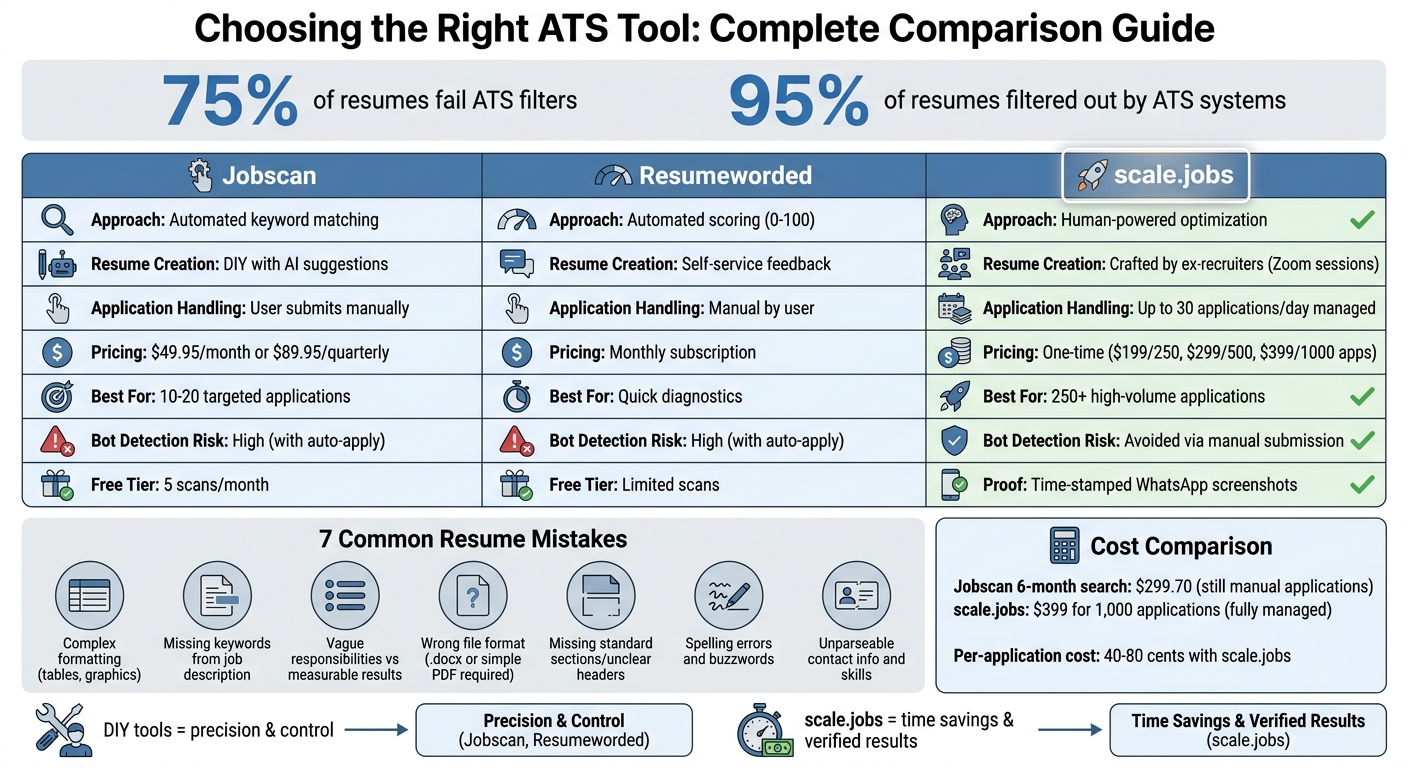
ATS Tools Comparison: Jobscan vs Resumeworded vs scale.jobs Features and Pricing
How to Beat the ATS (Most People Are Doing This Wrong)
sbb-itb-564272e
7 Resume Mistakes ATS Score Checkers Find Instantly
Understanding these common resume mistakes can help you see how Scale.jobs stands out compared to tools like Jobscan and Resumeworded. Free ATS score checkers can quickly identify errors that might get your resume filtered out before a human even sees it. Here are the seven most frequent mistakes they catch and why avoiding them is crucial when you're up against hundreds of applicants.
Complex Formatting That ATS Can't Read
Tables, sidebars, and graphics can confuse ATS systems. For instance, your job title might end up in the wrong section, or the system could miss your contact details entirely if they’re embedded in a graphic header.
Stick to a clean, single-column layout with standard fonts like Arial, Calibri, or Times New Roman. Use simple bullet points rather than custom icons, and avoid adding images, logos, or charts. Tools like ATSGrade can help you preview how an ATS will interpret your resume, making it easier to spot formatting issues before you hit "send."
Missing Keywords From the Job Description
ATS tools scan for specific keywords from job postings. They look for both hard and soft skills, as well as industry-specific terms. For example, if the job description mentions "customer service", but your resume says "customer support", the system might not recognize the match, which could lower your score.
Carefully extract key terms from the job ad and integrate them naturally into your resume. For example, if the role lists "project management" and "stakeholder communication" as requirements, use those exact phrases rather than paraphrasing. However, avoid cramming in every keyword - prioritize the top 10–15 most important terms to keep your resume readable for recruiters.
Vague Responsibilities Instead of Measurable Results
Generic descriptions don't impress ATS systems - or hiring managers. Phrases like "Responsible for managing team projects" don’t convey much about your achievements.
Focus on measurable results and action-oriented language. Instead of saying, "Handled customer inquiries", you could write, "Resolved 150+ customer inquiries weekly, boosting satisfaction scores by 23%." Similarly, replace "Managed social media accounts" with "Increased Instagram followers from 2,500 to 18,000 in six months, generating $45,000 in direct sales." Quantified outcomes not only improve your ATS score but also make your resume more compelling to recruiters. If you're unsure how to craft these, using a professional resume writing service can be a smart move.
Wrong File Format or Too Many Pages
ATS systems prefer .docx or simple PDFs, and they struggle with overly long resumes. Files created in Photoshop, InDesign, or Canva may not parse correctly, and resumes longer than two pages might get cut off, meaning your most recent experience could go unnoticed.
Save your resume as a Word document (.docx) or a plain PDF generated from Word, Google Docs, or an ATS-friendly resume builder. If you have under 10 years of experience, aim for a one-page resume. For senior roles, keep it to two pages at most.
Missing Standard Sections or Unclear Headers
Creative section titles can confuse ATS systems. For example, using "Where I Learned" instead of "Education" or "What I'm Good At" instead of "Skills" might lead to misclassification.
Stick to conventional section headings like Work Experience, Education, Skills, Certifications, and Contact Information. Ensure your name and contact details are in plain text at the top of your resume - not hidden in a header or footer - so ATS systems can easily extract them. Always include job titles, company names, employment dates, and degree details in a consistent format.
Spelling Errors and Overused Buzzwords
Even small typos or generic phrases can hurt your ATS score. For example, writing "Java Script" instead of "JavaScript" might prevent the system from recognizing the skill. With nearly 95% of resumes filtered out by ATS systems, attention to detail is critical.
Use spell-check tools and read your resume aloud to catch errors that automated tools might miss. Replace buzzwords like "excellent communicator" with concrete examples, such as "Presented quarterly business reviews to C-suite executives at Fortune 500 companies." Tools like Lemmi AI ($19.99/month) can help you refine grammar and avoid overused phrases before submitting your application.
Contact Info and Skills ATS Can't Parse
Improperly formatted contact details or irrelevant skills can hurt your chances. For example, an email address embedded in a graphic might not be extracted by the ATS. Similarly, listing outdated or irrelevant skills - like "Microsoft Word" for a senior developer role - can dilute your resume's focus.
Ensure your contact information is formatted clearly: John Smith | (555) 123-4567 | [email protected] | linkedin.com/in/johnsmith should appear at the top of your resume in plain text. In your skills section, list 8–12 of the most relevant technical and soft skills based on the job description. Use the exact wording from the posting - for example, if the job specifies "Python 3.x", make sure you include that precise term.
Next, take a closer look at how Scale.jobs compares to Jobscan in addressing these issues to determine which platform better supports your ATS optimization strategy.
Jobscan vs scale.jobs: Which ATS Tool Actually Gets You Interviews?
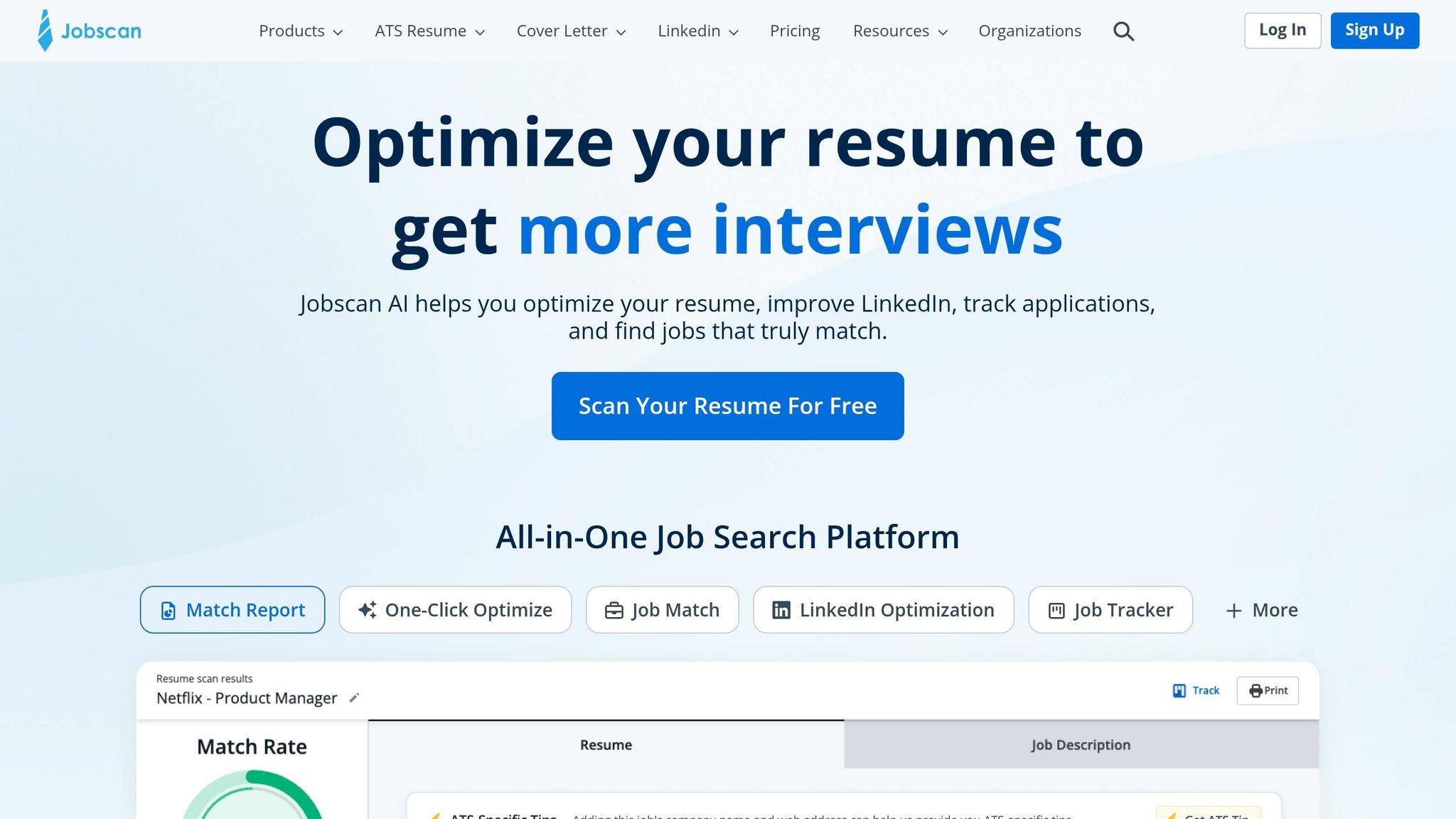
Jobscan focuses on keyword matching to compare your resume against job descriptions, providing a match rate. It identifies hard skills, soft skills, and buzzwords that are missing from your resume. While the platform offers 5 free scans each month, a paid subscription - $49.95 per month or $89.95 quarterly - is required for unlimited scans. However, you're responsible for editing your resume and submitting applications on your own.
scale.jobs offers a more hands-on approach by combining ATS tools with human assistance. Instead of just analyzing your resume, experienced recruiters work with you in live Zoom sessions to craft it. Additionally, human assistants manually submit up to 30 applications daily on your behalf. Unlike automated tools that focus solely on ATS metrics, scale.jobs ensures that your resume is optimized for both ATS systems and human recruiters. This manual submission process avoids triggering bot detection systems, which can be a problem with auto-apply tools. You even receive time-stamped WhatsApp screenshots as proof of submission.
The key difference lies in execution versus analysis. Jobscan provides data - match scores and keyword suggestions - but leaves the actual editing and application process to you. By contrast, scale.jobs takes care of the entire workflow, from tailoring your resume for each job to manually submitting applications. Their approach avoids keyword overuse, keeping resumes readable for both ATS systems and human recruiters.
Pricing models also differ. Jobscan charges a recurring subscription fee ($49.95/month), which can total $599.40 annually if you're job searching for a year. Meanwhile, scale.jobs offers one-time payment options: $199 for 250 applications, $299 for 500, and $399 for 1,000. They also offer pro-rata refunds for unused credits.
| Feature | Jobscan | scale.jobs |
|---|---|---|
| Primary Method | Algorithmic keyword matching | Human-powered optimization & submission |
| Resume Creation | DIY with AI/keyword suggestions | Crafted by ex-recruiters during Zoom sessions |
| Application Handling | User submits manually | Assistants submit up to 30/day |
| Submission Proof | In-app match score | Time-stamped WhatsApp screenshots |
| Pricing Model | $49.95/month or $89.95/quarterly | One-time payment ($199–$399) |
| Bot Detection Risk | High with auto-apply tools | Avoided via manual submission |
Why scale.jobs Outperforms Jobscan
- human-tailored resumes beat algorithm-driven keyword stuffing. Jobscan's emphasis on match rates can lead to keyword overuse, which may make resumes less appealing to recruiters. scale.jobs ensures resumes are customized for each job while maintaining readability.
- One-time payment eliminates subscription fatigue. A six-month job search with Jobscan costs $299.70, and you still have to handle all applications yourself. For $399, scale.jobs covers 1,000 applications and includes human assistance - no ongoing fees or hidden costs.
- Transparent proof of submission. scale.jobs provides real-time WhatsApp updates with screenshots, showing exactly when and where applications were submitted. Jobscan, on the other hand, leaves tracking entirely up to you.
- Manual submissions bypass bot detection systems. Jobscan users often pair it with auto-apply tools, which can trigger ATS flags. scale.jobs avoids this risk by having human assistants fill out applications manually.
- Ideal for high-volume job seekers. While Jobscan is effective for a few targeted applications, it becomes overwhelming when applying to hundreds of jobs. scale.jobs takes on the heavy lifting, saving you hours each week.
Who Should Use Jobscan
Jobscan is best for job seekers who enjoy a hands-on approach. If you're applying to 10–20 carefully chosen roles and want to understand ATS optimization principles, Jobscan's match-rate feedback can help you refine your resume. It’s also a good fit for those on a tight budget conducting short job searches, as the free tier allows for 5 scans per month.
This tool works well for people who prefer to control every aspect of their applications and have the time to tailor resumes manually for each job.
Who Should Choose scale.jobs
scale.jobs is ideal for candidates who need high-volume, customized applications. If you're applying to 250 or more positions or find it challenging to achieve a high ATS score, scale.jobs' human-powered approach ensures both ATS compatibility and recruiter appeal. It's especially helpful for individuals with unique challenges, such as career gaps or visa requirements, who need tailored resumes for each role.
Busy professionals benefit from scale.jobs' execution model. By delegating application tasks, you can focus on networking and interview preparation instead. The one-time payment model and real-time updates ensure accountability, making it a smart choice for those who want both ATS-optimized resumes and full application support. For candidates seeking a better return on investment, services like Virtual Assistant for Job Applications offer more value than software-only solutions.
Next, discover how scale.jobs compares to Resumeworded and when it makes sense to switch to scale.jobs.
Resumeworded vs scale.jobs: AI Feedback or Human Execution?
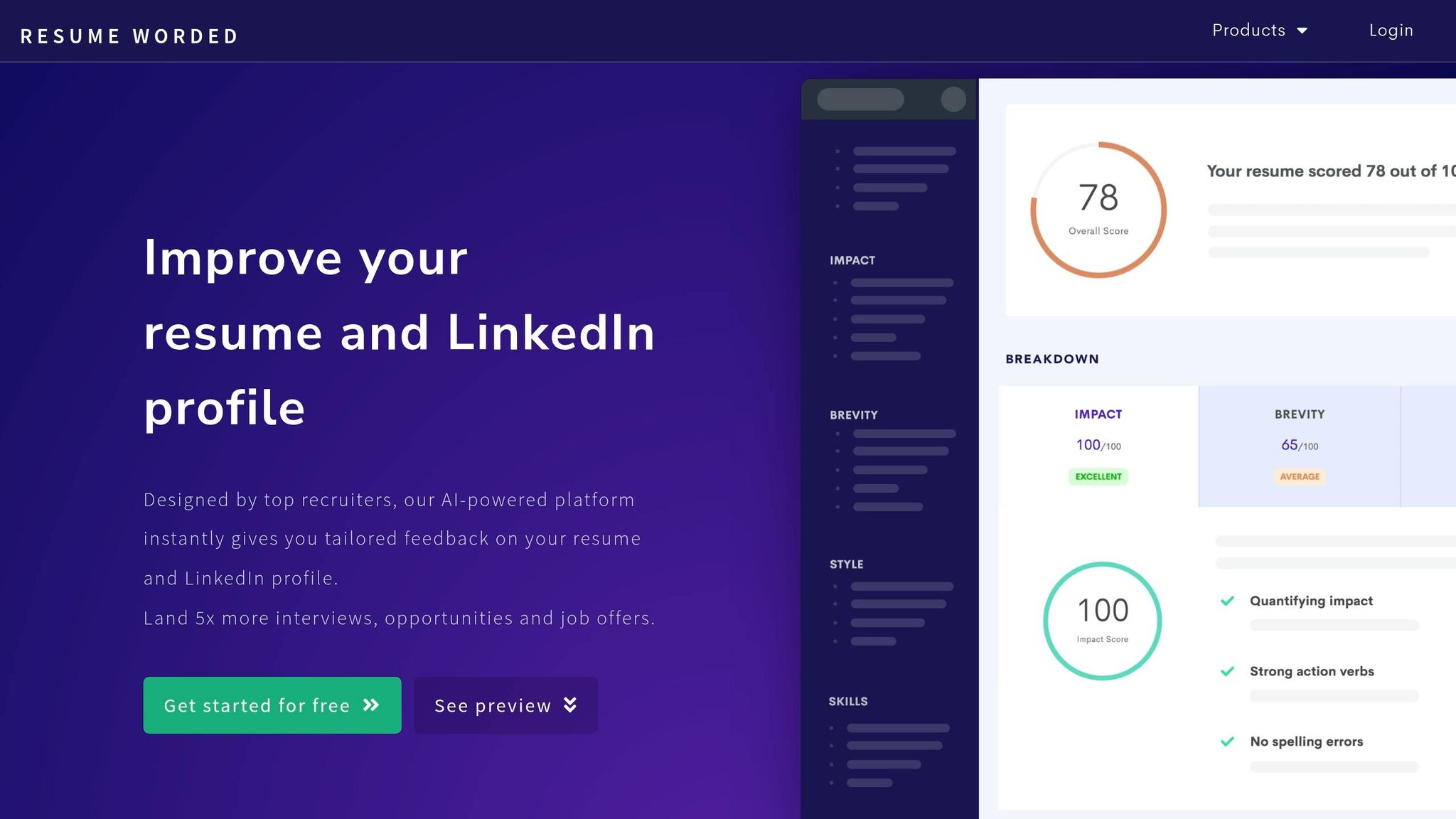
Resumeworded provides automated scoring (0–100) based on ATS compatibility, keyword density, formatting, and action verbs. It offers instant feedback, serving as a quick tool to identify missing sections or structural issues in your resume. This is ideal for candidates who want to diagnose potential problems and fix them independently. However, the platform's assistance stops at feedback, leaving the user to rewrite their resume, tailor it to job descriptions, and handle application submissions manually.
scale.jobs takes a different approach by combining AI analysis with human verification throughout the process. Experienced professionals customize your resume for specific jobs and handle the application process on your behalf. This includes manually submitting applications, which avoids triggering bot-detection systems. To ensure transparency, candidates receive time-stamped WhatsApp screenshots as proof of each application - a feature not offered by automated scoring tools.
The pricing structures also highlight their differences. scale.jobs uses a one-time payment model, while Resumeworded charges recurring subscription fees. For example, scale.jobs offers packages like $199 for 250 applications, $299 for 500, and $399 for 1,000, with refunds for unused credits.
| Feature | Resumeworded | scale.jobs |
|---|---|---|
| Primary Function | Automated resume scoring and feedback | Human-assisted customization and application management |
| Accuracy Method | Algorithmic checklist | AI analysis with human verification for each application |
| Customization | General suggestions | Job-specific tailoring for every submission |
| Execution | Self-service (user applies manually) | Managed (human assistants apply on your behalf) |
| Transparency | Stops at feedback | Time-stamped WhatsApp screenshots |
| Pricing | Monthly subscription | One-time flat fee |
Where Resumeworded Works Well
Resumeworded is a helpful tool for quick diagnostics but has a more limited scope compared to human-assisted services. It shines as a fast, 2-minute diagnostic tool. If you're targeting 10–15 carefully selected roles and want to understand basic ATS principles, it identifies issues like missing sections or formatting problems. This makes it particularly useful for fields like tech, finance, or consulting, where keyword-focused resumes are common. Its free tier allows users to run a few scans without upfront costs, making it appealing for those on a tight budget or conducting a smaller-scale job search.
Why scale.jobs Wins Against Resumeworded
Human oversight bridges the gaps that automation can't. While Resumeworded can flag keyword density, it doesn't assess whether your resume tells a cohesive story or effectively highlights transferable skills - especially critical during career transitions. scale.jobs ensures your resume appeals to both ATS systems and hiring managers, avoiding the keyword stuffing that can make resumes feel robotic.
One-time pricing avoids subscription fatigue. A six-month job search with Resumeworded can lead to recurring costs, whereas scale.jobs offers a flat fee for services like 1,000 applications, with no hidden charges.
Transparent proof of submissions builds trust. Unlike Resumeworded's scoring system, scale.jobs provides real-time WhatsApp updates along with screenshots of each application, so you can track progress.
Manual submissions reduce bot-detection risks. By having human assistants manually submit applications, scale.jobs ensures your submissions appear authentic to employers. For those navigating career transitions, visa requirements, or senior-level roles, professional resume writing services combined with human oversight offer a more reliable solution than automated tools alone.
Who Should Choose scale.jobs
scale.jobs caters to candidates who need end-to-end application management rather than just diagnostic tools. If you're applying to 250 or more positions, dealing with career gaps, or facing challenges like visa requirements, scale.jobs' human-in-the-loop model ensures your applications are both ATS-friendly and appealing to recruiters. For those who've already optimized their resumes with free tools but still aren't landing interviews, the issue may lie in execution and application volume - areas where scale.jobs excels.
Busy professionals can save over 20 hours per week by outsourcing the application process, freeing up time for networking and preparing for interviews. With its one-time payment model and real-time updates, scale.jobs offers a practical solution for candidates seeking ATS-optimized resumes and comprehensive application support, all while minimizing the risks associated with automated submission systems.
Switch to scale.jobs If You Match These Conditions
If you're struggling to get your resume past ATS systems or need help with large-scale job applications, scale.jobs provides tailored solutions that combine expert resume optimization with hands-on application execution.
Your ATS Score Stays Below 80% After Multiple Fixes
Still can't get your ATS score above 80%, even after multiple tweaks? The problem might go beyond simple keyword adjustments. Many resumes fail due to subtle issues like mismatched terms or formatting that ATS systems can't process effectively. For example, some platforms, like Lever, won’t outright reject resumes but may make them invisible to recruiters if terms like "CRM" don’t align with "Customer Relationship Management" in their search criteria.
At scale.jobs, experts go beyond automated tools to review your resume for contextual accuracy, ensuring it tells a clear story and highlights measurable achievements. They also optimize for both abbreviated and full-term keywords - for instance, "Amazon Web Services (AWS)" - to boost visibility in ATS searches. If you've been stuck tweaking your resume without landing interviews, explore their professional resume writing services to uncover and fix the real barriers.
But optimizing your resume is just the first step. Let’s talk about application volume and authenticity.
You Need 250+ Applications Submitted Without Bot Flags
High-volume job applications often fail when automated tools trigger bot-detection systems. scale.jobs solves this by using trained human assistants to manually complete each application. This approach ensures submissions appear genuine, which is critical when applying to hundreds of roles. Even one bot flag can silently disqualify you from multiple opportunities.
Unlike auto-apply tools compared in the market, scale.jobs assistants tailor application responses, upload customized resumes, and follow each employer’s specific submission guidelines. They also provide time-stamped updates via WhatsApp, along with proof of submission screenshots, so you know every application has been handled with care. This human-powered process ensures authenticity across all applications, giving you a better chance to get noticed.
You Want One-Time Pricing Instead of Monthly Subscriptions
For many job seekers, cost matters as much as results. Most competitors rely on subscription models that can quickly become expensive. scale.jobs offers transparent, flat-rate pricing instead: $199 for 250 applications, $299 for 500, or $399 for 1,000 applications. Plus, they offer refunds for unused credits.
This pricing structure breaks down to about 80 cents per application for smaller packages, dropping to roughly 40 cents per application for larger ones. That includes both ATS optimization and manual application execution, ensuring you avoid bot flags and maximize your chances of success.
You've Used Free ATS Checkers but Need Someone to Execute
Tools like Resumly and AtsPass are great for identifying resume issues but stop short of actual implementation. This leaves you with a to-do list instead of actionable results.
scale.jobs fills this gap by handling everything for you. After an initial AI review of your resume, human assistants tailor it for each job, manually complete application forms, and ensure submissions avoid bot detection. Real-time WhatsApp updates with proof-of-work screenshots keep you informed every step of the way. If you’ve already pinpointed your resume’s weaknesses but need help with execution and large-scale applications, scale.jobs provides the hands-on support you need to move forward efficiently.
Decision Summary: When to Use Each Tool
Free ATS checkers like Jobscan or Resumeworded are ideal when you're applying to a limited number of roles and have the capacity to manually implement the suggested changes. These tools are great at identifying what needs improvement - such as missing keywords, formatting problems, or unclear language - but the responsibility for making those adjustments falls entirely on you. If you're focusing on 10–20 carefully chosen positions and want to customize your resume for each job description, the monthly cost of $19.99–$49.95 can be worthwhile for the detailed feedback they provide. This option is best suited for applicants with time to fine-tune their documents for each opportunity.
Choose scale.jobs when you need to apply to many jobs efficiently without compromising quality. If you find yourself trapped in an endless loop of resume tweaks or struggling with low response rates despite achieving high ATS scores, the issue likely lies in the time-intensive nature of the process rather than your resume itself. With scale.jobs, trained human assistants handle the heavy lifting, tailoring and submitting over 250 applications on your behalf. You'll receive time-stamped proof-of-work screenshots and regular updates via WhatsApp, ensuring transparency. At $199 for 250 applications, this service provides both execution and accountability, making it a smart choice for high-volume job seekers.
The trade-off is clear: DIY tools are cost-effective but demand significant time, while human-powered services save time but require an upfront investment. If you've identified resume issues using free checkers but lack the bandwidth for applying to numerous roles, scale.jobs offers a more efficient solution. It eliminates the need for ongoing subscription fees and guarantees that every application is submitted correctly. For those dealing with tight timelines - like layoffs or visa constraints - professional services, whether through resume writing services or full application management, can significantly shorten your job search.
Here's a quick comparison to help you decide between DIY ATS checkers and scale.jobs' human-powered approach:
| Feature | DIY ATS Checkers (Jobscan/Resumeworded) | Human-Powered (scale.jobs) |
|---|---|---|
| Primary Function | Keyword optimization & scoring | Complete application management |
| User Effort | High (Manual updates & submissions) | Low (Fully managed process) |
| Best For | Optimizing resumes for niche roles | High-volume applications for busy job seekers |
| Accountability | Self-directed | Proof-of-work screenshots & real-time updates |
This table highlights the key differences, making it easier to decide whether to stick with DIY tools or opt for scale.jobs for a hands-off, high-volume application strategy.
Key takeaway: Use DIY checkers when precision and control are your priorities. Opt for scale.jobs when you value time savings and verified results over hands-on involvement.
FAQs
What ATS score should I aim for?
When it comes to ATS (Applicant Tracking System) scores, there isn't a universal benchmark to hit. However, aiming for a score in the range of 70-80% is often suggested by many tools as it indicates better compatibility with ATS software. To boost your chances of getting noticed, make sure your resume is optimized with relevant keywords, uses proper formatting, and has clearly defined sections that align with ATS standards.
Is a PDF or .docx better for ATS?
When it comes to ATS (Applicant Tracking System) compatibility, PDFs often have the edge because they maintain your resume's formatting exactly as intended and are widely supported by most modern ATS software. While many current ATS platforms can process both PDFs and Word (.docx) files effectively, older systems sometimes have trouble with .docx files. If you're aiming for consistency and avoiding potential issues, sticking with a PDF is usually the more reliable option.
Will keyword matching hurt readability?
Keyword matching plays a key role in getting past ATS filters, but cramming too many keywords or using them unnaturally can hurt your resume. Instead, focus on weaving keywords seamlessly into your content, aligning them with your actual skills and experiences. This approach keeps your resume polished and professional, making it easy to read for both ATS systems and human recruiters, while still boosting your chances during initial screenings.