
ATS Score vs Recruiter Score: Why They Don't Match

Sarah Mitchell
July 31, 2026

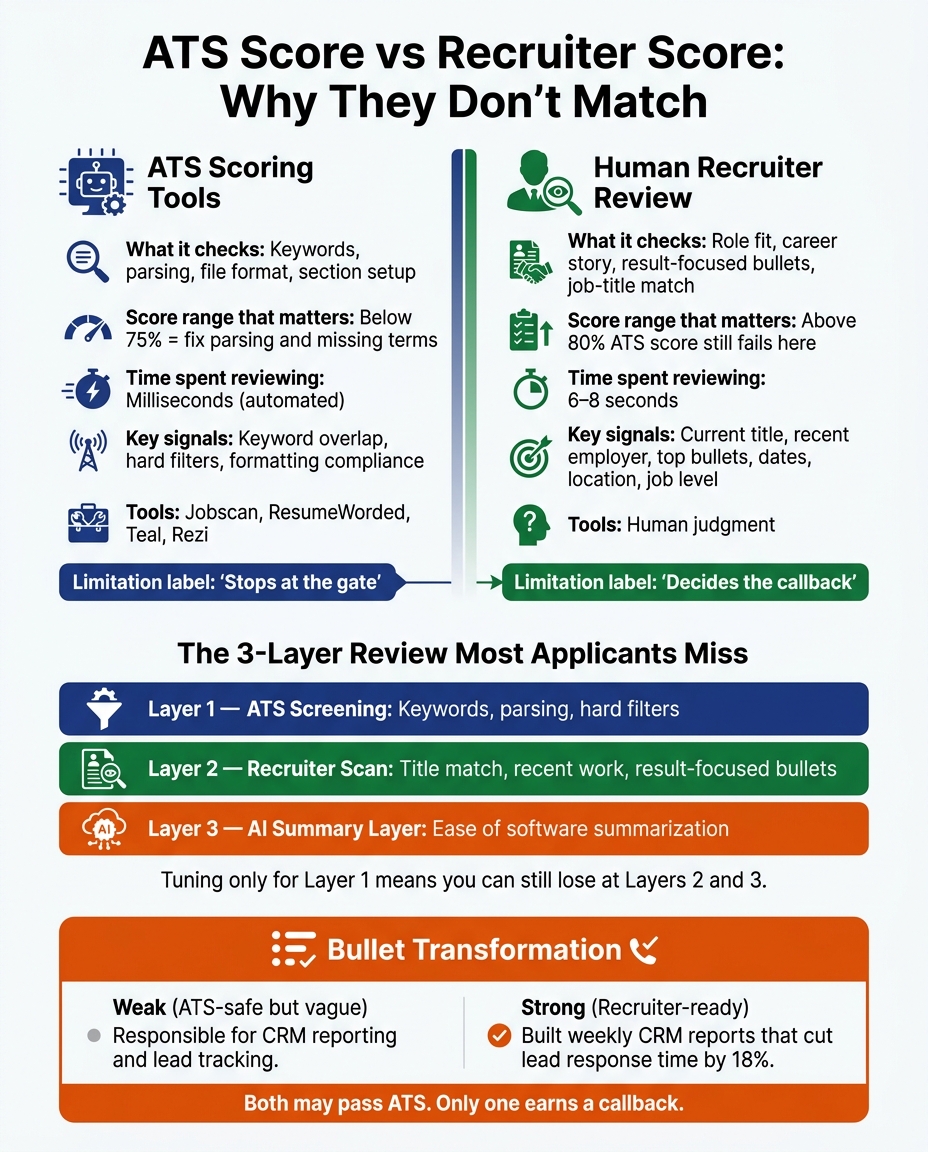
A high ATS score does not mean a recruiter will call you. If your resume scores 80% to 90% in tools like Jobscan, ResumeWorded, or Teal but your reply rate is still low, the problem is usually not keywords anymore.
Here’s the short version:
- ATS tools check parsing, keyword overlap, and section setup
- Recruiters scan for fit, recent role match, and proof of results in about 6–8 seconds
- AI summaries can also miss weak bullets, vague wording, and job-title mismatch
- If your score is already high, adding more keywords often does little
- At that point, the bottleneck is often tailoring, volume, and submission follow-through
If you’re trying to Apply for jobs at scale, this is the gap that matters most. A resume can pass software and still fail the human scan.
ATS Score vs Recruiter Score: What Each Tool Actually Measures
Ex-Recruiter Exposes The ATS and AI
Understanding how to human-proof your application is the first step in bridging the gap between automated filters and recruiter expectations.
sbb-itb-564272e
What I’d do first
I’d use this simple check:
- If I check my ATS score and it is below 75%, I’d fix parsing, titles, and missing terms first
- If my ATS score is above 80% and callbacks are still weak, I’d rewrite bullets around results
- If I still can’t keep up with tailoring and submissions, I’d look at a job application service or a Virtual Assistant for Job Applications
Quick comparison
| Tool type | What it helps with | Where it falls short |
|---|---|---|
| ATS scoring tools | Keywords, parsing, file setup | Recruiter fit, story, submission work |
| AI resume builders | Drafting resumes and cover letters | Per-role judgment and portal work |
| Human-led apply help | Tailoring, submissions, tracking | Less useful if your resume basics are still weak |
The core idea
I’d keep ATS tools for diagnosis. I’d switch tools when the issue moves from parsing issues to execution.
Why ATS scores and recruiter scores split
ATS tools are built to answer one question: Can the system read and sort your resume? This requires a modern ATS-ready resume with clear structure and formatting.
Recruiters ask a different set of questions:
- Does this person match the role fast?
- Is the career path easy to follow?
- Did their work lead to clear outcomes?
- Do I understand their level in seconds?
That’s why the scores don’t match. The tool checks for text signals to determine relevance. The recruiter checks for fit.
The 3-layer review most applicants miss
When I look at how resumes get judged, I break it into three layers:
-
ATS screening
Checks keywords, parsing, and hard filters -
Recruiter scan
Checks title match, recent work, and result-focused bullets -
AI summary layer
Checks whether your resume is easy for software to summarize
If you only tune for layer one, you can still lose at layers two and three.
A simple test: ATS-safe vs recruiter-ready
Here’s the fastest way I know to spot the problem.
Weak bullet:
Responsible for CRM reporting and lead tracking.
Better bullet:
Built weekly CRM reports that cut lead response time by 18%.
Both bullets may be ATS-safe. Only one gives a recruiter a reason to care.
That’s the shift: keywords get you indexed; outcomes get you interviews.
Why high ATS scores still fail
1. Your bullets sound like the job post
This happens a lot with keyword tools. You mirror the posting too closely, and the resume starts to sound flat.
Example:
“Led cross-functional collaboration to drive roadmap prioritization using agile methodology.”
It includes terms the ATS may like. But it says little about what shipped, what improved, or what changed.
I’d ask one question after every bullet: “So what?”
If the answer is vague, the bullet needs work.
2. Your title fit is weak
A career changer can have keyword overlap and still get passed over.
For example, someone moving from operations into product may list data work, process work, and cross-team projects. The ATS sees a match. The recruiter still sees an operations resume.
The same issue hits:
- relocation applicants
- overqualified candidates
- people with mixed job titles
- applicants with contract-heavy backgrounds
The fix is not more keywords. The fix is stronger positioning.
3. You pass the ATS but lose on speed
Recruiters often make a first-pass call in 6–8 seconds. In that window, they may only look at:
- current title
- recent employer
- top bullets
- dates
- location
- job level
If those points don’t line up fast, the application can stall even when the ATS score looks good.
My playbook for fixing the gap
Step 1: Stop chasing the last 5%
If your match score is already above 80%, I would not spend hours trying to push it to 90%+ unless a job has strict hard-skill filters.
Past a certain point, score gains often do little.
Step 2: Rewrite bullets into outcome format
Use this formula:
Action + scope + result
Examples:
- Managed email campaigns → Ran 12 email campaigns per month that lifted demo bookings by 14%
- Worked on dashboard reporting → Built sales dashboards used by 25 reps, cutting weekly reporting time by 6 hours
- Supported hiring process → Coordinated interview scheduling for 40+ candidates per quarter and cut time-to-schedule by 22%
This is where an ai resume builder can help if you need help drafting sharper bullets.
Step 3: Fix the first-third of the page
The top part of your resume does most of the work.
I’d check:
- target title is easy to see
- recent role supports the job you want
- first 2–3 bullets show numbers
- dates and location are clean
- summary is short or removed if weak
Step 4: Match the story, not just the terms
If you are changing fields, don’t just paste in job-post language.
Instead, make the connection plain:
- show similar work
- use the target title where fair
- move matching projects higher
- cut old details that pull attention away
If you need more search help than just resume edits, a job search coach may help sort out positioning.
Jobscan vs Scale.jobs
Jobscan is useful when I want to know:
- which keywords are missing
- whether my formatting is safe
- whether my resume aligns with a job description
But that’s where it ends.
If I still have to rewrite the story, tailor each version, and submit everything myself, the score alone won’t solve the full problem.
Scale.jobs is aimed at a different bottleneck: getting tailored applications out the door with human help.
Is Jobscan worth it?
Yes, if your main problem is resume setup.
I’d use Jobscan if:
- my score is low
- my resume is not parsing well
- I want to self-edit
- I’m applying to a smaller number of roles
I’d look past it if:
- my scores are already strong
- my reply rate is flat
- I don’t have time to tailor and submit many applications each week
ResumeWorded, Teal, and Rezi vs Scale.jobs
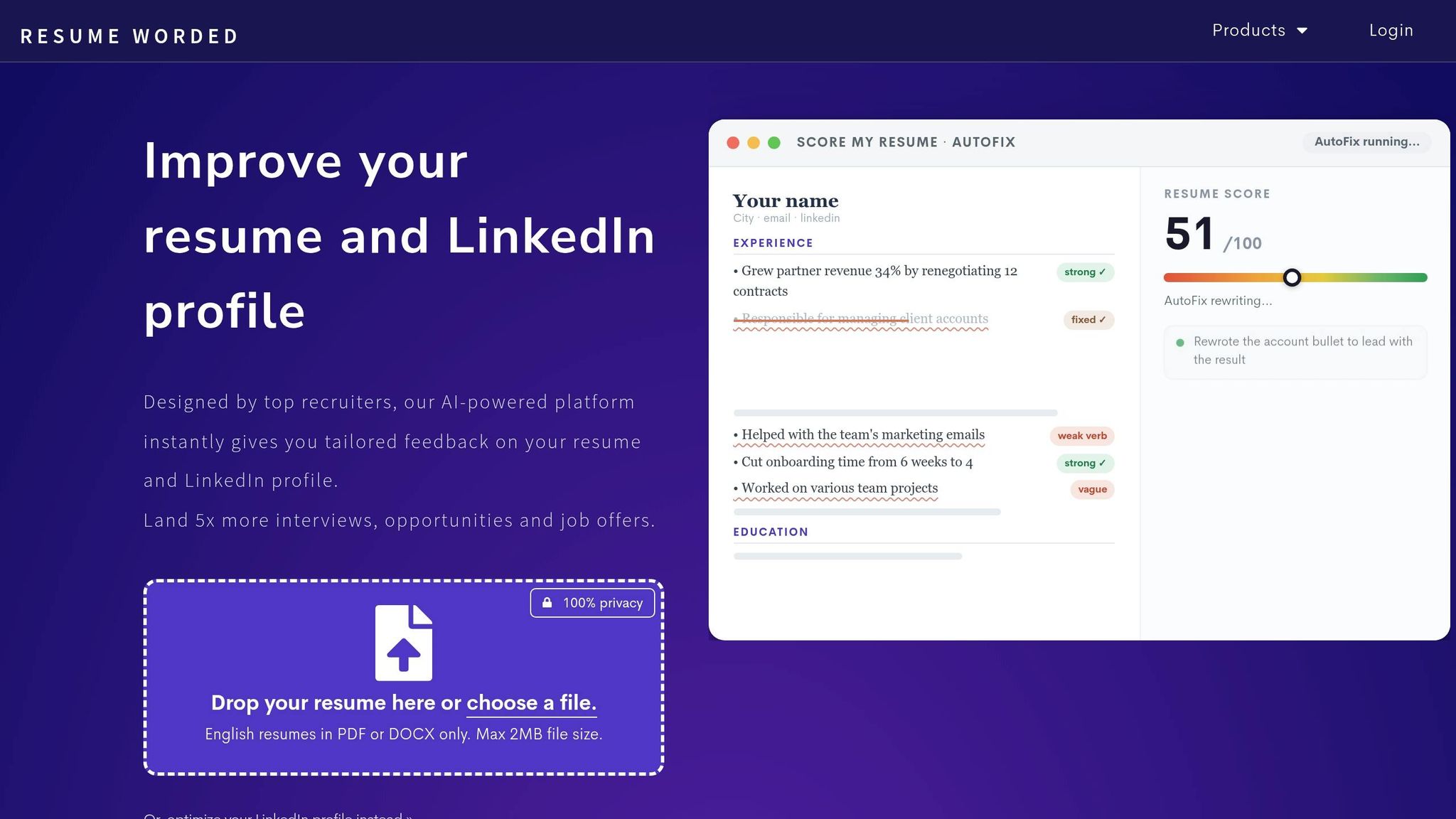
These tools are useful, but they solve a different part of the search.
- ResumeWorded: score and resume feedback
- Teal: job tracking and version control
- Rezi: ATS-safe resume drafting
That makes them prep tools, not execution tools.
If your main issue is organization, they can help. If your main issue is volume and follow-through, they may not move results much on their own.
You can pair them with tools like an ai cover letter builder if you still need help with drafting.
Is ResumeWorded worth it?
Yes, if you want quick feedback and want to edit on your own.
Is Teal worth it?
Yes, if your search is messy and you need a place to track roles, versions, and dates.
Is Rezi worth it?
Yes, if you need a clean ATS-safe resume from scratch.
Find My Profession vs Scale.jobs
This comparison is less about score tools and more about service type.
Find My Profession leans toward coaching and higher-touch guidance, often for senior candidates. Scale.jobs leans toward application output and submission help.
I’d think about it this way:
- use coaching if you need search direction
- use execution help if you already know what roles to target but can’t keep up with the work
If you want a mix of support and done-for-you help, a job search virtual assistant or virtual assistant for job seekers may fit better than another score tool.
When I’d keep ATS tools
I’d keep using ATS tools if:
- my resume score is low
- parsing errors keep showing up
- job titles are misread
- I’m missing basic terms from the posting
- I’m still building
Why High ATS Scores Still Fail With Recruiters
A high ATS score can help your resume parse cleanly and pass an initial filter. But it doesn't predict recruiter interest. Once your score is already high enough, adding more keywords usually stops moving the needle. At that point, the issue isn't parsing. It's whether your resume gives a recruiter a clear reason to care.
This is where a lot of job seekers get stuck. They tune for software, not for the person reading after the scan. If you're trying to Apply for jobs at scale, that gap matters a lot. A resume can look great inside a scoring tool and still fall flat in a human review.
Keyword stuffing can raise your score while weakening your resume
Here’s a concrete example. Imagine a product manager resume that mirrors a job description almost line for line - “roadmap prioritization,” “cross-functional collaboration,” “agile methodology,” “stakeholder alignment” all show up more than once. Jobscan gives it a high match score.
But the bullets read like this: "Led cross-functional collaboration to drive roadmap prioritization using agile methodology."
That sounds polished at first glance. Then you look closer. There’s no shipped product, no metric, no team size, no business result. A recruiter sees terms, but not proof.
That’s the trap. Keyword repetition can push up a score while making the resume feel flat and mechanical. Use keywords where they fit. Don’t force them in just to satisfy a tool. If your resume starts sounding like it was assembled from a job post, a recruiter will notice fast.
This is one reason many people move past score-only tools and look for a job application service or a job search coach that can help with message, fit, and positioning, not just matching.
ATS-safe formatting does not prove relevance or impact
ATS-safe formatting helps your resume get read by software. It does not show that your work mattered.
The most common failure pattern is simple: task-based writing inside a clean template.
Compare these two bullets for the same role:
- ATS-friendly but weak: "Responsible for CRM reporting and lead tracking."
- Impact-focused: "Built weekly CRM reports that cut lead response time by 18%."
Both could score about the same in a keyword match tool. But only one tells a recruiter what changed because of your work.
The first lists a duty. The second shows a result.
That’s the difference between a resume that passes a system and a resume that gets a callback. At this stage, formatting is no longer the problem. The real issue is whether the bullet proves business impact.
If you’re not sure your bullets are strong enough, use the “So What?” test. Read each bullet and ask: what changed? If the answer isn’t clear, the bullet probably needs work.
This is also where a stronger ai resume builder can help, especially if it pushes you to add outcomes instead of just polishing wording.
One resume can match many job postings but still signal the wrong fit
This tends to hit three groups the hardest: career changers, relocation applicants, and over-qualified candidates.
A career changer moving from operations into product management may have all the right terms on the page - data analysis, process improvement, cross-functional work. On paper, the match looks fine. The ATS lets it through. But when a recruiter scans it, the story still reads like operations, not product.
That’s the key problem. The resume matches the posting, but it signals the wrong professional identity.
The same thing happens with relocation candidates. The skills may line up, but the resume may not quickly answer location concerns. Over-qualified candidates face a similar issue. Their background may be strong, yet the resume may suggest they’re too senior, too expensive, or unlikely to stay.
In each case, the ATS sees overlap. The recruiter sees friction.
That’s where resume tuning ends and human judgment begins. A score can tell you whether terms are present. It can’t tell you whether your story feels right for the role. For many applicants, that’s the point where a job search virtual assistant or a virtual assistant for job seekers becomes more useful than another round of score chasing.
ATS rewards match. Recruiters reward clarity, credibility, and impact. That shift is what makes tool choice matter. Some tools only score resumes. Others help you get the application out the door in the right way, especially if you’re targeting full time jobs or trying to move faster on high-volume applications.
Jobscan vs scale.jobs: Keyword Precision vs Human-Powered Apply
Jobscan is at its best when you need keyword diagnosis, not application execution. It shows how closely your resume lines up with a job description, especially around keyword coverage. If your resume isn’t parsing well or you’ve missed plain technical terms, Jobscan can spot that fast.
Recruiters skim in seconds, so a strong score doesn’t mean they’ll care. That’s why Jobscan helps most with resume tuning, not with proving fit.
Once your score is already high, the next question is simple: who’s doing the tailoring and submission?
| Feature | Jobscan | scale.jobs |
|---|---|---|
| Human involvement | None (DIY/AI-driven) | Dedicated human assistants |
| Resume customization depth | Keyword density and skill matching | Narrative tailoring and impact-focused editing |
| ATS handling | Keyword matching and parsing checks | ATS-safe documents + human oversight |
| Application execution | User submits manually | Submitted by trained humans |
| Transparency & proof of work | Match score percentage | Proof-of-work screenshots & WhatsApp support |
| Pricing model | Recurring subscription | One-time campaign bundles ($199, $299, or $399) |
At that stage, the difference is workflow, not keyword coverage. A higher match score only helps if the next step still leads to a resume and application a recruiter will read.
If you’re still trying to apply for jobs after getting strong ATS scores, this gap matters a lot.
Why scale.jobs works better for users stuck after getting good ATS scores
If your score is already strong but replies are still quiet, the bottleneck usually isn’t the parser anymore. scale.jobs focuses on what comes next: human-led tailoring and manual application execution.
- Applications are submitted by trained humans rather than the user. That cuts manual work and helps with messy portals.
- Proof-of-work screenshots are included. You can see what was submitted and cut down the usual guesswork.
- WhatsApp support speeds up coordination. That makes it easier to shift focus when target roles change.
This is the main split between a scoring tool and a job application service. One tells you what to fix. The other helps get the work done.
Who should use Jobscan and who should choose scale.jobs
Jobscan: Use Jobscan if you want to self-edit, test keyword alignment, and submit applications on your own. It also fits people who already use an ai resume builder or ai cover letter builder and just want a score check before sending materials out.
scale.jobs: Choose scale.jobs if you need human help with tailoring, submission, and follow-through during a high-volume or time-sensitive search. That’s often the better setup for people targeting many full time jobs, juggling deadlines, or using a job search virtual assistant to keep the process moving.
Stop using Jobscan until you read this: when to switch
These are practical signs that you may have outgrown a DIY keyword tool:
- Your ATS match scores are consistently above 80%, but your interview rate still hasn’t moved.
- You don’t have time to manually tailor and submit 20–50 applications per week.
- You want screenshots and timestamps for your own tracking, or you need a clearer audit trail for your search.
- You need human handling of tailoring and submission, not just a score.
- You’d rather pay once for a defined campaign than keep a recurring subscription through a long search timeline.
"Optimising only for keywords passes the ATS but fails the recruiter. You need both." - Ana Neto, Founder, OneShot Coach
If that sounds like your situation, the issue usually isn’t resume parsing anymore. It’s the gap between keyword alignment and human review. That’s where a managed workflow, or even a virtual assistant for job seekers, can help with the steps scoring tools leave behind.
Use the same test for ResumeWorded, Teal, Rezi, and Find My Profession: does the tool diagnose the resume, or does it help execute the search? The same score-versus-execution tradeoff shows up across many tools in the job search platform space.
ResumeWorded, Teal, Rezi, and Find My Profession vs scale.jobs: Which Option Fits Your Bottleneck
ResumeWorded, Teal, and Rezi vs scale.jobs: useful scoring tools, limited human judgment
The same split shows up here too: diagnosis vs. execution.
ResumeWorded, Teal, and Rezi help with resume prep, but they stop at scoring, formatting, or tracking. ResumeWorded gives keyword feedback and scores your LinkedIn profile. Teal helps you track where you applied and manage different resume versions. Rezi creates clean single-column resumes that usually parse well in Workday and Greenhouse.
Those are prep tools. They can help you get organized. They can help you clean up the file. But they don’t step in and make judgment calls the way a person would. They also don’t handle submissions for you.
That gap matters. If ATS parsing is no longer the main issue, the problem often shifts to recruiter fit and sheer application volume. At that point, another score check may not move the needle. Execution usually does.
| Feature | ResumeWorded / Teal / Rezi | scale.jobs |
|---|---|---|
| Human involvement | None; self-service guidance | Dedicated human assistants |
| Resume customization depth | Automated scoring and templates | Human per-job tailoring |
| ATS handling | Parsing checks and keyword alignment | ATS-safe documents + human review |
| Application execution | User submits manually | Human assistants handle submissions |
| Transparency & proof of work | Score dashboards | Proof-of-work screenshots + WhatsApp updates |
| Pricing model | Monthly subscriptions | One-time payment bundles ($199, $299, or $399) |
If you're still fixing resume basics, tools like an ai resume builder can help you move faster. But if your resume already looks decent and you're still stuck, the bottleneck may be submission work, not document setup.
For many people trying to Apply for jobs at scale, that’s the fork in the road: do you need more feedback, or do you need help getting applications out the door?
Find My Profession vs scale.jobs: is a premium managed search worth it?
Find My Profession makes sense for senior or executive candidates who want hands-on career strategy and support from a dedicated consultant. In that setup, you're paying for coaching, positioning, and search guidance, not just resume help.
For most U.S. job seekers, the gap is pretty simple. Find My Profession leans heavily toward strategy. scale.jobs leans heavily toward execution.
With scale.jobs, human assistants apply across job portals, each submission comes with time-stamped proof-of-work screenshots, and updates happen over WhatsApp in real time. So the choice is less about which service is "better" in general and more about what kind of help you need right now.
| Feature | Find My Profession | scale.jobs |
|---|---|---|
| Target audience | Senior and executive candidates | Mid-career to senior, scalable for most levels |
| Human involvement | Hands-on career strategy and coaching | Human assistants handling application execution |
| Resume focus | Executive branding and positioning | ATS-safe + recruiter-readable per-job tailoring |
| Support channel | Email and phone | WhatsApp real-time coordination |
| Proof of work | Milestone updates | Timestamped screenshots per application |
| Pricing | Premium managed search fees | One-time payment bundles; first 5 applications free |
This is also where a job search coach differs from a job application service. One helps you think through the search. The other helps you do the work.
Who should use each tool and who should choose scale.jobs
Use ResumeWorded or Teal if your resume is not parsing well, you want structured keyword feedback, or you need a simple way to track your own search.
Use Rezi if you need a clean ATS-safe PDF from scratch and your main concern is file structure, not application execution.
Use Find My Profession if you're a senior executive going after a narrow set of high-stakes roles and want a consultant to guide your positioning and search plan.
Choose scale.jobs if you already have a decent resume but aren’t getting responses, you don’t want to spend hours filling out Workday and Greenhouse forms, or you want a clear record of what was submitted and when.
Think of it this way: ResumeWorded, Teal, and Rezi help you get ready. Find My Profession helps you plan. scale.jobs helps you ship applications.
That difference is why some job seekers pair tools. They may use an ai cover letter builder or a job search platform early on, then switch to a Virtual Assistant for Job Applications once the real problem becomes time, follow-through, and portal fatigue.
Decision Summary: When to Keep ATS Tools and When to Switch to scale.jobs
After comparing scoring tools with human-powered apply support, the choice comes down to where your job search is getting stuck.
Choose ATS-first tools if your issue is resume parsing and keyword coverage
If your resume isn’t parsing well in an ATS, or your keyword match is low, tools like Jobscan, ResumeWorded, Teal, or Rezi can help fix that. They’re built for resume parsing, keyword checks, and format issues.
The trouble starts when you’ve already fixed those basics and callbacks still don’t show up.
At that point, parsing is no longer the main issue. Execution is.
Switch to scale.jobs if your issue is weak callbacks, limited time, or manual submission fatigue
Once your ATS score looks solid and you’re still not hearing back, the bottleneck has moved. More keyword edits usually won’t change much. What matters next is simple: does your resume show clear impact in the few seconds a recruiter gives it, and can you keep up with the number of roles you need to apply to each week?
That’s where scale.jobs starts to make sense.
Switch to scale.jobs when these conditions apply:
- Your ATS scores look fine, but callbacks are weak or uneven
- You need tailored resumes and cover letters for many roles each week, but you don’t have hours to spare
- You want human assistants to handle portal submissions across major job portals with human oversight
- You want time-stamped proof-of-work screenshots and real-time WhatsApp updates
- You want one-time pricing instead of recurring subscriptions
You can test the first five applications free, which makes it easy to compare results before paying for a bundle. If you also need deeper document help, scale.jobs' resume writing services can pair resume support with application execution in one place.
For many people, this is the difference between planning to apply for jobs and actually getting applications out at a steady pace. That matters a lot when you’re targeting full time jobs or trying to move fast in a crowded market.
Key takeaways for U.S. job seekers comparing these options
An ATS score is a screening signal, not a hiring decision. It tells you whether a system can read your file. It does not tell you whether a recruiter will call.
That’s the core split:
- ATS tools help fix resume parsing and keyword issues
- scale.jobs helps with application output, tailoring, and follow-through
Think of it like this: a scoring tool checks whether your materials can get through the gate. A service like scale.jobs helps you keep moving once the gate is open.
If your main problem is resume quality, an ai resume builder or ai cover letter builder may help you get your documents into better shape first. If your documents are already in good shape and the problem is volume, consistency, or time, a job application service or Virtual Assistant for Job Applications is often the better fit.
The switch happens when the bottleneck moves from parsing to execution.
FAQs
What ATS score is good enough?
There’s no industry-standard ATS score. If a tool shows a match score, 70%–80% is usually enough to show that your resume lines up with the job description.
Once you get past that range, chasing a higher number often stops helping. In fact, scores above 90% can be a red flag. They may point to keyword stuffing, which can make your resume awkward to read when a recruiter opens it.
What matters more is clean parsing. If your resume parses the right way and lands in the 70%–80% range, shift your attention away from the score itself. Put the focus on relevance, clear results, and a story that makes sense to a human reviewer.
If you want extra help with this step, tools like an ai resume builder can help you line up the right keywords without turning your resume into a wall of jargon.
How do I make my resume recruiter-ready?
Shift your focus from beating keyword filters to passing the six-second human scan. Recruiters care far more about clarity, fit, and proof than raw keyword density.
Use a clean, single-column layout with standard headings. Start with a summary that shows your most relevant credential and one measured result. In your experience section, turn job duties into bullets that include an action, the tool or method you used, and the result. Pull key terms from the job description, but back them up with proof from your work history.
When should I stop tweaking keywords?
Stop once your resume score hits the 70% to 80% range. Going past 80% to 90% often turns into keyword stuffing. That’s where a resume starts to sound stiff, forced, and less convincing to a recruiter.
Think of the ATS as a pass/fail filter, not a high-score game. Once the system can read your file and spot the core skills, your attention should shift to what hiring teams care about next: clear impact, a strong career story, and fit for the role’s seniority.